
Atari
1 document by Atari in the Game Industry Library, the newest “Atari Rapport Financier Annuel: Exercice 2012/2013” (2013).
Connections
Each row is a game or company named alongside Atari, each column a document, oldest first. A mark means that document names it. Select a row to see those documents.
Its games in the library
 CentipedeGame · Atari · 1981 · 2 documents
 PongGame · Atari · 1972 · 34 documents
- Pac-ManGame · 60 documents
 RaymanGame · Ubi Soft Paris Studios · 1995 · 21 documents
- AsteroidsGame · 8 documents
- Donkey KongGame · 56 documents
- World CupGame · 419 documents
- Lunar LanderGame · 3 documents
- Star WarsGame · 320 documents
- Missile CommandGame · 3 documents
 CrossFireGame · Smilegate · 2007 · 67 documents
- SupermanGame · 6 documents
- E.T. the Extra-TerrestrialGame · 3 documents
- Video ChessGame · 25 documents
Documents
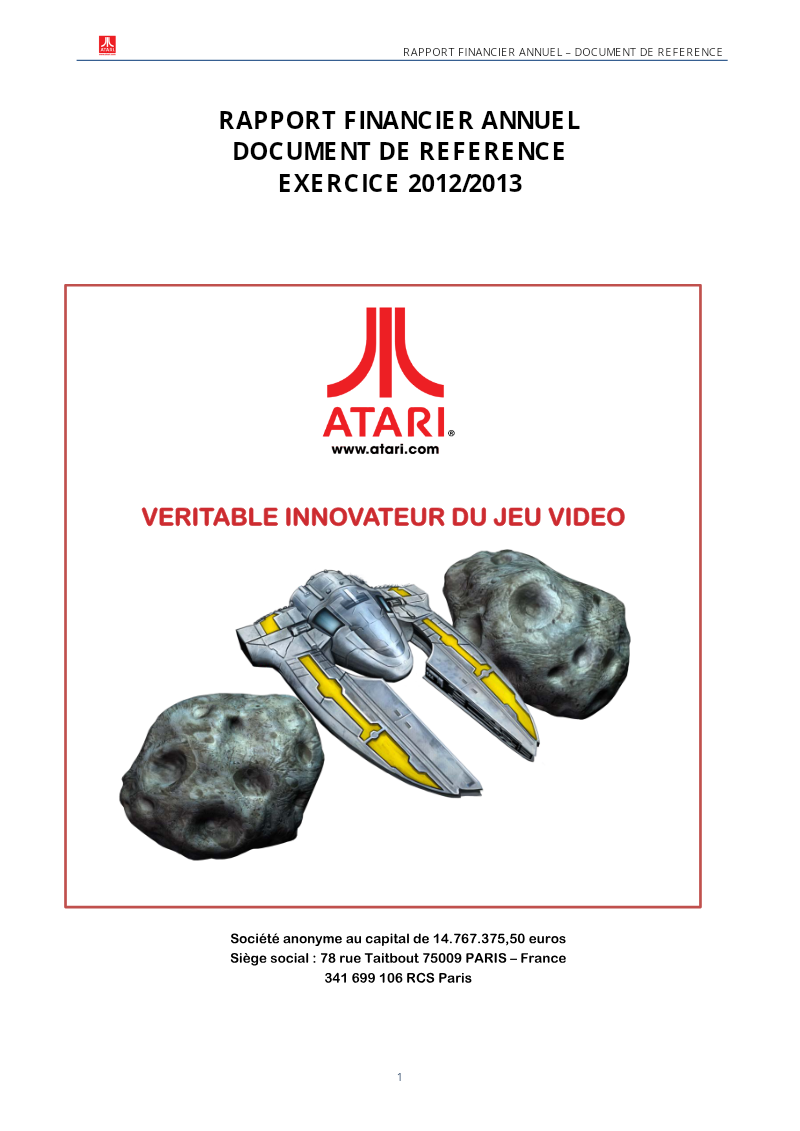
Atari Rapport Financier Annuel: Exercice 2012/2013
VERITABLE INNOVATEUR DU JEU VIDEO Société anonyme au capital de 14.767.375,50 euros Siège social : 78 rue Taitbout 75009 PARIS - France AXIF AUTORITE Le présent Document de référence a été déposé auprès de l'Autorité des Marchés Financiers le __ 2013, conformément à l'article 212- 13 de son Règlement général.
Reports about Atari
109 documents by other writers name Atari in the title or summary.
- Founded
- 1972
- Country
- United States
Company data from IGDB.com

Trial of the Space Invaders
Simon Parkin talks to us about his forthcoming book, Trial of the Space Invaders, and the court case that shaped an industry
- Simon Parkin’s forthcoming book, 'Trial of the Space Invaders' (releasing January 27, 2027), details how a 1980s patent dispute between Magnavox and Nintendo fundamentally shaped the modern video game industry.
- Magnavox generated over $100 million in revenue from patent litigation against early arcade pioneers like Atari, Activision, and Midway, despite only selling 350,000 units of its own console.
- Anthropic has updated its Claude AI model with specific instructions to prevent the decompilation and recreation of existing video games to mitigate intellectual property infringement.

“That Was a Very Frank Interview.” A 61-Game Chat With the CEO of Atari
Telling the story of the last five years of Atari, one game at a time.
- Since taking charge in 2021, CEO Wade Rosen has overseen a prolific output at Atari, publishing 61 games at a cadence of nearly one release per month.
- Atari’s recent portfolio strategy has been characterized by a mix of high-performing titles, such as the 'Atari 50' retro collection, and underperforming projects like 'Atari Mania'.
- The company maintains a pragmatic approach to development, occasionally allowing teams to proceed with projects that are not expected to be significant commercial successes.

What Happens When AI Becomes Your Gaming Teammate
The integration of foundation models into game development is shifting the industry toward autonomous behavior engines capable of managing complex, goal-oriented decision-making at runtime.
- Foundation models are shifting game AI from scripted behavior trees to autonomous, goal-oriented agents capable of improvising based on player intent.
- Hierarchical training models allow studios to reduce AI inference costs to single-digit cents per player hour, making the technology economically viable compared to using expensive frontier models.
- Successful agent implementation requires 'agent empathy,' where virtual entities are designed with environmental awareness to ensure they function naturally within the game world.
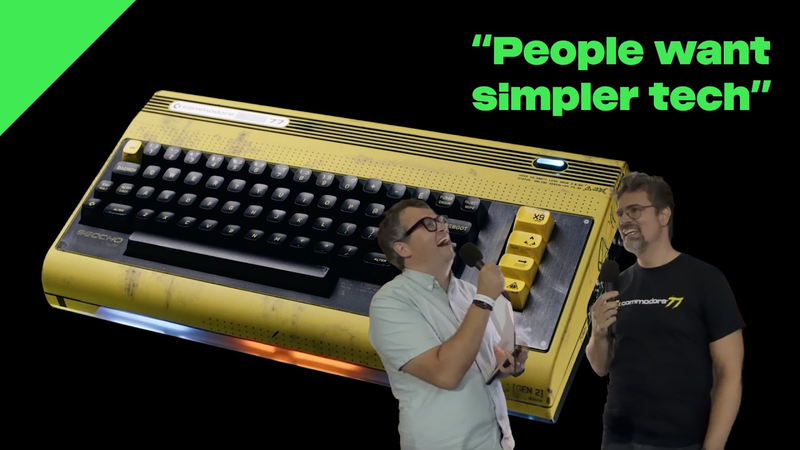
How one Star Wars actor became the CEO of Commodore
Commodore, under the leadership of CEO Christian Simpson, is executing a dual-track business strategy that blends retro-computing nostalgia with modern digital minimalism.
- Commodore has successfully pivoted from a niche hobbyist brand to a multifaceted publisher, selling over 27,000 Commodore 64 units since its relaunch.
- The 'Comeback 8020' flip phone, which promotes digital minimalism by excluding social media, achieved first-weekend sales volume equal to the first three months of Commodore 64 hardware sales.
- The company is executing a dual-track business strategy that balances retro-computing nostalgia with modern digital minimalism to capture a broader market beyond traditional gaming enthusiasts.

Weekly Industry Round-up: Games on Instagram, King Strikes, and Beta Updates
This weekly mobile games newsletter, dated September 25, 2026, rounds up the week's top stories and uses Meta's Horizon Create announcement as its central editorial theme.
- Meta announced 'Horizon Create,' an app allowing users to generate and publish games directly to Instagram and Facebook platforms.
- King has avoided recent Microsoft/Xbox layoffs and successfully averted planned strikes by reaching an agreement with Swedish labor unions.
- Supercell’s monster-hunting title 'Mo.co' has returned to beta testing in a 'low maintenance' mode as the development team continues to iterate on features.

Oakever Games shenanigans, King and the Xbox cuts, Hipster Whale, One State, Monopoly Go, more
The mobile games industry is currently navigating a period of significant structural change, legal scrutiny, and strategic consolidation.
- Oakever Games is facing multiple copyright infringement lawsuits, including a loss to Hungry Studio regarding the game Qblock, amid allegations that the company systematically clones successful titles and uses aggressive user acquisition to drown out competitors.
- Xbox’s latest restructuring resulted in 268 job cuts across its first-party studios, though the mobile-focused King division appears largely unaffected, despite looming strike actions in its Stockholm and Malmo offices.
- Hipster Whale, following its acquisition by Atari for $29.3 million, has gained access to Atari’s deep IP archive and plans to develop modern takes on classic titles like Pong, Breakout, and Centipede for mobile.
Noxious Fumes
Nathan Brown's Hit Points newsletter (issue #397, September 2026) argues that the western triple-A industry should answer its crisis by copying Japan, and Capcom in particular, rather than waiting for sweeping fixes like AI or the overthrow of capitalism.
- The Western triple-A game industry is facing an existential crisis driven by unsustainable development costs, prompting calls for a shift toward the financially disciplined model used by Japanese developers like Capcom.
- Capcom maintains profitability by keeping budgets in check, retaining long-term staff, and avoiding decade-long development cycles for tentpole franchises like Resident Evil and Monster Hunter.
- The industry is increasingly reliant on 'Myhrvold’s Law,' where software expands to fill available computing power, leading to bloated development that many industry experts argue must be reined in.

Is Gaming in an AI Bubble? What the Deal Data Says
The gaming industry is currently undergoing a structural transition characterized by a shift from speculative content creation toward infrastructure, hardware, and artificial intelligence.
- Gaming financing reached a 12-month high in Q2 2026 with over $2.5 billion raised, despite the total volume of deals dropping from roughly 200 per quarter in 2021-2022 to below 100.
- Capital allocation has shifted away from general content and studio funding toward AI, ad-tech, and hardware, with AR glasses emerging as a significant platform bet.
- The current funding landscape for game studios is bifurcated; while AI-native gaming companies are attracting massive capital, studios that raised small rounds in 2021-2022 are struggling to secure follow-on financing.
Why None of Us Saw Cyberpunk Coming Apart I Michal Nowakowski. joint CEO, CD PROJEKT RED
CD Projekt Red’s evolution from a regional distributor to a global AAA powerhouse is rooted in a strategy of intellectual property ownership and creative independence.
- CD Projekt Red restructured its development operations by abandoning proprietary technology in favor of Unreal Engine 5 to mitigate technical risks and streamline production.
- The studio transitioned from a siloed, waterfall production model to a unified, multi-platform approach that utilizes rigorous gating milestones to prevent future launch failures.
- Despite a 75% decline in stock value following the technical failures of Cyberpunk 2077, the studio achieved long-term commercial recovery with 35 million base game units sold and 10 million expansion units sold.

The Man Behind Most Gaming Deals | Affan Butt, Aream & Co.
Successful gaming mergers and acquisitions are fundamentally driven by long-term relationship building rather than transactional, high-pressure sales tactics.
- Successful gaming M&A is driven by long-term relationship building rather than transactional tactics, as evidenced by a track record of over 110 deals totaling $40 billion in value.
- Founders should prioritize meticulous data hygiene and financial validation to ensure deal certainty within a typical six-month timeline, as aggressive, unsuccessful outreach can permanently damage a studio’s reputation.
- Advisors often recommend delaying sales if internal metrics or market conditions are suboptimal, prioritizing the studio's long-term health over immediate transaction fees.

The Miraculous Story Behind Baldur’s Gate 3
The development and release of Baldur’s Gate 3 represents a significant anomaly in the modern video game industry, characterized by a complex history of licensing, financial instability, and creative perseverance.
- Larian Studios' success with Baldur's Gate 3 is attributed to its status as a rare, large-scale, privately owned developer, which allows it to avoid the short-term pressures of quarterly earnings and investor demands faced by publicly traded companies.
- The development of Baldur's Gate 3 required a massive scaling effort, with the studio growing its workforce from 140 to 450 employees to manage the complex production pipeline required for full cinematic integration.
- Baldur's Gate 3 has achieved significant commercial success, selling over 20 million copies and winning multiple Game of the Year awards despite facing major external challenges, including the COVID-19 pandemic and the forced relocation of staff due to the 2022 Russian invasion of Ukraine.
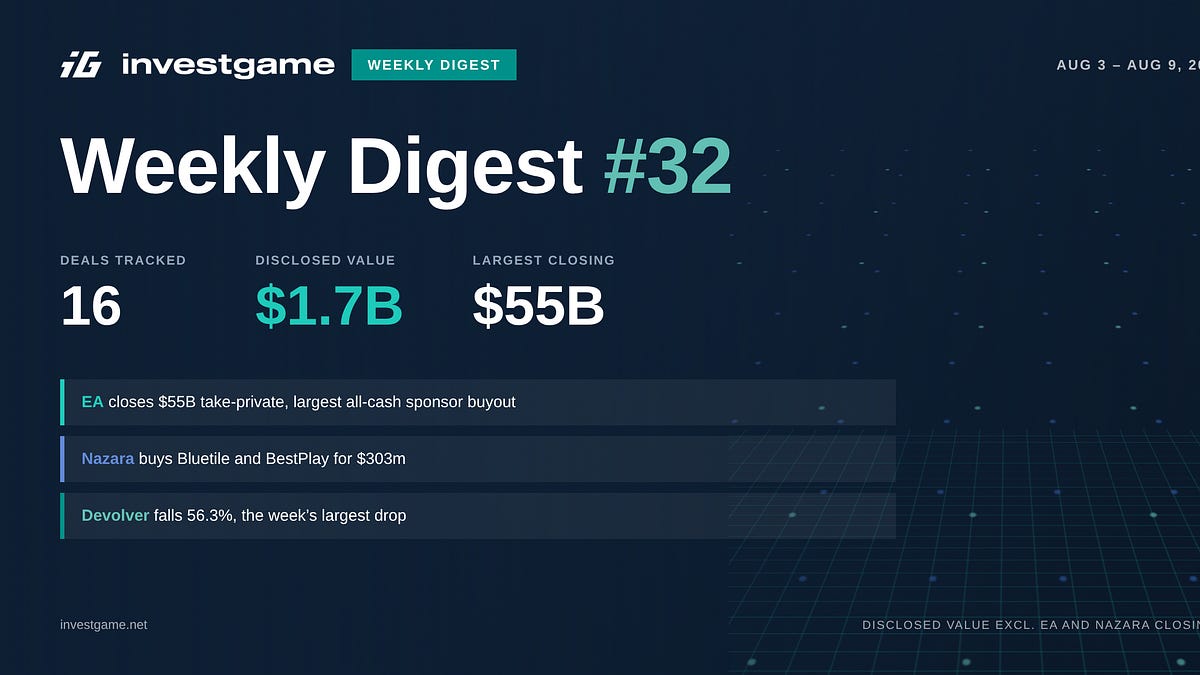
The $55B Take-Private of Electronic Arts and Nazara's $303m Bluetile & BestPlay Buy Lead the Week
InvestGame's weekly digest tracks 16 game-industry deals worth $1.7B, a total that excludes two large previously agreed transactions that closed during the window.
- Electronic Arts has completed its $55 billion take-private acquisition following regulatory clearance and shareholder approval, with Andrew Wilson remaining as CEO.
- Nazara Technologies acquired mobile developer Bluetile Games and engagement platform BestPlay Systems for $303 million in an all-cash deal, with Bluetile founder Raymond Albaladejo Stauffer set to become Nazara's CEO on September 1, 2026.
- Digital Hearts Holdings is being taken private by a vehicle owned by its chairman, Eiichi Miyazawa, in a tender offer valued at $149 million that represents a 41% premium over the August 5, 2026, closing price.
Do you work at Atari? Get a free report of how these documents are read and cited here.