Video Game
Game
Documents about Video Game

Russia’s Video Game Strategy
Russia's Video Game Industry Strategy, published by the Russian Video Game Trade Association (VIDO) at the St Petersburg International Economic Forum on 9 June 2026, is the country's first formal plan for its games sector.
- The Russian Video Game Industry Development Organization (VIDO) has published a formal national strategy aiming to increase the gaming sector's contribution to Russia's GDP to 0.4%-0.5%.
- The strategy proposes state-backed funding for startups, tax incentives for investors, and mandatory representation for the gaming industry in Duma policy discussions.
- Russian gaming policy is increasingly intertwined with state objectives, including the potential resurrection of a China-style approval system and the use of state-backed ID systems for player logins.

The Premium PC/Console Gaming Market: H1 2026
Premium PC and console games generated $30 billion in gross revenue over the twelve months from H2'25 through H1'26, with PlayStation taking 45.1%, Steam 38.6%, and Xbox 16.3%.
- The premium PC and console market generated $30 billion in revenue between H2 2025 and H1 2026, with PlayStation capturing 45.1% of the share, followed by Steam at 38.6% and Xbox at 16.3%.
- Market revenue grew 5.3% year-over-year to $13.8 billion in H1 2026, driven by a strong second quarter that saw a 13% revenue increase compared to the previous year.
- Steam's revenue is heavily reliant on back-catalog titles, which accounted for 68.7% to 74% of total revenue in H1 2026, despite a record-high volume of 11,800 new game releases during the same period.
Keeping Ms. Pac-Man Out of the Club: Pacmania, Video Game Magazines, and the Gendered Guardrails
Early video game history was defined by a pervasive, gendered culture that systematically marginalized female players and reinforced the expectation that the typical gamer was male.
- Early 1980s video game culture was defined by a pervasive, industry-wide expectation that the typical gamer was male.
- Video game magazines of the early 1980s played a significant role in establishing and reinforcing gendered guardrails within digital spaces.
- Marketing campaigns, including those by Nintendo, were heavily gendered and actively shaped the cultural environment to favor male participation.
The United States’ Strategic Political Communication and the Production of a Strategy Video Game
The United States utilizes strategic political communication through the development of specialized video games to influence public perception and advance foreign policy objectives.
- The U.S. military utilized Modeling & Simulation (M&S) technology to develop the strategy game 'Labbaik Ya Iraq' as a tool for strategic political communication and public diplomacy.
- The primary objective of the 'Labbaik Ya Iraq' project was to move beyond passive messaging by encouraging target audiences to learn through active participation and decision-making.
- The game integrated multiple Lines of Operations (LOOs) into a single interactive product to influence civilian perceptions and promote foreign policy objectives in Iraq.
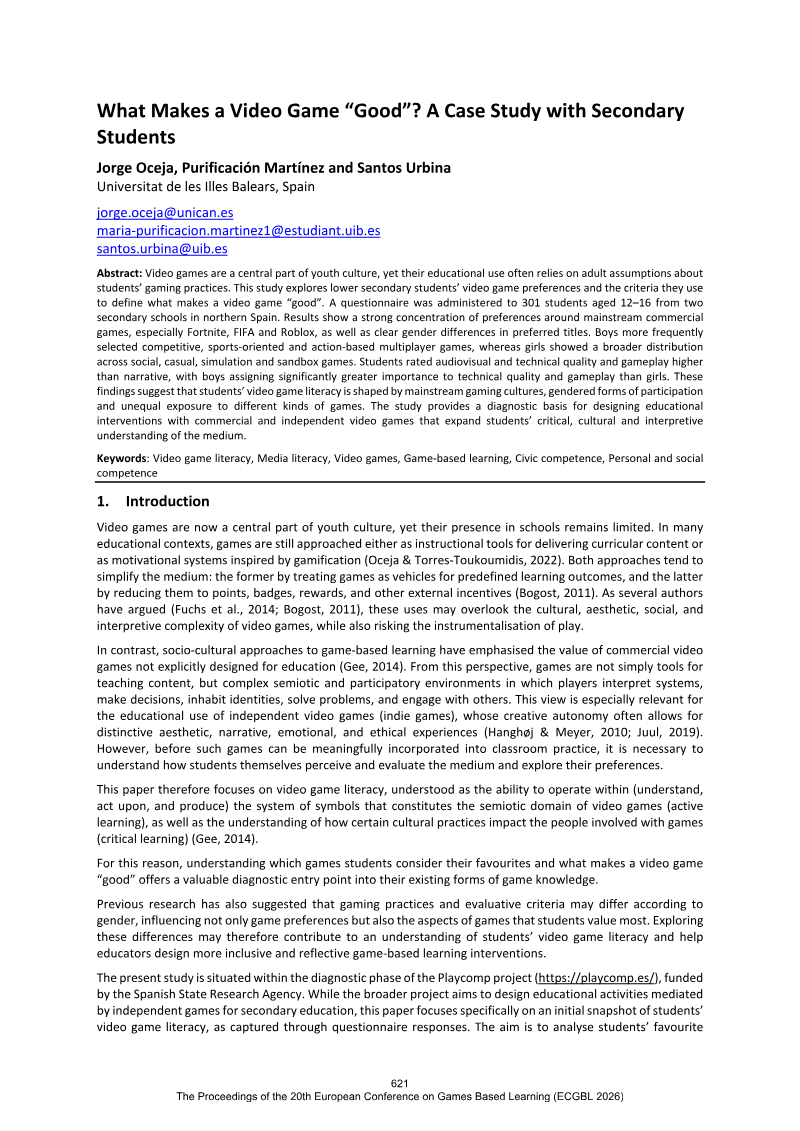
What Makes a Video Game "Good"? A Case Study with Secondary Students
This study investigates lower secondary students' video game preferences and their criteria for defining a "good" video game, aiming to inform educational interventions.
- Lower secondary students (N = 301, aged 12–16, two schools in northern Spain) favour mainstream commercial titles, led by Fortnite, FIFA and Roblox.
- Students rated audiovisual and technical quality (M = 4.70) and gameplay (M = 4.60) as the most important criteria for a 'good' game, with narrative rated lower (M = 4.22).
- Boys rated technical quality and gameplay as significantly more important than girls did, and placed narrative clearly behind the other two dimensions, whereas girls' ratings were more evenly distributed.
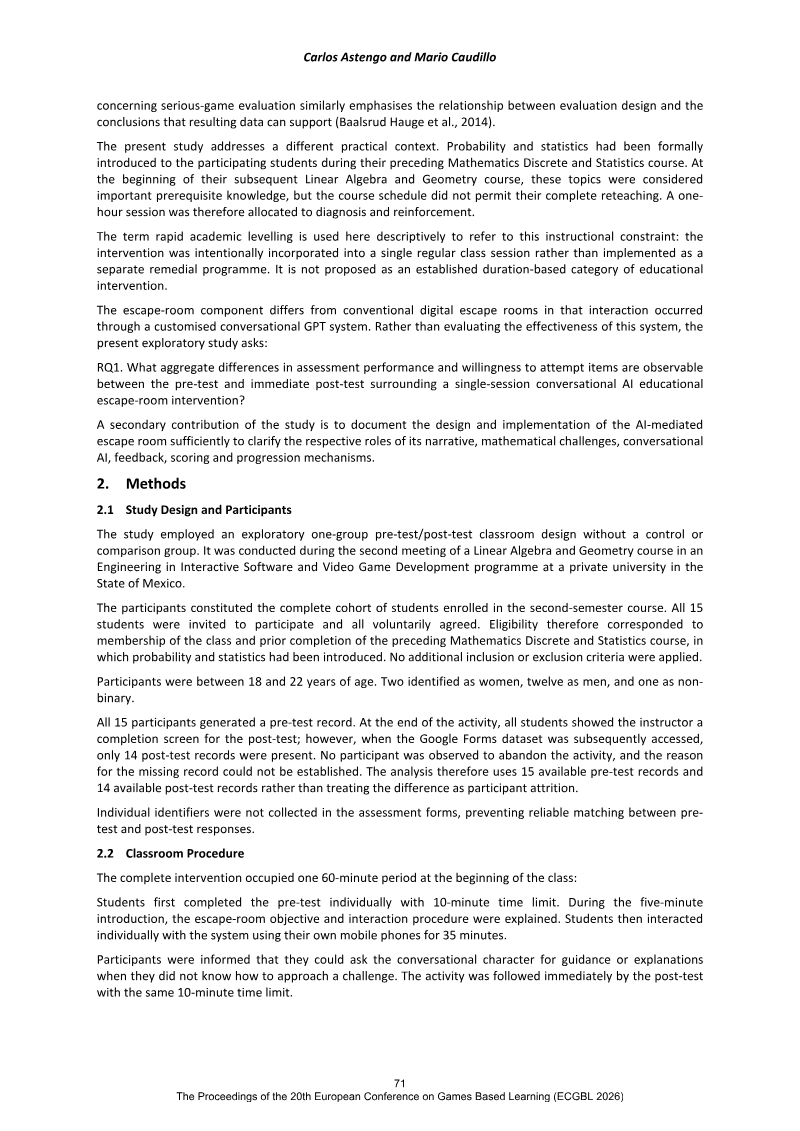

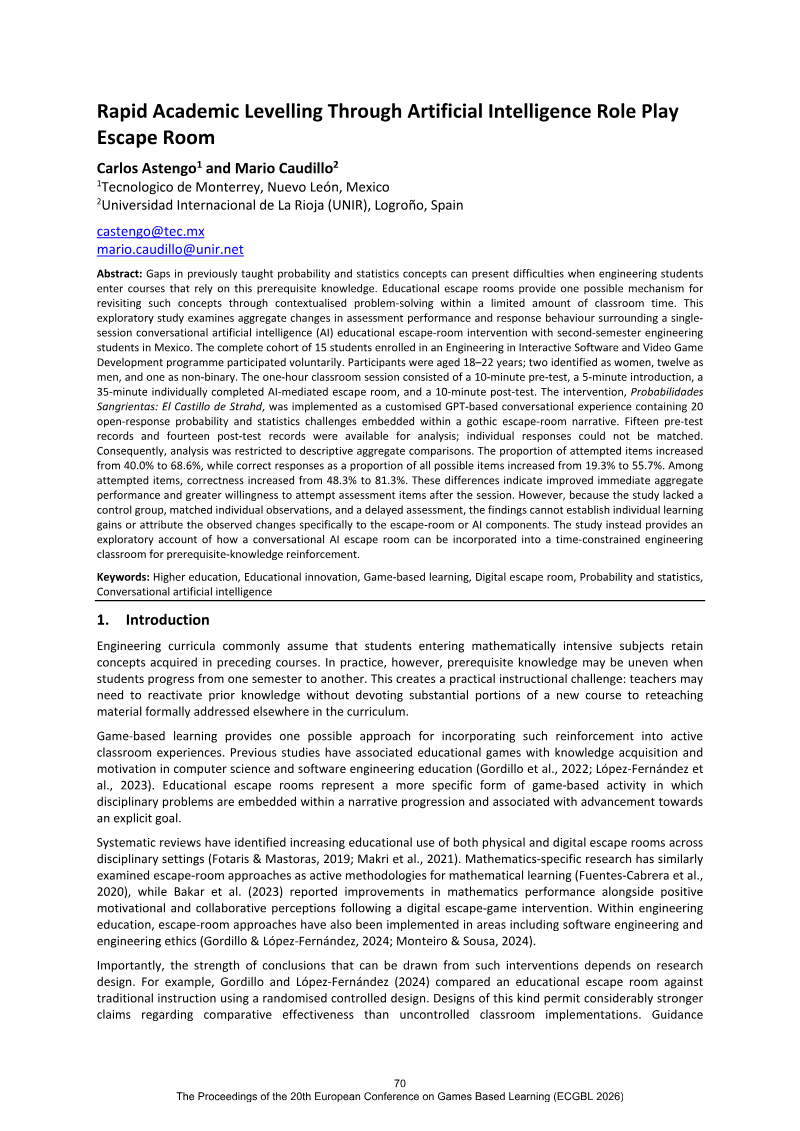
Rapid Academic Levelling Through Artificial Intelligence Role Play Escape Room
Astengo and Caudillo report an exploratory one-group pre-test/post-test classroom study of a single-session conversational AI educational escape room, run with 15 second-semester students in an Engineering in Interactive Software and Video Game Development programme at a private university in the State of Mexico.
- Aggregate correct responses across all possible items rose from 19.3% to 55.7% between pre-test and post-test. The authors stress these are descriptive differences, not individual learning gains.
- Correctness among attempted items increased from 48.3% to 81.3%, a difference the document reports as 32.9 percentage points.
- The proportion of attempted items rose from 40.0% to 68.6%. The authors interpret this only as a change in response behaviour, not as increased engagement or confidence.



How Mainland China Governs Video Game Monetisation: An Imbalanced Framework
The document analyzes the governance framework for video game monetization in Mainland China, identifying it as a crucial jurisdiction due to its status as a major global game producer and the world's most lucrative mobile game market.
- China governs video game monetisation through a dual framework: restrictive content moderation and consumer protection measures alongside active state promotion of 'high-quality' games, esports, and game-adjacent technologies.
- The analysis is based on 138 Chinese government regulatory documents and industry self-regulatory materials collected between November 2025 and March 2026, examined via thematic analysis.
- Regulatory measures are predominantly designed around protecting minors, with child-focused standards extended to the wider player population, an approach the authors argue may fail to effectively protect either group.
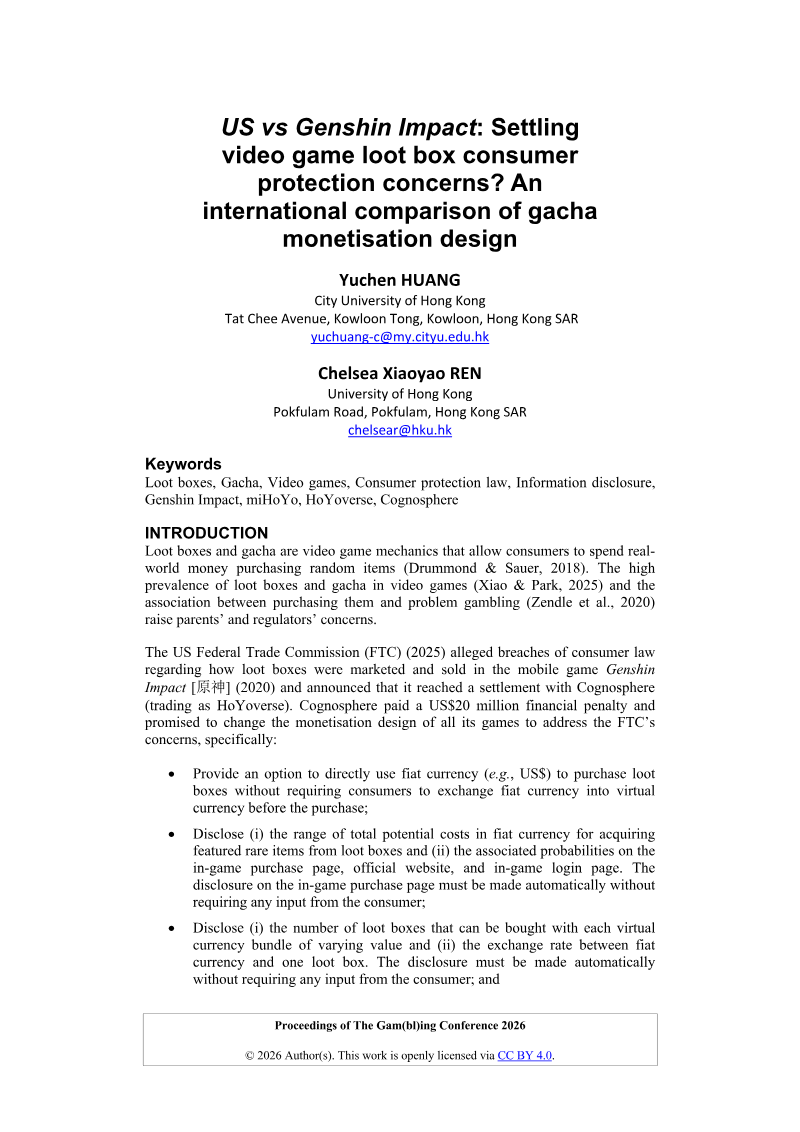
US vs Genshin Impact: Settling Video Game Loot Box Consumer Protection Concerns? An International Comparison of Gacha Monetisation Design
This analysis evaluates Cognosphere's compliance with a US Federal Trade Commission (FTC) settlement regarding loot box monetization in its games, specifically Genshin Impact.
- Cognosphere (HoYoverse) agreed to a $20 million penalty and specific design changes in a January 2025 US Federal Trade Commission settlement over loot box and gacha monetisation in Genshin Impact and sister titles.
- A preliminary compliance test of five Cognosphere games found widespread non-compliance: all examined games still contained loot boxes, and US versions still required converting real money into virtual currency before buying most loot boxes.
- Only one currency exchange step was removed for some prominent items in US versions, and cost ranges and drop probability disclosures appeared only for prominent loot boxes rather than all of them.

The Legend of Zelda: Ocarina of Time and GTA 6: The Video Game Industry’s Barbenheimer Moment
This is a Christopher Dring column from The Game Business, published September 10, 2026, covering Nintendo's Zelda Direct, Ubisoft's new Player Council, the Nova Games Foundation, and other industry news.
- Nintendo's Zelda Direct drew 2.1 million peak viewers according to LevelUp, ahead of Gamescom Opening Night Live at two million and the Mario Kart World Direct at 930,000.
- The Ocarina of Time 1998 original and its 2011 3D edition each sold around 6.5 million copies, a decent figure for a Zelda game that often sells around five million.
- Breath of the Wild has sold over 34 million copies, and Tears of the Kingdom is just short of 23 million, so the series has grown substantially.

Why Video Game Developers Love Remakes
The prevalence of video game remakes is driven by a combination of strategic risk mitigation, operational efficiency, and creative opportunity.
- Remakes serve as a risk mitigation strategy by providing a clear, pre-defined vision, which reduces the uncertainty and decision-making overhead associated with developing entirely new intellectual property.
- Studios utilize remakes to train staff on new tools and development pipelines, such as transitioning from Unreal Engine 4 to 5, without the added complexity of inventing a new game concept simultaneously.
- Remakes provide a productive outlet for large development teams during the 'pre-production' phase of a new project, preventing the need to assign staff to low-value busy work while core directors prototype the next title.

Global Video Game Market Revenue Forecast 2026
Newzoo forecasts that global video game revenue will reach a record $213.9 billion in 2026, with the release of Rockstar's GTA VI cited as a major driver.
- The global video game market is projected to reach a record $213.9 billion in revenue by the end of 2026.
- The release of GTA VI is a primary driver for this growth, with analysts projecting first-week earnings for the title between $3.25 billion and $5.2 billion.
- Driven by the launch of GTA VI, revenue from physical and digital console game sales is expected to spike by 17.5% in 2026.

Video Game Consoles Will Bounce Back: Here’s The Dring
Christopher Dring's subscriber newsletter and podcast from The Game Business, dated August 24, 2026, argues that video game consoles will recover despite alarming current sales data.
- US video game hardware revenue reached its lowest point since July 2020, driven by higher console prices and increased costs for components like RAM and storage.
- Total US sales for games, hardware, and accessories fell 10% year-on-year to $4.5 billion in July 2026, with mobile gaming cited as the primary contributor to the decline.
- Ampere Analysis projects that if next-generation consoles like the PlayStation 6 or Xbox Project Helix launch at a $1,000 price point, their combined five-year sales could be up to 38% lower than the current generation's performance.