Video Game
Game
649 documents in the library are about Video Game, from writers such as DiGRA, Entertainment Software Association and AEVI. Each has a summary and key insights with the page they come from.
Connections
Each row is a game or company named alongside Video Game, each column a document, oldest first. A mark means that document names it. Select a row to see those documents.
Key figures from the reports
The Russian Video Game Industry Development Organization (VIDO) has published a formal national strategy aiming to increase the gaming sector's contribution to Russia's GDP to 0.4%-0.5%.
Video Games Industry Memo, 2026 · Russia’s Video Game Strategy
A new Video Game Release funding stream was launched in May 2026, offering grants of up to £50,000 to assist UK developers with international marketing and release campaigns.
Ukie, 2026 · Games Growth Package: UK Video Games Industry Growth Analysis
Cited Video Game Insights estimates put average Steam second-game revenue at $168k versus $120k for debuts, a 40% increase.
Game Studio Unlocked, 2026 · The Next Game Decision, p. 1
Documents about Video Game

The History of Every Video Game Genre
Mark Brown's Game Maker's Toolkit article, published on Substack on 2026-10-29, traces the history of video game genres using a dataset of 9,902 games.
- Platformers are the single most popular genre in the dataset, with 1,273 of 9,902 games, or about 12%.
- The shoot 'em up was so dominant that about 75 of the 200 games from 1981 were shoot 'em ups, almost 40 percent.
- Platformers were the most popular genre in the dataset from 1989 to 1995, peaking in 1991 with about 74 games.
Can You Build a Legitimate Video Game Business on Prompts? Meta Thinks So
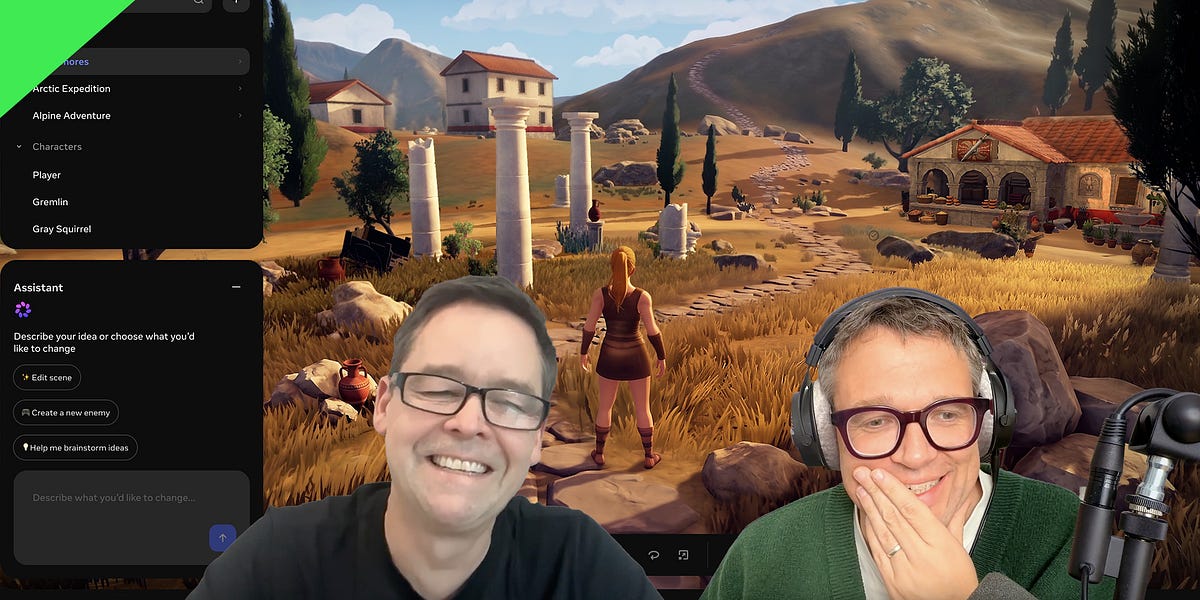
Meta Horizon VP Saxs Persson argues that prompt-based game creation is a legitimate business opportunity, in an interview with Christopher Dring of The Game Business published October 27, 2026.
- Meta has launched Horizon Studio and Horizon Create, AI-powered tools that allow users to build games via text prompts and publish them directly to Facebook and Instagram feeds.
- Meta Horizon VP Saxs Persson positions these tools as a way to accelerate game iteration and lower barriers to entry, aiming to democratize game development for a broader creator base.
- Unlike Roblox or Minecraft, which have established, opinionated artistic styles, Meta’s platform is designed to be platform-agnostic, allowing for diverse visual styles and greater creative freedom for developers.

The U.S. Video Game Market: September 2026
U.S. consumers spent $4.756 billion on video games in September 2026, a 1% decline from $4.796 billion a year earlier. Content spending came to $4.177 billion (-2% YoY).
- The U.S. video game market saw a 1% year-over-year decline in September 2026, with total spending reaching $4.756 billion and year-to-date spending down 3% to $41.038 billion.
- PlayStation 5 hardware sales grew 43% in dollar terms and 22% in units during September, driven by the release of 'Marvel's Wolverine,' which became the month's best-selling game.
- Xbox console unit sales hit an all-time September low, with physical game sales for the platform falling 32% year-over-year and representing only 4% of total physical unit sales for the month.
xXx_FANTASYLAND_xXx: Using Video Game Interfaces for Developing Interactive Live Performances
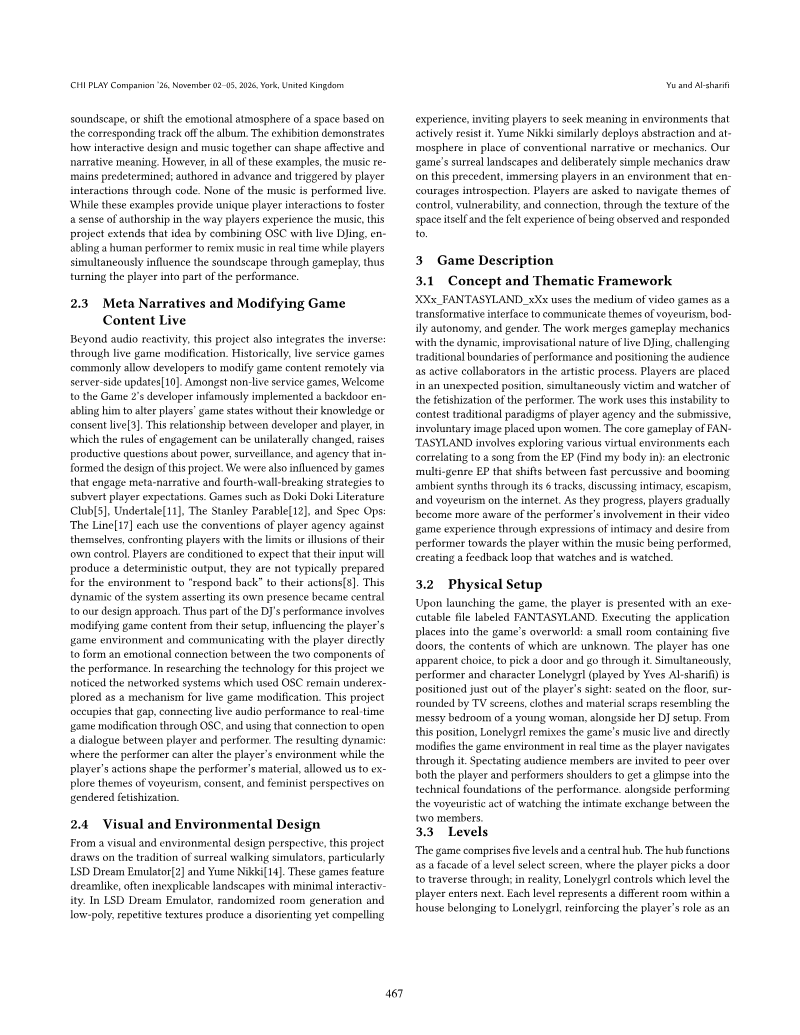
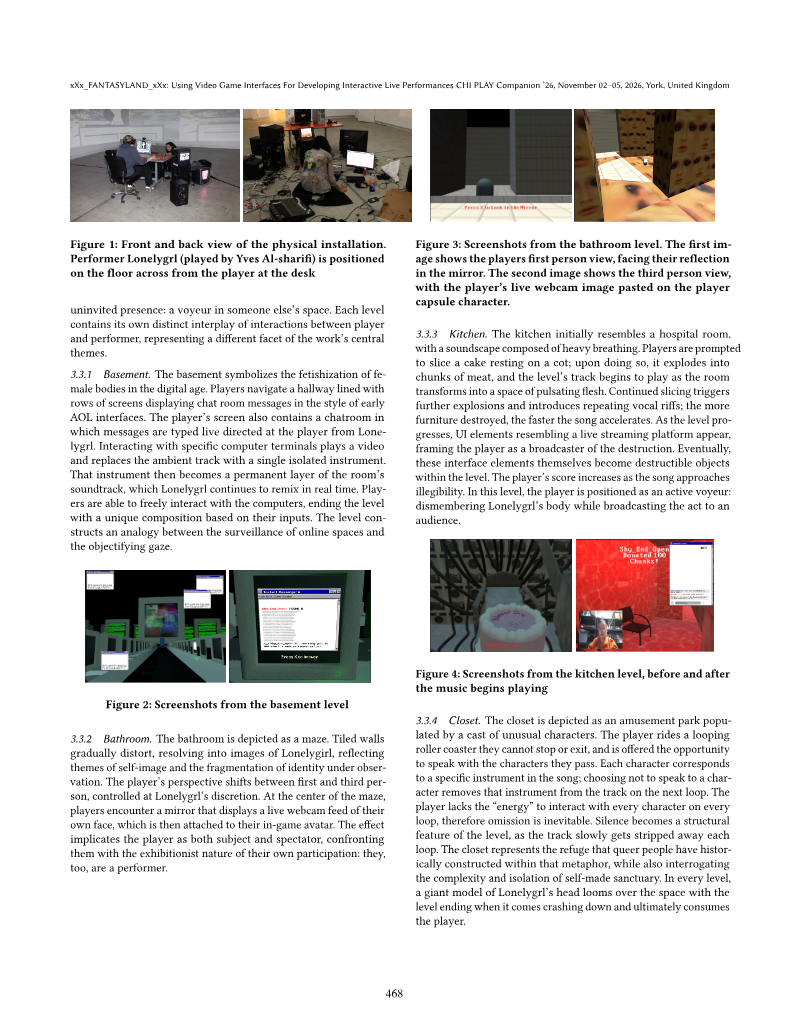
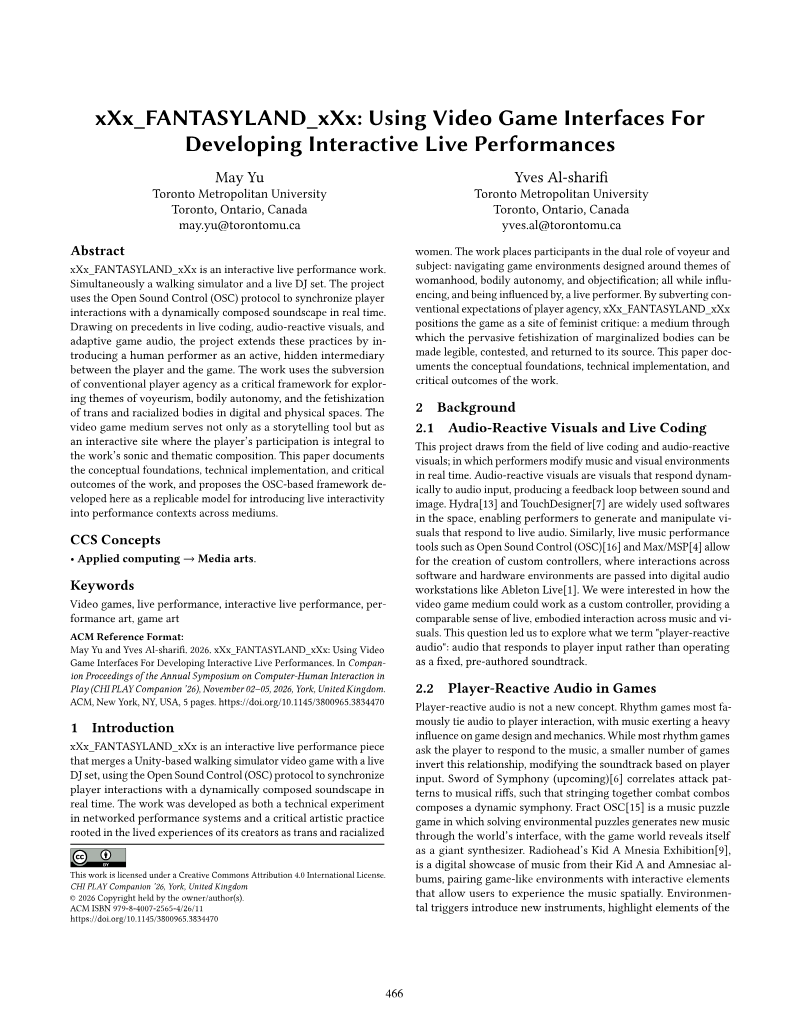
The paper by May Yu and Yves Al-sharifi of Toronto Metropolitan University, presented at CHI PLAY Companion '26, describes xXx_FANTASYLAND_xXx, an interactive live performance that combines a Unity-based walking simulator with a live DJ set.
- The project connects a Unity game engine, Max, and Ableton Live through OSC over a local LAN, letting the game and music software exchange data in both directions.
- Unlike earlier player-reactive games, the music in this project is not fully predetermined: a human performer remixes it live while players influence the soundscape.
- The performer can change the game environment while the player navigates it, and the hub's level choice is controlled by the performer rather than the player.
Levelling up the Narrative Evaluation Practices of Indie Video Game Developers
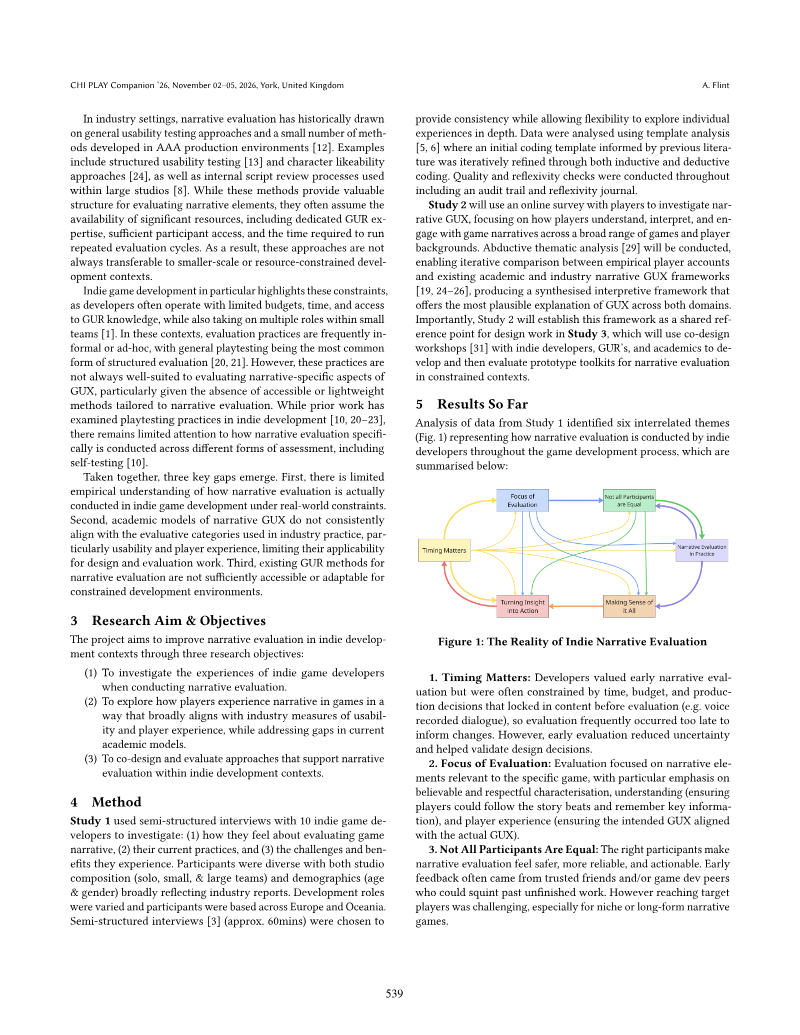
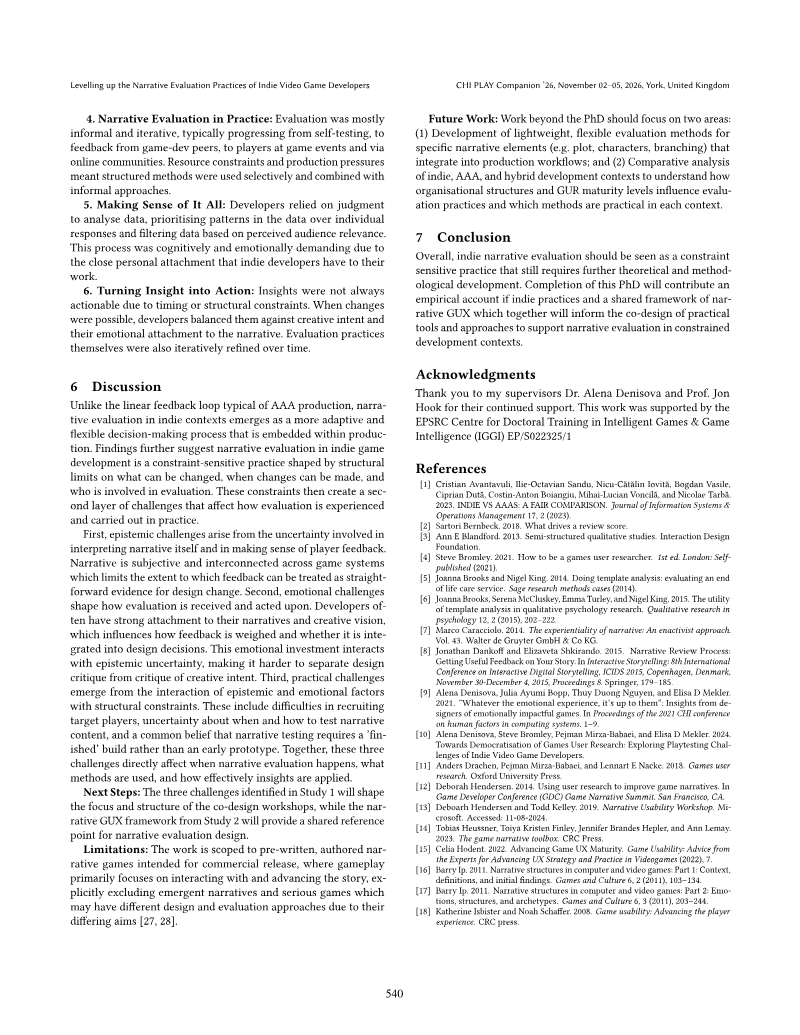
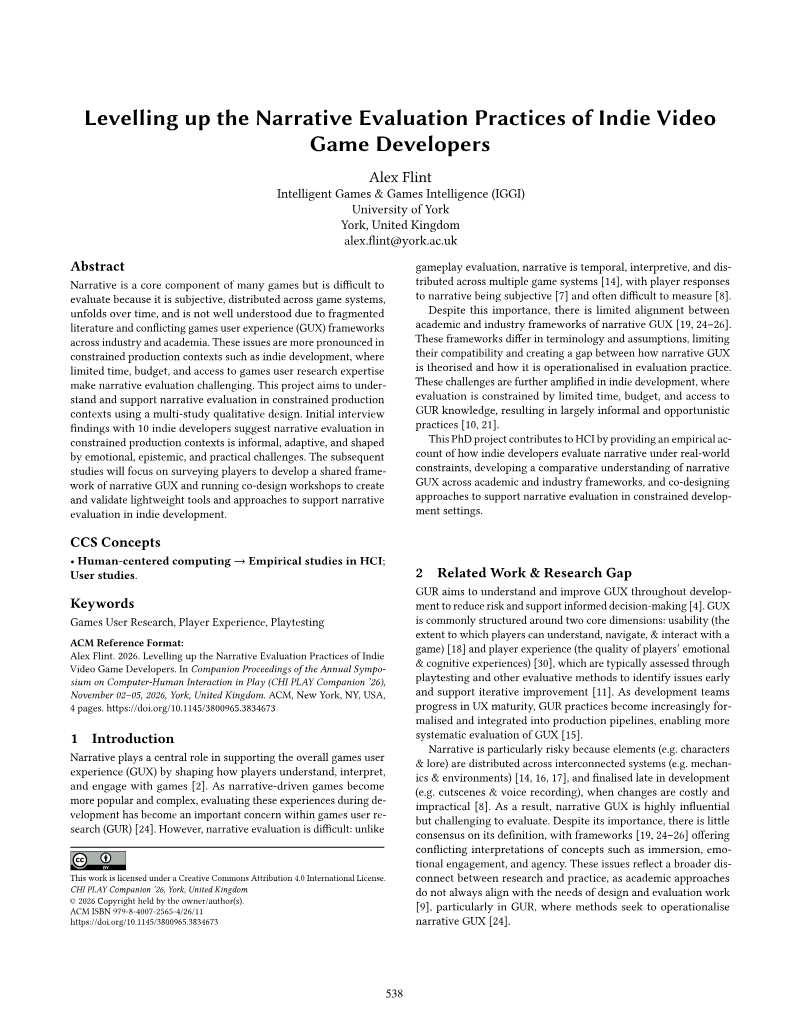
Alex Flint, a PhD researcher at the University of York's IGGI centre, presents a multi-study qualitative project on how indie video game developers evaluate narrative under real-world constraints.
- Developers valued early narrative evaluation, but budget, time and production decisions often locked in content before testing, so evaluation frequently came too late to inform changes.
- Narrative evaluation in indie development was mostly informal and iterative, typically progressing from self-testing to feedback from game-dev peers, then to players at game events and online communities.
- Early feedback often came from trusted friends and game dev peers who could look past unfinished work, but reaching target players was challenging, especially for niche or long-form narrative games.

A Blueprint for Unraveling Therapeutic Video Game Design
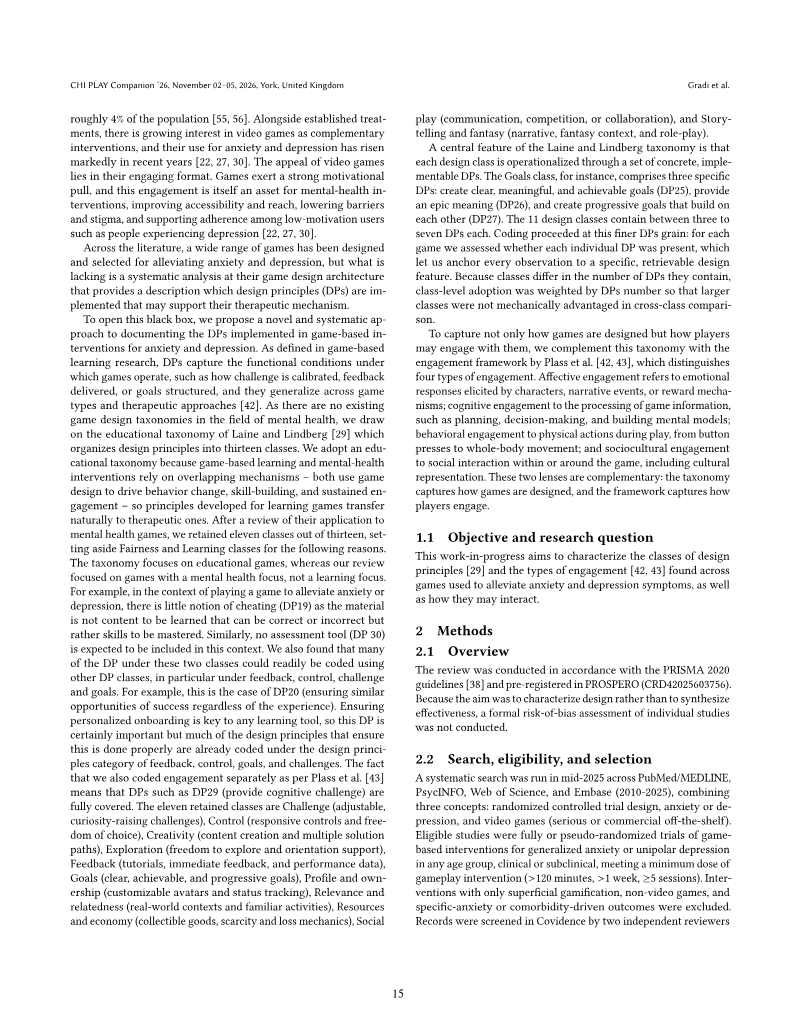
This work-in-progress systematic review, pre-registered in PROSPERO (CRD42025603756), examines video games used in randomized or pseudo-randomized controlled trials for generalized anxiety or unipolar depression.
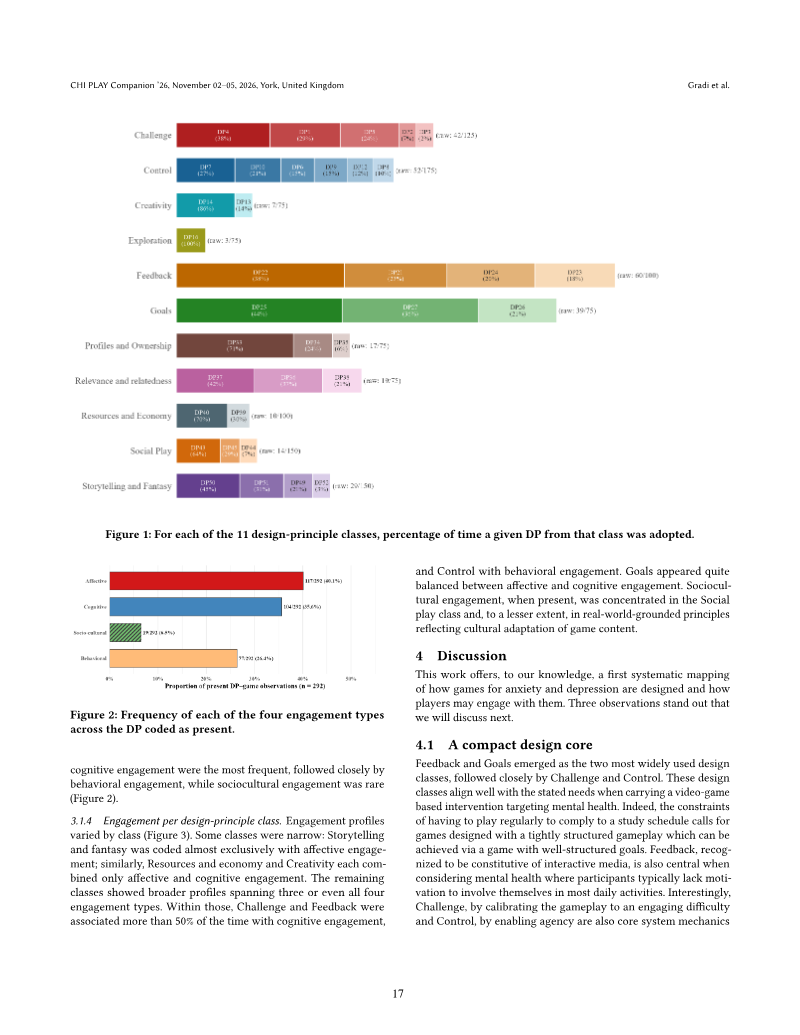
- Feedback and Goals were the most widely adopted design classes, with Challenge and Control following. The authors describe these as a compact design core.
- The single most widely adopted design principle was immediate, positive, and useful feedback, present in 23 of 25 games.
- Affective and cognitive engagement were the most frequent engagement types, while sociocultural engagement was rare.

Industri Gim Sumbang Ekonomi ASEAN Hingga Rp148 Triliun, Ini Peta Persaingannya
Industri gim Asia Tenggara menyumbang US$8,2 miliar (sekitar Rp147,6 triliun) bagi perekonomian kawasan pada 2025, menurut white paper "The Video Game Industry: Unlocking the Next Level of Economic and Social Development in Southeast Asia" yang disusun Tencent bersama Access Partnership dan diluncurkan di World Conference on…
- The Southeast Asian game industry is projected to contribute US$14.2 billion to the regional economy by 2030, a 73.2% increase from US$8.2 billion in 2025, and create 1.16 million jobs.
- In 2025, Malaysia was the largest contributor to the ASEAN game industry economy at US$2.5 billion, followed by Indonesia (US$1.8 billion), Thailand (US$1.7 billion), Singapore (US$1.3 billion), and the Philippines (US$1 billion).
- While hardware manufacturing generally dominates the ASEAN game industry's economic contribution (averaging 55%), Singapore's economy is primarily driven by game development (67%), and the Philippines by retail sales (43%).
Kemenekraf dan Tencent Bidik Peningkatan Kontribusi Gim Lokal yang Baru 7%
Indonesia's Ministry of Creative Economy (Kemenekraf) and Tencent are partnering to raise the contribution of locally developed and published games, which currently account for only about 7% of the national game industry's value added.
- Kemenekraf and Tencent aim to increase the contribution of local game development and publishing, which currently stands at only 7% of Indonesia's game industry value added.
- In 2025, Indonesia's game industry generated US$1.3 billion in revenue and US$1.8 billion in value added, accounting for 0.12% of the country's GDP.
- The largest contributions to the Indonesian game industry's value added come from hardware and peripherals (47%), esports (24%), and retail (21%), with game development and publishing contributing only 7%.



Games, Heritage, Arts, & Sport: Key Research Findings and Strategic Recommendations from the GAMEHEARTS Project
The GAMEHEARTS project aimed to maximize the value of the European Video Game Industry Ecosystem (EVGIE) by fostering its development and integration with broader cultural and creative industries (CCI).
- The GAMEHEARTS project, funded under Horizon Europe, combined a literature review, a survey of 127 European video game developers, 27 in-depth interviews, focus groups, and design thinking marathons involving 72 participants across 12 working teams over an 18-month research period.
- Survey respondents rated collaboration among game developers within the European video game industry ecosystem as low, and collaboration with cultural and creative industry sectors as very low.
- Developers rated their own innovativeness as generally modest, with behavioural innovativeness scoring highest and shown to strongly influence success, while co-innovation relationships correlate positively with innovativeness.

The U.S. Video Game Market: August 2026
U.S. video game spending fell 9% year over year in August 2026 to $4.259 billion, the third consecutive monthly decline.
- U.S. video game spending fell 9% year-over-year in August 2026 to $4.259 billion, marking the third consecutive month of market decline.
- Gaming hardware unit sales dropped 15% year-over-year to 559,000 consoles, the lowest volume for an August since 2013.
- The average price of a new console reached an August record of $541, with year-to-date average prices for Xbox and PlayStation rising 26% and 20% respectively, contributing to significant consumer price sensitivity.

The Hidden Way Video Game Companies Exploit Workers
The video game industry frequently utilizes a tiered employment structure that creates a significant divide between full-time staff and agency-hired contractors.
- Video game companies frequently use external agencies to hire 'contractors' who perform the same full-time, long-term roles as permanent staff but are denied equivalent benefits, paid time off, and company perks.
- The use of agency workers allows companies to bypass significant employment costs, including expensive healthcare premiums and mandatory severance packages during layoffs.
- When major companies like Xbox announce large-scale layoffs, the figures often exclude agency workers, meaning the actual number of people losing their jobs is significantly higher than reported.
Why Video Game Studios By Big-Name Developers Fail So Often
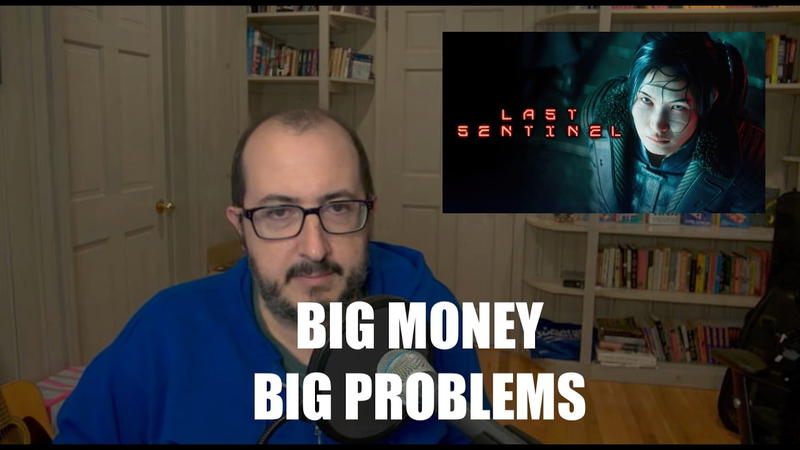
The frequent failure of independent game studios founded by veterans from major AAA companies stems from a disconnect between the resources of large organizations and the realities of smaller, independent operations.
- New studios founded by AAA veterans often fail because they lack the specialized infrastructure—such as dedicated marketing, cinematic teams, and administrative support—that large companies like Blizzard or Rockstar provide by default.
- Founders frequently struggle to adapt to modern market realities, such as the necessity of Early Access, community building via Discord, and iterative beta testing, instead relying on outdated 'surprise launch' strategies that are no longer effective.
- Excessive venture capital funding, common during the 2021–2022 zero-interest-rate period, often leads to 'scope creep,' where studios artificially inflate project size and headcount to match their inflated budgets, resulting in complacency and unmanageable complexity.