Video Game
Game
Documents about Video Game
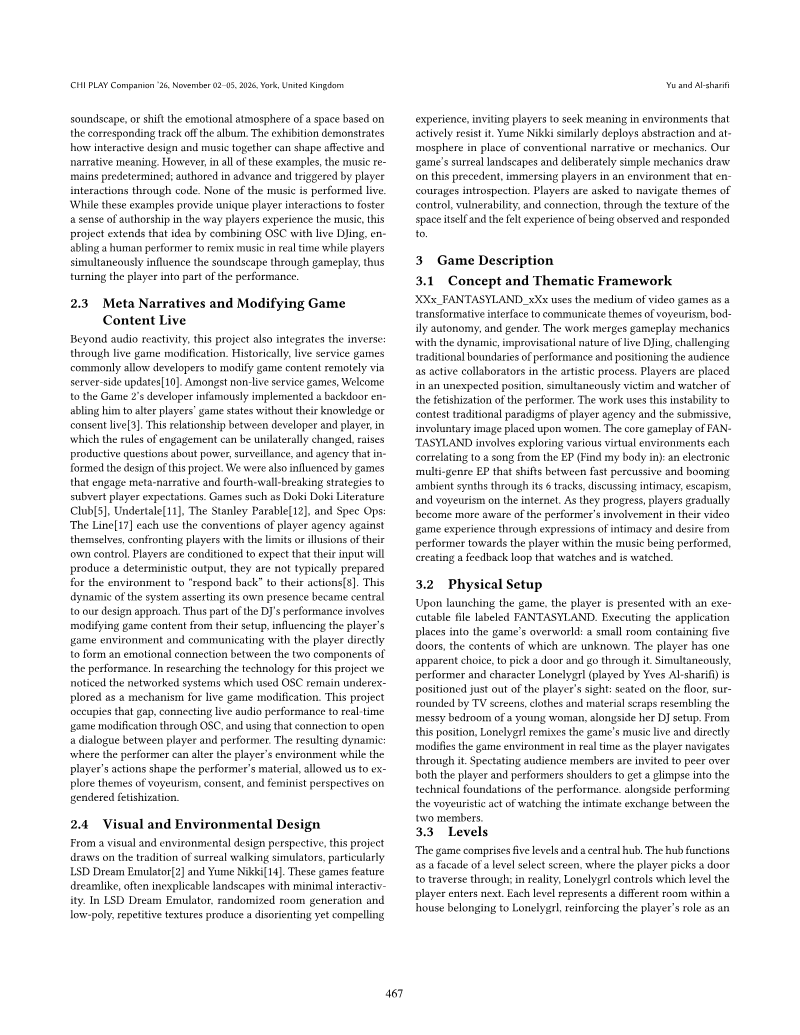
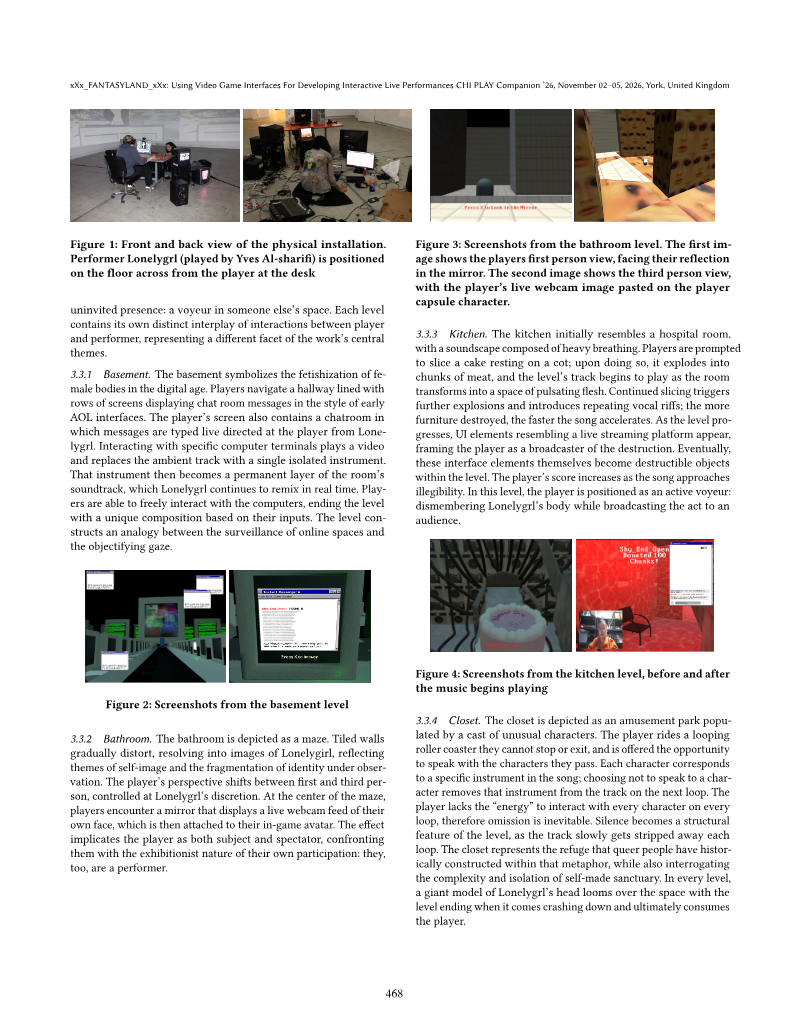
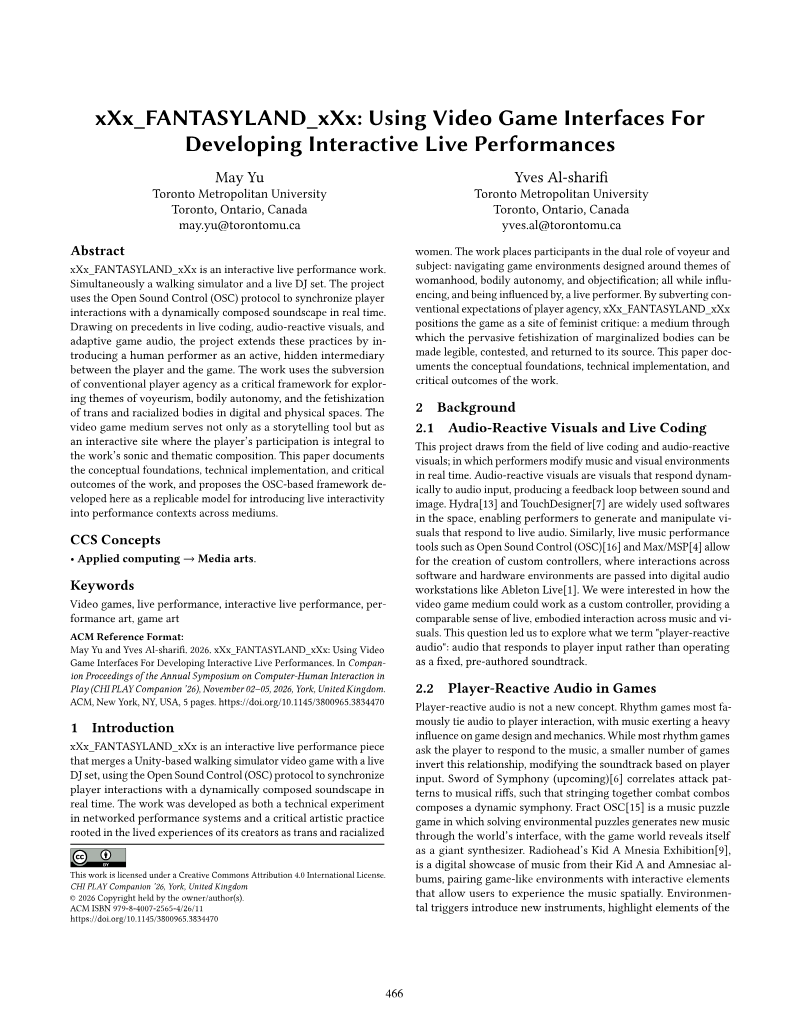
xXx_FANTASYLAND_xXx: Using Video Game Interfaces for Developing Interactive Live Performances
The paper by May Yu and Yves Al-sharifi of Toronto Metropolitan University, presented at CHI PLAY Companion '26, describes xXx_FANTASYLAND_xXx, an interactive live performance that combines a Unity-based walking simulator with a live DJ set.
- The project connects a Unity game engine, Max, and Ableton Live through OSC over a local LAN, letting the game and music software exchange data in both directions.
- Unlike earlier player-reactive games, the music in this project is not fully predetermined: a human performer remixes it live while players influence the soundscape.
- The performer can change the game environment while the player navigates it, and the hub's level choice is controlled by the performer rather than the player.
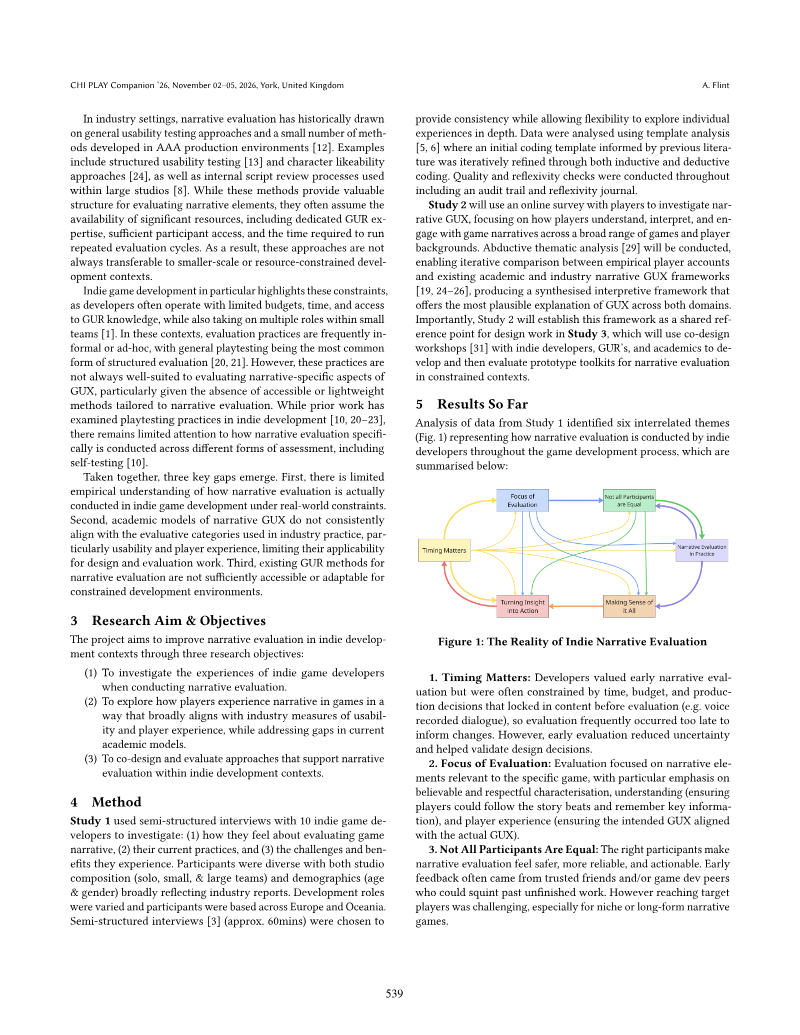
Levelling up the Narrative Evaluation Practices of Indie Video Game Developers
Alex Flint, a PhD researcher at the University of York's IGGI centre, presents a multi-study qualitative project on how indie video game developers evaluate narrative under real-world constraints.
- Developers valued early narrative evaluation, but budget, time and production decisions often locked in content before testing, so evaluation frequently came too late to inform changes.
- Narrative evaluation in indie development was mostly informal and iterative, typically progressing from self-testing to feedback from game-dev peers, then to players at game events and online communities.
- Early feedback often came from trusted friends and game dev peers who could look past unfinished work, but reaching target players was challenging, especially for niche or long-form narrative games.
A Blueprint for Unraveling Therapeutic Video Game Design
This work-in-progress systematic review, pre-registered in PROSPERO (CRD42025603756), examines video games used in randomized or pseudo-randomized controlled trials for generalized anxiety or unipolar depression.
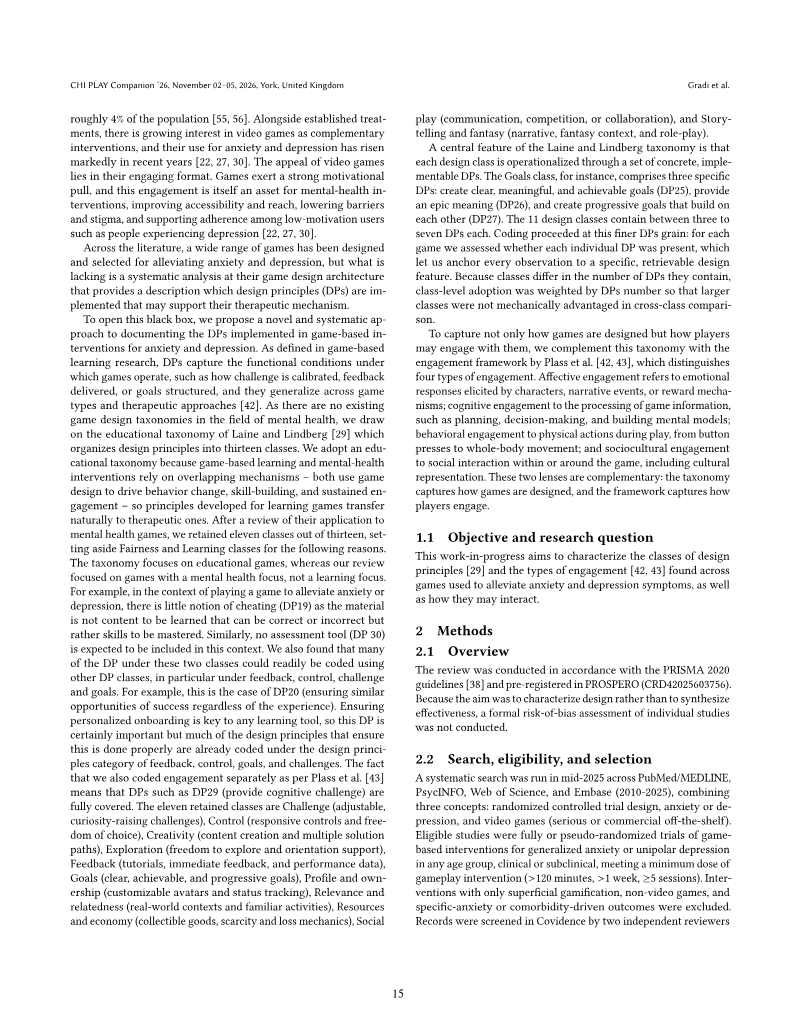
- Feedback and Goals were the most widely adopted design classes, with Challenge and Control following. The authors describe these as a compact design core.
- The single most widely adopted design principle was immediate, positive, and useful feedback, present in 23 of 25 games.
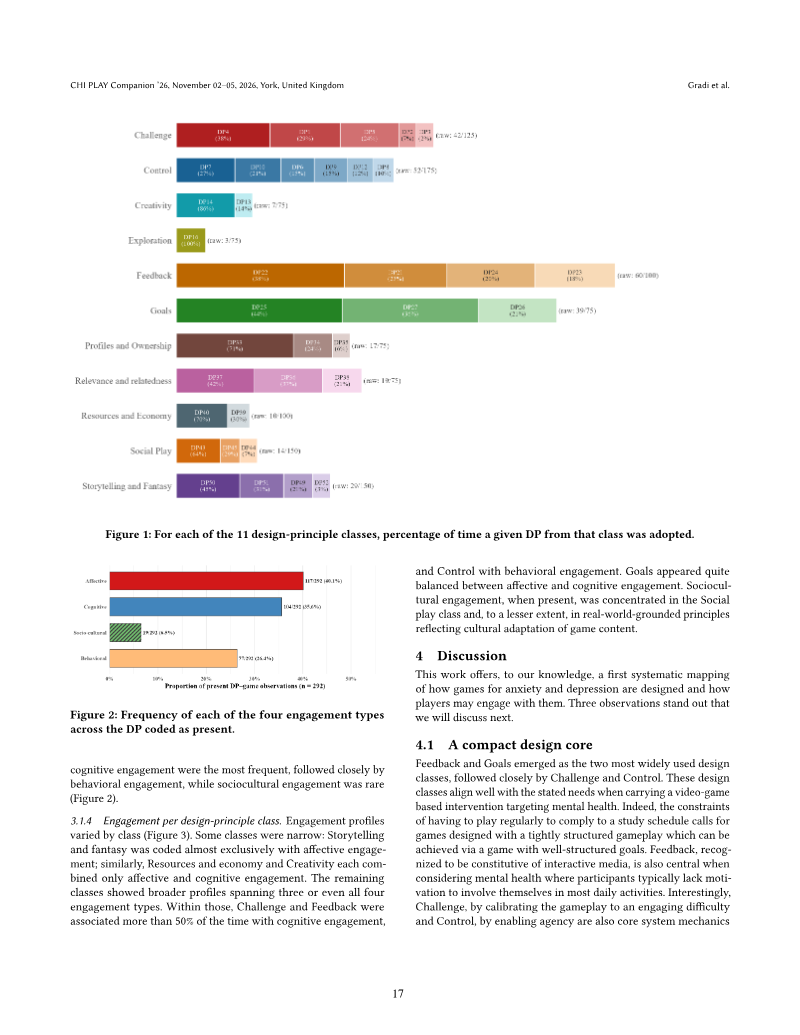
- Affective and cognitive engagement were the most frequent engagement types, while sociocultural engagement was rare.



Games, Heritage, Arts, & Sport: Key Research Findings and Strategic Recommendations from the GAMEHEARTS Project
The GAMEHEARTS project aimed to maximize the value of the European Video Game Industry Ecosystem (EVGIE) by fostering its development and integration with broader cultural and creative industries (CCI).
- The GAMEHEARTS project, funded under Horizon Europe, combined a literature review, a survey of 127 European video game developers, 27 in-depth interviews, focus groups, and design thinking marathons involving 72 participants across 12 working teams over an 18-month research period.
- Survey respondents rated collaboration among game developers within the European video game industry ecosystem as low, and collaboration with cultural and creative industry sectors as very low.
- Developers rated their own innovativeness as generally modest, with behavioural innovativeness scoring highest and shown to strongly influence success, while co-innovation relationships correlate positively with innovativeness.

Rapid Academic Levelling Through Artificial Intelligence Role Play Escape Room
Astengo and Caudillo report an exploratory one-group pre-test/post-test classroom study of a single-session conversational AI educational escape room, run with 15 second-semester students in an Engineering in Interactive Software and Video Game Development programme at a private university in the State of Mexico.
- Aggregate correct responses across all possible items rose from 19.3% to 55.7% between pre-test and post-test. The authors stress these are descriptive differences, not individual learning gains.
- Correctness among attempted items increased from 48.3% to 81.3%, a difference the document reports as 32.9 percentage points.
- The proportion of attempted items rose from 40.0% to 68.6%. The authors interpret this only as a change in response behaviour, not as increased engagement or confidence.



How Mainland China Governs Video Game Monetisation: An Imbalanced Framework
The document analyzes the governance framework for video game monetization in Mainland China, identifying it as a crucial jurisdiction due to its status as a major global game producer and the world's most lucrative mobile game market.
- China governs video game monetisation through a dual framework: restrictive content moderation and consumer protection measures alongside active state promotion of 'high-quality' games, esports, and game-adjacent technologies.
- The analysis is based on 138 Chinese government regulatory documents and industry self-regulatory materials collected between November 2025 and March 2026, examined via thematic analysis.
- Regulatory measures are predominantly designed around protecting minors, with child-focused standards extended to the wider player population, an approach the authors argue may fail to effectively protect either group.

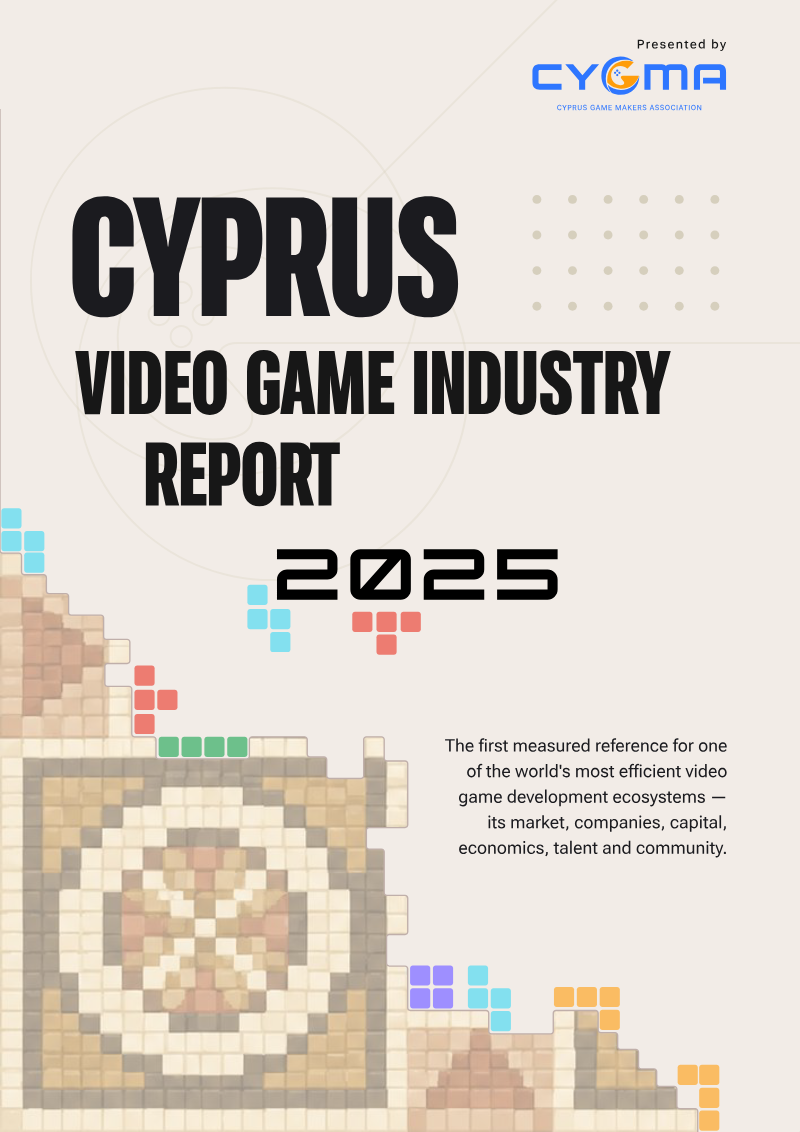
Cyprus Video Game Industry Report 2025
The document is the inaugural Cyprus Video Game Industry Report 2025, published by CYGMA (Cyprus Game Makers Association).
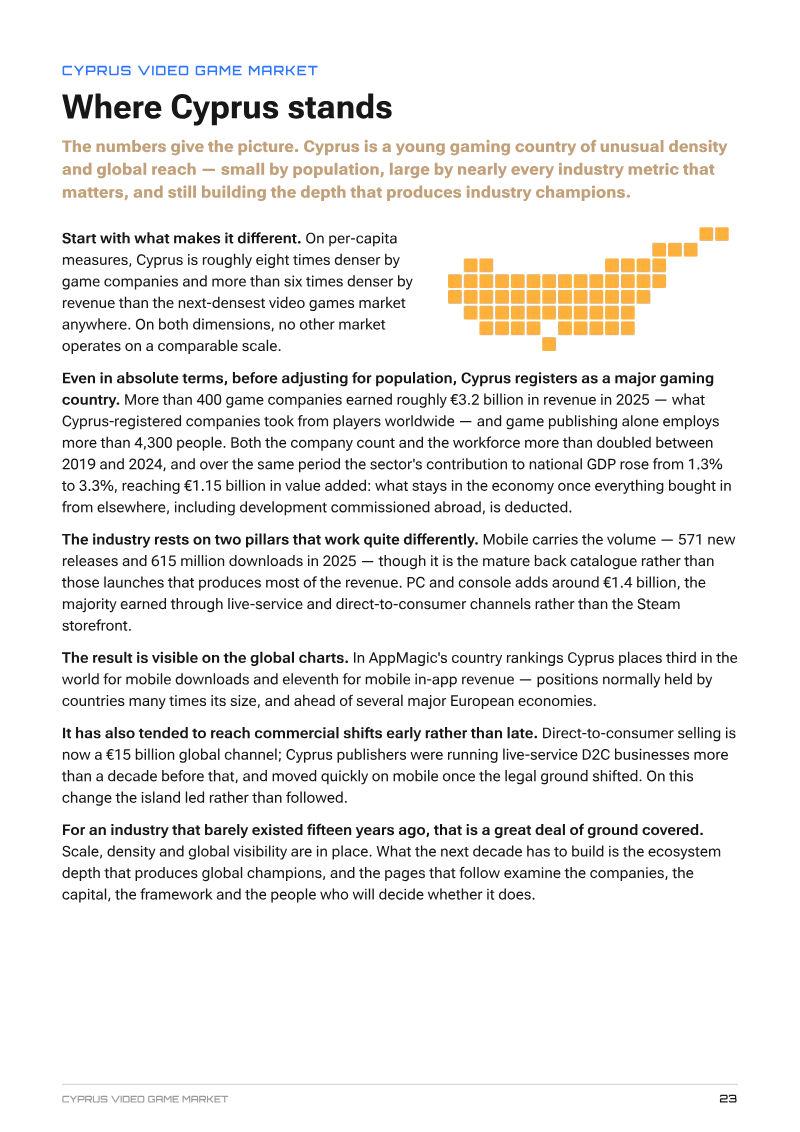
- Cyprus-based game companies grew from 169 in 2019 to 393 in 2024, while employment rose from 1,438 to 4,320 people.
- Titles released before 2025 account for about 96% of Cyprus's 2025 mobile revenue, with only about 4% from 2025 launches.
- Cyprus ranks third in the world for mobile game downloads and eleventh for mobile in-app grossing in AppMagic's 2025 rankings.
Player as Archivist: A Proposed Analysis of Player-centric Video Game Preservation Practice
This proposal, presented at DiGRA 2026 by researchers at Edinburgh Napier University, argues that video game preservation depends heavily on informal, player-driven labor that remains under-studied relative to institutional archiving.
- Video game preservation relies heavily on informal, player-driven labor that is under-studied compared with institutional archiving, and the paper argues this should be investigated empirically.
- The authors contend that games are complex digital objects whose authenticity depends on user practice and the lived playing experience, not only on technical layers, so purely technological preservation may lose what makes games culturally distinctive.
- The proposed research agenda examines four behavioral determinants of player-driven preservation: nostalgic motivation, preservation practice orientation (e.g., emulation, modding, walkthrough production), community engagement, and technical and resource investment.
Balancing In/formality within the Brno Video Game Industry
This document examines the interplay of formal and informal practices within the video game industry in Brno, Czechia, focusing on how these dynamics influence labor conditions and professionalization.
- The study draws on 32 semi-structured interviews (2024–2025) with developers, educators, government representatives, and community organizers, plus six mapping sessions and a thematic analysis of 89 public documents.
- Brno's industry is characterized as simultaneously formalized (ties to companies, universities, and municipal and regional authorities) and informal in governance, with membership organized around individuals rather than organizations.
- The local developer association, founded in 2020, depends largely on volunteers and donations rather than fees or wages, which participants see as a signal of earnestness but which the authors link to self-exploitation, barriers for newcomers, and sustainability concerns.
Applied Ethics Techniques for Video Game Ethics
This paper proposes that two families of techniques from analytic applied ethics, case construction and engaging perspectives, can strengthen both the teaching of video game ethics and collaboration among researchers and practitioners.
- The paper argues that game ethics has grown rapidly as a field, but its teaching and research are complicated by the diverse assumptions and evaluative standards found across games scholarship.
- Its central proposal is that two families of techniques from analytic applied ethics, case construction and engaging perspectives, can structure debate, clarify agreement, and pinpoint the true sources of disagreement among researchers and practitioners.
- Case construction includes analogies, which test a target case against a structurally similar one, and simplifying examples, which strip away complicating features to reveal which elements actually drive moral evaluation.
Producing Games, Reproducing Inequalities: Gender and Labour in the Argentine Video Game Market
This paper analyzes gender inequalities within the Argentine video game industry, aiming to provide empirical evidence and critical analysis to foster a more inclusive and equitable local ecosystem.
- Women make up roughly 46% of the global gaming community but held only about 30% of video game industry employment positions in 2021, and more than half face harassment and online abuse affecting both their play and professional visibility.
- The Argentine video game sector has grown substantially over two decades yet reproduces, and in some respects intensifies, the gendered hierarchies found in the wider software and IT services economy.
- No official, systematised statistics exist for the Argentine video game sector: games lack a dedicated intellectual property category and are dispersed across national accounting frameworks, including the Culture Satellite Account and technological classifications.

From Policy to Paradox: Diversity Washing, Policy Failures, and the Limits of Authentic Intersectional Pleasure in the European Video Game Industry
This extended abstract from the Horizon Europe GAMEHEARTS project critically examines the systemic failure of inclusiveness within the European Video Game Industry Ecosystem (EVGIE).
- The paper argues that weak institutional frameworks and formalised organisational mechanisms encourage superficial compliance with inclusivity goals, a practice it terms "Diversity Washing", with inclusivity often imposed to satisfy financing and reporting requirements rather than arising from grassroots creativity.
- The study's evidence base combines a systematic review of 61 academic publications, analysis of 55 industry reports and 18 statistical reports, and nine comparative case studies of games incorporating European cultural heritage.
- A 2024 quantitative survey of 1,270 European video game developers, supplemented by 27 in-depth interviews, three national and one international design thinking marathons (72 participants), and focus groups with eight practitioners from Austria, Ireland, Sweden, and Poland, forms the empirical core of the research.