Digital Games
Company
Documents about Digital Games
State Aids for Digital Games in the European Union: A Symbiotic or Parasitic Relationship?
The document analyzes state aid mechanisms for digital games within the European Union, examining the relationship between national/regional state interventions and the games industry.
- The paper's central thesis is that EU state aid for digital games is simultaneously symbiotic (genuinely supporting creative production) and parasitic (embedding that support within capitalist commercial logics).
- The European Commission treats digital games as a cultural form under Article 107(3)(d) TFEU, but its approvals are driven by multiple rationales, including protection of the EU internal market and alignment with creative industries discourses that emphasise the marketisation of culture.
- The study examines national tax incentives, grants, and credits in Belgium, Denmark, France, Germany, Ireland, and the United Kingdom (a pre-Brexit measure), with the earliest scheme introduced in France in 2007 and the most recent in Ireland in 2022.
Demonic Games: Demonic Figures and Functions in Contemporary Digital Games
The document explores the historical and theoretical presence of demonic figures and functions in digital games, aiming to develop an interpretive framework for understanding "ludic demons."
- Frans Mäyrä's paper argues that theory on monsters in games is well developed but the specific category of the demonic remains underexplored, and it builds on his earlier theory of demonic polyphony and the "Textual Self", which holds that demonic figures signal internal tensions in subjectivity and agency.
- The study traces gaming's demonic imagery to late 1970s dungeon-adventure games inspired by Dungeons & Dragons and to 1980s United States moral panics that linked role-playing games to occultism, noting that this demonological imagery persisted after those religious anxieties faded.
- In first-person shooters such as DOOM, demons serve as endless, transformable adversaries, and the paper reads the underlying anxieties about military empowerment through technology in terms of historically male relationships to power and sexuality.
Died on First Try, 10/10 Would Recommend LMAO: Studying the Appreciation of Historical Digital Games about WWII via Text Mining Methods
This study investigates player appreciation of historical digital games, specifically those set during World War II, by analyzing player reviews on Steam.
- Steam, the dominant digital PC storefront, accounts for roughly 50% to 70% of global PC game downloads, making its player reviews a substantial source of player discourse.
- The study addresses a gap in prior research, which relied mainly on focus groups and surveys, by mining large volumes of player-generated online text from Steam reviews.
- The author applies a multi-step text mining workflow in R, combining automated web scraping with unsupervised topic modeling to surface latent themes in player language.
Toward an Agential Realist Account of Digital Games: Revisiting Gamic Agency and Materiality
This paper proposes an agential realist and posthumanist reconceptualization of agency in digital games, drawing on Karen Barad's agential realism and Rosi Braidotti's affirmative ethics.
- The paper argues that gamic agency should be understood not as an attribute owned by players or machines but as an enactment arising through "intra-action," with players and games co-constituted as posthuman subjects, drawing on Karen Barad's agential realism and Rosi Braidotti's affirmative ethics.
- It proposes a "relational materiality" of digital games, marked by inherent indeterminacy, as an alternative to substance-based views, and critiques prevailing humanist accounts of gaming.
- The analysis of The Elder Scrolls IV: Oblivion is central: its uncanny, autonomously behaving non-player characters rupture the seamlessness mainstream games prize, exposing gamic agency and fostering relational co-generation between game and player.
Slovak Digital Games Industry: 2022 Annual Report
The Slovak Game Developers Association's 2022 annual report details the performance and characteristics of the Slovak digital games industry.
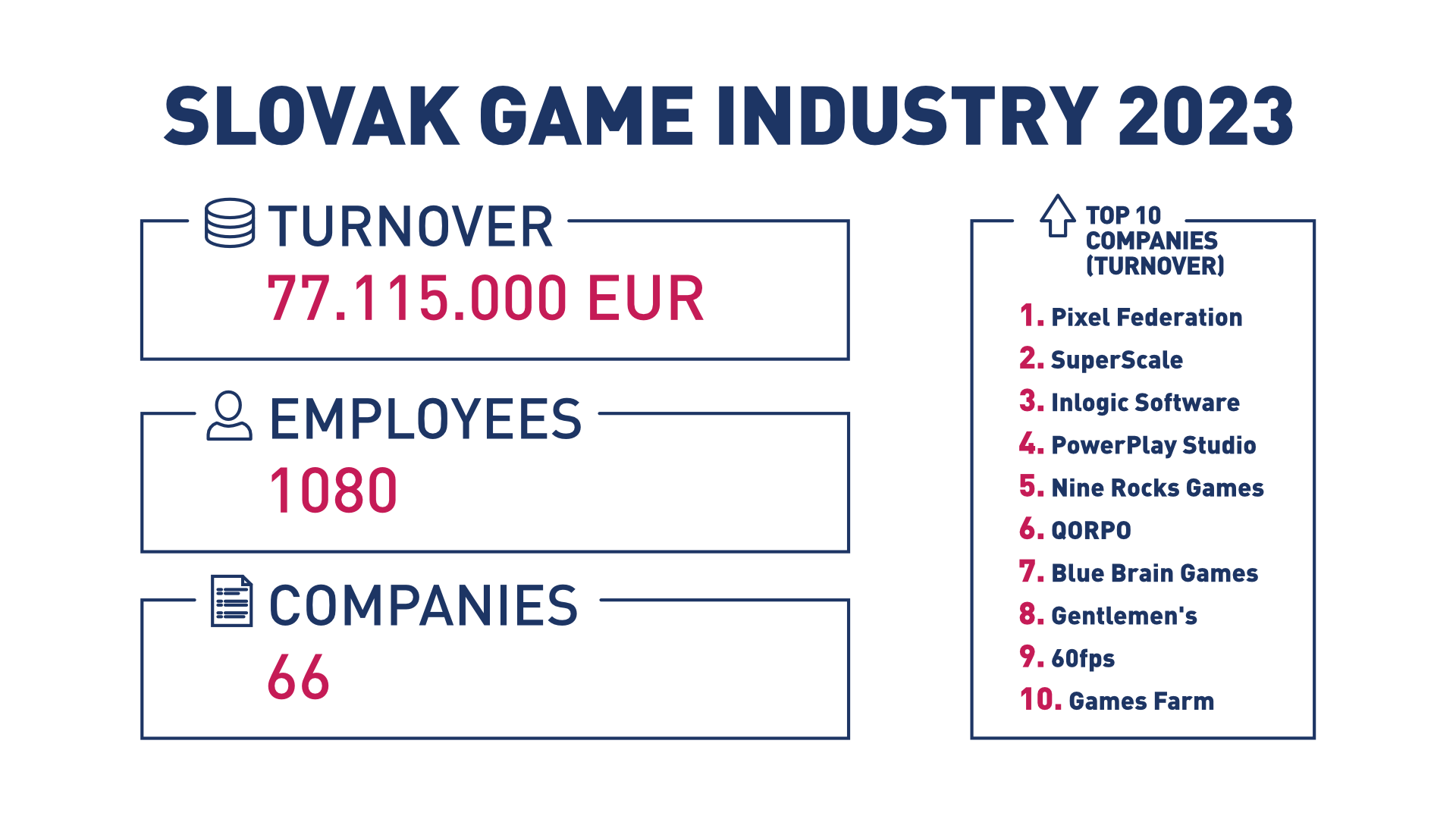
- The Slovak digital games industry experienced a slight downturn in 2022, with total turnover falling to EUR 77.1 million from EUR 80 million in 2021.
- The industry consists of 66 companies employing 1,080 professional developers, with 19% of the workforce being women and 9% international staff.
- Market concentration remains high, as the top 10% of companies generated EUR 65.3 million of the total annual turnover.
Tracing Wajda: Polish Digital Games About World War II Between Center and Periphery
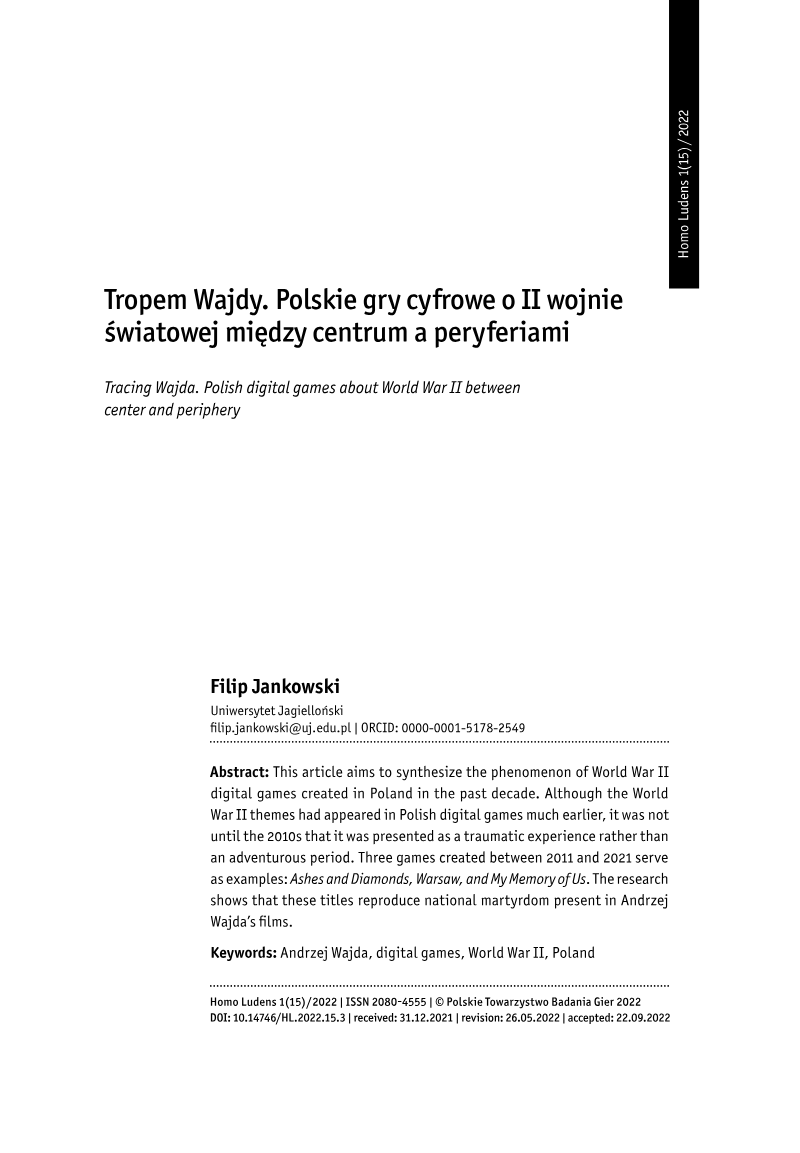
This analysis synthesizes the phenomenon of Polish digital games about World War II created between 2011 and 2021, arguing that these titles reproduce the national martyrdom present in Andrzej Wajda's films.
- Polish digital games about World War II shifted in the 2010s from treating the war as adventure or comedy to portraying it as national trauma, with each examined title reproducing the martyrological framing associated with Andrzej Wajda's war trilogy.
- The study analyses three games released between 2011 and 2021: Ashes and Diamonds, Warsaw, and My Memory of Us.
- The analysis frames Polish developers as occupying a periphery relative to a cultural center identified with the American games industry, and notes that Western critics often dismissed their work as derivative.
Why Oatmeal Is Cheap: Kolmogorov Complexity and Procedural Generation
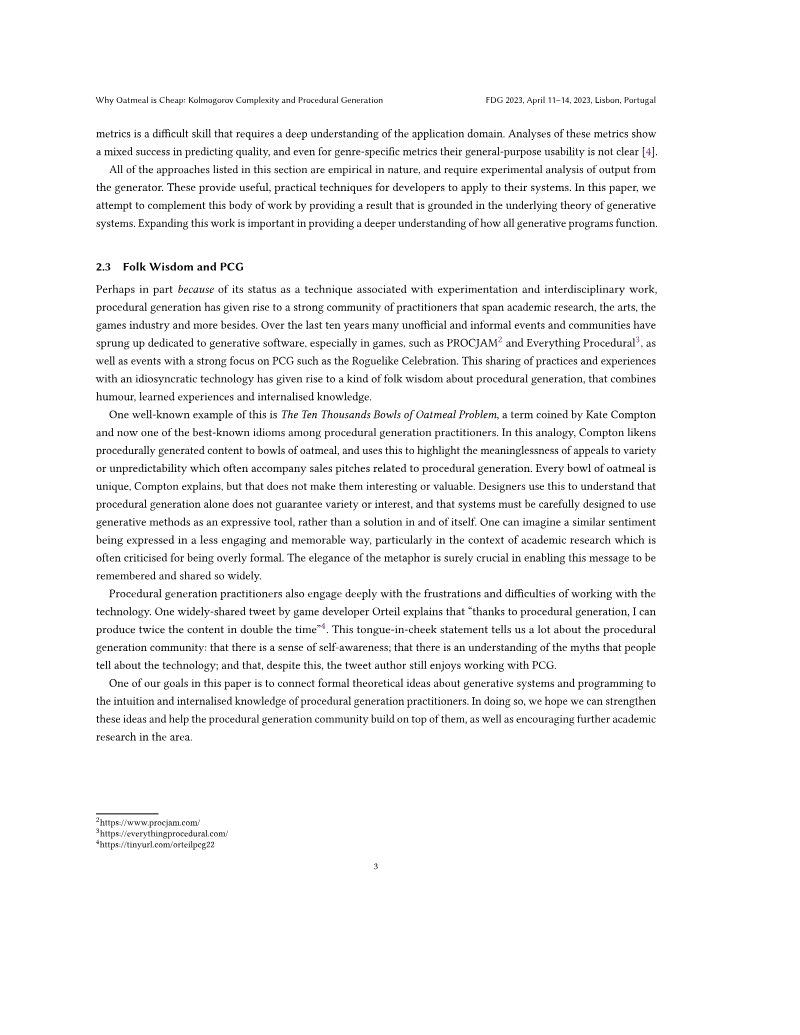
Rabii and Cook, of Queen Mary of London and King's College London, present a theoretical paper published for the Foundations of Digital Games 2023 conference, relating Kolmogorov complexity from information theory to procedural content generation in games.
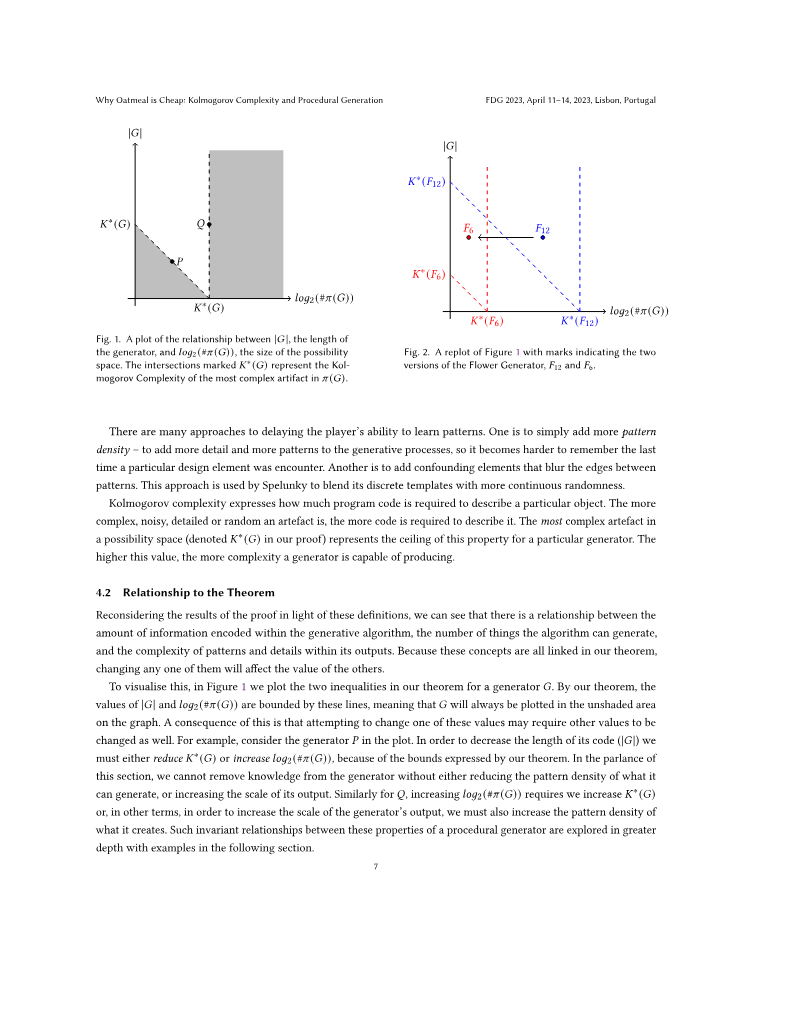
- The authors prove that for an ideal generator, the generator's code length plus the log of its possibility space size bounds the maximum Kolmogorov complexity of its artefacts.
- The authors argue that the oatmeal phenomenon is common because adding scale by combining subcomponents is cheaper than encoding new design knowledge.
- The authors state that linearly increasing the maximum complexity by scaling up the generator exponentially increases the size of the possibility space without adding encoded knowledge.
Level Generation Through Large Language Models
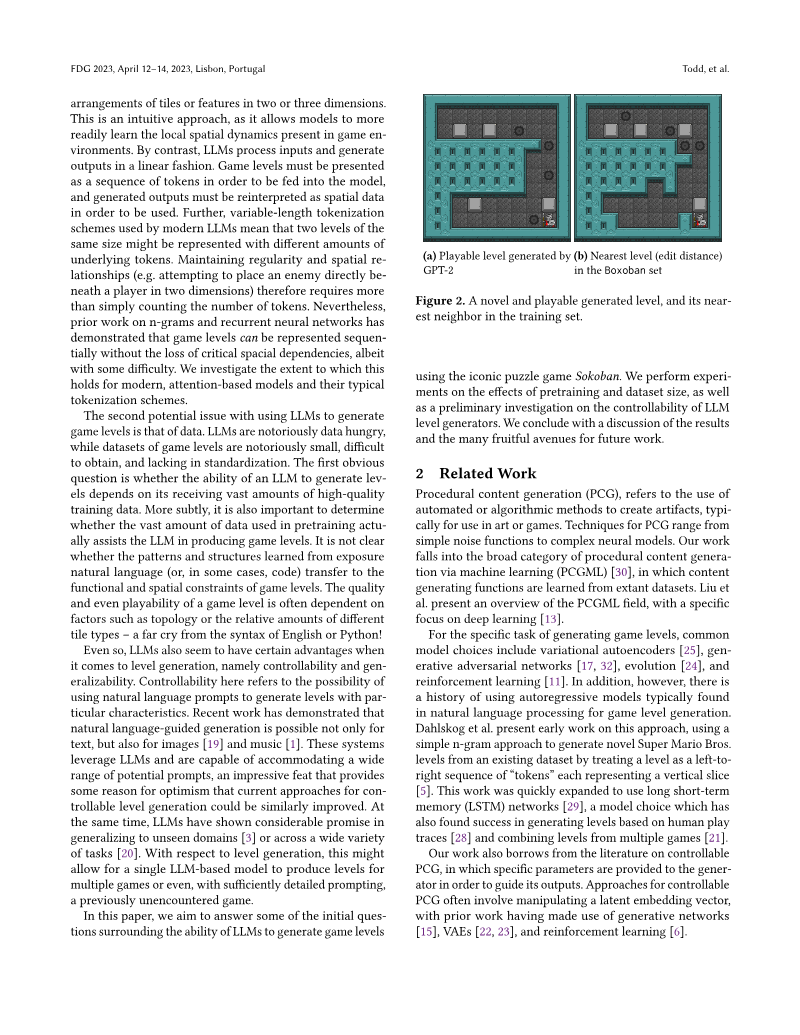
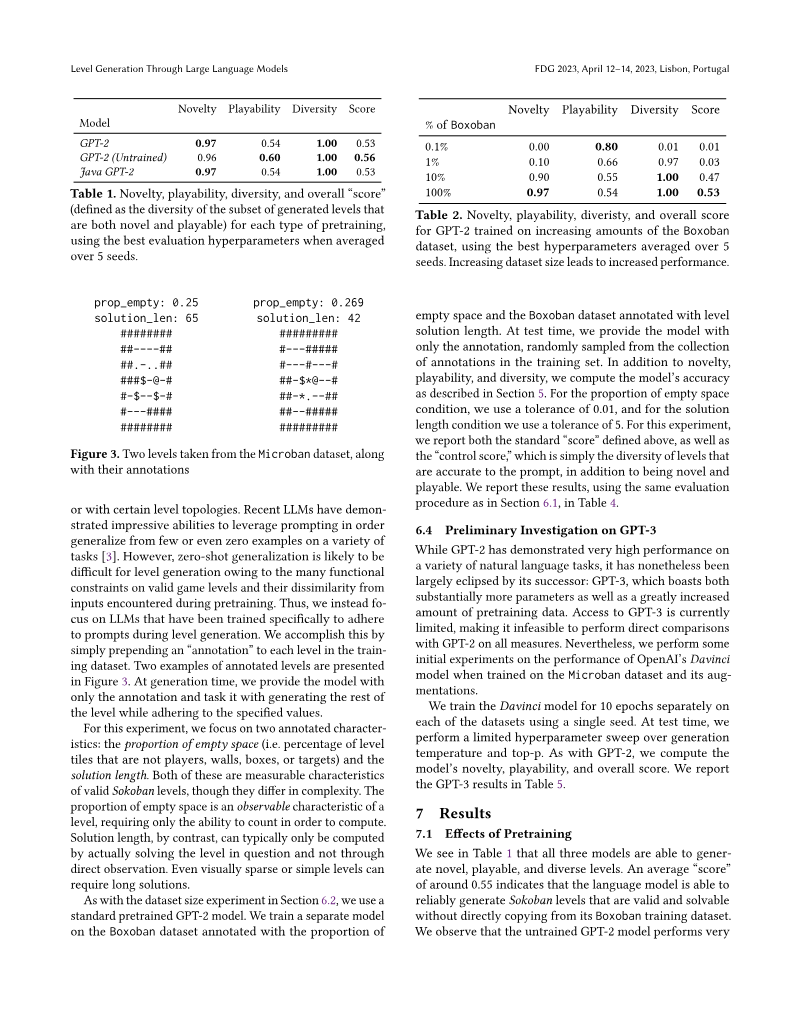
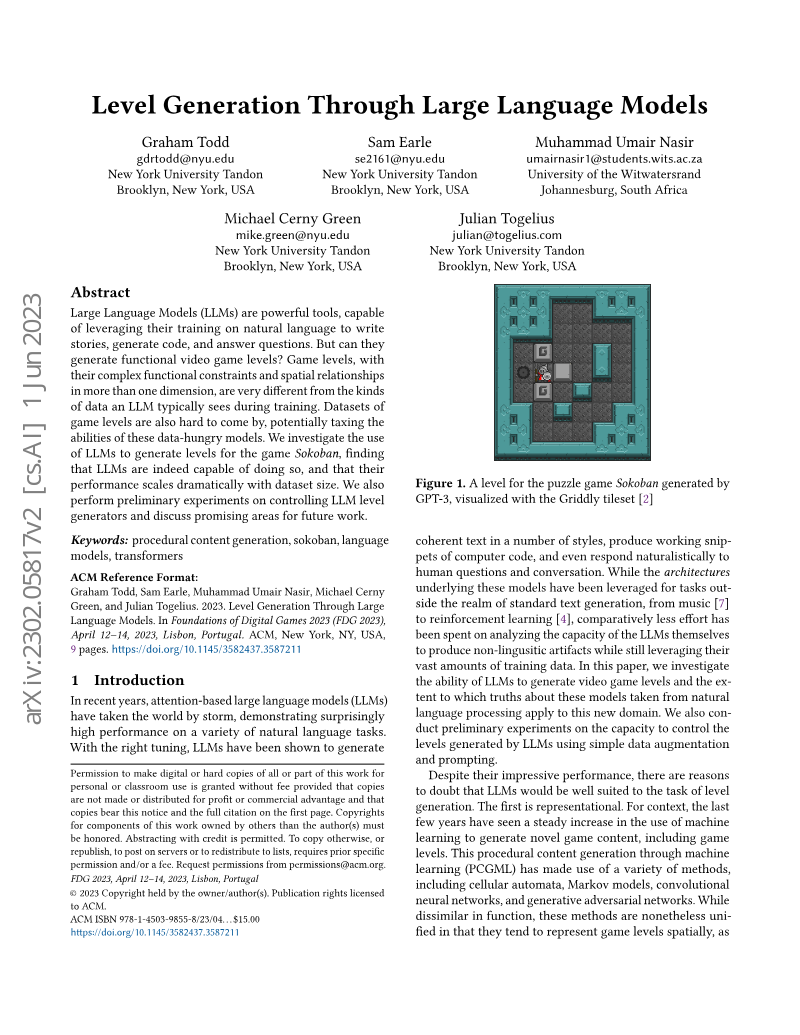
This paper by Graham Todd, Sam Earle, Muhammad Umair Nasir, Michael Cerny Green and Julian Togelius, published at the Foundations of Digital Games 2023 conference, investigates whether large language models can generate functional video game levels for Sokoban, a block-pushing puzzle game.
- On the Boxoban dataset, GPT-2's overall score rose as training data grew, from 0.01 at 0.1% of the data to 0.53 at the full dataset.
- Untrained GPT-2 scored 0.56 overall on Boxoban, slightly above the pretrained standard model's 0.53, and the authors attribute the difference to random variance.
- For solution-length control, GPT-2 reached an accuracy of only 0.17, while proportion-of-empty-space control reached 1.00.
The Right Variety: Improving Expressive Range Analysis with Metric Selection Methods
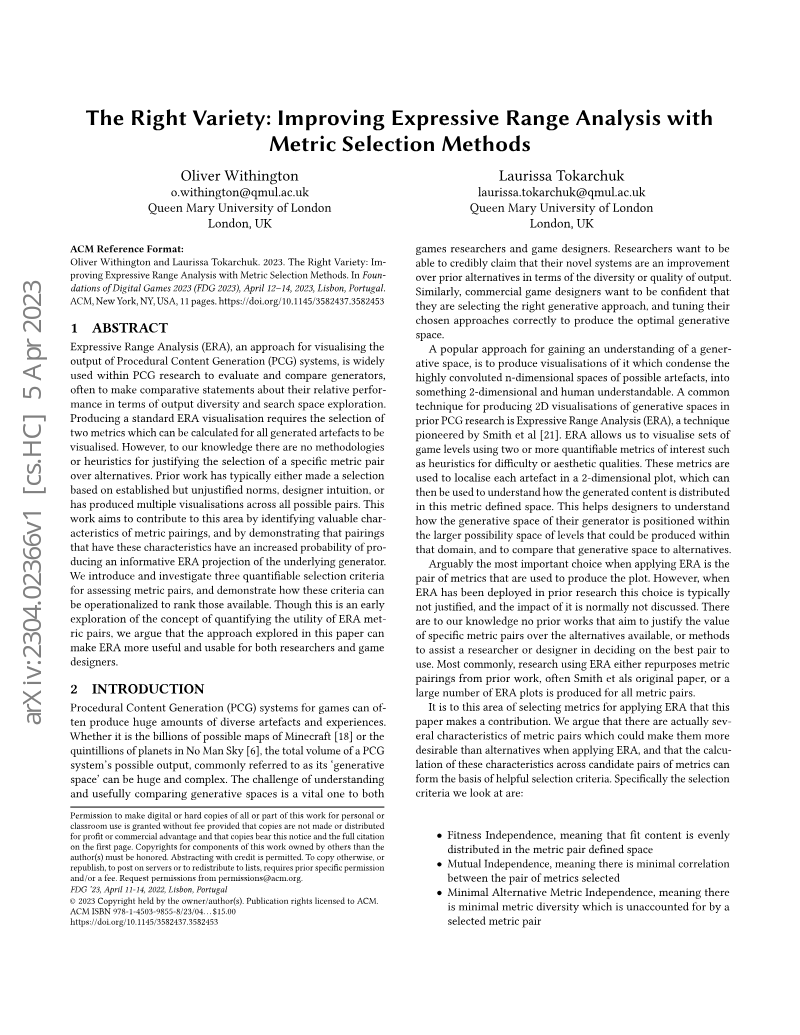
The paper by Oliver Withington and Laurissa Tokarchuk of Queen Mary University of London, published at the Foundations of Digital Games 2023 conference, addresses how metric pairs are chosen for Expressive Range Analysis (ERA), a 2D visualisation of procedural content generation (PCG) output.
- The authors argue that ERA metric pairs have typically been chosen from established norms, designer intuition, or by plotting all pairs, with little justification for the choice.
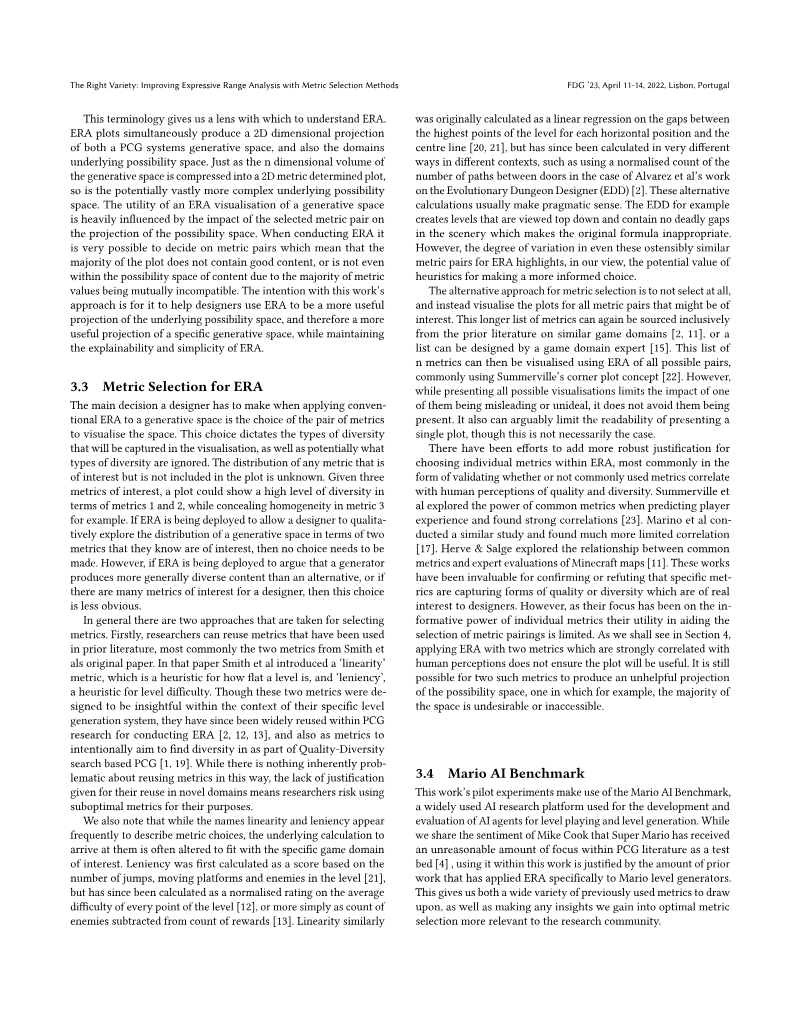
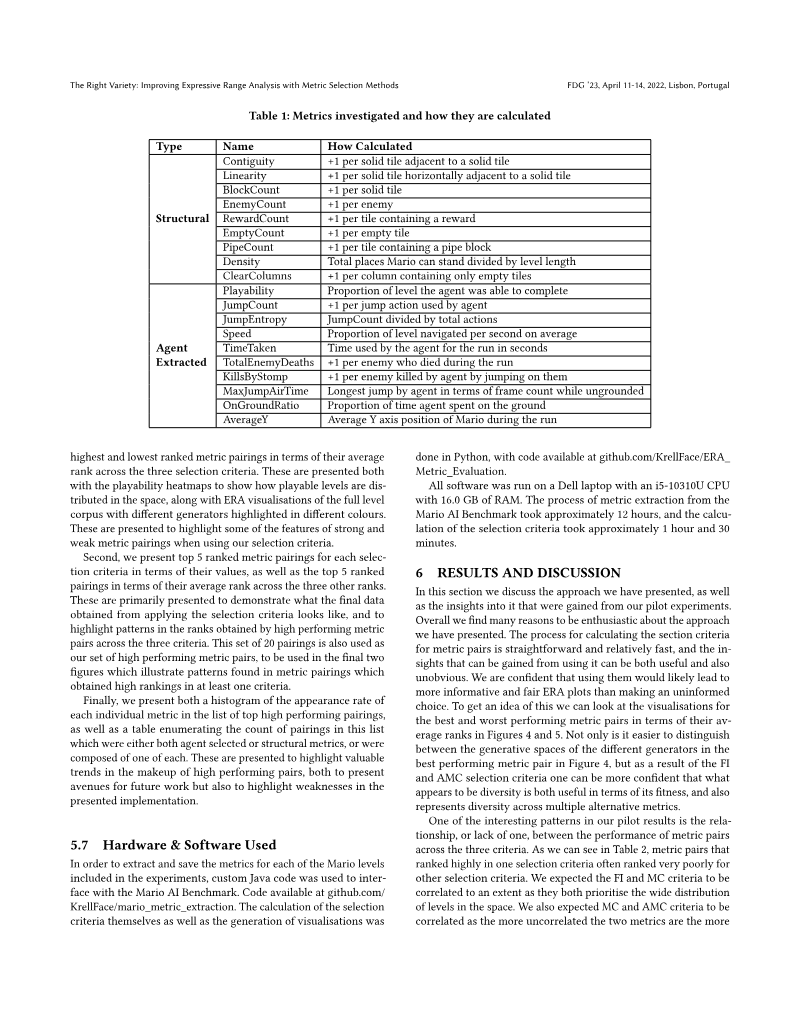
- The pilot experiment evaluated 153 unique metric pairs drawn from 18 metrics calculated for 9,015 Mario levels.
- Metric pairs ranking highly on one selection criterion often ranked very poorly on others, according to the authors' results.


Digital Games' Impact in Denmark
Digital games are a broad part of everyday life in Denmark, and a 2023 study by Seismonaut for Producentforeningen, supported by the Danish Film Institute's games scheme, is the first to examine what they mean to people.
- Digital gaming is a mainstream activity in Denmark, with 79% of the population having played a game in the past year.
- Engagement is high across all age groups, ranging from 62% of those aged 55–79 to 74% of those aged 16–24 playing on a weekly basis.
- Puzzle games are the most popular genre, preferred by 65% of respondents and yielding the highest relaxation scores among all game types.
Australian Game Development Survey FY2023 Industry Snapshot
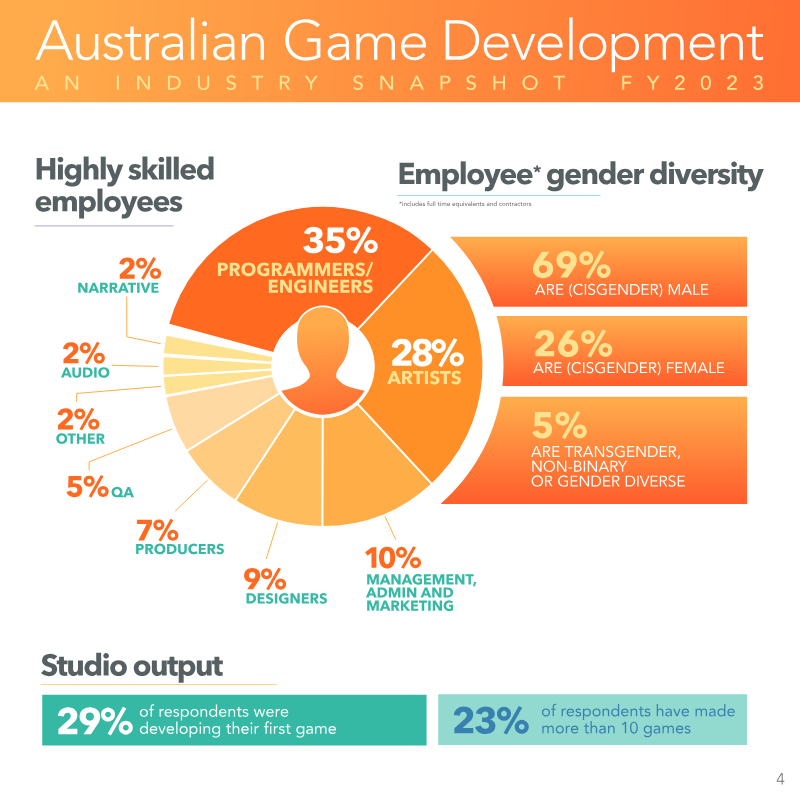
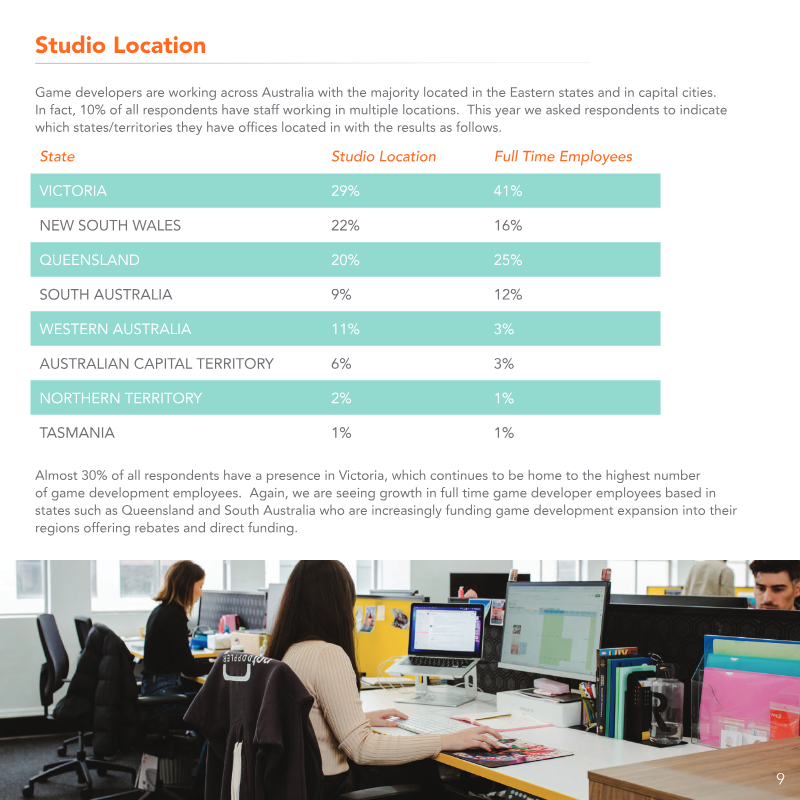
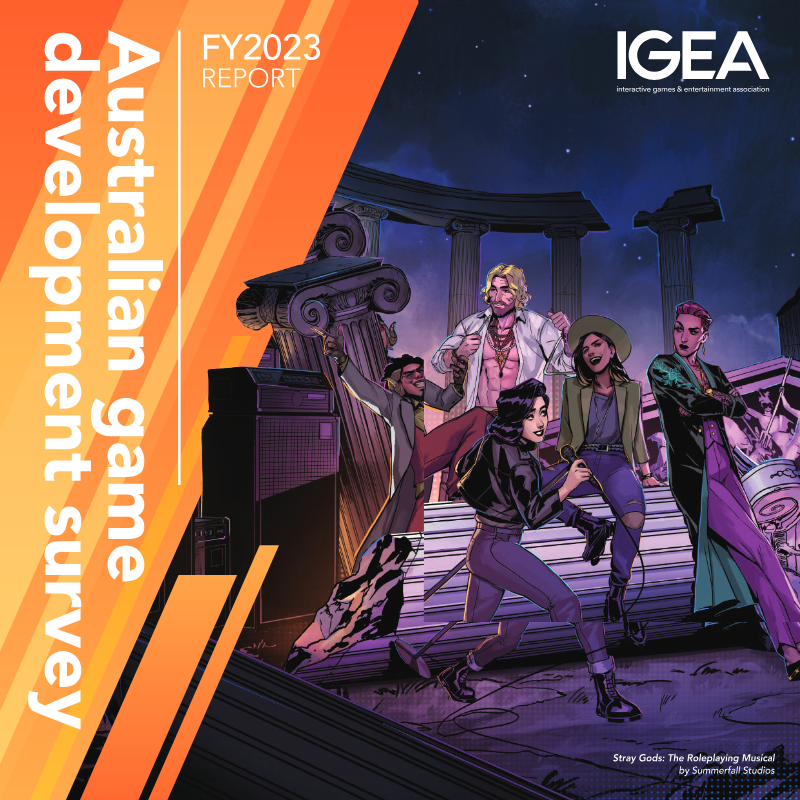
The Australian Game Development Survey FY2023 Industry Snapshot, produced by IGEA in its seventh annual edition, measures the size, employment and health of the Australian game development sector for the financial year from 1 July 2022 to 30 June 2023.
- The Australian game development industry generated $345.5 million in revenue during FY2023, representing a 21% year-over-year increase.
- The workforce grew by 17% to 2,458 full-time equivalent employees, with 63% of studios planning further hiring in the coming year.
- The sector is highly export-dependent, with 87% of total revenue derived from international markets.
Digital Games, Image-Consciousness and Superreality
Daniel O'Shiel's article in the Journal of the Philosophy of Games (published online 31 December 2022) argues that digital games are best understood as a form of image-consciousness (Bildbewusstsein), rather than as perception or phantasy.
- The author argues that experiences of digital games are not straightforward perceptions, because one always implicitly knows that the game is not real and that one can respawn after dying.
- Following Husserl, the article describes image-consciousness as having three components: the physical image, the image object, and the image subject.
- The author argues that Fink treats image-consciousness as a unity of two components, consciousness of the real carrier and of the image world, rather than three.