Digital Games
Company
Documents about Digital Games
Technology Tells a Tale: Digital Games and Narrative
"Technology Tells a Tale: Digital Games and Narrative" examines how digital games redefine and transform traditional notions of storytelling, rather than simply being narratives themselves.
- Digital games are not narratives in themselves; the digital medium is reshaping how culture understands what a story is.
- The paper frames the long-running debate between narratologists (applying literary and film theory to games) and ludologists such as Aarseth, Frasca, and Eskelinen (prioritizing play and interactivity).
- The author identifies five recurring characteristics of computing as the basis for how games produce meaning: procedurality, participation, quantifiability, modularity, and finiteness.

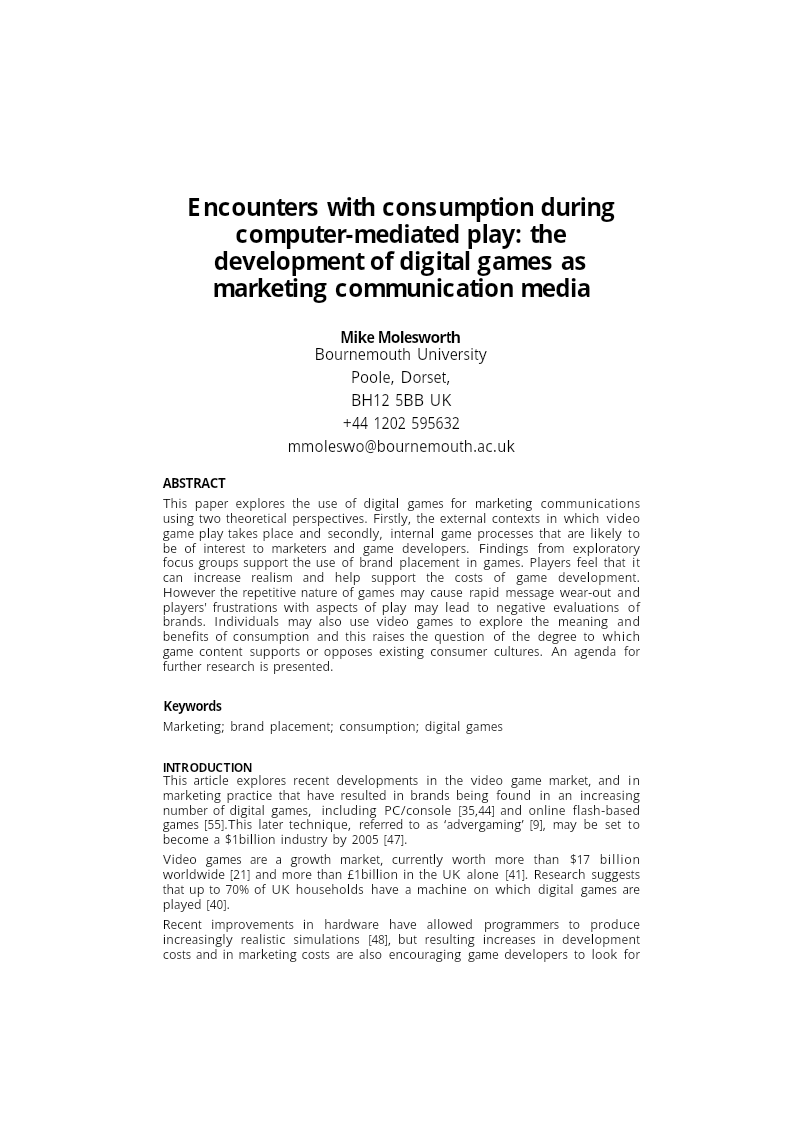
Encounters With Consumption During Computer-Mediated Play: The Development of Digital Games as Marketing Communication Media
This analysis examines the evolving role of digital games as a marketing communication medium, focusing on how brand integration within game environments influences player perception and consumer behavior.
- Exploratory focus groups with 24 experienced video game players across four sessions found that players generally view in-game brand placement as a source of realism and as a way to fund lower-priced games.
- Players also voiced concern that brand placement can be invasive and that advertising revenue could distort game design.
- Brand placement is presented as potentially effective: it can strengthen brand recall, and players may show shifts in attitude or purchase intention.

Tiny Patches of Peace: Signs of Agency in Digital Games
Cindy Poremba's study examines how player-created modifications function as a form of authorship in digital games, with particular attention to peace-themed works produced after September 11, 2001.
- Player-created modifications are framed as an independent form of authorship that both expresses and reinforces the player's legitimacy as an author, with the study focusing on peace-themed mods made after September 11, 2001.
- Cindy Poremba's analysis centers on two cases: the anti-war Counter-Strike modification "Velvet-Strike" and the anti-war posters "Tiny Signs of Hope" created for The Sims.
- Velvet-Strike adopts a "gamer" persona to gain credibility within the combative first-person shooter community while aiming its message at an outside audience of artists and activists.

Women Just Want to Have Fun: A Study of Adult Female Players of Digital Games
This study examines adult female digital game players, challenging the prevailing notion of gaming as a male-dominated activity.
- Social networks, rather than individual initiative alone, are the main force shaping how adult women first enter digital gaming and how they keep playing, with early exposure through brothers, fathers, or friends and access to shared or borrowed consoles as the principal routes in.
- Despite Sony's marketing and redesign claims of gender neutrality, female ownership of the PlayStation 2 reached only 6.7 percent of registered PAL-territory owners, compared with 11.1 percent in Japan.
- The study attributes the PlayStation 2's limited female uptake to a continued focus on hardcore male gamers, price sensitivity among women, and manufacturers' reliance on registered-user data that cannot capture people playing on borrowed hardware.

Enhancing Gameplay: Challenges for Artificial Intelligence in Digital Games
The document, "Enhancing Gameplay: Challenges for Artificial Intelligence in Digital Games," posits that significant advancements in computing power and increased AI expertise offer an unprecedented opportunity for transformative innovation in digital game AI.
- The paper argues that rapid growth in computing power gives game designers a timely opportunity to pursue radical AI advances rather than incremental refinements, and that AI innovation is essential to avoid industry stagnation and establish games as a serious artistic medium.
- Current titles still rely largely on established techniques such as finite-state machines, A pathfinding, and scripting, with designers prioritizing the appearance of intelligence over realistic behavioral models.
- The paper identifies three priority areas for innovation: storytelling (especially player-driven narratives in MMORPGs), dynamic online learning (illustrated by the rare example of Black & White), and emotional expression, where real-time character animation lags well behind pre-rendered film.

Delightful Identification & Persuasion: Towards an Analytical and Applied Rhetoric of Digital Games
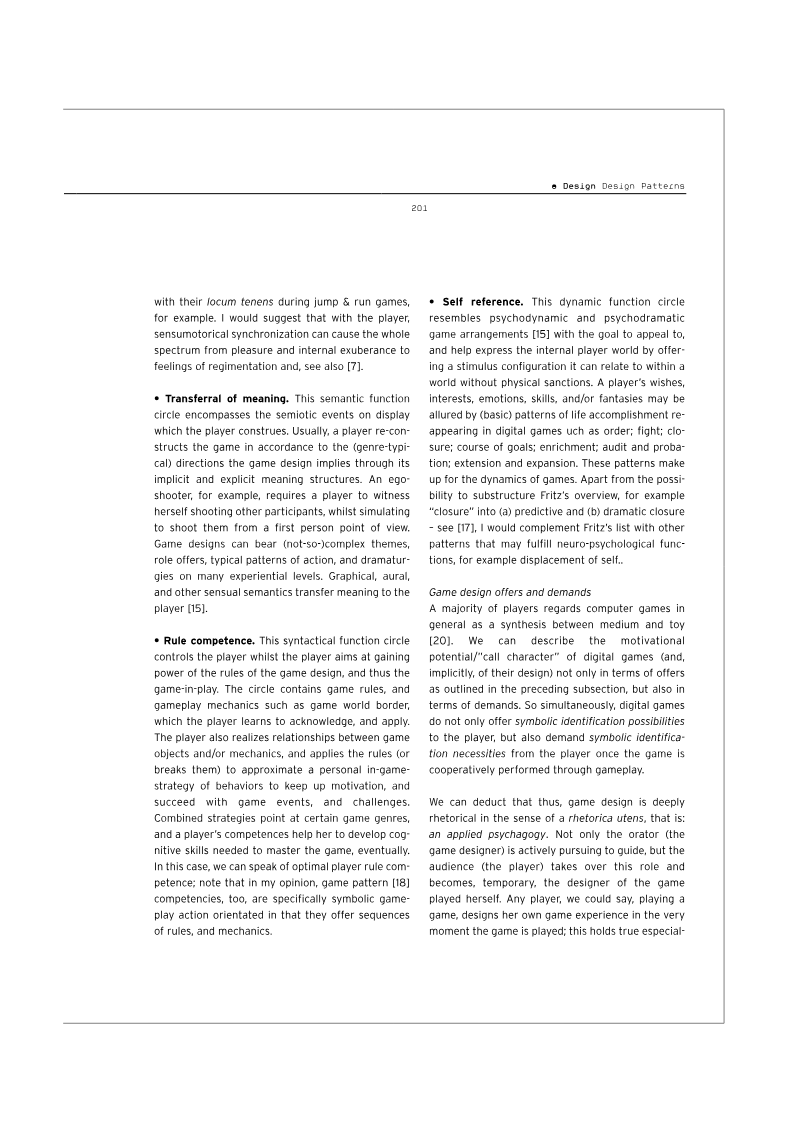
This document develops a theoretical rhetoric of digital games, arguing that gameplay constitutes a symbolic performance among designer, game, and player in which players are persuaded and come to identify with a game's design.
- Gameplay is framed as a symbolic performance among designer, game, and player, in which players are persuaded and come to identify with a game's design, drawing on Aristotle's rhetorical triad and Burke's concept of identification.
- Persuasion in games becomes visible through behavioral change: the shift from not playing to playing, and from playing to continuing.
- The model rests on three couplings between designer and player: systemic (an experiential "eigenworld" of reciprocal control, mastery, and empowerment), symbolic (performance loops grounded in identification), and structural (aligning the game's motivational offers and demands with player expectations).
Representing Users in the Design of Digital Games
The document examines the strategies for representing users in digital game design, contrasting the traditional "supplier-driven" artistic approach with a "consumer-driven" model emphasizing user research.
- Digital game designers typically represent their users implicitly rather than through direct engagement, and this tacit approach, often shaped by designers' own tastes, can embed gender bias into game design.
- The study's Irish interviews covered digital game companies that were almost entirely male and targeted young men aged roughly 15 to 40, with industry factors such as risk-averse publishers, console manufacturers, and skilled-labour shortages shaping game types and design priorities.
- In the central case study of the fictional online multiplayer strategy game from games.inc, launched in Germany in December 2001 with about 1,000 subscribers, designers projected their own preferences as technologically literate male gamers aged 25 to 40 instead of conducting formal user research.
Australian Game Development Survey 2024
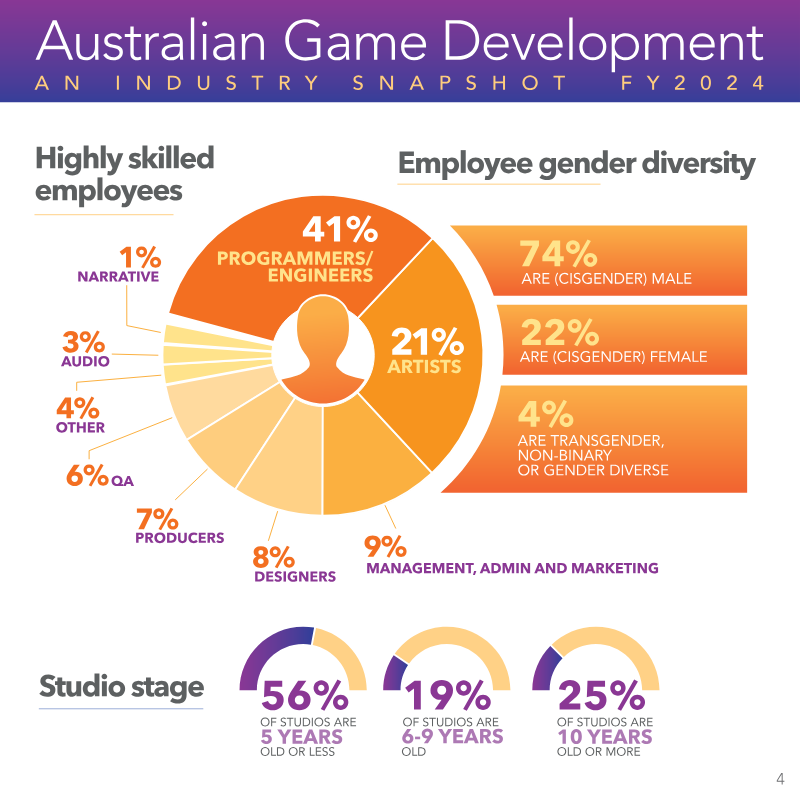
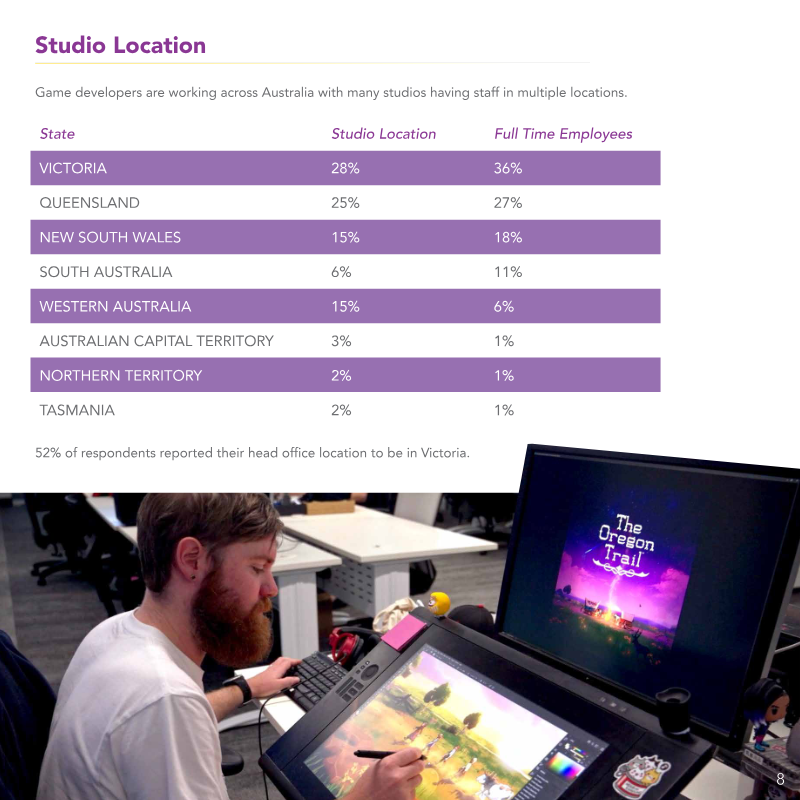
The Australian Game Development Survey 2024 provides an annual snapshot of the Australian game development industry, detailing its size, scope, health, and key trends for the financial year 2024.
- Australian game development revenue dipped 1.9% to $339.1 million in FY2024 (1 July 2023 to 30 June 2024), while employment held roughly steady at 2,465 people, signalling stability amid global headwinds.
- The sector is heavily export-oriented, with 93% of revenue generated outside Australia.
- Eighty-five percent of studios develop their own intellectual property, pointing to a sector with strong original content capability.



2019 Year in Review: Digital Games and Interactive Media
The 2019 Year in Review by SuperData, a Nielsen company, provides a comprehensive analysis of the global digital games and interactive media market, highlighting key revenue trends, audience shifts, and technological advancements.
- Digital games revenue reached $109.4 billion in 2019, up 3% year over year, while the broader interactive media sector grew about 4%.
- Free-to-play titles drove growth, accounting for roughly 80% of digital games revenue, with mobile contributing $64.4 billion, about three-fifths of total spending.
- Premium game revenue fell 5% to $18.9 billion, reflecting a year with fewer blockbuster releases than 2018.

Ireland's Video Games Opportunity
Ireland has an opening to strengthen its position as a high-value European hub for game development, gametech, publishing and live operations, but capturing a larger share of global growth depends on resolving constraints around talent, scale, finance and visibility through a coordinated national approach.
- Ireland has a significant opportunity to become a high-value European hub for game development, gametech, publishing, and live operations, leveraging its existing strengths in technology and creative industries.
- The Irish games sector is an integrated value chain, with firms participating across development, gametech, QA/testing/localisation, publishing, distribution/promotion, post-launch operations, monetisation, and player engagement.
- Key players active in Ireland include Black Shamrock, Larian Studios (game development), Havok, Unity Technologies (gametech), Keywords Studios, Electronic Arts Galway (QA/testing/localisation), 2K Games, Activision Publishing (publishing), and Riot Games (distribution/promotion, post-launch operations, player engagement).

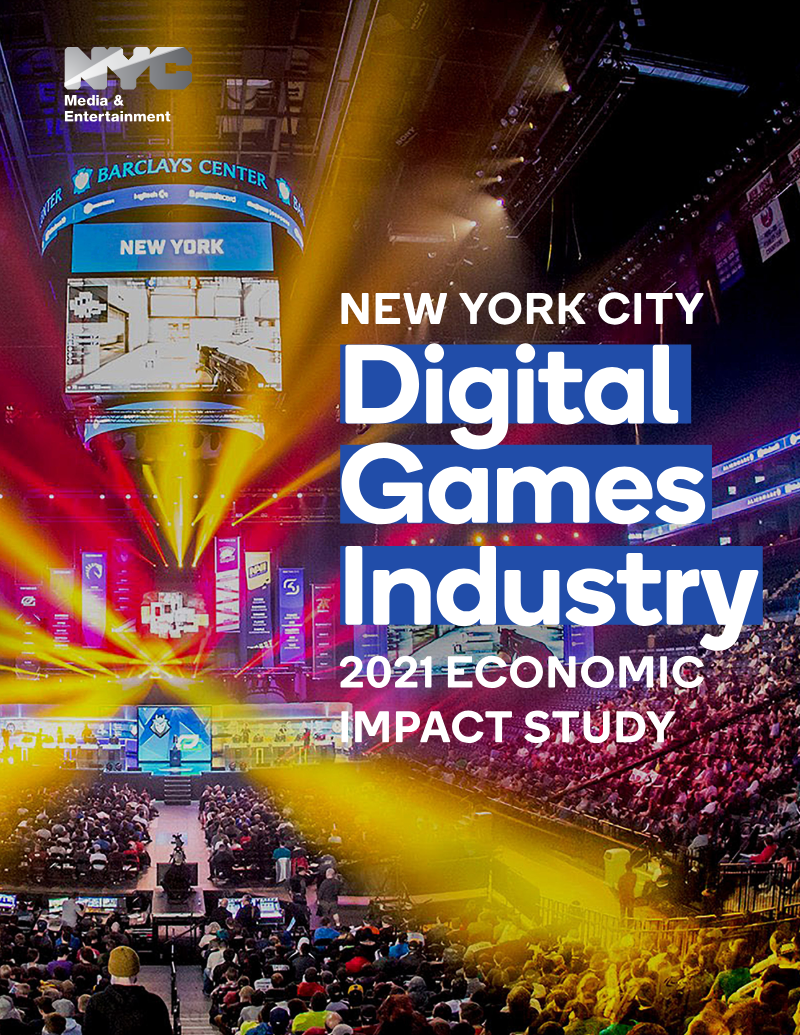
New York City Digital Games Industry: 2021 Economic Impact Study
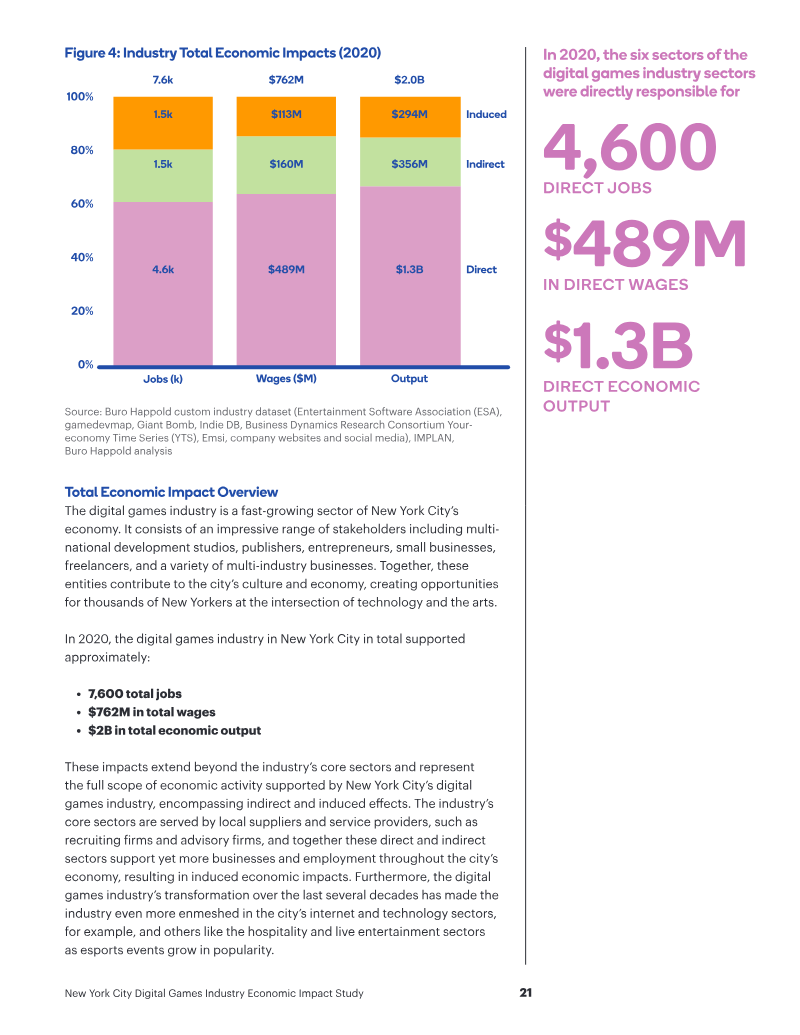
The "New York City Digital Games Industry: 2021 Economic Impact Study" comprehensively assesses the economic contributions and growth potential of New York City's digital games sector in 2020.
- New York City’s digital games industry generated $2 billion in total economic output and supported 7,600 direct jobs as of 2020.
- The sector has tripled in size since 2008 and is supported by an ecosystem of over 200 development and publishing studios.
- Venture capital investment in the industry reached $774 million in 2020, representing a 105% year-over-year increase.
Report of the German Games Industry: 2026
The "Report of the German Games Industry: 2026" provides a comprehensive overview of the German games market and industry, highlighting its significant growth, key revenue drivers, and persistent challenges, while also detailing efforts in cultural promotion, youth protection, and industry representation.
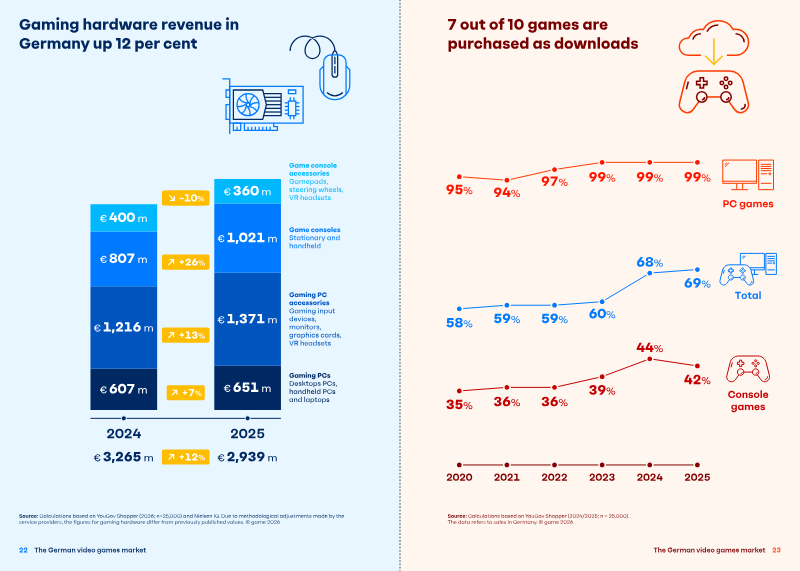
- The German video games market reached 9.4 billion euros in 2025, a four percent increase driven by a 12 percent surge in hardware sales and over one billion euros in online gaming service revenue.
- Domestic production remains low, with local companies capturing only 5.50 euros of every 100 euros spent in the German market.
- Federal funding for the industry is set to reach 125 million euros annually by 2026, supplemented by proposed tax incentives and infrastructure projects like the House of Games Berlin to boost competitiveness.