Digital Games
Company
Documents about Digital Games
Storytelling and Gameplay en Abyme in Firewatch
Alfonso Cuadrado Alvarado's article, published in Transactions of the Digital Games Research Association (November 2022, Vol. 6 No 1, pp. 123-146), analyses the 2016 walking simulator Firewatch by Campo Santo.
- The author argues that Firewatch's several plots do not form a narrative mosaic but explain, reinforce and clarify the main story of Henry's relationship with his wife.
- Delilah's storyline is described as a mirror of Henry, as both flee their pasts and withdraw into the solitude of watchtowers.
- The author argues that the game's ludonarrative relationship is a detachment rather than a contradiction, which is why the author does not classify it as dissonance.
Monster Theory and Game Studies: A Case Study for The Witcher 3: Wild Hunt
This Spanish-language paper by Rafel Guardiola Marí, published in Transactions of the Digital Games Research Association (November 2022, Vol. 6 No 1, pp.
- The author argues that The Witcher 3 constructs monstrosity through action rather than through being a monster, which the paper calls 'monstrosity in action'.
- In the Carnal Sins quest, the paper identifies the killer as Hubert Rejk, a high vampire, and locates the monstrosity in his human conduct rather than his vampiric condition.
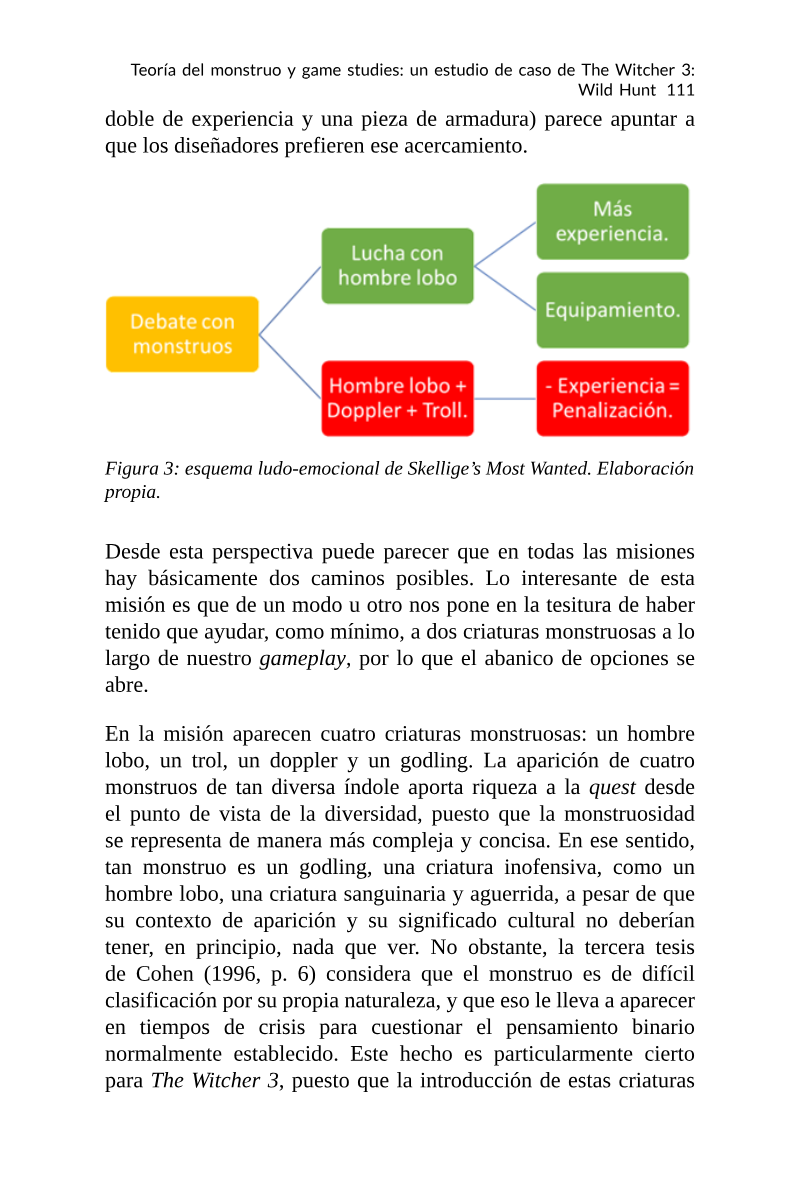
- The paper reports that in Skellige's Most Wanted, the diplomatic route yields a double amount of experience and a piece of armour compared with combat.
The Musical Supradiegesis in JRPG Combat Systems
This Spanish-language article by Alberto Porta-Pérez, published in the Transactions of the Digital Games Research Association (November 2022, Vol. 6 No 1, pp.
- The article's Kingdom Hearts analysis states that the game includes a normal battle track for each location, which the author links to locating the player in space and a distinct atmosphere per location.
- In Persona 5 Royal, the article says Last Surprise is heard when the Phantom Thieves are ambushed, while Take Over is heard when the avatar catches the enemy off guard.
- The author describes the Persona 5 Royal track Take Over as a non-guaranteed pre-victory theme that conveys dynamism and a sense of control over the battlefield.
The “Room” in Text Adventure Games and Analysis of Real Geographical Locations in Aventuras AD Games
The Digital Games Research Association's November 2022 journal article by Juan José Muñoz Falcó and Raúl Montoliu Colás examines the concept of the "room" (location) in text adventure games and the geography of seven games produced by Aventuras AD, a Spanish company based in Valencia that operated from 1988 to 1992 and was…
- Aventuras AD produced seven games selected as case studies, with the company described as the only Spanish video game developer dedicated exclusively to text adventures.
- The authors report that in Jabato the Doric capitals of the Pantheon's columns are shown, whereas the real Pantheon has Corinthian capitals, which they attribute to low graphic resolution.
- The authors state that the Colosseum is located southeast of the Pantheon, while in the game the player moves north and then west to reach it.
Investigating Social Media Potential for Supporting Teachers' Digital Games Literacy
The study "Investigating Social Media Potential for Supporting Teachers' Digital Games Literacy" examines the extent to which social media platforms like YouTube, Twitch, and Twitter provide resources that align with the Game Literacy for Teacher Education (GLTE) framework.
- Teachers have largely built their digital game literacy informally and independently, because formal professional development in this area is scarce.
- The study analysed 150 multimedia resources from 2021 and 2022 on YouTube, Twitch, and Twitter, gathered via multilingual search terms and qualitative coding with input from 30 stakeholder groups, mainly in the US, UK, Sweden, and Germany.
- The resources were organised into eight topic categories, with Design for digital game-based learning (instructional design) the most prevalent, followed by Game Use.
Digital Games in Schools: A Qualitative Study on Teacher's Beliefs
This qualitative study investigates Swiss primary and secondary school teachers' perceptions and beliefs regarding the integration of digital games into the classroom, aiming to inform the development of a new transversal games curriculum.
- Swiss youth play games frequently, with 34 percent reporting playing several times a week according to the 2020 JAMES study, yet games remain marginal in Swiss classrooms.
- The study examines teachers' beliefs through interviews with five teachers, whose initial views of games ranged from educational tools and rewards to time-wasters or inappropriate content for school.
- Teachers recognized benefits of games for motivation, individualized learning, and social skills, but their willingness to use them was conditional on games being simple, thematically relevant, low-effort, and carefully vetted.
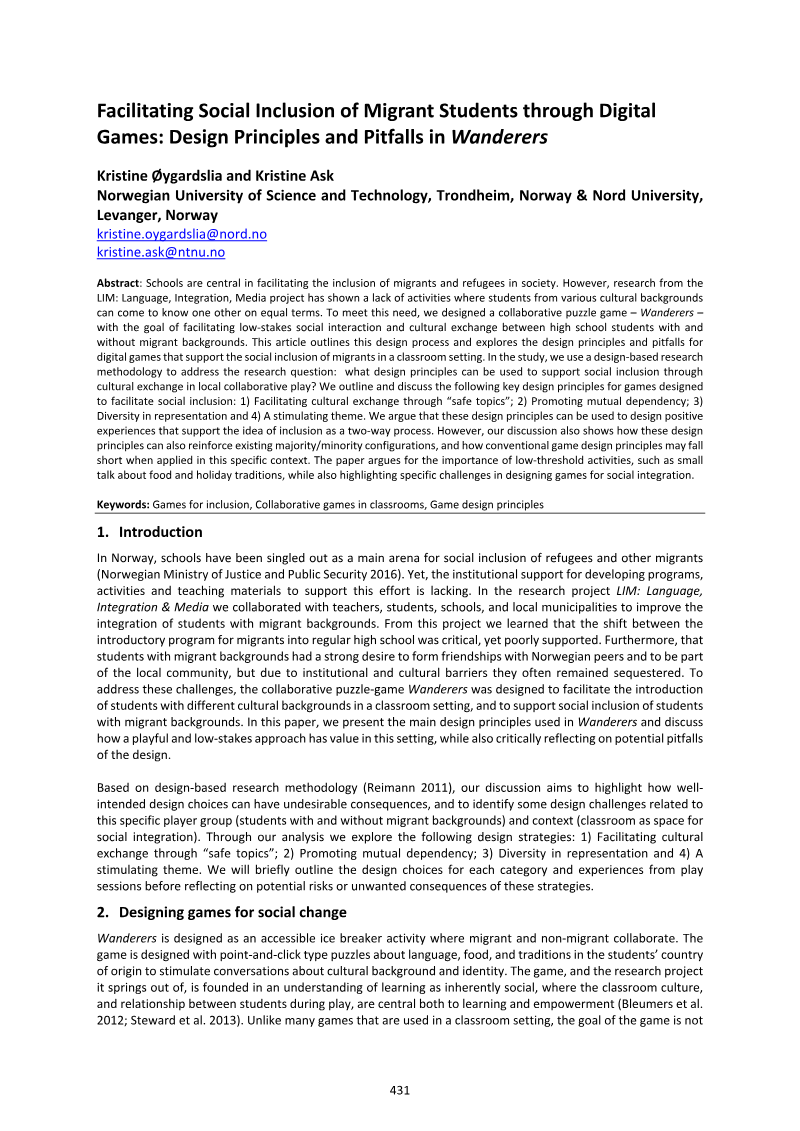
Facilitating Social Inclusion of Migrant Students through Digital Games: Design Principles and Pitfalls in Wanderers
This document explores the design principles and potential pitfalls of digital games aimed at fostering social inclusion and cultural exchange among high school students with and without migrant backgrounds in Norway.
- A central finding is that well-intended design choices produced problematic outcomes: "safe topics" can displace harder conversations about migration, trauma, and racism, and may partly shield designers and teachers from uncomfortable realities.
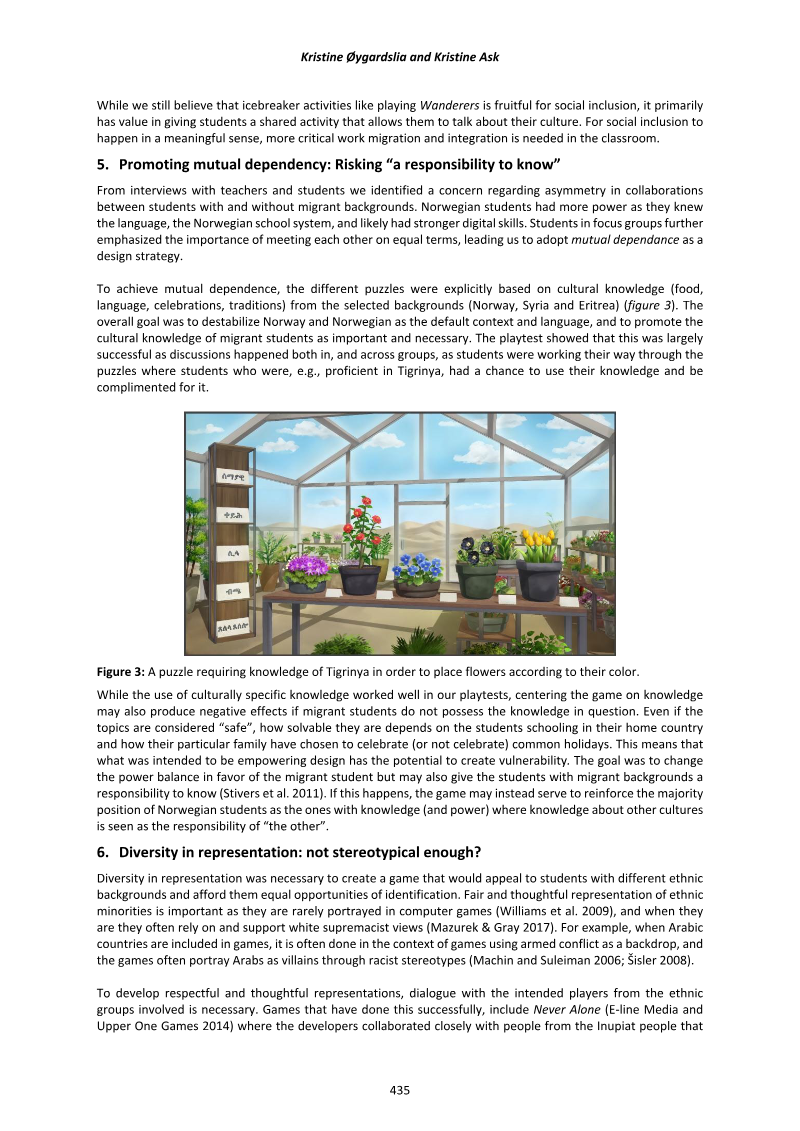
- Culturally specific puzzles were empowering in playtests but risked placing a "responsibility to know" on migrant students whose schooling and family traditions varied.
- Efforts at representation created tension between authenticity and stereotyping, and an extensive narrative proved less accessible to students still learning Norwegian.
Players' Reflections on Digital Games as a Medium for Education: Results from a Qualitative Study
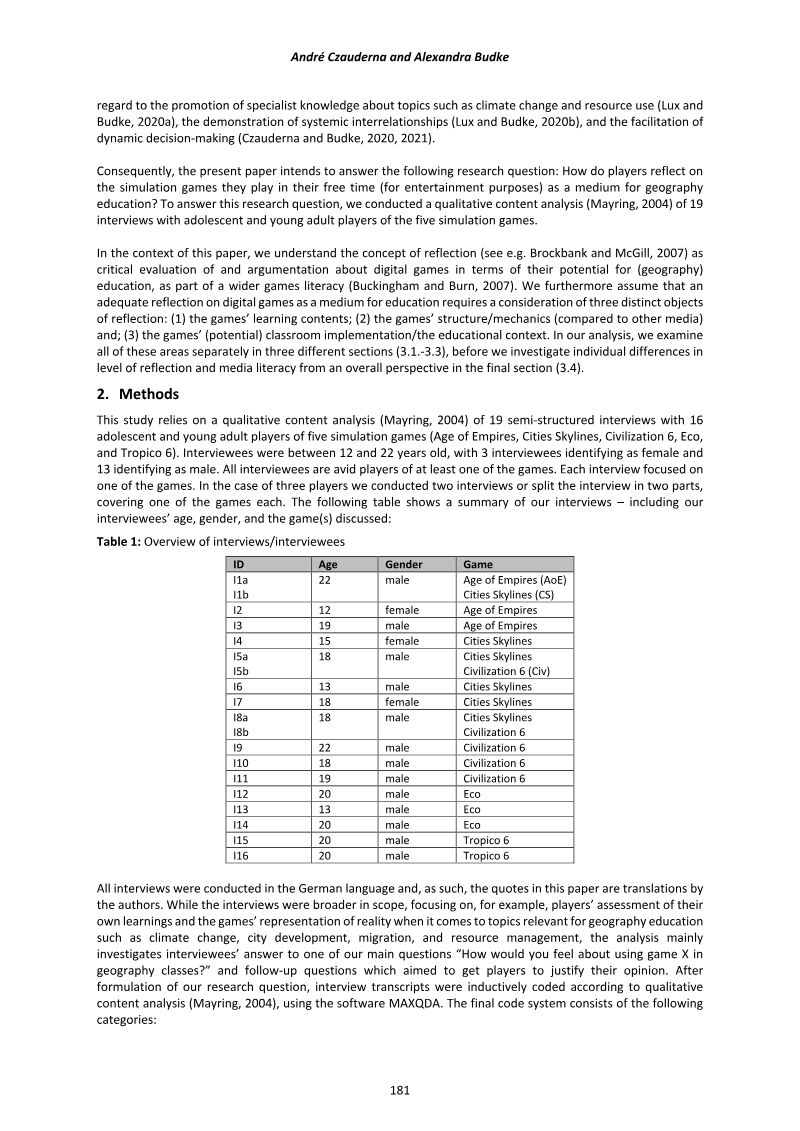
This qualitative study investigates adolescent and young adult players' perceptions of digital entertainment games as a medium for geography education.
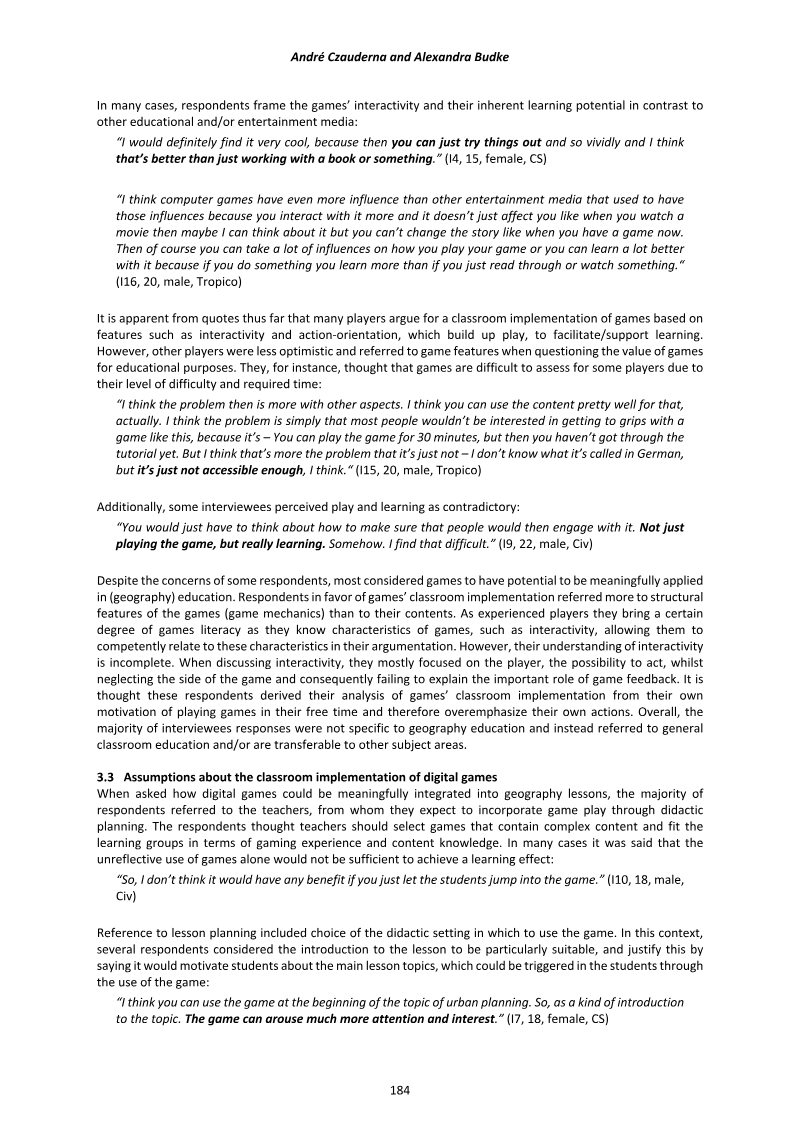
- The study draws on 19 interviews with adolescent and young adult players of five digital simulation games, sorting their attitudes toward games as a geography education medium into dismissive, enthusiastic, and mixed groups.
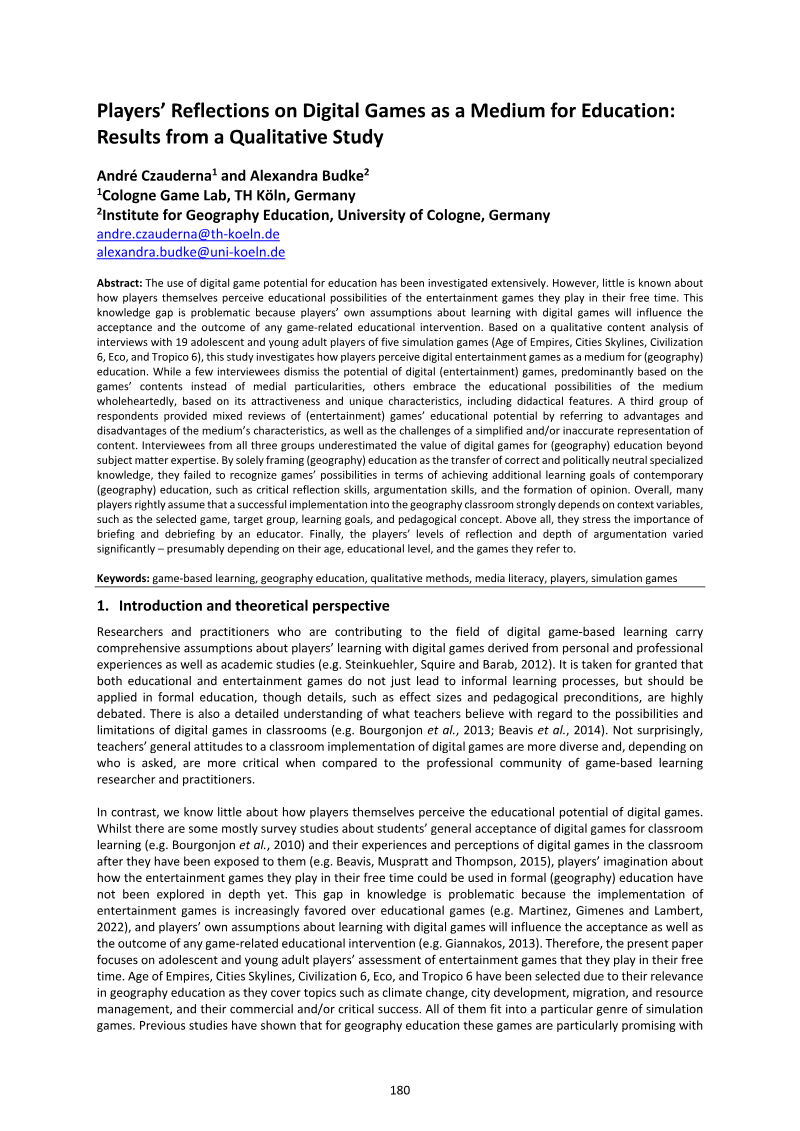
- Dismissal of games as educational tools typically rests on game content, while enthusiasm centers on engagement, interactivity, and the chance to explore systems, with players seeing games as more action-oriented than books or film.
- Players view games' educational value skeptically due to accessibility barriers, time demands, and a perceived tension between play and learning.
Generative Personas That Behave and Experience Like Humans
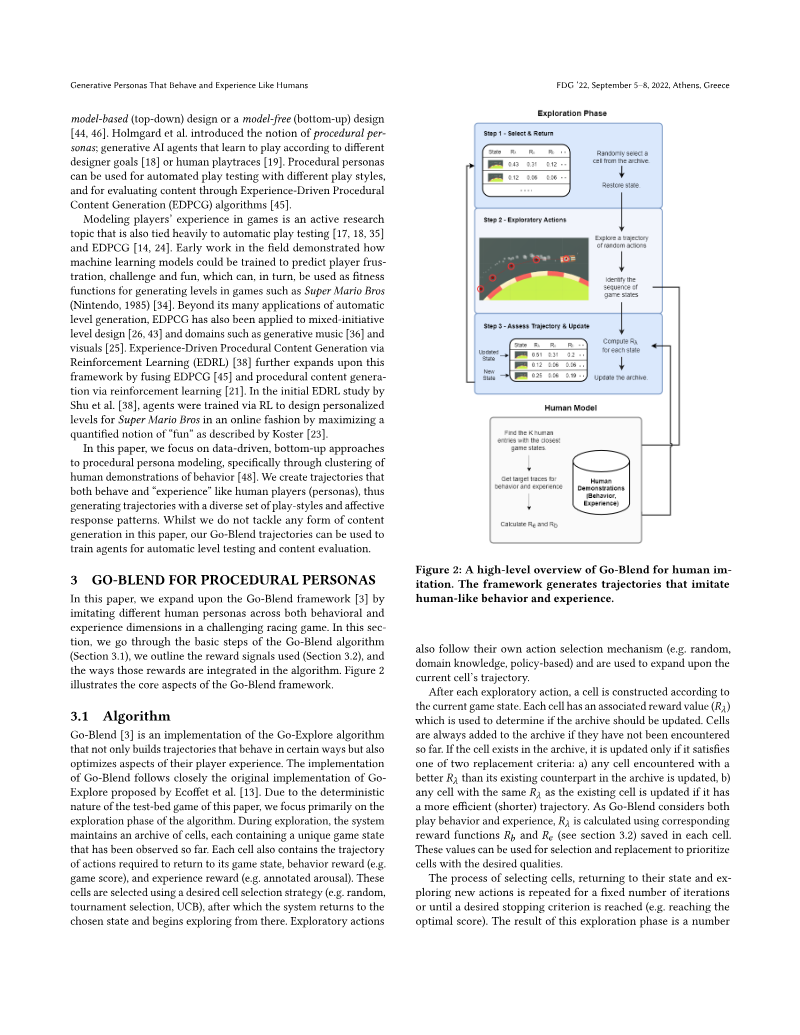
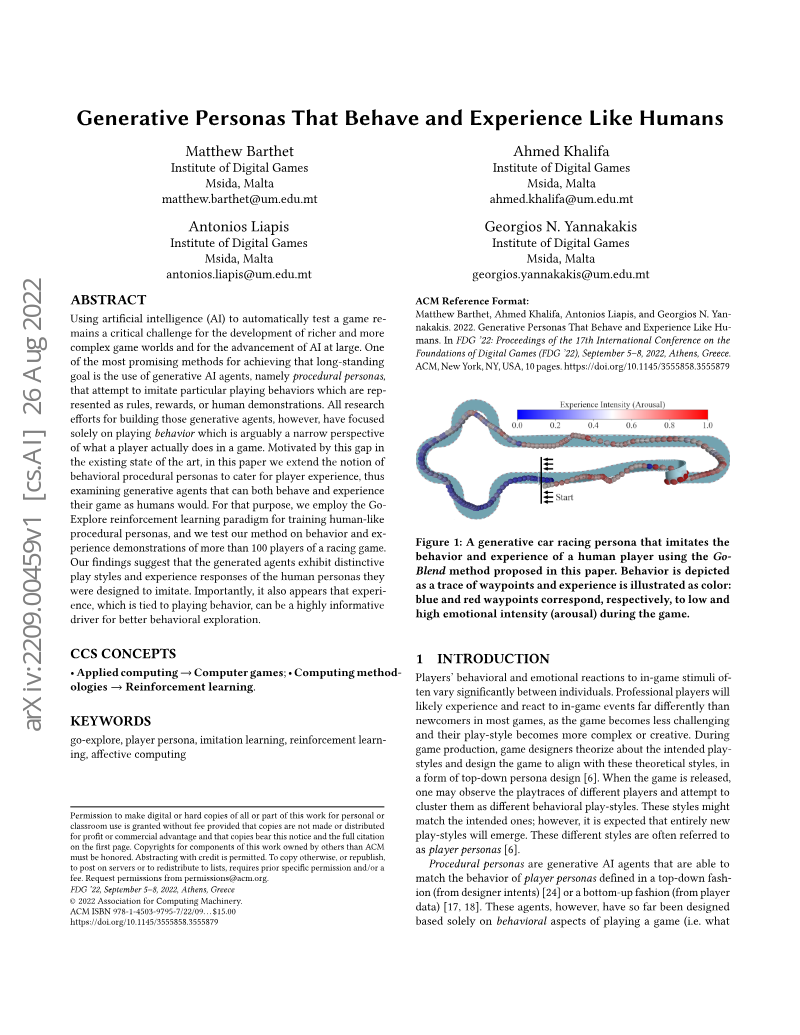
The paper, by Matthew Barthet, Ahmed Khalifa, Antonios Liapis and Georgios N. Yannakakis of the Institute of Digital Games in Msida, Malta, presents a method for training generative procedural personas that imitate both the playing behavior and the experience of human players.
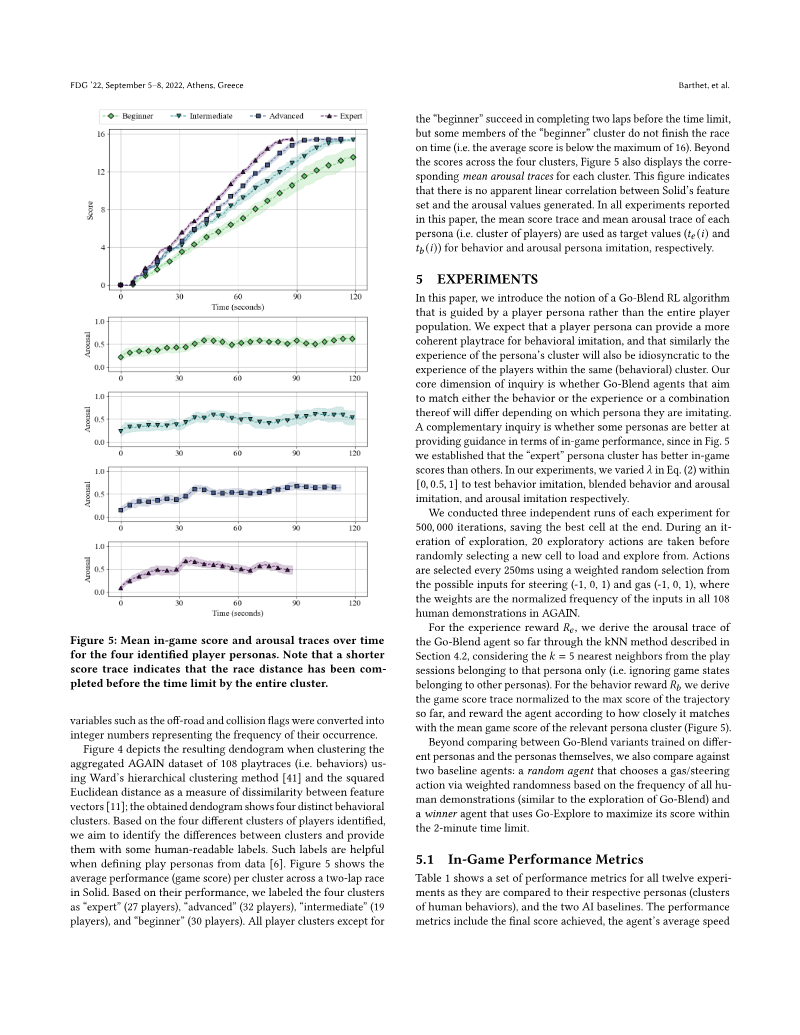
- The authors clustered 108 human play sessions into four player personas, labeled expert (27 players), advanced (32), intermediate (19) and beginner (30).
- Agents trained with λ values of 0.0 and 0.5 produced lap times and average speeds similar to their target personas.
- Agents trained only on arousal (weight 1.0) generally failed to match their persona's behavior, but the expert-persona agent behaved similarly to the expert persona.
The Effectiveness of Adaptive Digital Games for Learning: Calling for a Broader View on Assessment
The primary purpose of this analysis is to address the lack of standardized, comprehensive assessment methods for digital games used in educational settings.
- Adaptive digital games significantly improve learning efficiency, allowing students to achieve educational goals in less time compared to nonadaptive versions.
- Adaptive game features do not necessarily produce superior cognitive gains or better knowledge transfer compared to nonadaptive versions.
- The efficiency benefits of adaptive game design are not uniform, as the impact varies significantly based on a learner's prior knowledge.
Why Do You Play Dungeons & Dragons [D&D]?: Investigating Motivations for Play in Non-Digital Games
This DiGRA 2022 presentation abstract examines why people play Dungeons & Dragons today, arguing that creativity is a key motivator that existing play-motivation models tend to overlook or minimise.
- The study argues that creativity is a key motivator for contemporary Dungeons & Dragons play, a dimension that existing player-motivation frameworks such as Nick Yee's model of online game motivations tend to overlook or minimise.
- Creativity was mentioned by roughly 70% of interview and observation participants (20 people), 71% of focus group participants (14 people), and 34.5% of the 354 survey respondents aged 18 to 63.
- Participants frequently contrasted D&D's creative freedom and flexible ruleset with the predetermined rules and systems of digital games.
Playing for Keeps: Digital Games to Preserve Indigenous Languages & Traditions
The document examines the potential of digital games as a mechanism for preserving and revitalizing Indigenous languages and traditions, advocating for a co-design model rooted in Indigenous sovereignty.
- Digital games are valuable for Indigenous language preservation only when Indigenous communities lead their design, control how their cultural material is represented, and consent to its sharing.
- Urgency is high: Scots Gaelic faces a risk of disappearing within a decade, and most remaining speakers of many languages are elderly.
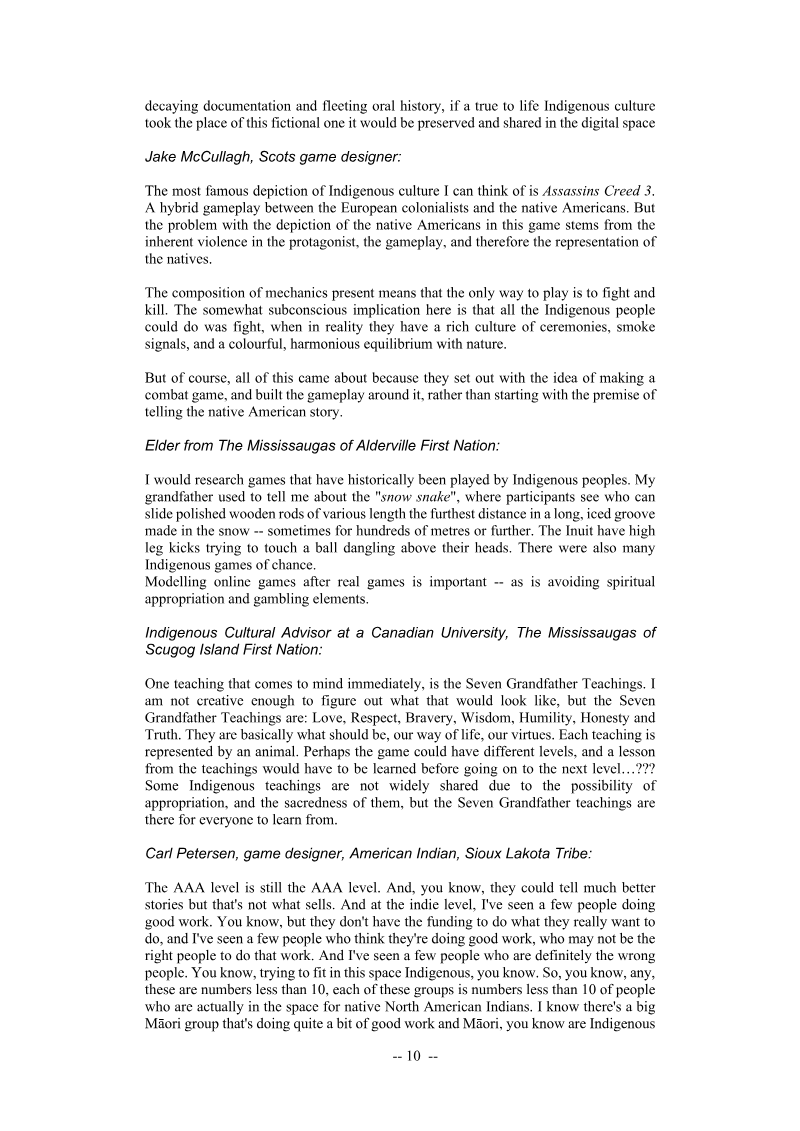
- Poorly researched or outsider-led depictions can cause real harm, with cited examples including the misuse of Moko Kauae in The Mark of Kri and combat-centred portrayals in Assassin's Creed III.