Digital Games
Company
Documents about Digital Games

Post-Digital Games: The Influence of Nostalgia in Indie Games' Graphic Regimes
Frank Bosman argues that Ubisoft's Assassin's Creed series reinterprets Christian mythology through a rationalistic-reductionist lens, recasting biblical miracles and events as effects of advanced technological artifacts, the "Pieces of Eden," left by an extinct First Civilization, the Isu.
- The article analyzes how the Assassin's Creed series reinterprets Christian mythology through a rationalistic-reductionist lens, treating the games as "playable texts" and applying cultural theology and reception-history methods rather than commercial or industry analysis.
- The franchise recasts miracles and sacred relics as products of an extinct advanced civilization, the Isu, within an "Ancient Astronauts" meta-narrative in which Templars and Assassins contend over Pieces of Eden.
- The series inverts Genesis by reading Adam and Eve's expulsion as liberation and locating the origins of the Templar-Assassin conflict in Cain, drawing on Gnostic traditions such as Marcionism.

Post-Digital Games: The Influence of Nostalgia in Indie Games' Graphic Regimes
Thibault argues that the growing indie reliance on pixelated, hand-drawn, and otherwise analogue-looking graphics reflects a post-digital shift, in which saturation with digital media prompts a nostalgic revival of older media and aesthetics.
- Mattia Thibault argues that indie games' turn toward retro, pixel, hand-drawn, and analogue aesthetics is a post-digital reaction against AAA photorealism, forming a heterogeneous alternative within digital game design rather than a simple replacement for it.
- Three forces drive the shift: budget and technological constraints that make photorealistic rendering unaffordable for small studios, nostalgia for the perceived Golden Age of gaming, and a wider cultural desire for experiences that slow down or enhance the passage of time.
- Drawing on non-photorealistic rendering research and Lauteren's application of Barthes and Caillois, the paper argues that stylized graphics can heighten believability and immersion rather than diminish them.
Twenty-Five Years of Digital Games Research in Poland
This paper provides a historical overview of digital games research in Poland over the past twenty-five years, beginning with the first known peer-reviewed publication in 1991.
- The history of Polish video game research is traced over roughly twenty-five years, beginning with what the authors identify as the first known peer-reviewed Polish paper on video games, published in 1991.
- The study takes a broad scope, covering all Polish research into video games rather than only work identifying with a delineated game studies field, and combines a sociohistorical account with analysis of publications including titles, keywords, and abstracts of journal articles.
- Key developments identified include early interest among media scholars in the 1990s, a hiatus in international contacts during the 2000s, institutionalization through the Games Research Association of Poland, and recent growth in research activity.

Realism and the Everyday in Digital Games
This paper refines Alexander Galloway's theory of social realism in digital games by emphasizing the critical role of representational modes and the concept of the everyday.
- Martin revises Alexander Galloway's theory of 'social realism' in digital games, arguing that realism's critical potential emerges only when the mode of representation, the everyday, and Lukács's concept of the social totality are considered together.
- The paper critiques Galloway's account for neglecting representation, conflating realism with critique in general, and relying on a 'congruence requirement' that ties the everyday life depicted in a game to players' own everyday experience.
- Drawing on Lukács's defence of literary realism and Yuri Lotman's view of everyday life as a boundary zone where personal habits collide with dominant codes, Martin frames realism as a means of linking individual lives to the totality of social relations.
Charismatic Leadership and Digital Games
Digital games have long cast players as commanders who act decisively on critical problems or managers who organise processes toward known ends.
- The paper argues that the media through which audiences encounter leadership shape how they understand it, rather than studying skills players gain from games.
- Its central thesis is that different media formats support different models of charismatic leadership, based on Max Weber's theory: early twentieth-century cinema centres the charismatic individual with little role for followers, while serialised comics, television and digital games give the inner circle a much larger part.
- Digital games, especially role-playing titles, let players occupy a leader whose authority rests on normative compliance, drawing on Etzioni's typology of coercive, calculative and normative compliance.
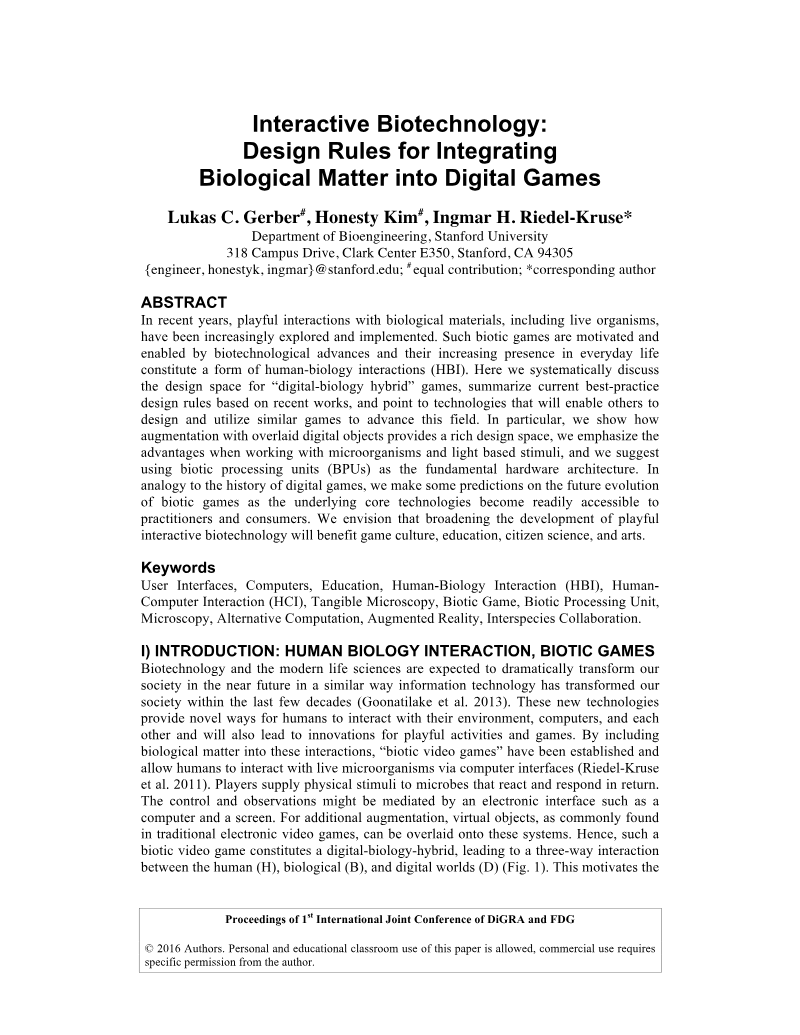
Interactive Biotechnology: Design Rules for Integrating Biological Matter into Digital Games
The document outlines the emerging field of "biotic games," which integrate live biological matter, primarily microorganisms, into digital game environments to create novel "digital-biology hybrid" interactions.
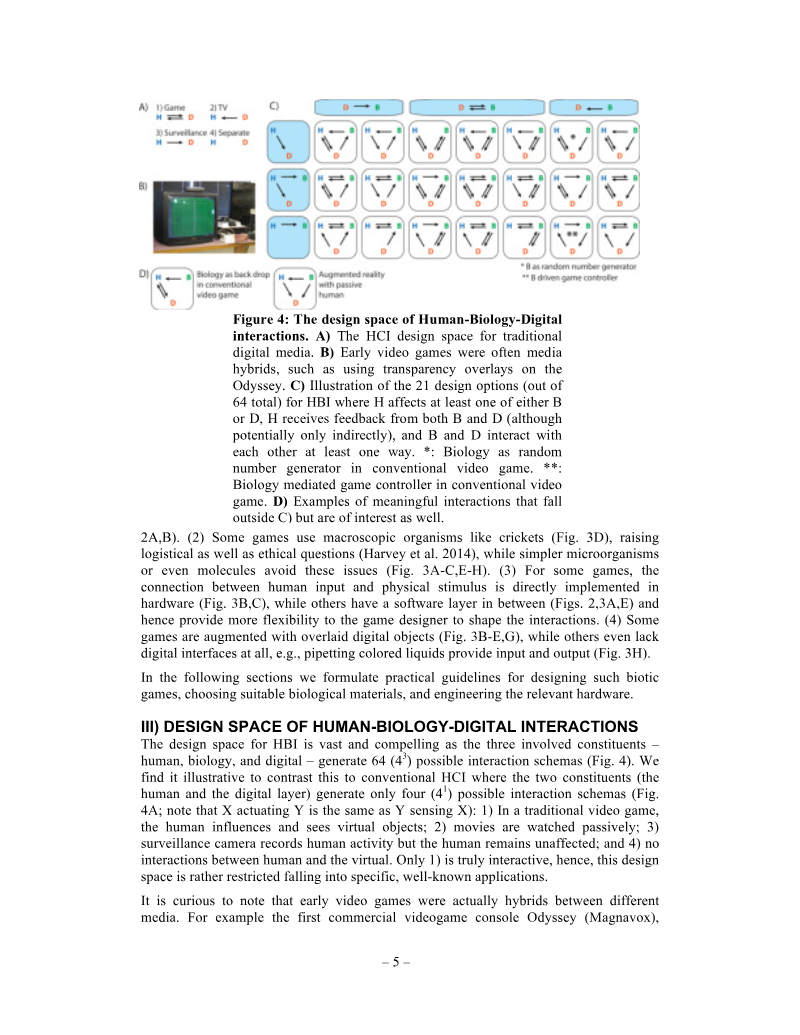
- The authors count 64 possible interaction schemas for integrating biology into games, compared with four for standard setups, and enumerate 21 arrangements of biology, digital systems, and human players.
- The report proposes the "biotic processing unit," treating biological components as abstracted hardware analogous to a GPU or physics engine.
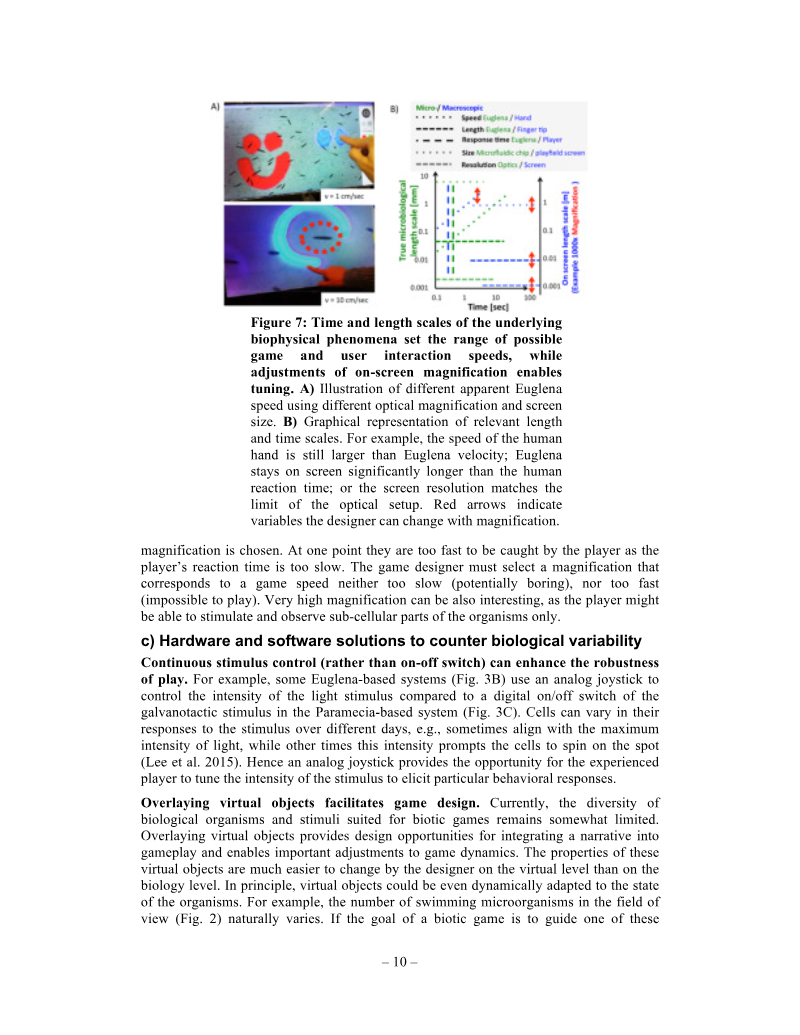
- Design rules address the mismatch between biological and human time scales, using on-screen magnification, analog controls, and virtual overlays that compensate for biological variability.
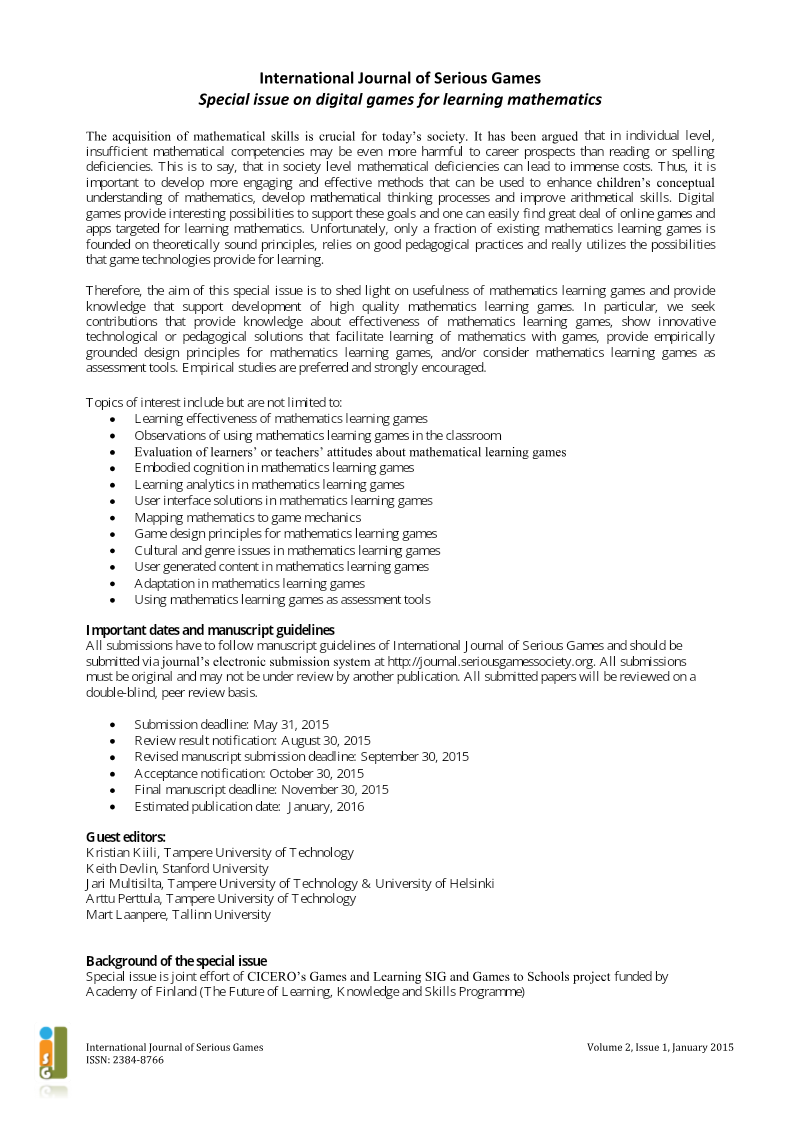
Special Issue on Digital Games for Learning Mathematics
Mathematical proficiency serves as a critical foundation for individual career success and broader societal economic stability.
- A significant gap exists between the volume of available mathematics software and the application of theoretically sound, pedagogically effective design principles.
- The initiative aims to establish a rigorous, empirical evidence base for mathematics learning games to move beyond superficial engagement.
- Key research areas include the integration of learning analytics, mapping mathematical concepts to core game mechanics, embodied cognition, and adaptive difficulty.
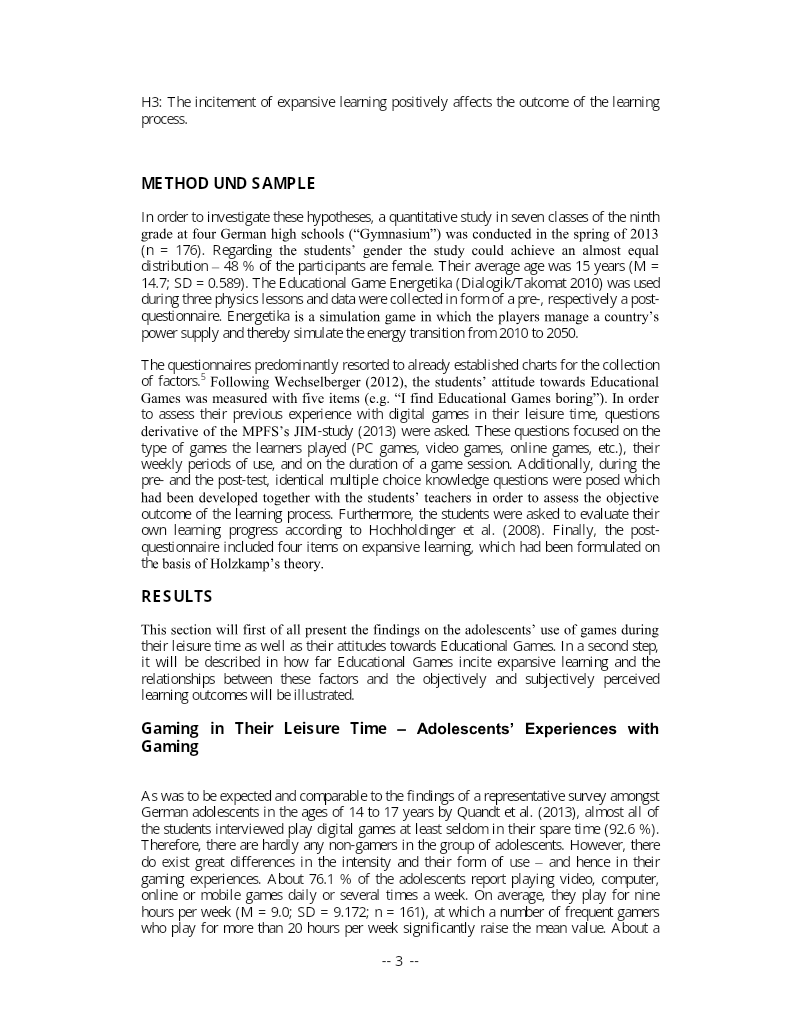
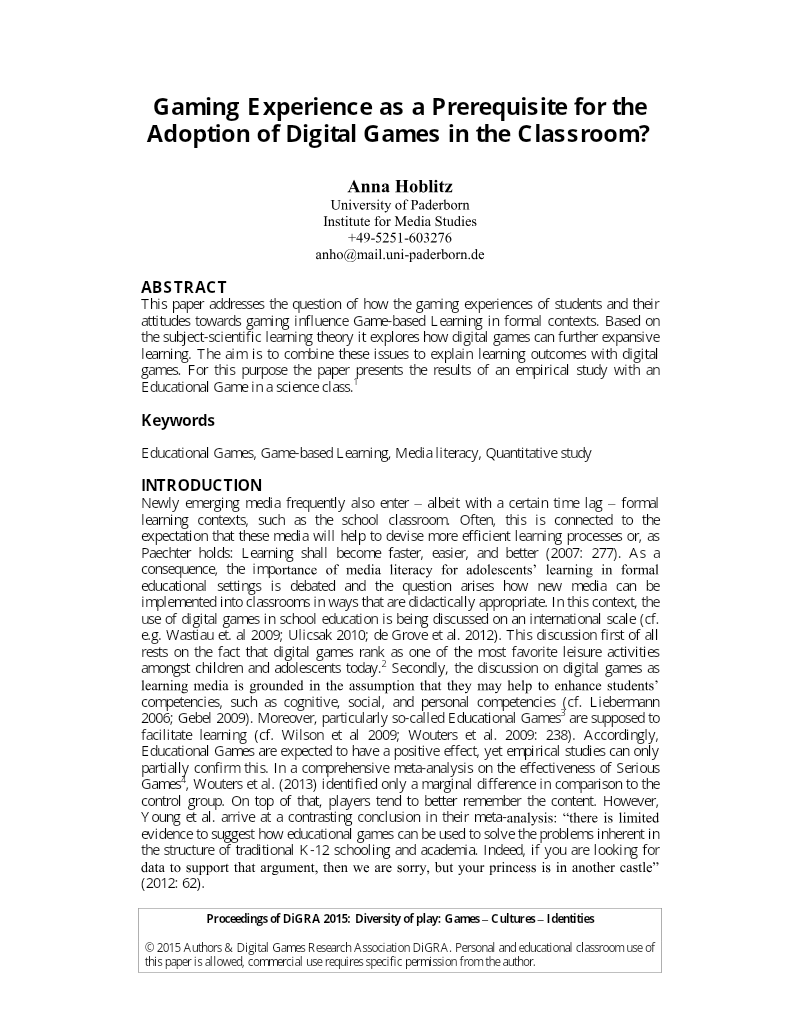
Gaming Experience as a Prerequisite for the Adoption of Digital Games in the Classroom?
The document investigates the relationship between students' prior gaming experience and their adoption and learning outcomes from digital games in educational settings.
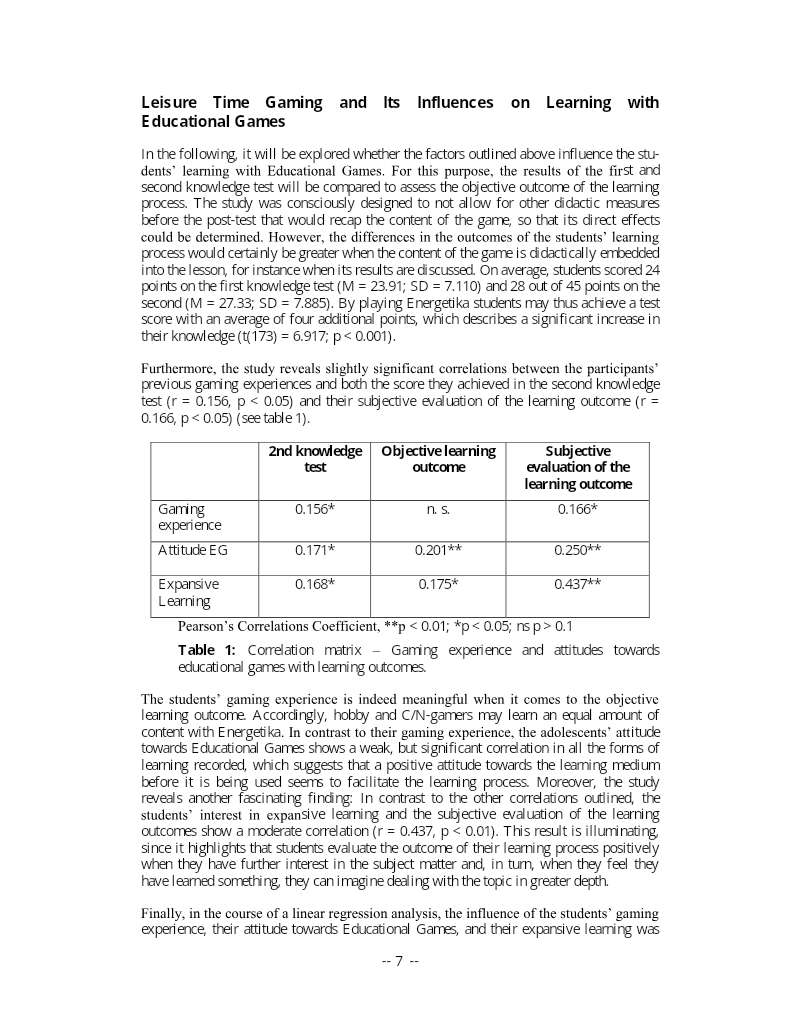
- Gaming experience did not significantly predict objective learning outcomes; prior experience showed only weak correlations with the second knowledge test (r = 0.156) and with subjective learning evaluations (r = 0.166).
- Disposition mattered more than familiarity: attitudes toward educational games correlated weakly but significantly with all learning measures, and sustained interest in the topic (expansive learning) correlated moderately with subjective learning evaluations (r = 0.437).
- Hobby gamers were more critical of educational games than casual players despite their greater gaming experience.
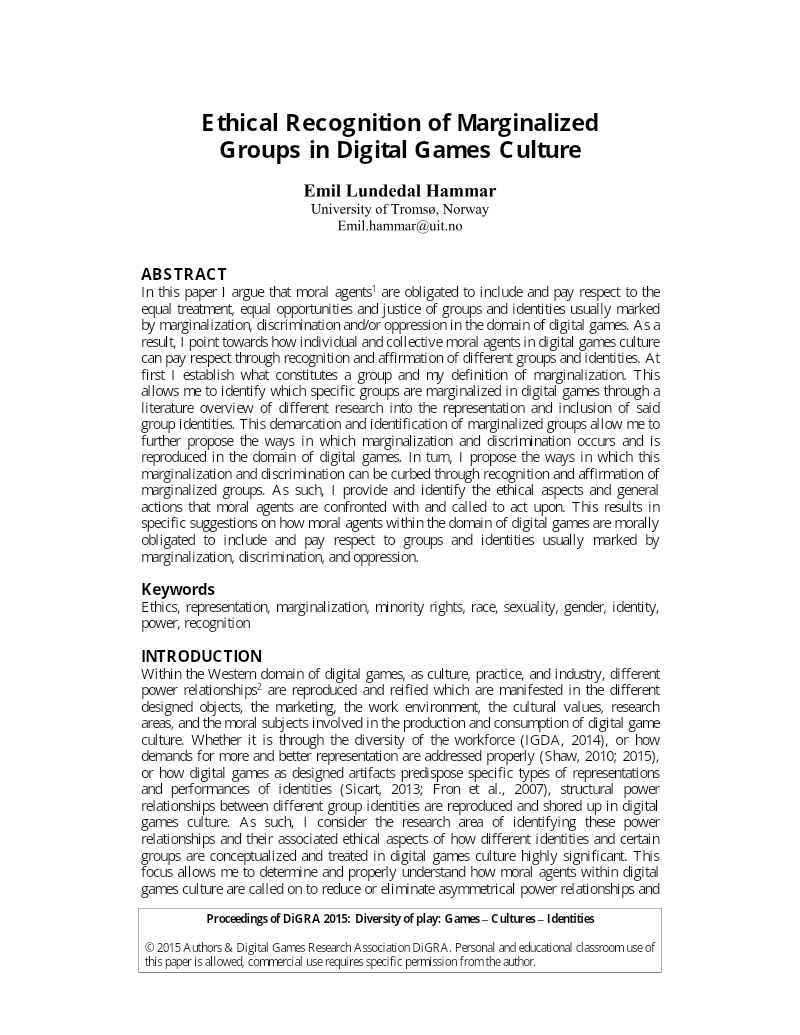
Ethical Recognition of Marginalized Groups in Digital Games Culture
The document, "Ethical Recognition of Marginalized Groups in Digital Games Culture," asserts that moral agents within the digital games industry and culture bear an ethical obligation to actively recognize and affirm marginalized groups.
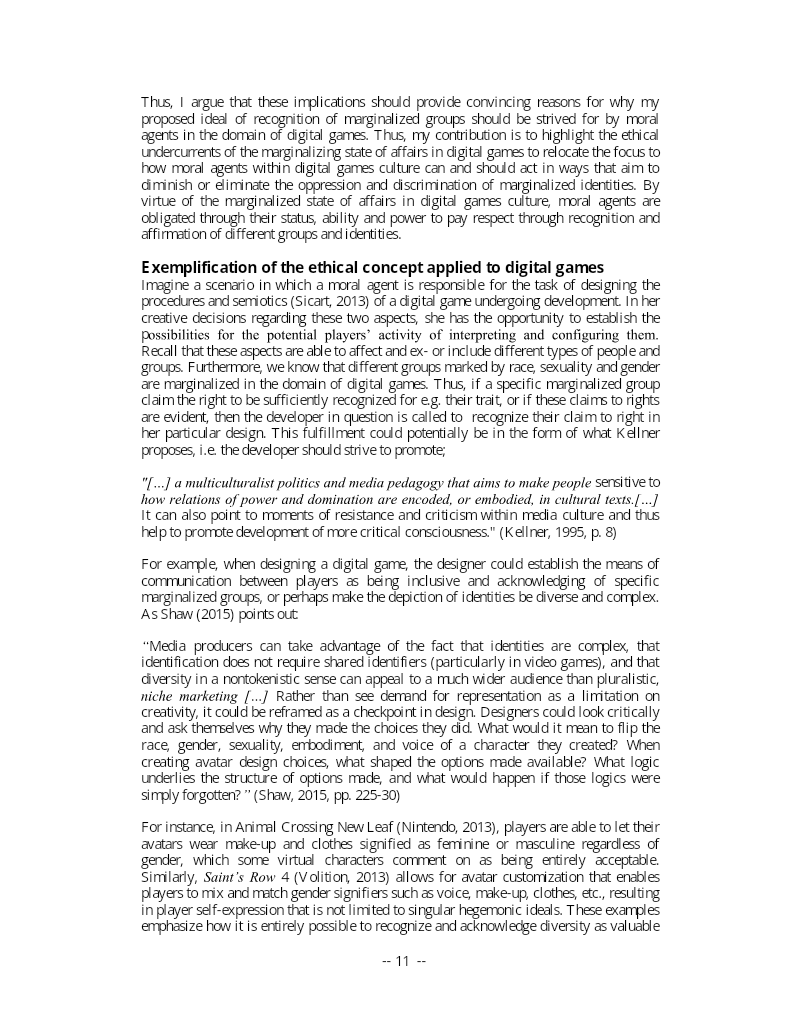
- The paper argues that everyone in games culture, including publishers, developers, critics, researchers, and players, has an ethical obligation to promote equal treatment and justice for marginalized groups, with recognition extending beyond representation to visibility, participation, platform access, and power redistribution.
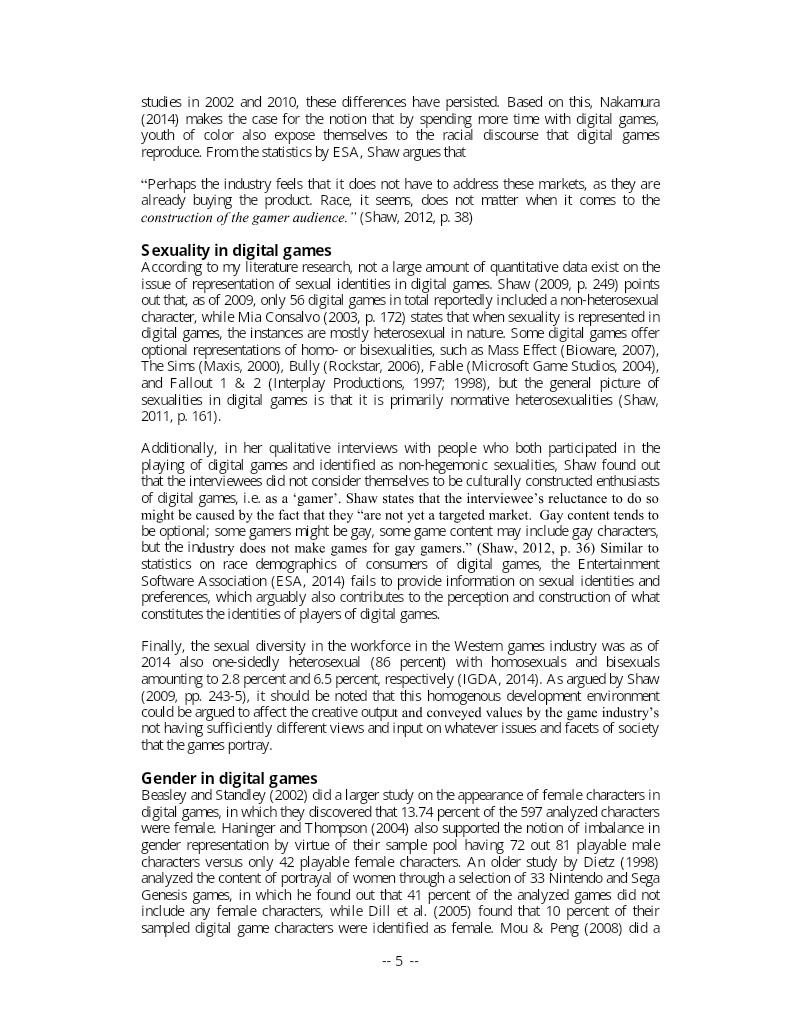
- Industry data from the IGDA Diversity Report 2014 indicate the Western games workforce is roughly 79% White and 86% heterosexual, while character studies find White characters make up about 70–74% of those reviewed.
- Female characters account for only about 10–15% of characters across major studies, and non-heterosexual characters are rare.

A Practical Guide to Using Digital Games as an Experiment Stimulus
This paper, by Simo Järvelä, Inger Ekman, J. Matias Kivikangas and Niklas Ravaja of Aalto University, University of Tampere and University of Helsinki, is a practical guide to using digital games as an experiment stimulus.
- The authors argue that the choice of game must make the stimulus sufficiently identical across participants in the aspects relevant to the dependent variable. Variation beyond that is treated as irrelevant to the experiment.
- The authors note that commercial games often lack logging, and that log files are highly useful for event-based analysis and for spotting manipulations not evident from video.
- According to the Electronic Software Association (2011), 72% of American households play digital games, and 29% of gamers are above 50 years old.
DeFragging Game Studies: Proceedings of DiGRA 2013
The "DeFragging Game Studies: Proceedings of DiGRA 2013" document serves as the welcome and introductory remarks for the sixth bi-annual Digital Games Research Association conference, held in Atlanta, GA, U.S., from August 26-29, 2013.
- The 2013 DiGRA conference (sixth biannual, Atlanta, August 26–29, 2013) framed game studies as an interdiscipline that must balance growth with coherence, using the theme "Defragging Game Studies" to argue for unity rather than splintering into separate disciplinary camps.
- Presentations were weighted heavily toward the humanities and the social and behavioral sciences, which outnumbered smaller tracks by a considerable margin, partly due to growing student interest and DiGRA's perceived academic standing.
- Some computer science scholars chose other venues such as CHI or SIGGRAPH instead of DiGRA, which the authors cite as a factor in the field's disciplinary makeup.
The Long Decade of Game Studies: Case of Finland
This study examines 34 games-related doctoral dissertations completed in Finland between 1998 and 2012, offering a metareview of how game studies took shape as an academic field within a single national context.
- The study analyses 34 games-related doctoral dissertations completed in Finland between 1998 and 2012, and finds no unified "Finnish school" of game research: the works mainly engage with international debates in game studies.
- Citation networks reveal a loose core of scholars, largely tied to DiGRA and the University of Tampere Game Research Lab, with Frans Mäyrä prominent among them, who most heavily reference the field's canon.
- Dissertation output rose steadily over the period, with a shift toward English-language publication and greater gender balance among authors.