1 free read left. Create a free account for unlimited reading + AI research.
Create free accountWhitepaper DiGRA
1 free read left. Create a free account for unlimited reading + AI research.
Create free accountWhitepaperDiGRA
The report proposes this concept, which treats biological components as abstracted hardware analogous to a graphics processing unit or physics engine.
Like a GPU or physics engine, the component is accessed through an abstraction.
This document argues that integrating live biological matter into digital games opens a design space far richer than conventional human-computer interaction, with the authors counting 64 possible interaction schemas compared with four for standard setups. Its central proposition is that biology, digital systems, and human players can be combined in many more configurations than purely digital games allow, and that this expanded space calls for a distinct set of design principles. Existing examples such as TrapIt!, EteRNA, and DNA Tic-Tac-Toe anchor the discussion, while the authors motivate applications in education, citizen science, and the arts.
The framework enumerates 21 arrangements of biology, digital systems, and human players, and it identifies enabling technologies that make such games practical, including microfluidics, cloud laboratories, and light-based stimulation through optogenetics and projectors. Single-celled organisms such as Euglena receive particular emphasis for their density, low cost, and manageable ethical profile. The authors introduce the "biotic processing unit," which treats biological components as abstracted hardware analogous to a graphics processing unit or physics engine, and they propose design rules for reconciling biological and human time scales, such as on-screen magnification, along with analog controls and virtual overlays that compensate for biological variability.
Guidance on practice centers on letting players select individual cells to cope with variability, prototyping through simulation, and making biological features and the authenticity of interactions visible to players. Ethical and biosafety considerations favor non-sentient single-celled organisms and closed systems. Drawing on an estimated 50-year lag between computing and biotechnology, the authors project consumer-level expansion within five to ten years, followed eventually by games built on purely biological interactions. Their references draw on microfluidic engineering and the motility and fluid dynamics of microorganisms, alongside the authors' earlier hybrid systems, including a cricket-controlled Pac-Man game.
Each row is a game or company this document names, each column a document, oldest first. A mark means that document names it. Select a row to see those documents.
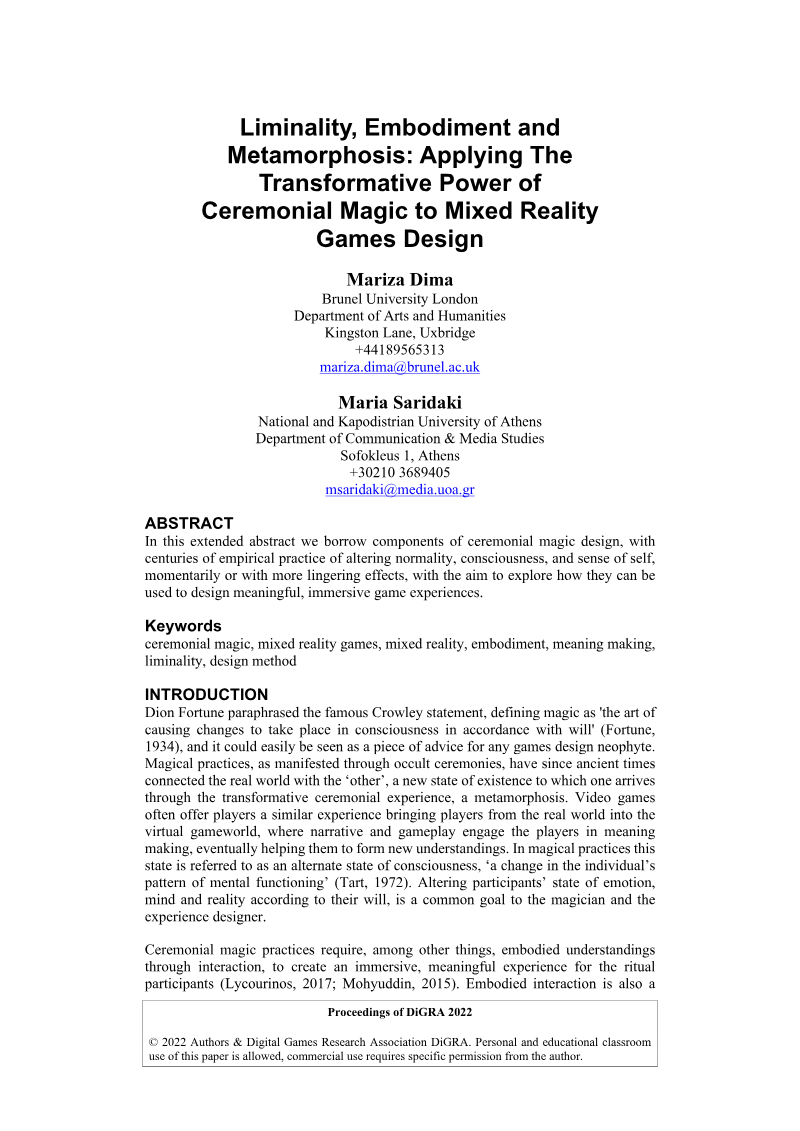
DiGRA · 2022

DiGRA · 2022
DiGRA · 2022
DiGRA · 2022
DiGRA · 2022
DiGRA · 2022
DiGRA · 2022
DiGRA · 2022
DiGRA · 2022
DiGRA · 2022
DiGRA · 2022
DiGRA · 2022
PocketGamer.biz · 2023