1 free read left. Create a free account for unlimited reading + AI research.
Create free accountWhitepaper DiGRA
1 free read left. Create a free account for unlimited reading + AI research.
Create free accountWhitepaperDiGRA
Distilling the key insights…
This paper argues that moral agents within digital games culture, including publishers, developers, critics, researchers, and players, bear an ethical obligation to promote equal treatment, opportunities, and justice for marginalized groups. It defines marginalization relationally and contends that recognition must extend beyond textual representation to encompass visibility, participation, platform access, and the redistribution of power. Drawing on scholarship in media studies, ethics, and critical theory, the author positions recognition as a means of legitimizing marginalized identities for all audiences and of reducing asymmetrical power relations.
The evidence assembled portrays a markedly homogenous culture. Industry data from the IGDA Diversity Report 2014 indicate a workforce roughly 79% White and 86% heterosexual in the Western games sector, while character studies find White characters comprising approximately 70–74% of those reviewed. Female characters account for only about 10–15% across major studies, and non-heterosexual characters are rare. Case examples such as female voices receiving three times as many negative messages as male voices in Halo 3 and the stereotyped depiction of Black "Redguard" characters in Skyrim are used to argue that these patterns reproduce invisibility, exclusion, and discrimination both within games and in players' lived experiences. Pay disparities, including men earning 23.6% more than women as game designers, are noted in the endnotes.
The author concludes that digital games culture functions as a hegemony of White, heterosexual, cisgender male identities with ethically significant marginalizing consequences. Tokenistic gestures, such as trivial avatar customization or representations that flatten or essentialize identities, are judged insufficient. Examples of more substantive practice, including gender-neutral customization in Animal Crossing and Saints Row 4, are offered as models for critical design reflection. The analysis is confined largely to Western games culture and draws on data from the mid-2010s, with groups such as people with disabilities, older players, and non-binary individuals receiving little direct attention.
Each row is a game or company this document names, each column a document, oldest first. A mark means that document names it. Select a row to see those documents.
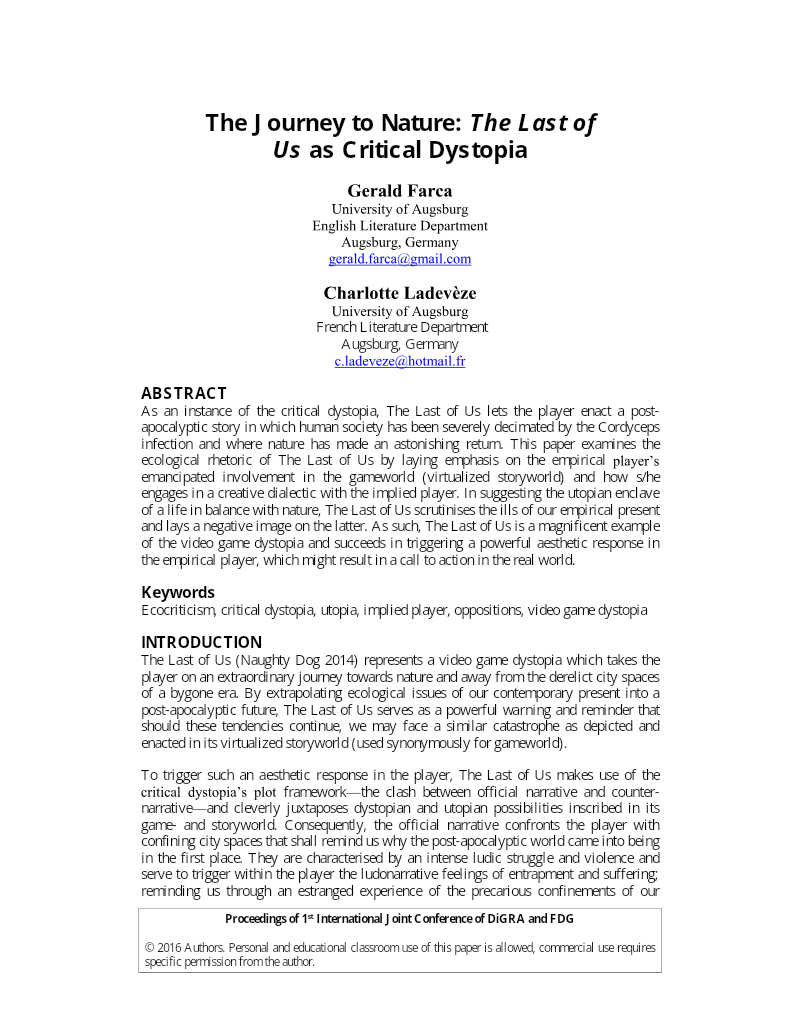
DiGRA · 2016
DiGRA · 2016
DiGRA · 2016
DiGRA · 2016
DiGRA · 2016
DiGRA · 2016
DiGRA · 2016
DiGRA · 2016
DiGRA · 2016
DiGRA · 2015
DiGRA · 2015
DiGRA · 2015
Game Developers Conference · 2018