Digital Games
Company
Documents about Digital Games


The Spontaneous Playfulness of Creativity: Lessons from Interactive Theatre for Digital Games
This paper argues that integrating the theories and practices of improvisational and activist theatre can significantly enhance spontaneous, playful creativity in digital game design.
- The paper argues that improvisational and activist theatre methods can introduce spontaneous, playful creativity into digital game design, shifting developers away from a sole focus on technical topics like facial rendering and AI agents.
- It proposes adapting Uta Hagen's character analysis questions and Stanislavski-inspired "inside out" development to build digital characters from the inside rather than from surface traits.
- It applies Chris Crawford's arithmetic formulation of relationship motivation, along with Keith Johnstone's status-tower and "Lists" exercises, to construct relationship dynamics and generate first-instinct game ideas.

Digital Games for Education: When Meanings Play
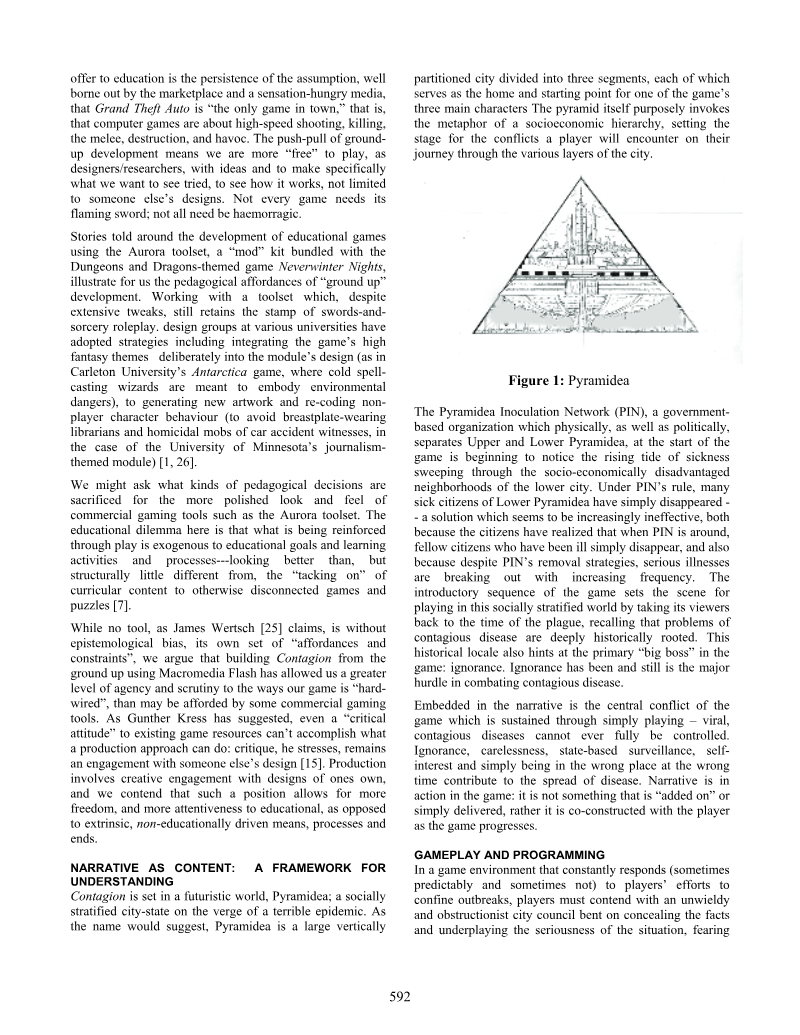
Suzanne de Castell, Jennifer Jenson and Nicholas Taylor, from Simon Fraser University and York University in Canada, document the development of Contagion, a web-based educational role-playing game prototyped in Macromedia Flash for players aged 10-15.
- The authors argue that educational content should be understood as enacted through all aspects of a game, not as a separate layer added to it.
- Contagion was built over a two-year development cycle by seven undergraduate artists, three undergraduate programmers and two graduate students.
- The team chose Macromedia Flash so that students could play at school without downloading or installing anything beyond an accessible and widely-used browser driver.
A Method for Discovering Values in Digital Games
The authors, a research team from the Values at Play (VAP) project at Tiltfactor Lab, Hunter College and New York University, present the "Values Cards" exercise, a tool that helps game designers discuss values embedded in digital games.
- The authors argue that games carry values within their representation systems and mechanics, whether designers intend them to or not.
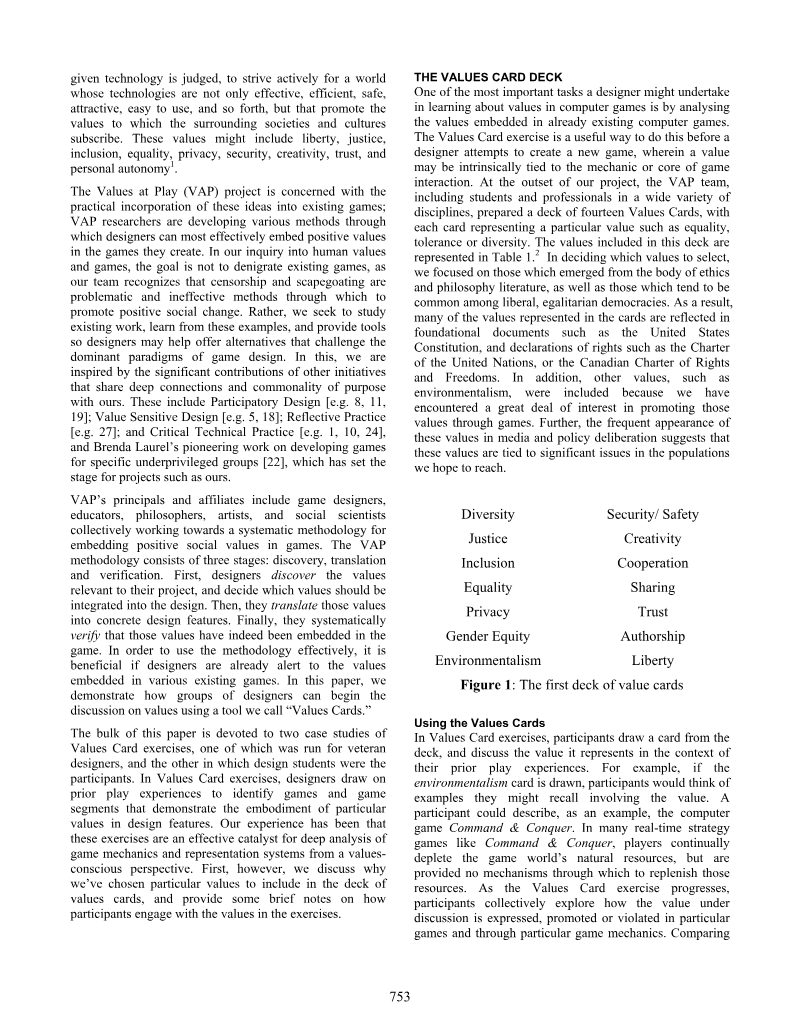
- The Values Cards exercise asks participants to draw a card and identify game segments that express or violate the value it names.
- The deck was built with fourteen values, selected from ethics and philosophy literature and values common in liberal, egalitarian democracies.
The Sponsored Avatar: Examining the Present Reality and Future Possibilities of Advertising in Digital Games
This paper examines the current state and future potential of advertising within digital games, a practice often termed "advergaming."
- Advertising spending is shifting away from traditional television commercials toward placements in entertainment, with one cited beverage company redirecting more than $300 million in annual spending.
- Game-based advertising remained a small share of revenue relative to film and television, with projections of roughly $260 million by 2008, though agencies increasingly seek game placements and some have created dedicated game advertising divisions.
- Players generally accept in-game advertising, mostly because it enhances realism, but they worry that placements may feel incongruous and detract from the experience.
The Localization of Digital Games: A Case Study in China
This paper investigates the complexities of digital game localization, specifically focusing on the Chinese market.
- Game localization is more complex than general software localization because games function simultaneously as commercial and cultural products.
- The authors propose a three-dimensional model comprising the In-Game Environment (storyline, gameplay, engagement, interface), the External Environment (social, political, legal, ideological factors), and the Users, who link the two.
- The central contention is that all three dimensions should be considered throughout the entire game design process rather than treated as a late-stage adjustment.
Digital Games: A Motivational Perspective
This literature review explores the motivational differences and similarities between commercial and educational digital games, aiming to inform the design of more effective learning tools.
- Commercial digital games have grown steadily while educational games remain marginal, and the review argues that understanding the motivational differences between the two can help designers combine their strengths to build more effective learning tools.
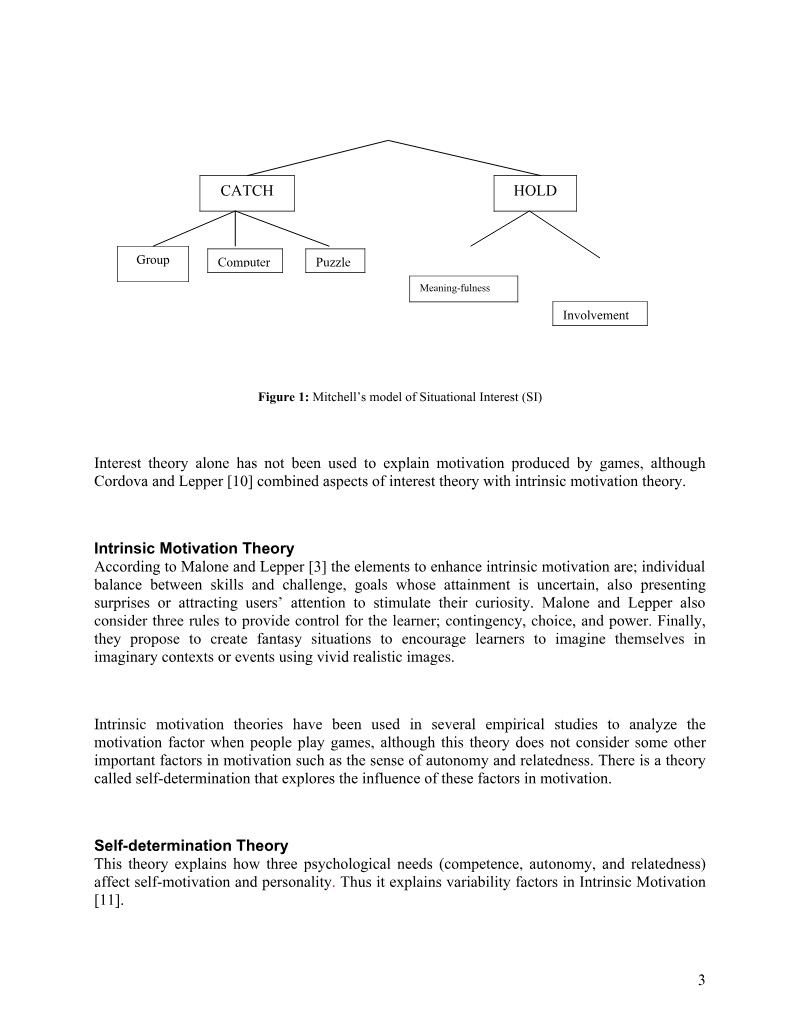
- The review grounds its analysis in three frameworks: Mitchell's situational interest model (CATCH versus HOLD), intrinsic motivation theory (challenge, fantasy, curiosity, control), and self-determination theory (competence, autonomy, relatedness).
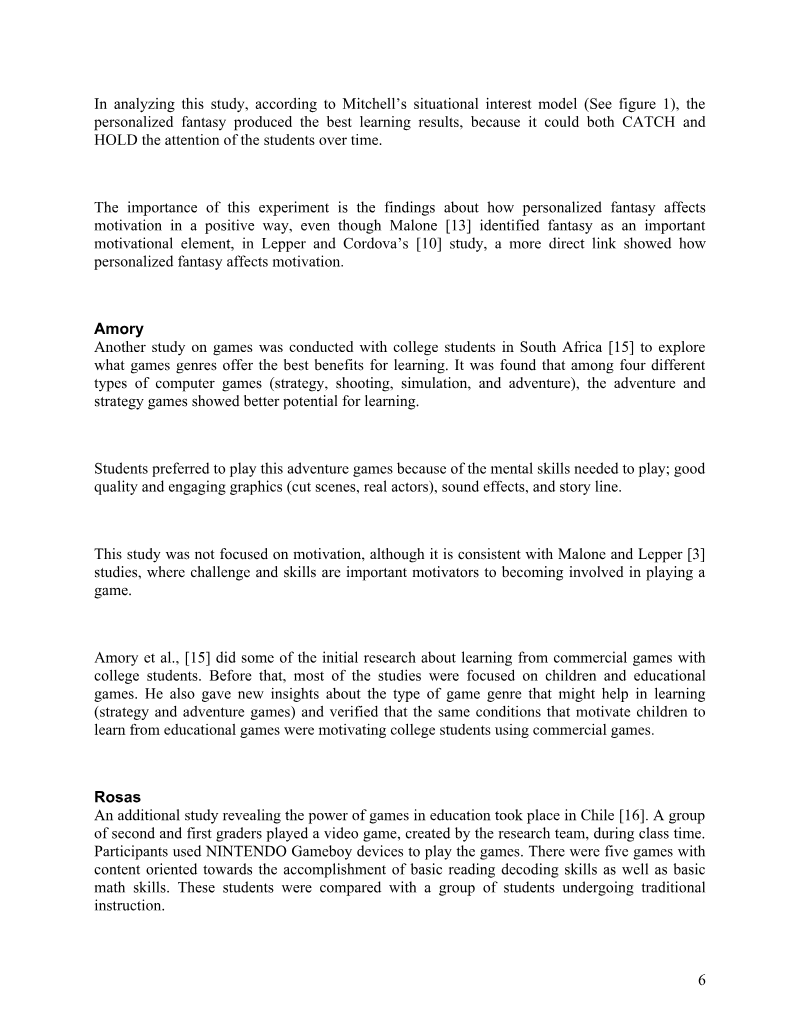
- Lepper and Cordova's arithmetic game experiments found that personalized fantasy and player choice improved intrinsic motivation, time on task, and learning, with personalized fantasy producing the strongest results.
History of Digital Games in Turkey
This study provides a historical overview and current status of digital games and the game industry in Turkey, covering the period from the late 1980s to 2005.
- Turkish players' habits and play durations parallel global averages, but domestic game development has been extremely limited and poorly documented.
- Digital games reached Turkey in the early 1980s via arcade-style "Atari Salonu" halls, which prompted a 1985 regulatory response requiring local permits.
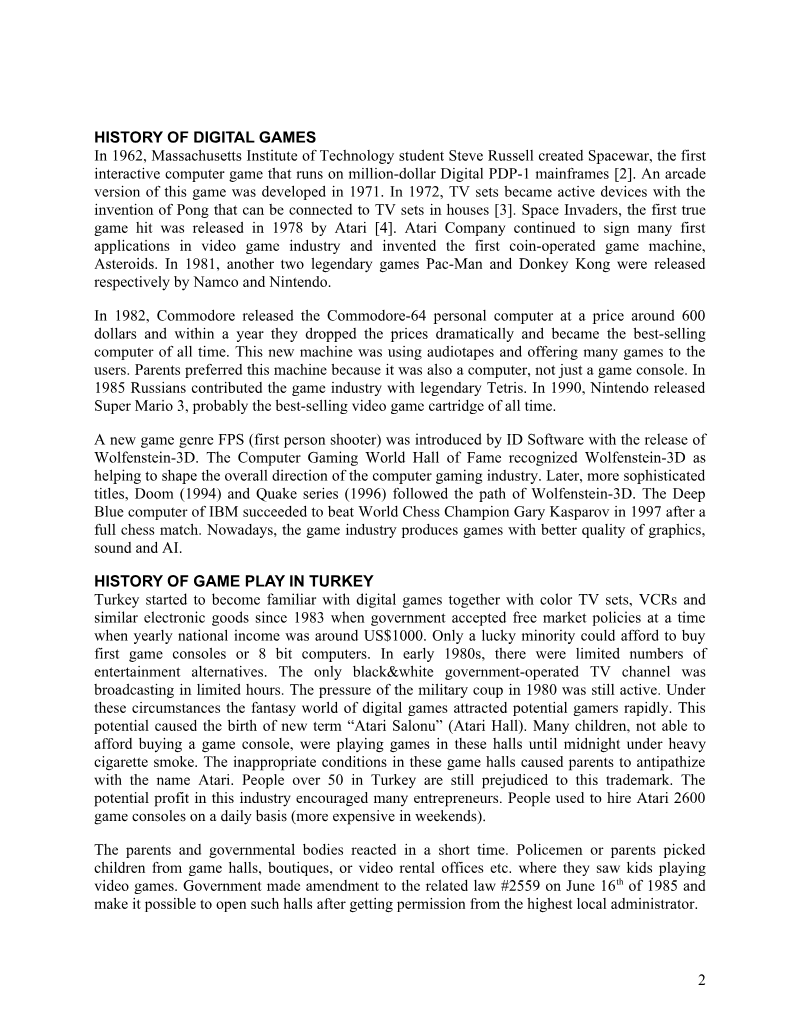
- Turkish home game development passed through three phases: an amateur 1980s period built on the Commodore 64 and magazine-published source code, a semi-professional 1990s period centered on Amiga and PC groups like Siliconworx and Compuphiliacs, and a professional stage from 2000 onward.
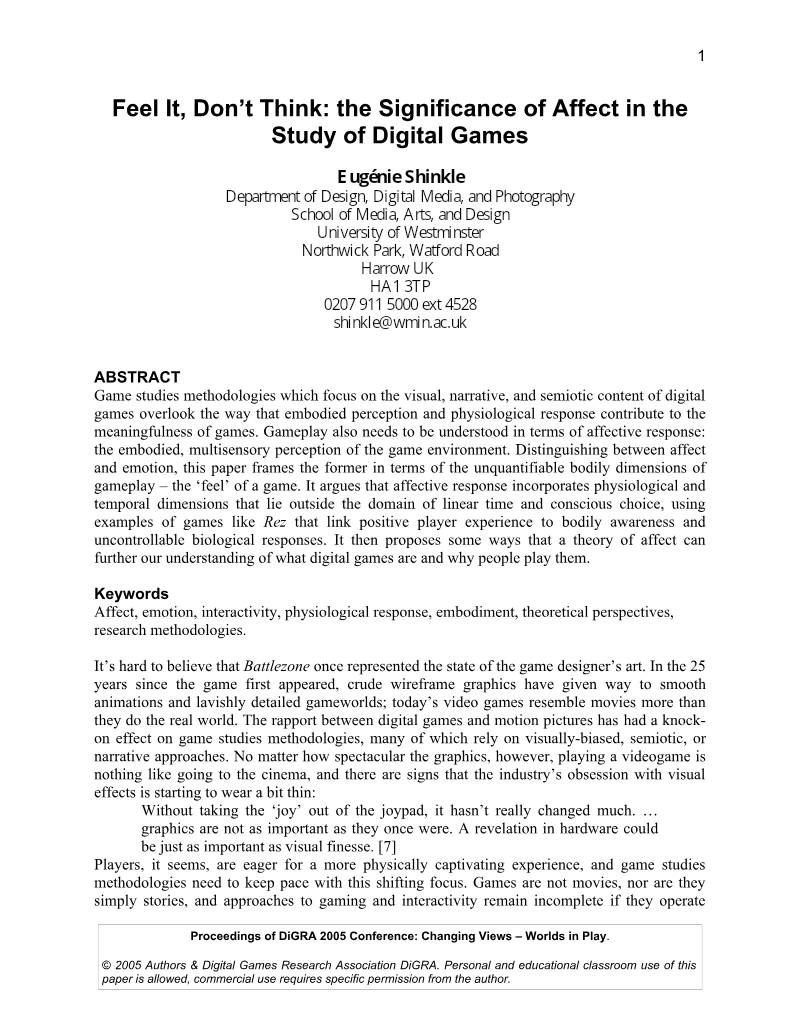
Feel It, Don't Think: The Significance of Affect in the Study of Digital Games
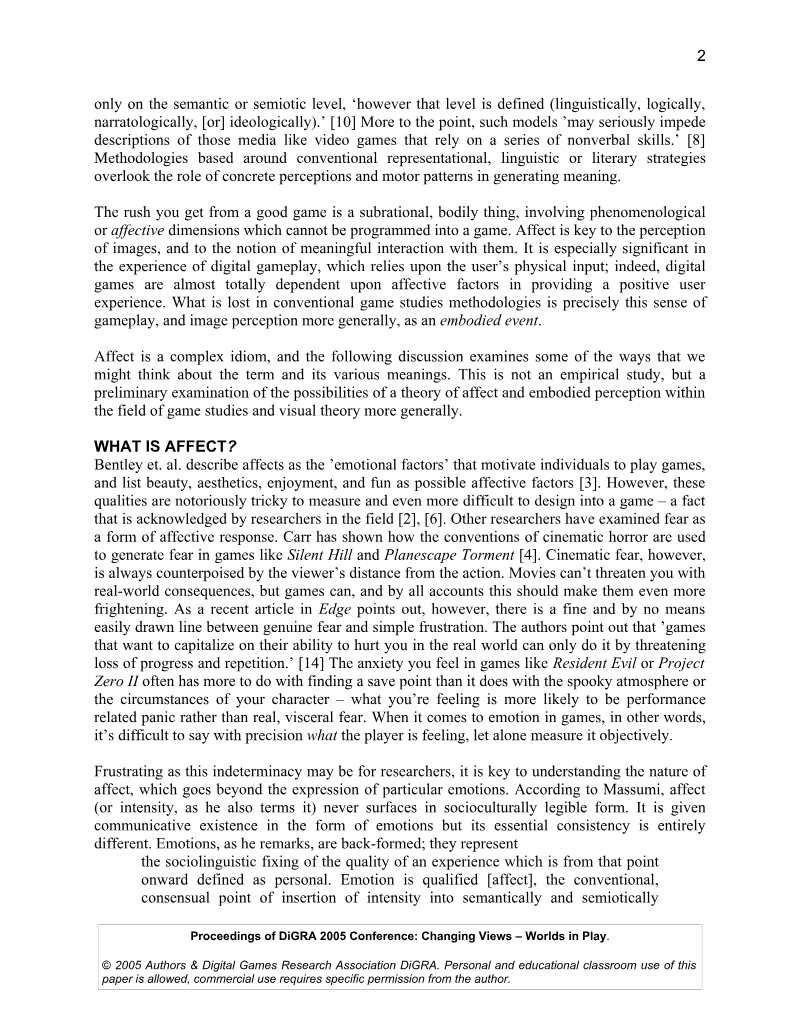
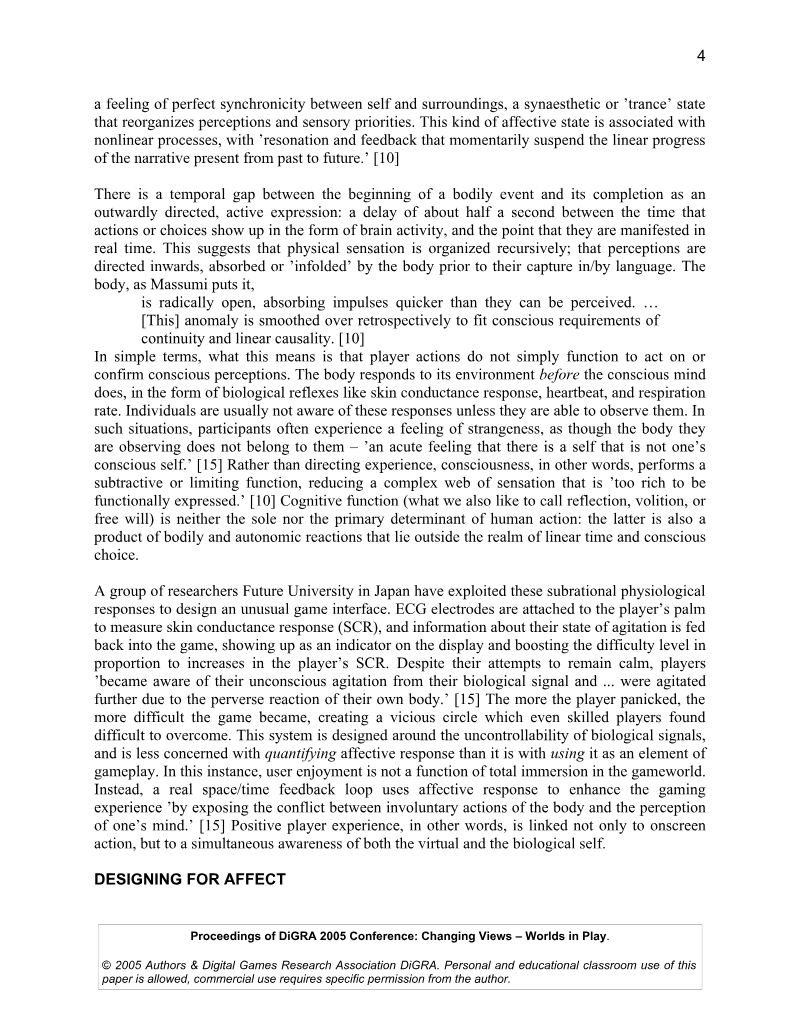
The document, "Feel It, Don't Think: The Significance of Affect in the Study of Digital Games," argues that traditional game studies methodologies, which prioritize visual, narrative, and semiotic elements, fail to adequately account for the embodied, multisensory, and physiological dimensions of gameplay.
- Shinkle argues that game studies focused on visual, narrative, and semiotic content overlook the embodied, physiological 'feel' of gameplay, which she calls affect: a multisensory, temporally delocalized experience that operates partly outside linear time and conscious choice.
- The paper distinguishes affect from emotion and presents itself as a preliminary theoretical examination rather than an empirical study, drawing on Massumi, Grodal, Aarseth, and Poole.
- Sega's rave-inspired Rez is cited as an example whose appeal lies in a trance-like synchronicity between player and environment rather than in level completion.


Issues and Approaches in Artificial Intelligence Middleware Development for Digital Games and Entertainment Products
The document examines the challenges and solutions in developing Artificial Intelligence (AI) middleware for digital games and entertainment products.
- AI has shifted from a secondary concern to a priority in game development, yet developers still rely on a narrow set of techniques and lack flexible, reusable tooling.
- Dedicated AI middleware, a software layer that supplies agent behavior and decision-making services to game engines, is presented as the likely next step for improving game AI and freeing developers for creative work.
- Dominant practice relies on finite state machines, hierarchical and fuzzy state machines, A pathfinding, steering behaviors, decision trees, and rule-based systems, each trading off speed, expressiveness, and predictability.


Technology Tells a Tale: Digital Games and Narrative
Kevin Schut, of the Communication Studies Department at the University of Iowa, examines the debate over whether digital games are narratives, framed through medium theory (media ecology).
- Schut argues that games are not narratives, but that the digital medium is transforming what a story is. He describes this as a change in cultural categories rather than an alien addition.
- The paper describes games as having a range of narrative possibilities, from none to a near-complete story. Bejeweled is placed at the no-narrative end, while Monkey Island is at the most narrative end.
- In Escape from Monkey Island, external and internal time are pretty much simultaneous for most of the game, so the story timeline unfolds as the player experiences it.


Encounters With Consumption During Computer-Mediated Play: The Development of Digital Games as Marketing Communication Media
Mike Molesworth of Bournemouth University presents an exploratory paper on the use of digital games as marketing communication media, examining brand placement in PC, console and online Flash-based games.
- Most players were positive about brand placement in games, citing increased realism and financial support for developers as the two main reasons.
- The author notes that during extended play, players' focused attention may mean peripheral messages, such as trackside or stadium advertising, are not processed.
- Players described console and PC play as intensive, with some reporting extended play of up to 60 hours a week.


Tiny Patches of Peace: Signs of Agency in Digital Games
Cindy Poremba, of Simon Fraser University in British Columbia, examines player authorship in digital games through the rhetoric of two peace-themed player artifacts created after the September 11, 2001 attacks.
- The author argues that player-created artifacts carry the agency of the player rather than the designer, which makes them a form of authorship.
- Velvet-Strike was built as a set of peace-themed sprays for Counterspray, a Counter-Strike graffiti modification, and its sprays are publicly available for download.
- The most prevalent player counter-argument to Velvet-Strike was that it is just a game, which rebuts the use of the game as a forum for political protest.