1 free read left. Create a free account for unlimited reading + AI research.
Create free accountWhitepaper DiGRA
1 free read left. Create a free account for unlimited reading + AI research.
Create free accountWhitepaperDiGRA
The authors argue that meaning is not confined to a game's subject matter. It also lives in character selection, art, narrative, programming, goals, and play itself.
The document, "Digital Games for Education: When Meanings Play," examines how educational games can be designed and evaluated, using the experimental web-based game Contagion as its central case. Contagion, built in Macromedia Flash for students aged 10 to 15, addresses four infectious diseases (SARS, West Nile Virus, Avian Flu, and AIDS) and was developed through design-based research by teams at Simon Fraser University and York University. The authors' central thesis is that educational meaning is not confined to a game's subject matter but is embedded in every element of its design, including character selection, art, narrative, programming, goals, and play itself. They position building games from the ground up as preferable to modifying commercial toolsets, since it affords greater pedagogical freedom.
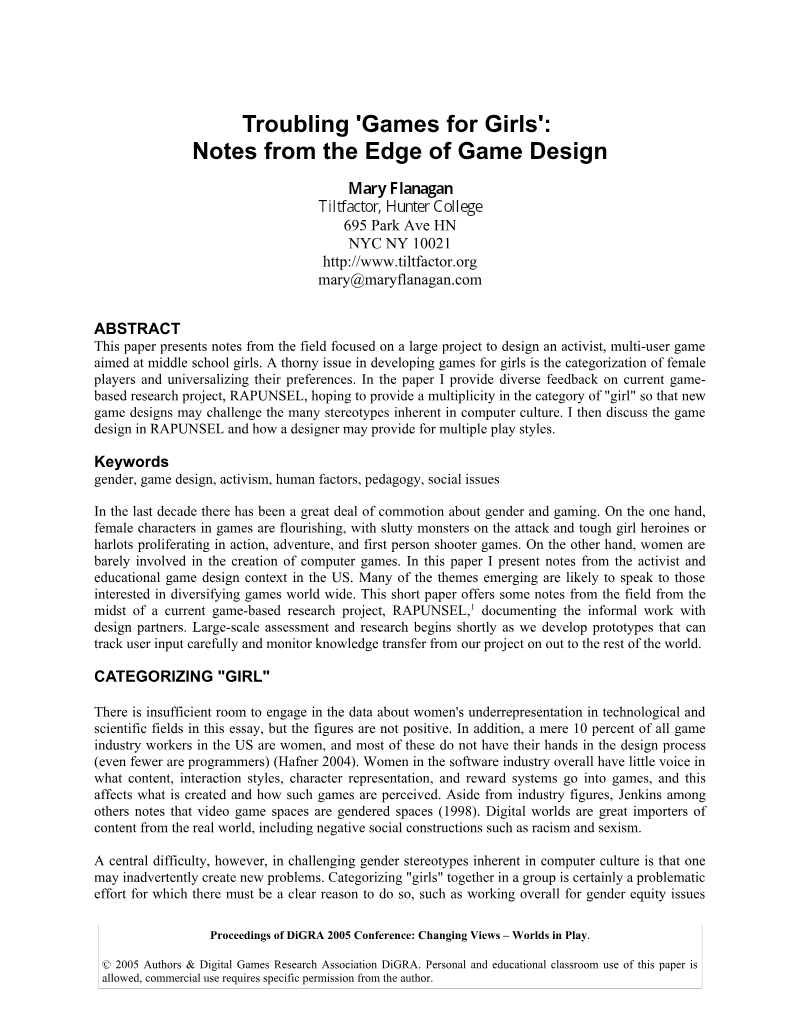
A key finding concerns gender. The authors discovered that their initial character art and pronoun choices reproduced stereotypes, and they revised toward more ambiguous, "marked" characters. They also conclude that the game's engaging mini-activities contain little discrete educational content, arguing that the conventional view of content as testable information is poorly suited to games and, more broadly, to education.
The document's broader argument holds that digital games are a powerful medium because they capture voluntary, sustained attention, which the authors treat as the foundation of intelligence and learning. The project is aligned with science, geography, health, and technology curricula in Ontario and British Columbia. The authors contend that traditional schooling grows less sustainable as attentional economies reshape how young people learn, and they identify girls' lower confidence with game play as an educationally significant gap. The work marks a shift from reception-oriented toward production-oriented research on educational games.

DiGRA · 2016

DiGRA · 2016



DiGRA · 2016

DiGRA · 2016

DiGRA · 2016

DiGRA · 2016

DiGRA · 2016

DiGRA · 2016
DiGRA · 2016
DiGRA · 2016
DiGRA · 2016
DiGRA · 2016
DiGRA · 2011