1 free read left. Create a free account for unlimited reading + AI research.
Create free accountWhitepaper DiGRA
1 free read left. Create a free account for unlimited reading + AI research.
Create free accountWhitepaperDiGRA
The review examines why players engage persistently with commercial digital games, while educational games struggle to attract comparable interest.
This literature review examines why players engage persistently with commercial digital games while educational games struggle to attract comparable interest, using motivation theory as its analytical lens. The paper argues that the commercial games market has grown steadily while educational games remain marginal, and that understanding the motivational differences between the two can help designers combine the strengths of each to build more effective learning tools. Its guiding questions concern how players' motivations differ across these two game types and what features drive those differences.
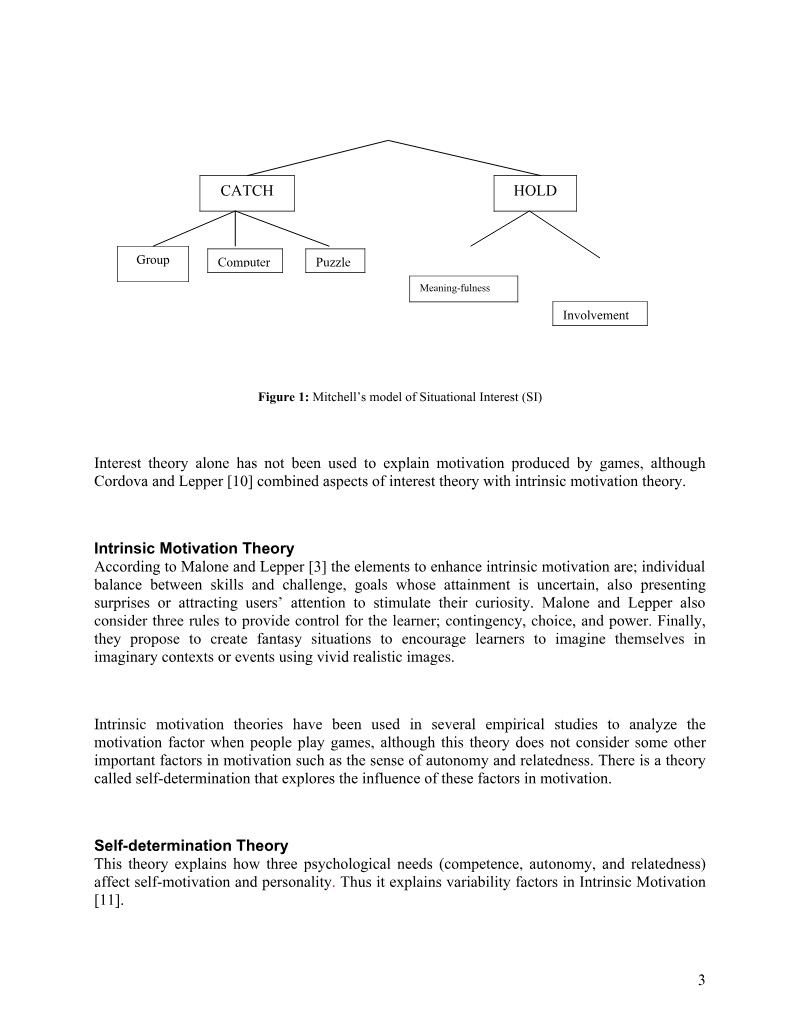
The review draws on three theoretical frameworks: Mitchell's model of situational interest, which distinguishes the conditions that capture attention (CATCH) from those that sustain it (HOLD); intrinsic motivation theory, which identifies challenge, fantasy, curiosity, and control as core motivators; and self-determination theory, which emphasizes competence, autonomy, and relatedness as psychological needs. It then reviews empirical studies from the past two decades, beginning with Malone's early work on the game "Darts," which found that a sense of competence increased enjoyment for students already strong in the subject. Lepper and Cordova's experiments with arithmetic games showed that personalized fantasy and player choice improved intrinsic motivation, time on task, and learning, with personalized fantasy producing the strongest results. Studies with college students, Chilean elementary students using handheld consoles, and British classrooms found adventure and strategy genres most beneficial, and Squire's work with "Civilization III" showed that games perceived as relevant to students' interests were more readily accepted, with substantial play time, roughly 30 hours, needed before students gained confidence using the game for learning.
The review concludes that intrinsic motivation has dominated game research, that future work should incorporate self-determination and other motivational frameworks, and that industry research methods offer new ways to measure engagement. It identifies the main distinction between commercial and educational games as the experience each provides, shaped by challenge, personalized fantasy, choice, social interaction, and the merging of personal and situational interest.
DiGRA · 2016
DiGRA · 2016
DiGRA · 2016
DiGRA · 2016

DiGRA · 2016

DiGRA · 2016



DiGRA · 2016

DiGRA · 2016

DiGRA · 2016

DiGRA · 2016

DiGRA · 2016

DiGRA · 2016