2015
Company
Documents about 2015
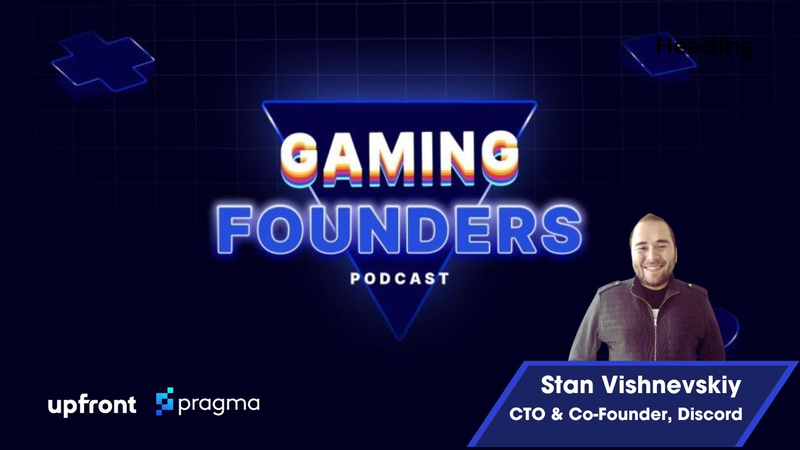
Pivoting To Survive: Stan Vishnevskiy's Journey on Founding Discord
Discord emerged from the strategic pivot of Hammer and Chisel, a game studio that transitioned from developing a mobile MOBA to building a dedicated communication platform.
- Discord achieved initial traction by manually convincing users on Reddit to try the platform, resulting in a steady growth of over 100 new users per day during the early launch phase.
- The company successfully pivoted from a failed game studio model to a social communication platform by ruthlessly prioritizing product-market fit, even when it required difficult personnel decisions.
- Discord maintains technical agility by distinguishing between 'one-way' and 'two-way' architectural doors, allowing the team to make temporary compromises that can be refactored later as the platform scales.

Digital Foundry Leaves IGN
Digital Foundry, a prominent specialist publication focused on technical analysis of gaming hardware and software, has officially transitioned to a fully independent business model.
- Technical analysis specialist Digital Foundry has become a fully independent entity, separating from IGN.
- Digital Foundry was previously part-owned by IGN following IGN's 2024 acquisition of Gamer Network.
- Owner Richard Leadbetter stated that the team had sought to return to independence since the brand's time under ReedPop ownership.

Tencent Games: Revenue by Year [2015 – 2026]
Tencent’s mobile revenue trajectory from 2015 to 2025 illustrates the company’s evolution from a domestic gaming entity into a global digital powerhouse.
- Tencent's mobile revenue reached a record peak of $7.88 billion in 2024, followed by a slight stabilization to $4.61 billion in the first part of 2025.
- Honor of Kings remains the company's primary revenue driver, consistently generating over $1 billion annually for nearly a decade and reaching $1.87 billion in 2024.
- PUBG Mobile has been a critical global asset, peaking at $1.79 billion in 2020 and continuing to contribute over $1 billion in annual revenue through 2025.

Supercell Revenue by Year (2015 – 2025)
Supercell has established itself as a dominant force in the mobile gaming industry, generating over $13.58 billion in total lifetime revenue as of 2026.
- Supercell’s annual revenue has experienced a long-term downward trend since its peak in 2015 ($1.9 billion), hitting a low of $788.5 million in 2023 before rebounding to $1.45 billion in 2024.
- Brawl Stars is the company’s most volatile asset, experiencing a significant resurgence in 2024 with $678.5 million in revenue, more than doubling its 2023 performance.
- Clash of Clans remains the company’s primary revenue anchor, consistently serving as the top-earning title for over a decade despite a gradual decline from its $1.36 billion peak in 2015.
Defence of Chinese State-Sanctioned History Against Perceived Attacks from Honor of Kings
This extended abstract examines how Chinese state media and the Chinese public have responded to Honor of Kings, Tencent's 2015 mobile multiplayer online battle arena game that drew heroes from Chinese history and mythology and reportedly reached around 200 million registered users.
- Official Chinese state media, including People's Daily and Guangming Daily, criticised Tencent's Honor of Kings from March 2017 onward, focusing on its addictiveness and on concern that its fantastical reworking of historical figures could confuse young players about the real past.
- Honor of Kings, Tencent's 2015 mobile MOBA drawing on Chinese history and mythology, reportedly reached around 200 million registered users.
- The study examines public responses on Zhihu, a Q&A platform generally seen as offering relatively open debate, analysing ten of the most relevant questions with 2,674 answers in total, some read nearly two million times.
Fictional Videogames as Framing Devices: Suicide Communication in MMOs
In "Fictional Videogames as Framing Devices: Suicide Communication in MMOs," Gutiérrez Carrera argues that fictional massively multiplayer online games can function as framing devices that reveal online games as social spaces with their own communication norms, norms that can make direct talk about suicide easier to voice.
- The report argues that fictional MMOs can act as framing devices that expose online games as social spaces with their own communication norms, norms that can make direct talk about suicide easier to voice.
- Using three scenes from the fictional MMO Agony of a Dying MMO, whose premise is the final hours of a game's service, the study finds the dying-server framing simultaneously provides an alibi for jokes, an implicit channel for serious statements, and authenticity for players who speak openly.
- Chat logs, logging out, and guild, faction, and friend-list structures make serious remarks ambiguous or emotionally weighty, while the impending dissolution of a social network reduces the face-threatening nature of suicide statements.
Avatar and Real Me: Identity Anxiety of Chinese Mobile Otome Game Players: A Case Study of Papergames
This paper examines identity anxiety among Chinese players of free-to-play mobile otome games, using Papergames' Love and Producer (2017) and Love and Deepspace (2024) as case studies.
- The paper argues that existing otome game scholarship, which treats avatars as stable and players as closely identifying with them, fails to explain mobile players, who often reject or feel unease toward their avatar's presence in the two-dimensional game world.
- Within free-to-play otome games, the paper proposes that three identities, the player, the believer, and the lover, come into conflict, and it distinguishes mobile otome games from buy-to-play otome visual novels in how player identity is constructed.
- The study uses semi-structured interviews with thematic analysis organized around the acquisition, retention, and monetization model, supplemented by game narrative and mechanics and official Sina Weibo posts from the developers; the interview sample size is not specified in the extended abstract.
(Dis)Embodiment: Trans Hauntings in Kitty Horrorshow's Corpus
Dr Merlyn Seller's paper examines trans embodiment and haunting in the small-scale horror games of developer Kitty Horrorshow, focusing on works such as Rain, House, Eternity (2015), Anatomy (2016), and Hornets (2015).
- Dr Merlyn Seller's paper analyses trans embodiment and haunting in the small-scale horror games of developer Kitty Horrorshow, including Rain, House, Eternity (2015), Anatomy (2016), and Hornets (2015), using audio-visual-haptic and textual analysis plus autoethnographic reflection as a trans player.
- The paper's central concept is "diapolar haunting," in which the trans player is simultaneously haunting and haunted, existing in an ambivalent state of present-absence and absent-presence both inside and outside the game.
- Horrorshow's minimalist 32-bit environments, uncanny architectures, forced reboots, and disembodied first-person avatars are framed as a means of exploring the affective darkness of transition.
Virtual Memories of Displacement: A Narrative Game in VR Exploring Refugee Stories through Symbolic Interaction
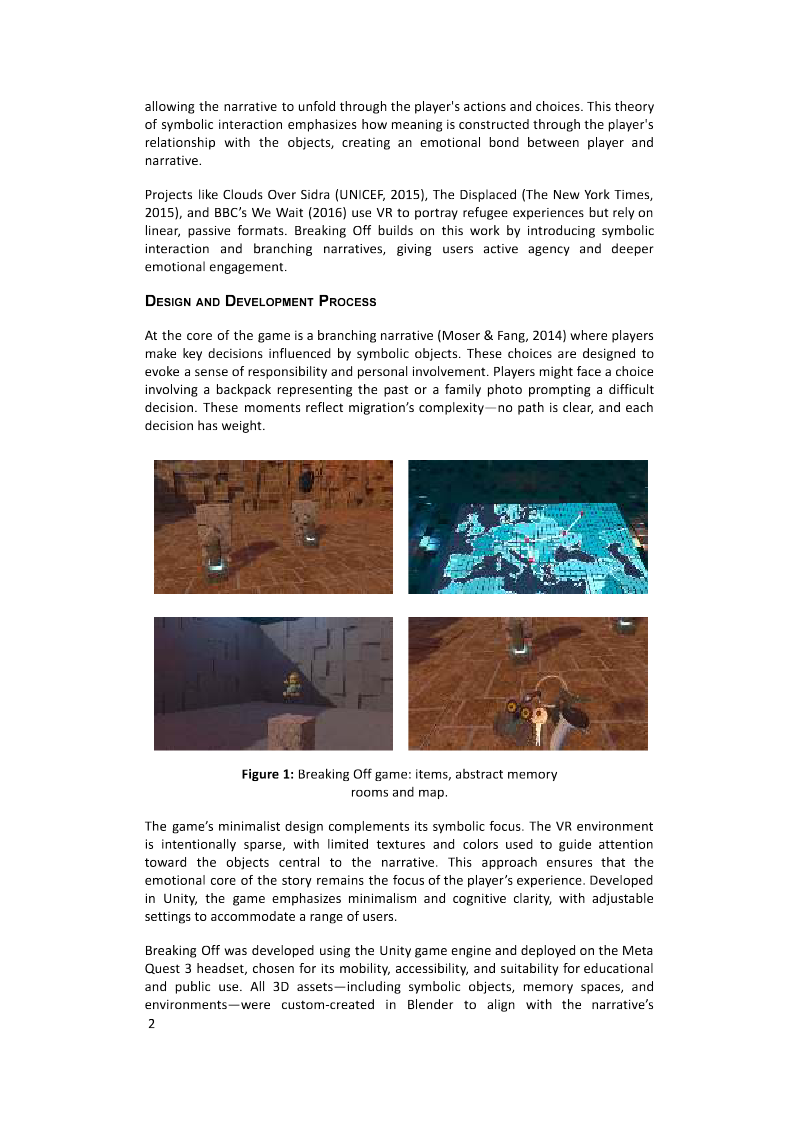
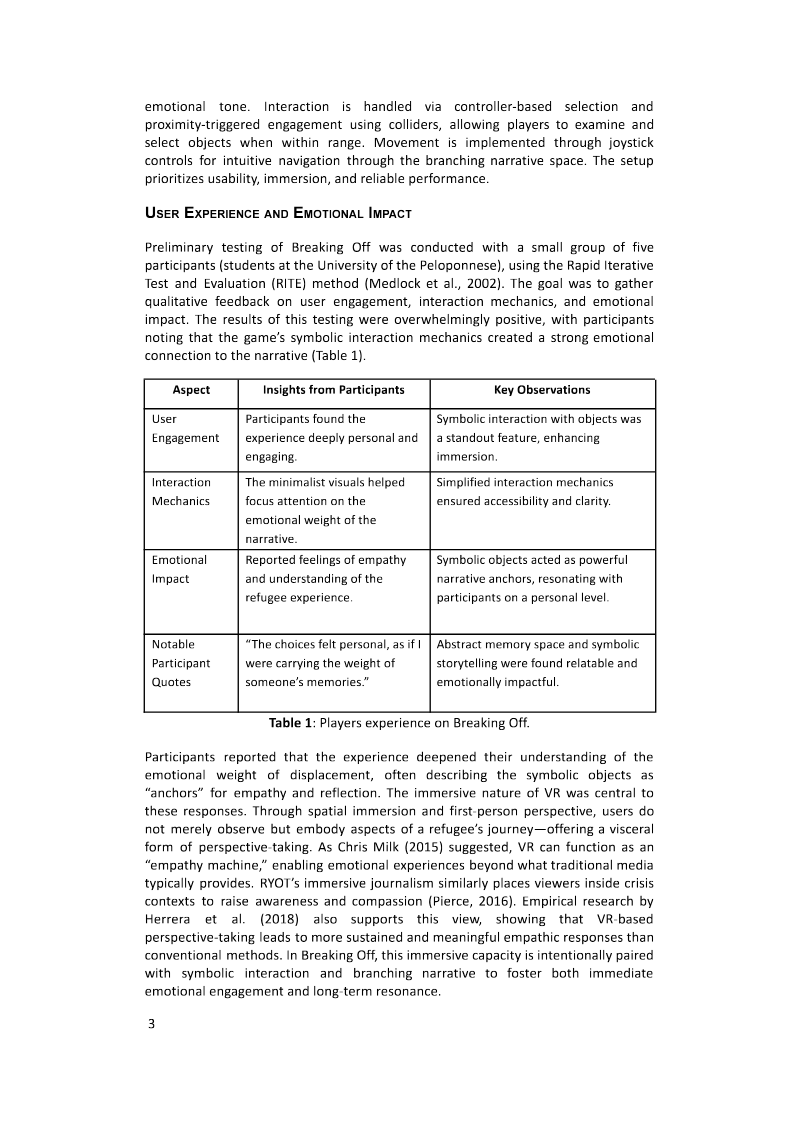
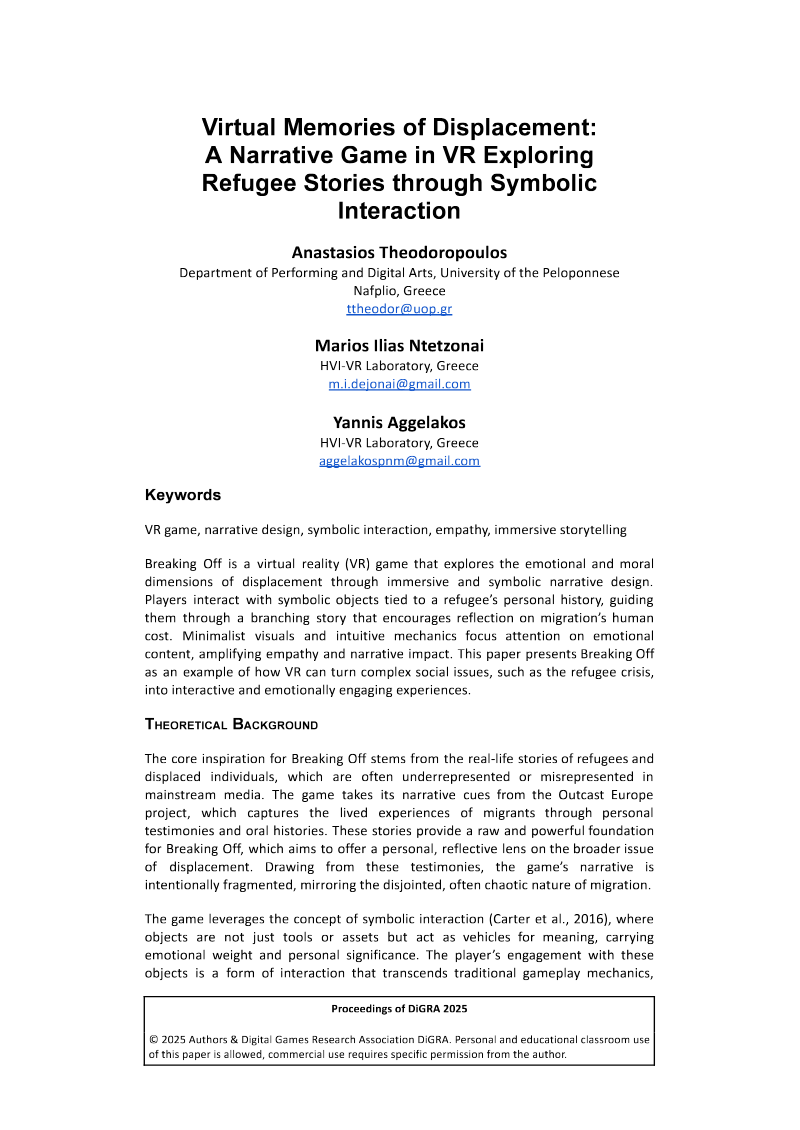
"Breaking Off" is a virtual reality narrative game that explores the emotional and moral dimensions of refugee displacement through symbolic interaction and branching storytelling.
- "Breaking Off" is a VR narrative game on refugee displacement that uses symbolic interaction, where objects like a backpack or family photograph carry personal meaning, paired with branching decisions that create personal responsibility without clear moral resolution.
- The game draws its narrative from migrant testimonies and oral histories, presenting a fragmented storyline meant to mirror the disordered nature of migration and move beyond the linear, passive formats of earlier VR refugee projects.
- Built in Unity for the Meta Quest 3 with custom Blender assets, the game uses a deliberately minimalist environment with sparse textures and restrained color, controller-based selection, proximity-triggered interaction, and adjustable accessibility settings.
Folklore-Driven Representations of Femininity in Slavic-Coded Video Games: The Figure of Baba Yaga
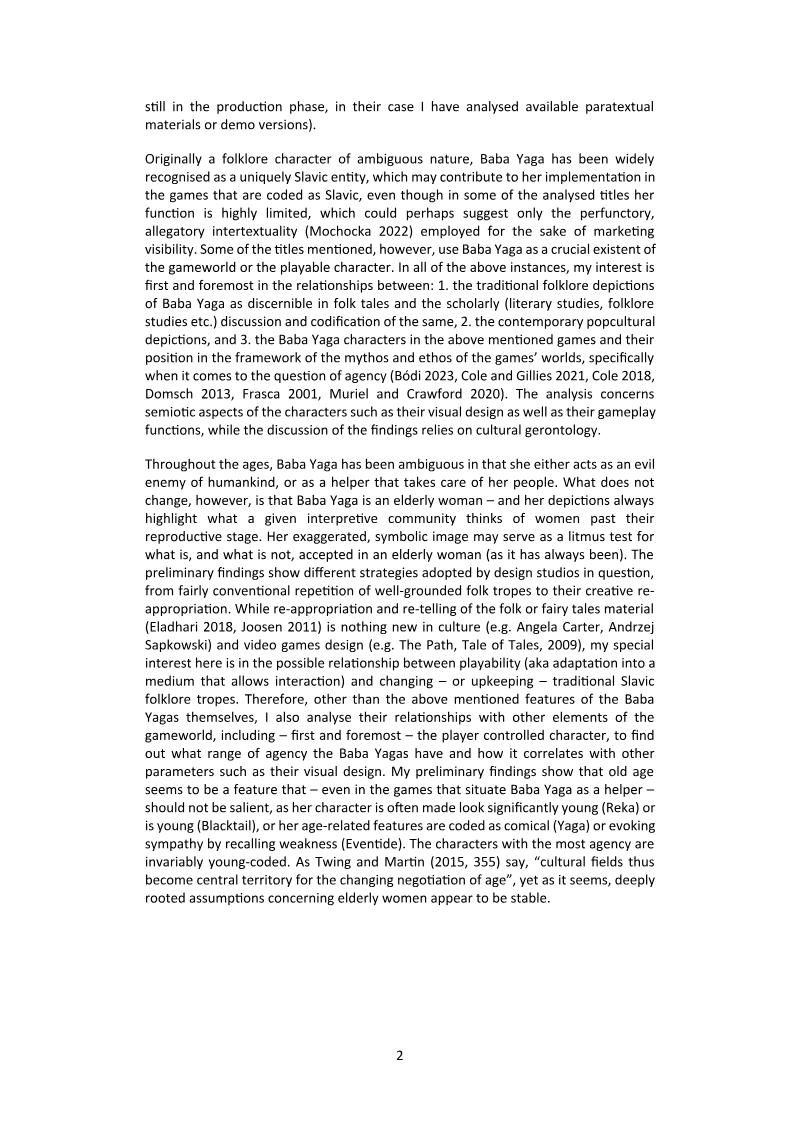
This paper examines how Baba Yaga, the ambiguous figure of Slavic folklore, is represented in a selection of Slavic-coded video games published or announced between 2015 and 2025.
- The study analyses eight Slavic-coded games released or announced between 2015 and 2025, including Eventide, Yaga, Black Book, Blacktail, Reka, Scarlett Deer Inn, Night is Coming, and The End of the Sun, some assessed via paratext or demos because they remain in production.
- Across the sample, old age is rarely foregrounded even when Baba Yaga appears as a helper; she is often rendered youthful or simply young.
- Where her aged features do appear, they are treated comically or designed to evoke sympathy through frailty.
Assassin's Creed Syndicate and the Depiction of Female "Britishness" in Victorian London
This paper examines how Assassin's Creed Syndicate (Ubisoft Quebec, 2015), a French-owned, Canadian-developed action-adventure game set in Victorian London, depicts female "Britishness," meaning the traditional cultural and social values associated with women in nineteenth-century Britain.
- The paper examines how Assassin's Creed Syndicate (Ubisoft Quebec, 2015), a French-owned, Canadian-developed game set in Victorian London, constructs gendered notions of female "Britishness" through its characters and setting, rather than approaching British identity from a national-representation standpoint.
- Its central focus is the dual protagonists Evie Frye and her antagonist counterpart Lucy Thorne, whom the analysis presents as embodying independence, ambition, and engagement with education and enterprise, in contrast to the subservient, domestic image of Victorian women.
- The wider game world features female leaders within gangs and organized crime, which the authors argue are not wholly anachronistic because female-led criminal groups and reported female involvement in violence existed in the period, though such portrayals may be read as tokenistic given the franchise's earlier criticism over female representation.
Playfully Conservative: Reinventing Nintendo's Platform Games through Materiality in Yoshi's Crafted World
This paper by Josef Tichý, presented at DiGRA 2025, argues that Nintendo's Yoshi's Crafted World (2019) reinvents the platform genre through physical, material-based textures such as cardboard, paper, and packaging, and that this aesthetic choice is best understood as a conservative production strategy.
- Tichý's DiGRA 2025 paper argues that Yoshi's Crafted World (2019) reinvents the platform genre through material textures like cardboard, paper, and packaging, and that this is best understood as a conservative production strategy.
- The game blends traditional Japanese forms, including mingei folk crafts, shinden-zukuri architecture, and Heian-period imagery, with modern consumer materials, creating a landscape that reads either as a dreamlike space or a modern wasteland.
- The paper frames Nintendo's design philosophy as nostalgia-driven, cautious, and resistant to innovation since the 1983–1984 video game crash, with Yoshi's Crafted World recycling familiar gameplay while updating its surface aesthetics.