
Report5 pages
East vs. West: Monetization Trends
The study examines how mobile gaming spending patterns differ between Eastern and Western markets, focusing on frequency of purchases, average spend per transaction, and motivational drivers. Findings reveal that Eastern gamers purchase in‑app items more often than Western players; 35 % of East spend frequently versus 36 % in the West, with a higher proportion of occasional and rare spenders in the West. When it comes to transaction size, Eastern users tend to pay more per purchase: 76 % spend over $10 compared with only 42 % of Western users, while a smaller share of East spend under $5 (30 %) versus 8 % in the West. Motivational analysis shows that Western gamers prioritize value and bundles, whereas Eastern players are more attracted to exclusivity, limited‑time items, new offers, and character acquisition. The research covers key markets in Asia—Korea and Japan—and Western regions including the United States, United Kingdom, and broader Europe. Data were collected through a survey of mobile gamers across these regions, with sample sizes sufficient to compare spending behaviors and motivations. The report concludes that monetization strategies should be tailored regionally: value‑based bundles may resonate better in the West, while exclusive content and limited editions could drive higher spend in Eastern markets.
- Eastern mobile gamers demonstrate a significantly higher propensity for large transactions, with 76% of purchases exceeding $10 compared to only 42% in Western markets.
- Western mobile gamers are more likely to make small-scale purchases, with 8% of spenders in the West opting for transactions under $5, contrasted with 30% in the East.
- Monetization strategies in the West should prioritize value-based bundles, as these resonate more effectively with the purchasing preferences of Western players.
- Eastern markets, specifically Korea and Japan, show a stronger consumer preference for exclusivity, limited-time offers, and character acquisition.
- Purchase frequency remains relatively balanced across regions, with 35% of Eastern gamers and 36% of Western gamers identified as frequent spenders.
+5
Mistplay

Whitepaper41 pages
What Good Are AI NPCs?: Lessons from a Large-scale Player Study
The study demonstrates that generative AI‑driven non‑player characters can deliver deeply engaging, emotionally resonant gameplay. In a 122‑hour experiment with 68 participants, the “Dead Meat” demo achieved high immersion scores—97 % UES reward and 94 % focused attention—while keeping mental demand low (NASA‑TLX scores of 64.7 for demand and 52.7 for performance). Qualitative interviews consistently cited the NPCs’ human‑like dialogue and narrative depth as key contributors to player enjoyment.
Quantitative data confirm widespread satisfaction: 96 % of players rated overall enjoyment as high, and 90 % praised the creative freedom afforded by the open‑ended design. Subscale analysis of the GUESS instrument revealed that 60 % achieved a top score for Creative Freedom, 65 % for Personal Gratification, and 80 % for Play Engrossment. Thematic coding identified freedom of expression, challenge‑driven motivation, and immersive conversation as primary drivers of satisfaction, indicating that the game successfully balances agency with sufficient guidance.
Player behavior analysis uncovered seven distinct strategic approaches—such as “Good Cop/Bad Cop” interrogation, “Rule Bender End Justifies the Means,” and “Smart Arse” manipulation—often combined within a single session. Participants responded equally to voiced and text‑based NPCs, and the 20‑minute session length encouraged replayability through role‑playing different characters. Although the brief duration limited long‑term insight, emergent strategies were viewed as a feature rather than a flaw. Future research will explore how authorial adjustments influence player responses across demographic groups, reinforcing the potential of AI NPCs to enrich narrative gameplay on a broad scale.
- Generative AI NPCs drive high player engagement, with 97% of participants reporting high immersion and 96% rating their overall enjoyment as high.
- The integration of AI NPCs maintains a balance between agency and guidance, as evidenced by 80% of players achieving top scores for play engrossment and 90% praising the creative freedom of the open-ended design.
- Cognitive load remains manageable during AI-driven interactions, with participants reporting NASA-TLX mental demand scores of 64.7 and performance scores of 52.7.
- Players adopt diverse, emergent interaction strategies, including interrogation, manipulation, and rule-bending, which suggests that AI NPCs support complex, role-playing-heavy gameplay.
- Player satisfaction is consistent across communication formats, as participants responded equally well to both voiced and text-based AI NPC interactions.
+2
University of Bristol
Report13 pages
Half-Yearly Report: 2014
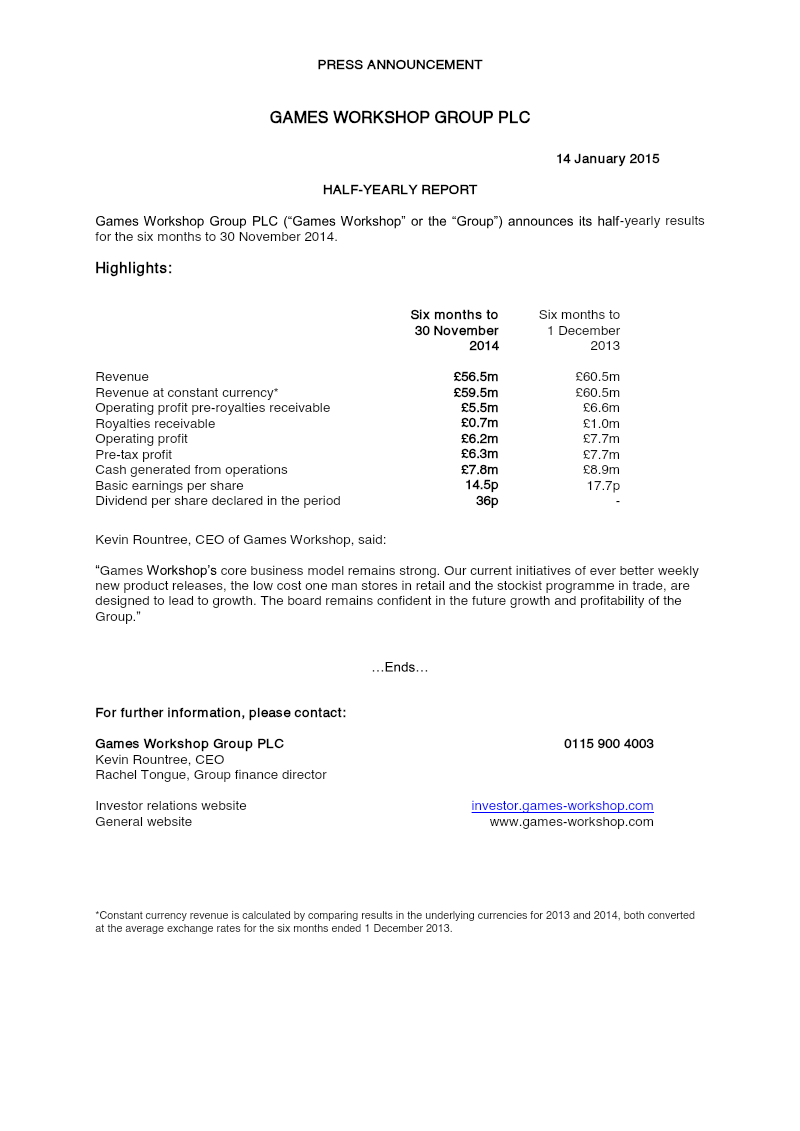
Games Workshop Group PLC (“Games Workshop” or the “Group”) announces its half-yearly results for the six months to 30 November 2014. Six months to Six months to Revenue £56.5m £60.5m Revenue at constant currency £59.5m £60.5m Operating profit pre-royalties receivable £5.5m £6.6m Royalties receivable £0.7m £1.0m Operating profit ...
- Games Workshop Group PLC reported a 6.6% decline in revenue to £56.5 million for the six months to November 30, 2014, compared to £60.5 million in the prior year, with a constant currency decline of 1.7%.
- Operating profit decreased to £6.2 million from £7.7 million in the previous year, and pre-tax profit also fell to £6.3 million from £7.7 million.
- Basic earnings per share dropped to 14.5p from 17.7p, although a dividend of 36p per share was declared in the period, compared to none in the prior period.
- Retail sales declined by 9.7% (£2.4 million) due to restructuring in North America and Continental Europe, and reduced sales from the Nottingham Visitor Centre; Trade sales also fell by 5.1% (£1.2 million).
- Operating expenses were reduced by £3.2 million, including £2.7 million from retail channel costs and £1.0 million from the Continental European reorganization, resulting in a core business operating margin of 9.8% (down from 11.0% in 2013).
+1
Games Workshop Group
Report14 pages
Half-Yearly Report and Trading Update: 2015-2016
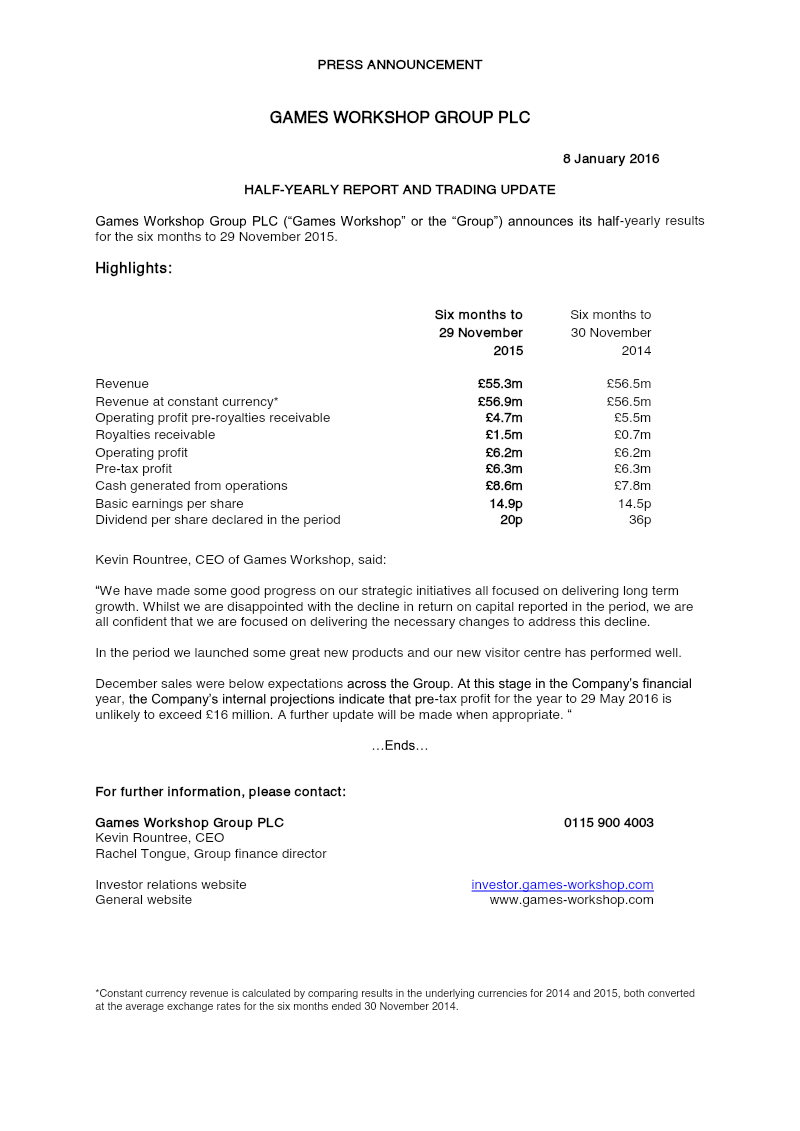
HALF-YEARLY REPORT AND TRADING UPDATE Games Workshop Group PLC (“Games Workshop” or the “Group”) announces its half-yearly results for the six months to 29 November 2015. Six months to Six months to 29 November 30 November 2015 2014 Revenue £55.3m £56.5m Revenue at constant currency £56.9m £56.5m Operating profit pre-royalties receivable ...
- Games Workshop's pre-tax profit for the year to May 29, 2016, is projected to be no more than £16 million, and December sales were below expectations across the Group.
- Revenue for the six months to November 29, 2015, decreased to £55.3 million from £56.5 million in the prior year, though it increased to £56.9 million at constant currency.
- Operating profit remained flat at £6.2 million for the six months to November 29, 2015, compared to the previous year, but core business operating profit (pre-royalties) fell by £0.8 million to £4.7 million.
- Return on capital declined from 38% in November 2014 to 36% in November 2015, attributed to increased average capital employed and a decline in operating profit before royalties.
- Royalties receivable from licensing significantly increased from £0.7 million to £1.5 million in the period.
+1
Games Workshop Group
Report16 pages
Half-Yearly Report: 2017
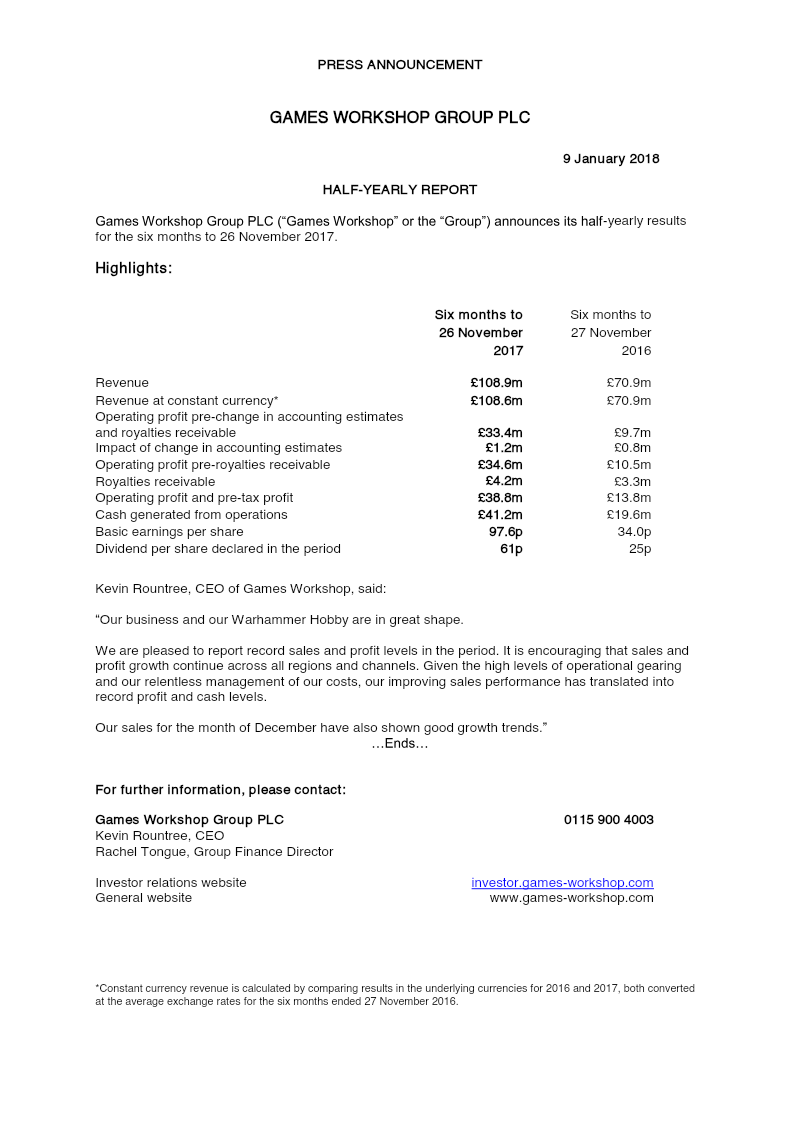
Games Workshop Group PLC (“Games Workshop” or the “Group”) announces its half-yearly results for the six months to 26 November 2017. 26 November 27 November Revenue £108.9m £70.9m Revenue at constant currency £108.6m £70.9m Operating profit pre-change in accounting estimates and royalties receivable £33.4m £9.7m Impact of change in accounting estimates ...
- Games Workshop Group PLC reported record sales and profit for the six months to November 26, 2017, with revenue increasing by 53.6% to £108.9 million (from £70.9 million in 2016) and operating profit soaring by 181.2% to £38.8 million (from £13.8 million in 2016).
- This strong performance translated into significantly higher earnings per share, which rose from 34.0p in 2016 to 97.6p in 2017, and a substantial increase in dividends declared, from 25p to 61p per share.
- Growth was broad-based, with sales and profit increasing across all regions and channels, including a 71% rise in online shop sales and a 22% increase in digital publication sales through Apple, with new distribution channels like Amazon and Audible also launched.
- The company's focus on its 'Warhammer Hobby' and continuous improvement of its miniatures range, combined with effective cost management, contributed to these record financial results and strong cash generation (£41.2 million from operations).
- Games Workshop also saw significant growth in its Trade segment (up 63.5% to £47.96 million) and Mail Order segment (up 71.2% to £21.28 million) in external revenue for the period.
+2
Games Workshop Group
Report16 pages
Half-Yearly Report: Six Months to 1 December 2019
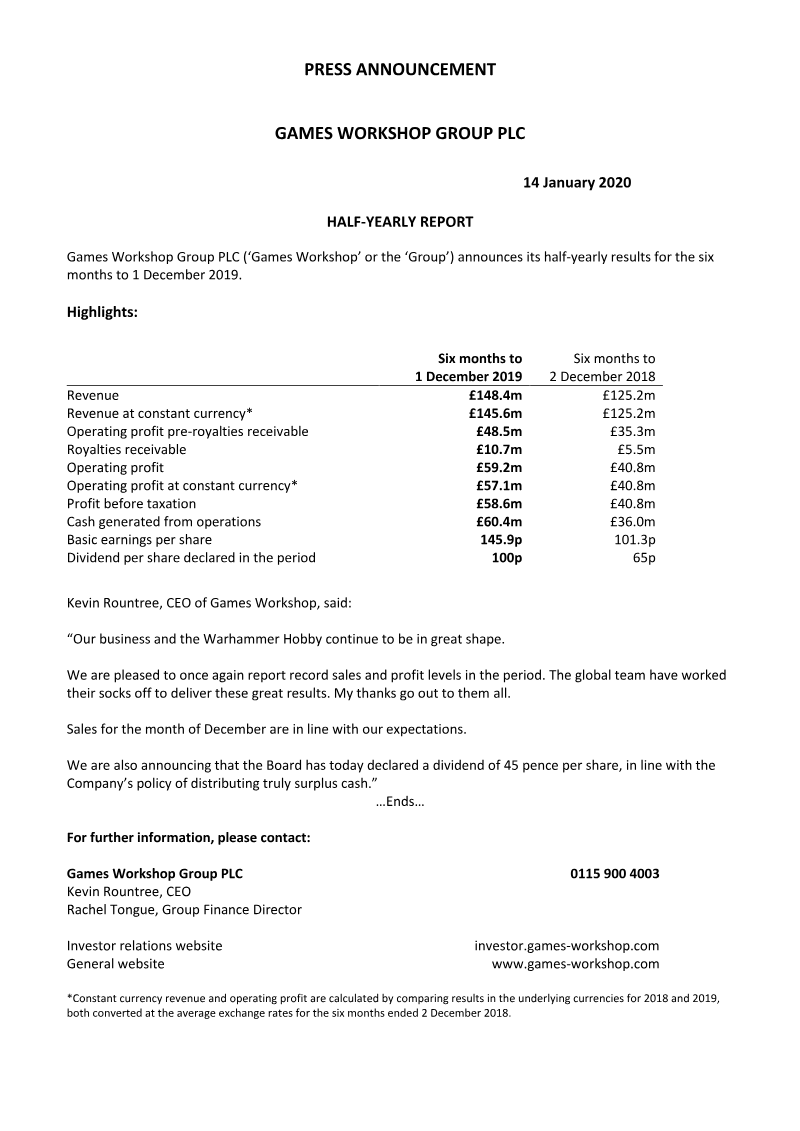
Games Workshop Group PLC (‘Games Workshop’ or the ‘Group’) announces its half-yearly results for the six Six months to Six months to 1 December 2019 2 December 2018 Revenue £148.4m £125.2m Revenue at constant currency £145.6m £125.2m Operating profit pre-royalties receivable £48.5m £35.3m Royalties...
- Games Workshop Group PLC reported record sales and profit for the six months ending December 1, 2019, with revenue increasing by 19% to £148.4 million (16% at constant currency) and operating profit rising to £59.2 million from £40.8 million in the prior year.
- Profit before taxation increased by £17.8 million to £58.6 million, and basic earnings per share grew to 145.9p from 101.3p.
- Licensing income (royalties receivable) significantly increased by £5.2 million to £10.7 million, including £6.2 million from new license contracts, compared to £1.6 million in the previous year.
- Sales growth was observed across all channels: Trade (£76.1 million), Retail (£45.3 million), and Online (£24.2 million).
- The company declared dividends of 100p per share during the period, including a new dividend of 45 pence per share, and invested £5.7 million in capital projects.
+2
Games Workshop Group
Report17 pages
Half-Yearly Report: 29 November 2020
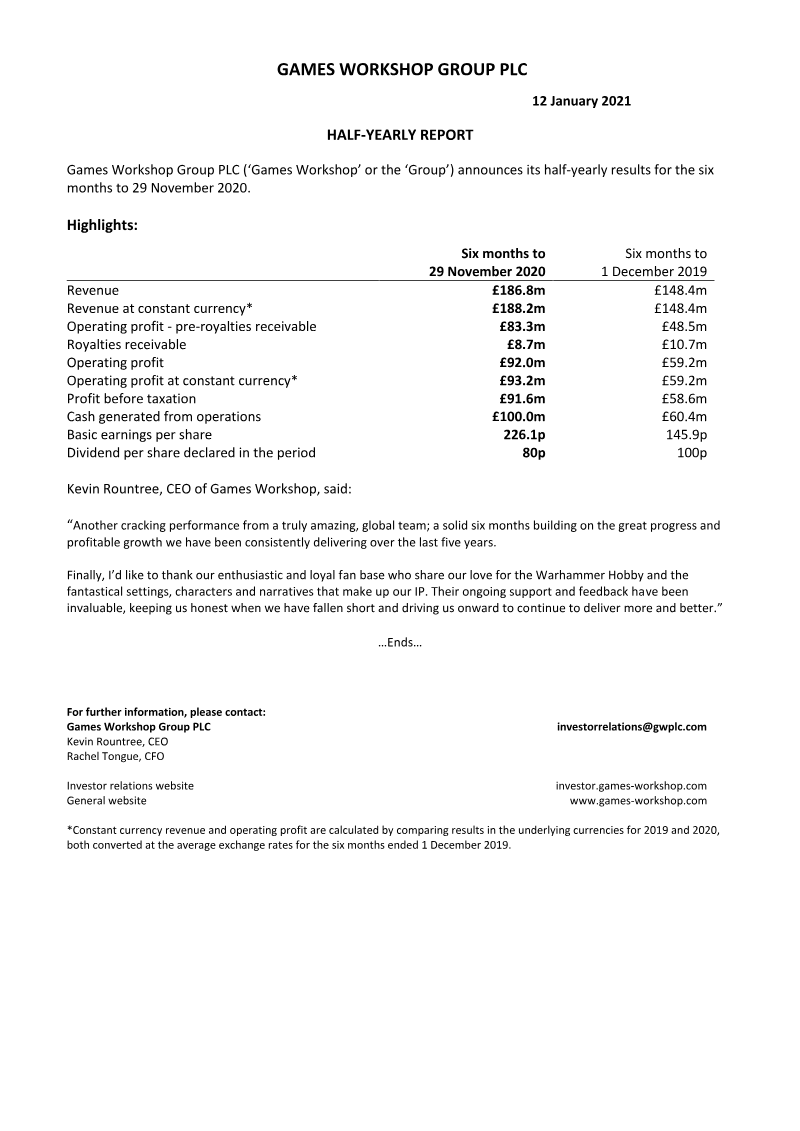
Games Workshop Group PLC (‘Games Workshop’ or the ‘Group’) announces its half-yearly results for the six Six months to Six months to 29 November 2020 1 December 2019 Revenue £186.8m £148.4m Revenue at constant currency £188.2m £148.4m Operating profit - pre-royalties receivable £83.3m ...
- Games Workshop Group PLC reported significant growth for the six months to November 29, 2020, with revenue increasing to £186.8m from £148.4m in the prior year, and operating profit rising to £92.0m from £59.2m.
- Profit before taxation for the period reached £91.6m, up from £58.6m, and basic earnings per share grew to 226.1p compared to 145.9p in the previous year.
- Sales growth was strong across all channels, with trade sales up 33%, online sales up 87%, and retail sales broadly following government lockdown rules, contributing to a 26% overall sales increase.
- The company achieved a 75% gross margin, a 6% increase, driven by higher volumes, and maintained a controlled cost-to-sales ratio of 28% (excluding group profit share and discretionary bonus), down from 36% in 2019.
- Manufacturing output increased by 30% compared to the same period last year, with the new Warhammer 40,000 launch breaking production volume records, and the company is expanding its manufacturing capacity with a new factory nearing completion and securing additional land.
+2
Games Workshop Group
Report21 pages
Half-Yearly Report: 2024–2025
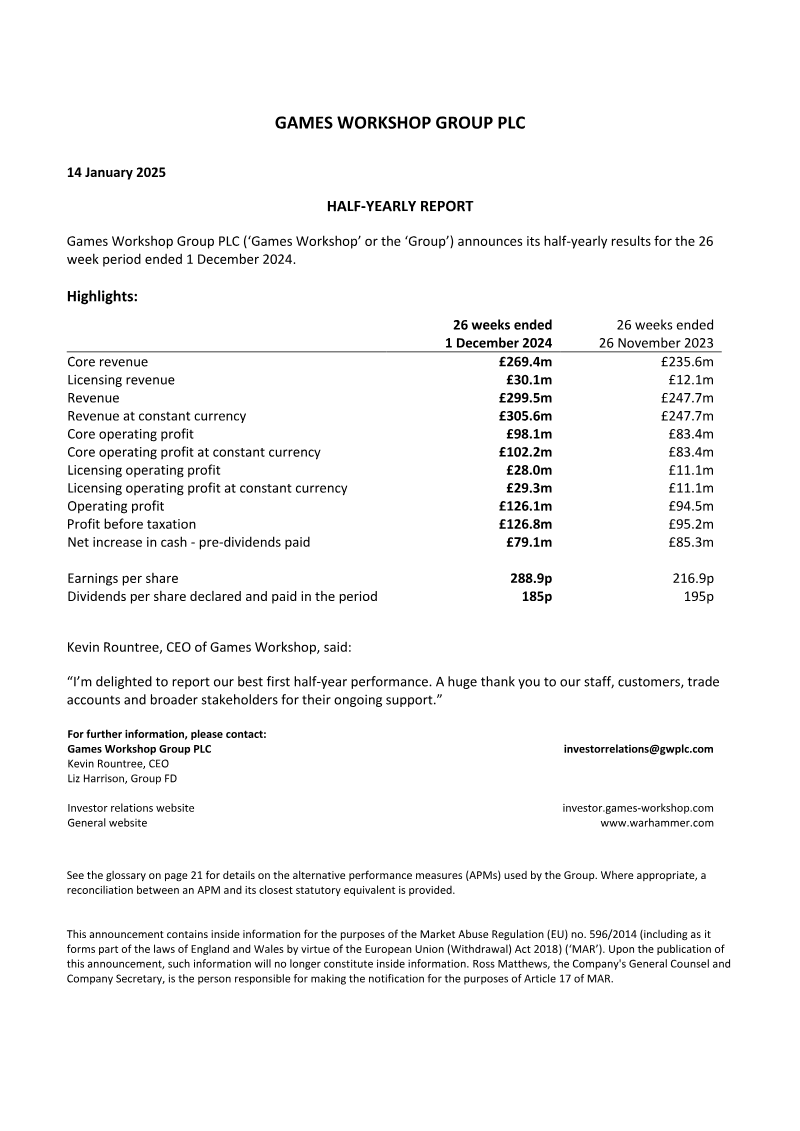
Games Workshop Group PLC (‘Games Workshop’ or the ‘Group’) announces its half-yearly results for the 26 week period ended 1 December 2024. 26 weeks ended 26 weeks ended 1 December 2024 26 November 2023 Core revenue £269.4m £235.6m Licensing revenue £30.1m £12.1m Revenue £299.5m £247.7m Revenue at cons...
- Games Workshop Group PLC reported its best first half-year performance for the 26 weeks ended December 1, 2024, with total revenue reaching £299.5m, up from £247.7m in the prior year.
- Operating profit significantly increased to £126.1m for the 26 weeks ended December 1, 2024, compared to £94.5m in the same period last year, with profit before taxation at £126.8m.
- Core revenue grew by 14.3%, driven by strong performance in Trade (+21.7%) and Retail (+11.2%), although Online revenue decreased by 4.2%.
- Licensing revenue saw substantial growth, increasing from £12.1m to £30.1m, with licensing operating profit rising from £11.1m to £28.0m.
- Earnings per share rose to 288.9p for the 26 weeks ended December 1, 2024, up from 216.9p in the previous year.
+3
Games Workshop Group
Report14 pages
FY24 Interim Results: Frontier Developments
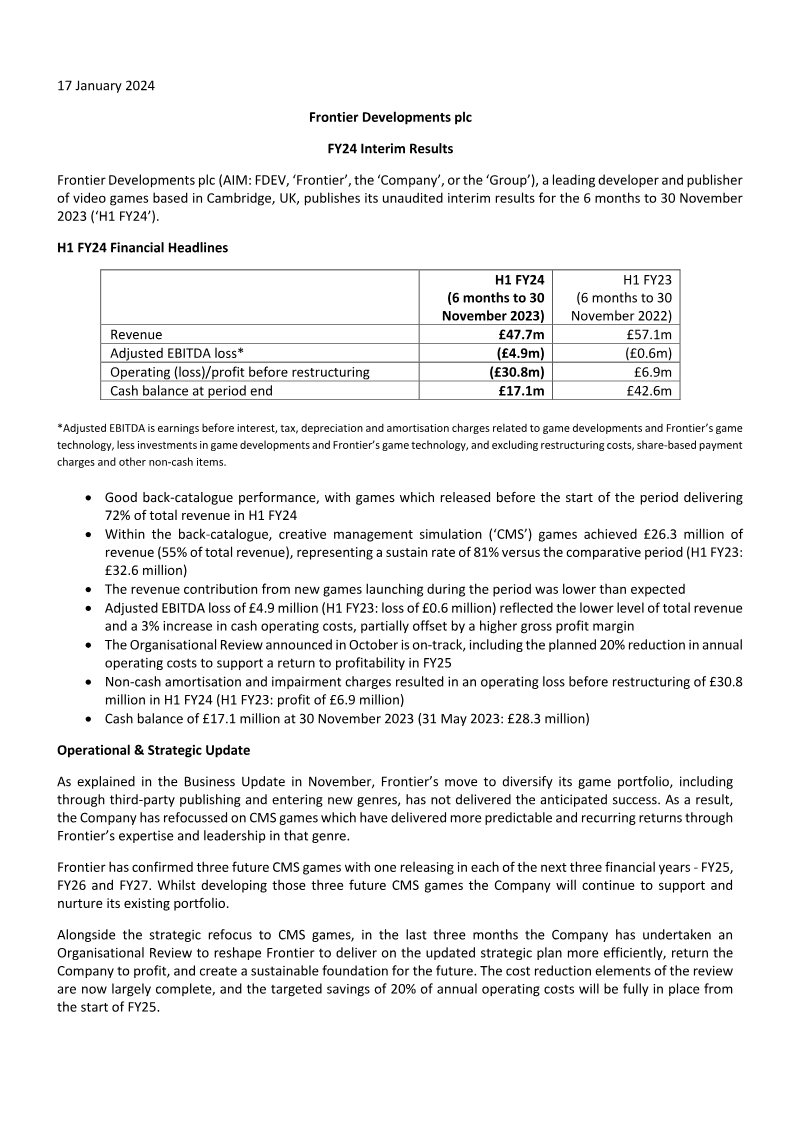
Frontier Developments plc (AIM: FDEV, ‘Frontier’, the ‘Company’, or the ‘Group’), a leading developer and publisher of video games based in Cambridge, UK, publishes its unaudited interim results for the 6 months to 30 November (6 months to 30 (6 months to 30 November 2023) November 2022) Revenue £47.7m £57.1m Adjusted EBITDA loss (£4.9m) (£0.6m) Operating (...
- Frontier Developments experienced a significant financial downturn in H1 FY24 (6 months to 30 November 2023), reporting a £33.1 million loss after tax compared to a £6.7 million profit in H1 FY23, and an operating loss of £30.8 million versus a £6.9 million profit in H1 FY23.
- Revenue decreased to £47.7 million in H1 FY24 from £57.1 million in H1 FY23, primarily due to lower-than-expected contributions from new game launches and a full impairment charge of £16.9 million for 'Realms of Ruin'.
- The company's cash balance significantly reduced to £17.1 million at November 30, 2023, down from £42.6 million in H1 FY23, though it increased to £19.9 million by December 31, 2023, after receiving subscription fees.
- Frontier is strategically refocusing on Creative Management Simulation (CMS) games, with three new CMS titles planned for release in FY25, FY26, and FY27, building on the strong performance of existing CMS games which generated £26.3 million (55% of total revenue) in H1 FY24.
- An organizational review led to cost reduction efforts, targeting 20% savings in annual operating costs by the start of FY25, with a £2.5 million restructuring charge recorded in H1 FY24.
+2
Frontier Developments

Report94 pages
Annual Report and Accounts 2024
ANNUAL REPORT AND ACCOUNTS 2024 30 YEARS OF HEADLINES CONTENTS CREATIVITY, STRATEGIC REPORT See a summary of the headlines for FY24, 01 Headlines INNOVATION AND ...
- Frontier plans to release three self-published CMS (Creative Management Simulation) games in the next three consecutive financial years: Planet Coaster 2 in autumn 2024 (FY25), a new Jurassic World game in FY26, and a third unannounced CMS game in FY27.
- Frontier reported a loss before taxation of £28.425 million for the 12 months ending May 31, 2024, an increase from £26.509 million in the previous year.
- Net cashflows from operating activities decreased to £31.625 million in FY24 from £47.875 million in FY23, while net cashflows used in investing activities improved to (£27.868 million) from (£52.310 million).
- The company incurred £1.4 million in costs from an Organizational Review in FY24, primarily due to redundancy costs, compared to £nil in FY23.
- Frontier's total unrecognised tax losses increased to £109.5 million at May 31, 2024, from £80.2 million at May 31, 2023, with these losses having no expiry date.
+3
Frontier Developments
Report13 pages
FY25 H1 Results: A Strong Turnaround
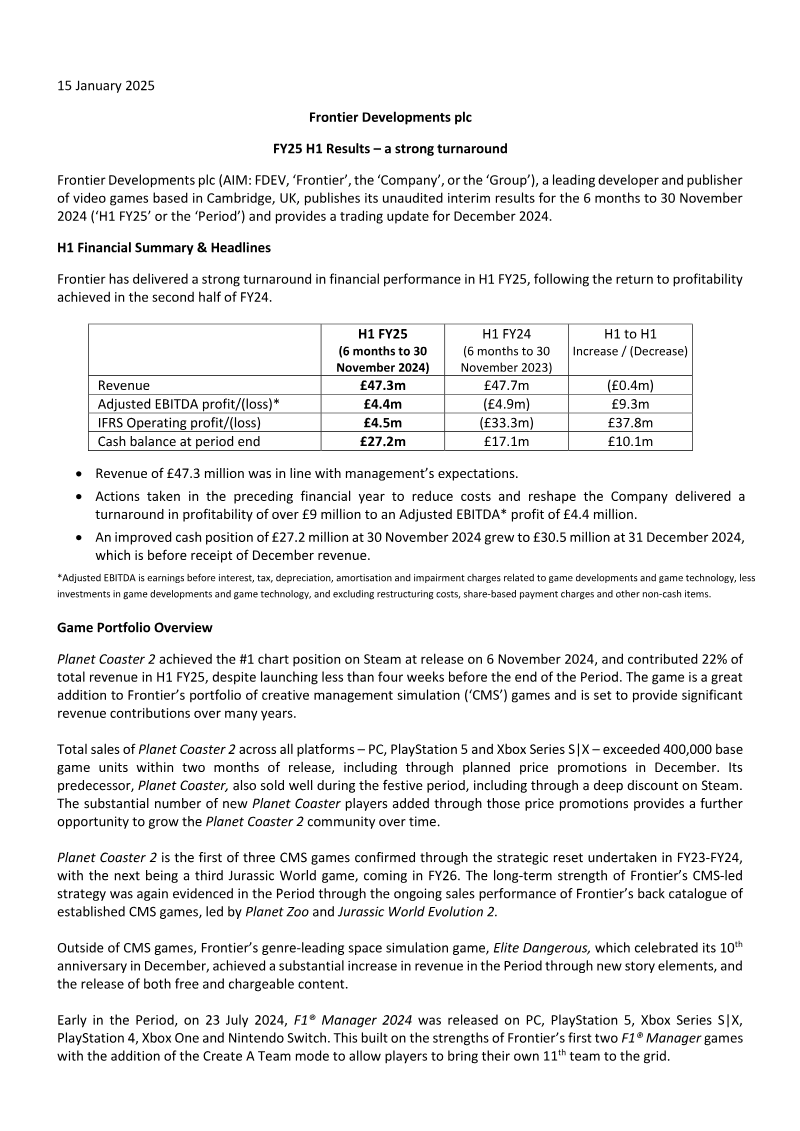
Frontier Developments plc reported a robust turnaround in its first half of FY25, with revenue of £47.3 million nearly matching the prior year’s £47.7 million and an adjusted EBITDA profit of £4.4 million, a swing from a £4.9 million loss in H1 FY24. Operating profit rose to £4.5 million from a £33.3 million loss, driven by significant cost reductions following an organisational review and the closure of Frontier Foundry. Cash reserves strengthened to £27.2 million at 30 November, rising to £30.5 million by 31 December after the November launch of Planet Coaster 2.
Planet Coaster 2, released on 6 November, dominated the period by contributing 22% of total revenue and selling over 400,000 base‑game units across PC, PS5, and Xbox Series platforms within two months. The game’s launch reinforced the company’s CMS strategy, supported by strong sales of existing titles such as Planet Zoo and Jurassic World Evolution 2. Elite Dangerous also saw revenue growth through new story content, while F1® Manager 2024 added a fresh title to the portfolio.
Cost efficiencies were evident: adjusted operating costs fell 25% to £28.5 million, R&D expenses dropped 21% to £19.5 million, and marketing and administrative costs declined 32%. Gross profit margin improved to 70% from 69%, reflecting a favourable revenue mix.
The company maintains a positive outlook for FY25, citing continued momentum from the CMS lineup and upcoming releases. Management expressed confidence in sustaining profitability and capitalising on planned content updates, while acknowledging subscription deal timing as a variable factor. Overall, the interim results demonstrate that Frontier’s strategic reset and disciplined cost management have restored profitability and positioned the firm for continued growth in the competitive video‑game market.
- Frontier Developments achieved a significant financial turnaround in H1 FY25, swinging from a £4.9 million EBITDA loss in the prior year to a £4.4 million profit.
- Operating profit reached £4.5 million, a substantial recovery from the £33.3 million loss reported in H1 FY24, driven by aggressive cost-cutting measures and the closure of the Frontier Foundry division.
- The November 6 launch of Planet Coaster 2 generated 22% of total H1 revenue, selling over 400,000 units across PC, PS5, and Xbox Series platforms within two months.
- Disciplined cost management reduced adjusted operating costs by 25% to £28.5 million, with R&D expenses falling 21% and administrative/marketing costs dropping 32%.
- Cash reserves strengthened to £30.5 million by December 31, 2024, up from £27.2 million at the end of November.
+1
Frontier Developments
Report3 pages
FY25 Trading Update: Strong Results and Increased Momentum
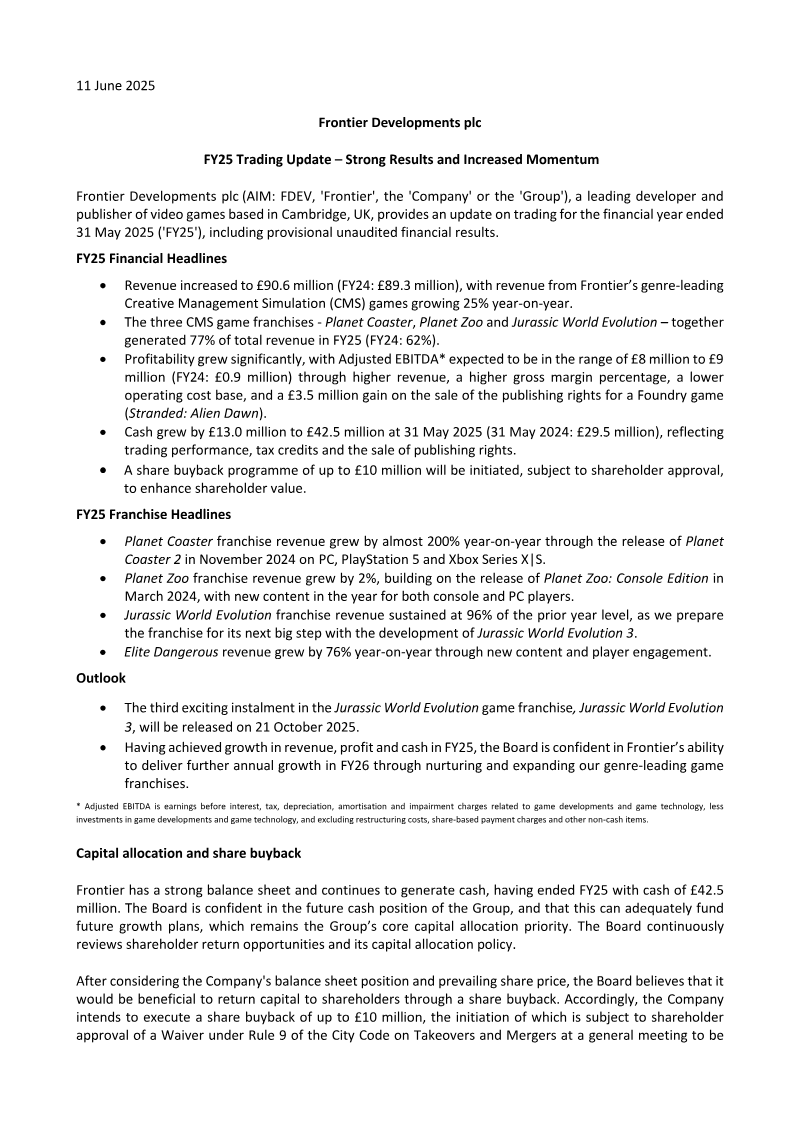
Frontier Developments plc reports a modest revenue rise to £90.6 million for FY25, up from £89.3 million in FY24, driven by a 25 % year‑on‑year increase in its Creative Management Simulation (CMS) titles. The three flagship CMS franchises—Planet Coaster, Planet Zoo and Jurassic World Evolution—accounted for 77 % of total revenue in FY25, a jump from 62 % the previous year. Planet Coaster alone grew almost 200 % following the launch of Planet Coaster 2, while Planet Zoo and Jurassic World Evolution maintained near‑stable sales levels.
Profitability improved sharply; Adjusted EBITDA is projected between £8 million and £9 million, compared with a £0.9 million profit in FY24, thanks to higher gross margins, reduced operating costs and a £3.5 million gain from selling publishing rights to Stranded: Alien Dawn. Adjusted Operating Profit, a new metric effective FY26 that incorporates tax credits and reliefs, is expected to reach £11 million‑£12 million in FY25.
Cash position strengthened, with cash on hand rising to £42.5 million from £29.5 million at the end of FY24, supporting a planned share buyback up to £10 million pending shareholder approval. The board also announced the creation of an Executive Board to streamline decision‑making and highlighted the upcoming release of Jurassic World Evolution 3 on 21 October 2025 as a key growth driver.
- Frontier Developments achieved a significant increase in profitability, with projected Adjusted EBITDA rising to £8–£9 million from £0.9 million in FY24.
- Revenue grew to £90.6 million, driven by a 25% year-on-year increase in Creative Management Simulation (CMS) titles, which now account for 77% of total revenue.
- The launch of Planet Coaster 2 catalyzed a nearly 200% revenue increase for the Planet Coaster franchise.
- The company’s cash position strengthened to £42.5 million, up from £29.5 million, enabling a proposed £10 million share buyback.
- Profitability was bolstered by a £3.5 million gain from the sale of publishing rights to Stranded: Alien Dawn, alongside reduced operating costs.
+4
Frontier Developments
Report12 pages
Interim Results: H1 FY26
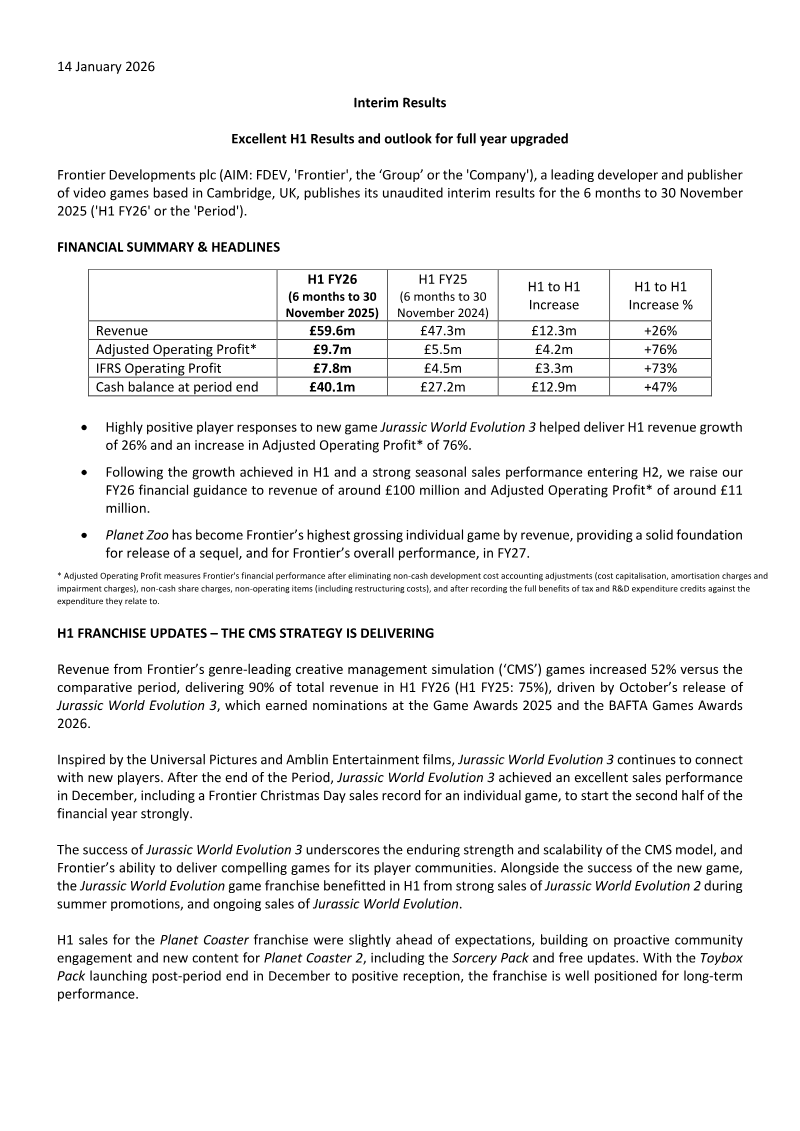
Frontier Developments plc reported unaudited interim results for the six months to 30 November 2025, showing a 26 % increase in revenue to £59.6 million and a 76 % rise in adjusted operating profit to £9.7 million compared with the same period in 2024. The growth was driven primarily by the launch of Jurassic World Evolution 3, which contributed 90 % of total revenue in H1 FY26 and earned nominations at the Game Awards 2025 and BAFTA Games Awards 2026. Other titles such as Planet Zoo, Planet Coaster 2 and Elite Dangerous also performed strongly, with Planet Zoo becoming the Group’s highest‑grossing individual game.
Cash profitability improved markedly; adjusted operating profit, which excludes non‑cash development capitalisation and includes tax and R&D credits, grew to £9.7 million from £5.5 million year‑on‑year. IFRS operating profit rose 73 % to £7.8 million. Gross margin fell to 64 % from 70 %, reflecting higher royalty‑bearing IP revenue. The Group’s cash balance increased to £40.1 million, up 47 % from the prior year, after a £10 million share buy‑back that raised earnings per share to 21.4 p.
The Board upgraded FY26 guidance, now targeting revenue of approximately £100 million and adjusted operating profit of around £11 million, citing strong seasonal sales momentum. CEO Jonny Watts stepped down on 1 January 2026, succeeded by Jo Cooke, with Watts remaining as Executive Director until 31 May 2026 to ensure a smooth transition. The Group remains debt‑free, with no significant liabilities beyond lease obligations, and maintains a robust pipeline of CMS titles slated for release in FY27–FY28.
- Frontier Developments reported a 26% revenue increase to £59.6 million and a 76% rise in adjusted operating profit to £9.7 million for H1 FY26, driven primarily by the launch of Jurassic World Evolution 3.
- Jurassic World Evolution 3 accounted for 90% of total revenue in H1 FY26, while Planet Zoo became the company's highest-grossing individual title.
- The Board upgraded full-year FY26 guidance to approximately £100 million in revenue and £11 million in adjusted operating profit, supported by strong seasonal sales momentum.
- Cash reserves grew 47% year-on-year to £40.1 million, even after executing a £10 million share buy-back that increased earnings per share to 21.4p.
- Gross margin declined from 70% to 64% due to a higher proportion of revenue generated from royalty-bearing intellectual property.
+4
Frontier Developments
Report2 pages
Current Report No. 40/2021: Investment Agreement with Square Enix Limited
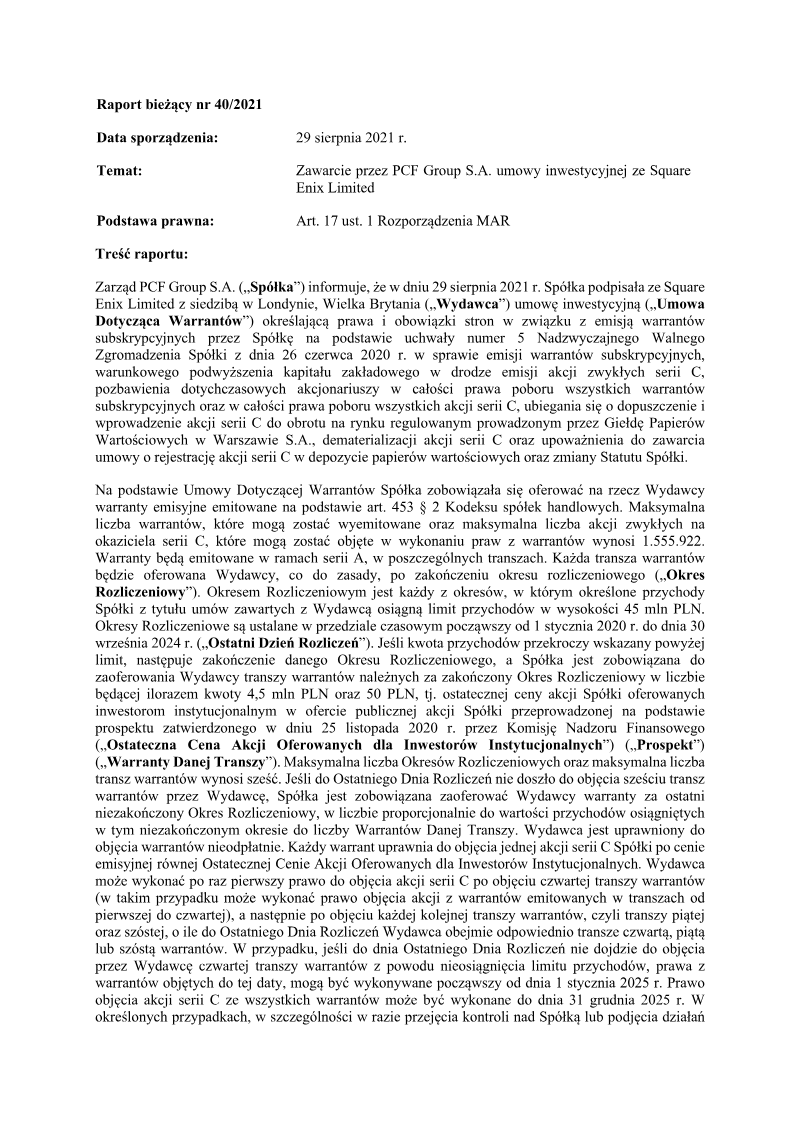
The report announces that PCF Group S.A. entered into an investment agreement with Square Enix Limited on 29 August 2021, formalizing the issuance of subscription warrants and related capital‑raising activities. The agreement stipulates that PCF will offer up to 1,555,922 warrants, each convertible into one Series C ordinary share, in up to six tranches linked to revenue milestones from contracts with Square Enix. Each tranche is released once cumulative contract revenue reaches a 45‑million‑PLN threshold, with the final tranche capped by 30 September 2024. The number of warrants per tranche is calculated as the ratio of 4.5 million PLN to the final share price offered in the public offering, ensuring a proportional allocation relative to revenue performance.
Square Enix may exercise its conversion rights after the fourth tranche and subsequently with each additional tranche, subject to a 31 December 2025 expiry. The agreement allows for accelerated tranching or conversion in events such as a change of control or delisting from the Warsaw Stock Exchange. Square Enix also retains an opt‑out clause, enabling it to relinquish conversion rights in exchange for compensation if the parties decide against further investment.
As of the report date, PCF’s revenue from Square Enix contracts exceeded 90 million PLN, triggering the obligation to offer two warrant tranches. The potential conversion of these warrants would represent roughly 1.8 % of PCF’s share capital, indicating a modest dilution impact. The agreement concludes prior negotiations that began with an initial memorandum of understanding on 31 July 2020, thereby formalizing the terms outlined in PCF’s prospectus.
- PCF Group S.A. entered an investment agreement with Square Enix Limited on 29 August 2021, establishing a mechanism for issuing up to 1,555,922 subscription warrants convertible into Series C ordinary shares.
- Warrant issuance is tied to revenue milestones from contracts with Square Enix, with each tranche triggered by cumulative revenue increments of 45 million PLN.
- As of the report date, PCF had already exceeded 90 million PLN in contract revenue, triggering an immediate obligation to offer two warrant tranches.
- The potential conversion of all 1,555,922 warrants represents a modest dilution of approximately 1.8% of PCF’s total share capital.
- Square Enix may exercise conversion rights starting after the fourth tranche, with all rights subject to a final expiry date of 31 December 2025.
+1
PCF Group
Report1 pages
Raport Bieżący Nr 44/2025: Zawarcie Warunkowego Porozumienia ze Spółką Square Enix Limited
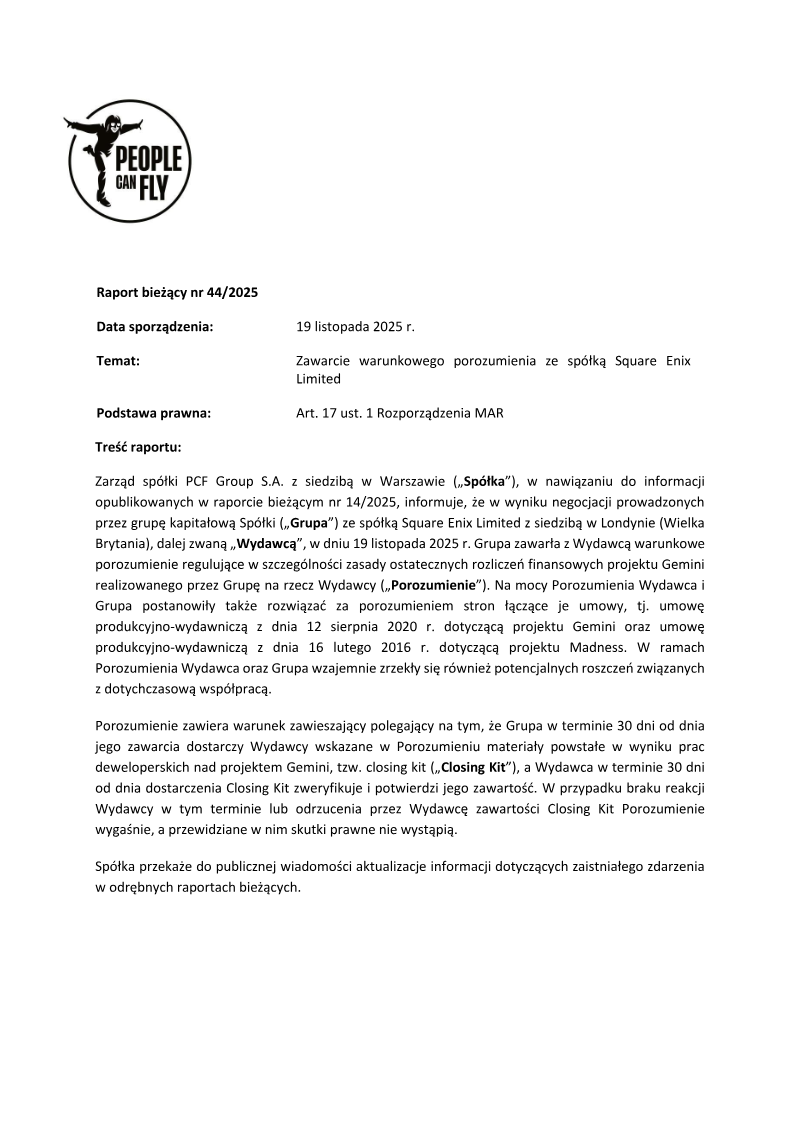
PCF Group S.A. has entered into a conditional agreement with Square Enix Limited to finalize the financial settlement of the Gemini project and formally terminate existing development and publishing partnerships. This agreement marks the conclusion of two long-standing collaborations, specifically the 2020 production-publishing contract for the Gemini project and the 2016 agreement concerning the Madness project. As part of this settlement, both parties have agreed to waive all potential claims arising from their previous professional relationship.
The effectiveness of this agreement is subject to a specific condition precedent involving the transfer of technical assets. PCF Group is required to deliver a comprehensive closing kit containing all development materials related to the Gemini project within 30 days of the agreement date. Square Enix Limited then has a subsequent 30-day window to verify and accept these materials. Should the publisher fail to respond or formally reject the contents of the closing kit, the agreement will expire, and the stipulated legal consequences, including the termination of the contracts and the waiver of claims, will not take effect.
This development represents a strategic shift in the operational relationship between the Warsaw-based developer and the London-based publisher. By resolving these outstanding project obligations, the parties aim to clear the path for future independence or alternative partnerships. The company intends to provide further updates as the verification process for the closing kit progresses and the final status of the agreement is confirmed.
- PCF Group S.A. and Square Enix Limited have signed a conditional agreement to formally terminate their 2020 Gemini project contract and 2016 Madness project agreement.
- The settlement includes a mutual waiver of all potential claims arising from the previous professional relationship between the two companies.
- The agreement is contingent upon PCF Group delivering a comprehensive closing kit of all Gemini project development materials within 30 days of the agreement date.
- Square Enix Limited has a 30-day window following the delivery of the closing kit to verify and accept the materials.
- If Square Enix fails to accept the closing kit or does not respond within the 30-day verification period, the agreement will expire and the contract terminations and claim waivers will not take effect.
+2
PCF Group

Report10 pages
Reconnecting with Gen Z Mobile Gamers: UK
Mobile gamers aged 18 to 24 represent a critical demographic for the UK gaming industry, characterized by high engagement levels but increasing volatility. While 79% of this cohort plays mobile games at least several times a week, their overall time investment is declining, dropping to an average of 4.4 hours per week. This shift is driven by intense competition from other digital entertainment channels, with 57% of Gen Z players reporting that social media, streaming, and short-form video content are actively displacing their mobile gaming time.
The research, based on an online survey of 1,605 UK residents, reveals that Gen Z exhibits significantly lower title loyalty than the general population. Approximately 57% of these players frequently rotate between games, constantly seeking new experiences. This churn is exacerbated by dissatisfaction with current industry practices; 71% of Gen Z players cite intrusive monetization and advertising as primary deterrents, while 62% feel there is a lack of fresh, appealing content in the current market.
To recapture this audience, developers must pivot toward discovery strategies rooted in social proof and authentic gameplay. Gen Z discovery is increasingly spontaneous, relying on creator content and peer recommendations rather than traditional marketing assets. Successful engagement strategies require front-loading immediate rewards, designing for shareable social moments, and implementing fair, non-intrusive monetization models. By prioritizing short-form satisfaction and consistent content updates, developers can better align with the fragmented attention spans and high expectations of this demographic, ultimately fostering more sustainable long-term retention.
- 71% of UK Gen Z mobile gamers cite intrusive monetization and advertising as the primary reason for abandoning games.
- Gen Z mobile gaming time is declining to an average of 4.4 hours per week as 57% of players shift their attention to social media, streaming, and short-form video.
- Title loyalty is low among this demographic, with 57% of players frequently rotating between games in search of new experiences.
- 62% of Gen Z players report a lack of fresh, appealing content in the current mobile gaming market.
- While 79% of 18- to 24-year-olds play mobile games at least several times a week, engagement is increasingly volatile and reliant on spontaneous discovery through creator content and peer recommendations.
+2
BryterJan 2026
Report45 pages
The Value of Esports in the UK
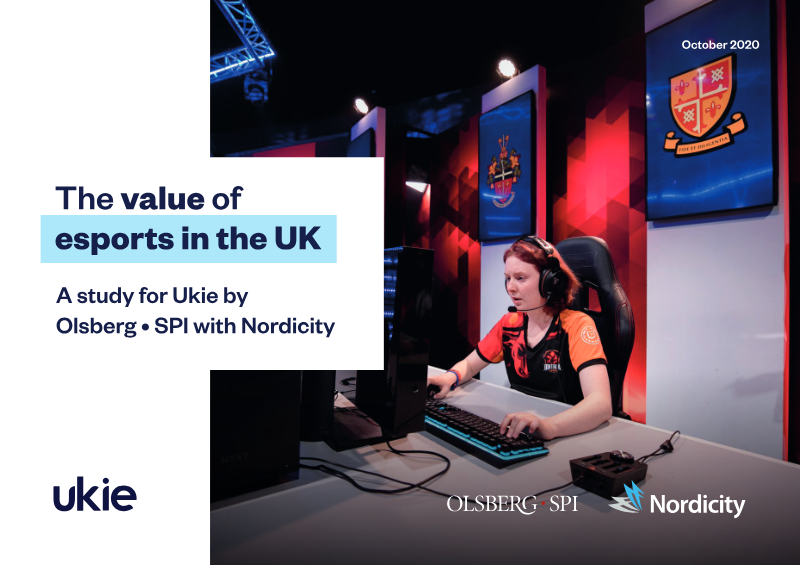
The study demonstrates that the United Kingdom’s esports industry has experienced robust growth, expanding at an average annual rate of 8.5 % between 2016 and 2019. In 2019 alone, the sector generated approximately £60 million in revenue—about eight per cent of global esports earnings—and contributed £111.5 million to the national Gross Value Added, supporting more than 1,200 full‑time equivalent jobs. These figures underscore the sector’s role as a significant driver of the UK digital creative economy.
Key drivers identified include the proliferation of professional teams, high‑profile tournaments hosted by organisations such as ESL, Gfinity and Epic.LAN, and the rise of streaming platforms that have broadened audience reach. Dedicated venues like Belong Gaming Arenas further stimulate grassroots participation and local economic activity. Modelling of direct, indirect and induced effects reveals a total impact of roughly 216 FTEs and £19.5 million in GVA, while spill‑over benefits from event tourism—estimated at £234 k per 1,000 visitors and nearly five FTEs—highlight additional value for host communities.
The analysis projects that hosting a major global esports event could add 238 full‑time equivalents and £12 million in GVA to the UK economy, signalling substantial upside potential. The findings point to opportunities for further investment, clearer regulatory frameworks and strategic positioning to attract international events, thereby consolidating esports as a pivotal growth sector within the United Kingdom’s broader digital economy.
- In 2019, the UK esports industry generated £60 million in revenue and contributed £111.5 million to the national Gross Value Added (GVA), supporting over 1,200 full-time equivalent (FTE) jobs.
- The sector experienced robust growth between 2016 and 2019, expanding at an average annual rate of 8.5%.
- Hosting a single major global esports event is projected to add £12 million in GVA and 238 FTE jobs to the UK economy.
- Event tourism provides significant spill-over benefits, estimated at £234,000 in economic value and nearly five FTEs per 1,000 visitors.
- Key industry drivers include professional tournament organizers such as ESL, Gfinity, and Epic.LAN, alongside the expansion of streaming platforms and physical infrastructure like Belong Gaming Arenas.
UkieDec 2025

Report46 pages
Esports 2023: Challenges and Opportunities in the UK
The report argues that the United Kingdom’s esports sector has evolved from a fragmented niche into a rapidly professionalised ecosystem, yet it still requires coordinated investment and policy to sustain growth. Key findings show an audience of roughly 55 million adults, with 82.7 % aged 18‑34 and a male dominance of 83 %. While shooters such as Call of Duty, CS:GO and Fortnite command the largest viewership, only 3.8 % of gamers follow competitive play, revealing a small “iceberg” of engaged fans. This gap highlights opportunities for talent development and global brand expansion, especially as the UK lags behind U.S. and Asian markets in producing top‑tier professionals.
Economic data underscore the sector’s momentum: gross value added reaches £111 million and sponsorship revenue exceeds $1.38 billion, with UK events and teams capturing a $1.5 billion share of the global market. Major brands—Intel, Red Bull, Saudi PIF—and tournament operators such as ESL, FACEIT and Gfinity are driving investment, while infrastructure projects by XLHQ, Royal Ravens and Cloud9 create dedicated studios and community hubs. Educational initiatives, including a BTEC programme with Pearson and university leagues like NUEL, demonstrate that esports can boost computing engagement and skill development among 10 000 pupils.
Despite these gains, challenges persist. Mainstream media coverage remains limited, and government support is uneven, constraining broader recognition of esports as a legitimate sport. Diversity and inclusion remain under‑addressed, with female participation at 17 % and a need for stronger links between education, industry and policy to create sustainable career pathways. Emerging monetisation models—Web3, NFTs, metaverse experiences—offer new revenue streams but require regulatory clarity and infrastructure investment. Coordinated action across stakeholders is essential to unlock the UK’s full economic and cultural potential in esports.
- The UK esports sector generates £111 million in gross value added, with UK-based teams and events capturing a $1.5 billion share of the global market.
- While the UK has a potential audience of 55 million adults, only 3.8% of gamers follow competitive play, indicating a significant opportunity for fan base expansion.
- The demographic profile of the UK esports audience is highly concentrated, with 82.7% aged 18–34 and 83% male, highlighting a need for improved diversity and inclusion efforts.
- Major investment is being driven by global brands like Intel, Red Bull, and the Saudi PIF, alongside infrastructure developments from organizations such as XLHQ, Royal Ravens, and Cloud9.
- Educational initiatives, including a Pearson BTEC programme and the NUEL university league, are currently engaging 10,000 pupils in computing and skill development.
+1
British EsportsDec 2025
Report13 pages
Annual Review: 2025
The document outlines Ukie’s first year of its five‑year “Supercharged” strategy, aimed at accelerating the UK video games and interactive entertainment sector. The thesis is that a coordinated policy, industry‑wide campaigns, talent development and trade support can secure the UK’s position as a global leader in games. Key findings show that consumer spending reached £7.6 billion in 2024, a record high, and that Ukie’s advocacy generated three major policy wins: recognition of games as a growth sector, a tailored growth package and £30 million for the UK Games Fund. The organisation also secured £75 million in business wins through global trade activity at GDC and Gamescom, and delivered 19 consultations to government bodies. In talent development, Ukie supported 30 companies via its Growth Programme and ran the largest student game jam with over 200 participants, while Digital Schoolhouse won a national BETT award for best opportunities and experience. The scope covers the UK, with outreach to Scotland, Wales, Northern Ireland and international partners such as Tencent. Methodology includes evidence‑based lobbying, a national pulse survey network, and partnership with academic institutions for skills research. The report concludes that the next year will focus on deepening policy influence, expanding trade missions, and fostering emerging mobile, UGC and external‑engine opportunities to sustain industry growth.
- UK consumer spending on video games and interactive entertainment reached a record high of £7.6 billion in 2024.
- Ukie’s advocacy efforts secured £30 million in funding for the UK Games Fund and official recognition of the sector as a key driver of economic growth.
- Global trade activities at GDC and Gamescom generated £75 million in business wins for the UK games industry.
- The organization delivered 19 formal consultations to government bodies to influence policy and secure a tailored growth package for the sector.
- Talent development initiatives included supporting 30 companies through the Growth Programme and hosting a student game jam with over 200 participants.
+2
UkieDec 2025

Report39 pages
Business Case for an Enhanced Video Games Expenditure Credit: UK
The analysis argues that a targeted increase in the Video Games Expenditure Credit (VGEC) would markedly strengthen the United Kingdom’s competitive position within the global video‑games sector. By raising the nominal rate to 53 % for projects up to £10 million and to 39 % for larger productions, the model predicts an additional £530 million in gross value added (GVA) and roughly 6,000 new full‑time jobs over five years. The return on investment is projected at £2.12 of GVA and tax revenue for every £1 spent, positioning the UK as one of the most attractive jurisdictions for game development.
Key findings highlight a worldwide contraction in employment, with 30 000 layoffs expected between 2023 and 2024, prompting a shift toward freelance and subcontracted talent. Venture‑capital funding has fallen sharply from $9 billion in 2020 to just over $3 billion by early 2024, while indie sales on platforms such as Steam now account for nearly 70 % of full‑game revenue. These trends underscore the need for flexible, cost‑efficient production models and a supportive fiscal environment.
Comparative analysis shows that the current UK VGEC effective rate of 14 % is lower than those in France (20.2 %) and Canada’s Quebec (18.2 %). The proposed tiered scheme would raise the UK rate to 20.6 %, matching or surpassing many international competitors and potentially adding an extra 5,000 full‑time equivalents over five years. Across all scenarios, the cost‑benefit profile remains favorable, with GVA returns of £1.3–£1.4 per £1 invested and tax returns of £0.4–£0.5 per £1.
In sum, the enhanced VGEC package delivers a superior economic return by stimulating export‑driven intellectual property creation and supporting both small studios and multinational operations. The model demonstrates that a carefully calibrated incentive structure can offset macro‑economic pressures, sustain employment growth, and secure the UK’s position as a global leader in video‑game development.
- Increasing the Video Games Expenditure Credit (VGEC) to a tiered rate of 53% for projects under £10 million and 39% for larger productions is projected to generate £530 million in additional gross value added (GVA) and 6,000 new full-time jobs over five years.
- The proposed fiscal enhancement would raise the UK’s effective VGEC rate to 20.6%, surpassing current rates in France (20.2%) and Quebec (18.2%) to improve international competitiveness.
- Every £1 of government investment in the enhanced VGEC is projected to yield a return of £2.12 in combined GVA and tax revenue.
- The global video game industry faces significant contraction, with 30,000 layoffs expected between 2023 and 2024 and venture capital funding dropping from $9 billion in 2020 to roughly $3 billion by early 2024.
- Indie game sales on platforms like Steam now represent nearly 70% of total full-game revenue, highlighting a market shift toward smaller, cost-efficient production models.
+1
UkieDec 2025