1 free read left. Create a free account for unlimited reading + AI research.
Create free accountArticle DiGRA
1 free read left. Create a free account for unlimited reading + AI research.
Create free accountArticleDiGRA
The paper argues this view does not explain mobile players, who often reject or feel unease toward their avatar.
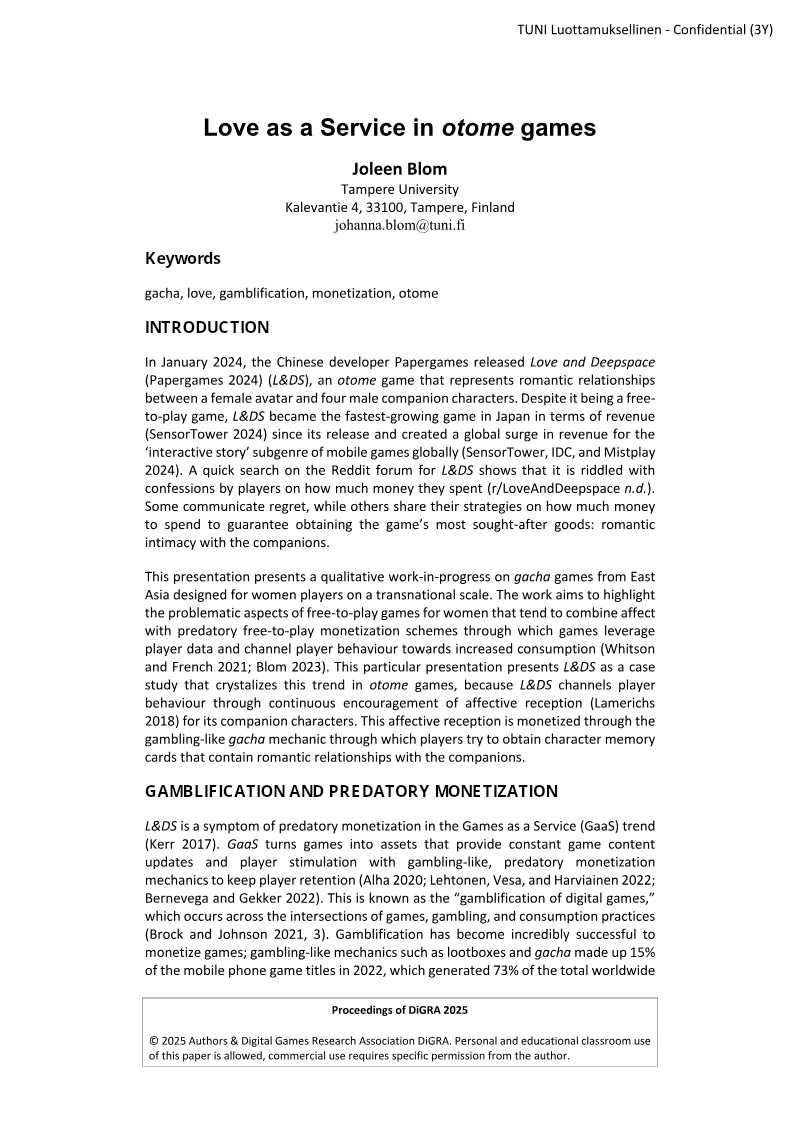
This paper examines identity anxiety among Chinese players of free-to-play mobile otome games, using Papergames' Love and Producer (2017) and Love and Deepspace (2024) as case studies. Its central argument is that existing otome game scholarship, which has largely treated avatars as stable and players as identifying closely with them, does not account for the experience of mobile players, who often reject or feel unease toward an avatar that reminds them they do not belong to the two-dimensional game world. The paper proposes that three identities, the player, the believer, and the lover, come into conflict within the free-to-play otome genre, and it seeks to distinguish mobile otome games from buy-to-play otome visual novels in how player identity is constructed.
The methodology combines semi-structured interviews with thematic analysis organized around the acquisition, retention, and monetization model commonly used to describe free-to-play games. The analysis is further supported by game narrative and mechanics and by official posts from the developers' Sina Weibo accounts. The study's geographic focus is Chinese players, and its scope covers the period from the release of Love and Producer to the more recent Love and Deepspace. The interview sample size is not specified in the extended abstract.
The paper highlights a notable development in developer practice: Papergames initially used the placeholder name "Youran" for the avatar in Love and Producer, which provoked controversy over whether players were witnessing a romance between the avatar and the love interests or experiencing one themselves. In response, the developers reframed the player as the true heroine, and in Love and Deepspace they replaced the avatar name with the heroine's profession, "Hunters," a shift the paper treats as evidence of a deliberate strategy to minimize avatar presence and strengthen player identification with the romantic fiction.
Each row is a game or company this document names, each column a document, oldest first. A mark means that document names it. Select a row to see those documents.

DiGRA · 2026

DiGRA · 2026



DiGRA · 2026



DiGRA · 2026



DiGRA · 2026



DiGRA · 2026



DiGRA · 2026



DiGRA · 2026

DiGRA · 2026



DiGRA · 2026



DiGRA · 2026

DiGRA · 2026
DiGRA · 2026