2015
Company
Documents about 2015
Beyond the Headline: Unpacking the Reported Drop in Conscientiousness
This analysis examines the reported decline in conscientiousness among individuals aged 16–39, addressing the statistical validity of recent findings and the broader implications for societal behavior.
- Conscientiousness scores among U.S. adults aged 16–39 dropped from 35.51 in 2015 to 33.26 in 2025, representing a Cohen’s d effect size of 0.40.
- This decline in conscientiousness is occurring at a rate 2.4 times faster than the natural longitudinal development typically observed between the ages of 12 and 47.
- Quantic Foundry data corroborates these psychological findings, showing a parallel decline in the appeal of strategy-based gaming among 1.85 million users over the same decade.

Digital Foundry Leaves IGN
Digital Foundry, a prominent specialist publication focused on technical analysis of gaming hardware and software, has officially transitioned to a fully independent business model.
- Technical analysis specialist Digital Foundry has become a fully independent entity, separating from IGN.
- Digital Foundry was previously part-owned by IGN following IGN's 2024 acquisition of Gamer Network.
- Owner Richard Leadbetter stated that the team had sought to return to independence since the brand's time under ReedPop ownership.

Tencent Games: Revenue by Year [2015 – 2026]
Tencent’s mobile revenue trajectory from 2015 to 2025 illustrates the company’s evolution from a domestic gaming entity into a global digital powerhouse.
- Tencent's mobile revenue reached a record peak of $7.88 billion in 2024, followed by a slight stabilization to $4.61 billion in the first part of 2025.
- Honor of Kings remains the company's primary revenue driver, consistently generating over $1 billion annually for nearly a decade and reaching $1.87 billion in 2024.
- PUBG Mobile has been a critical global asset, peaking at $1.79 billion in 2020 and continuing to contribute over $1 billion in annual revenue through 2025.

Supercell Revenue by Year (2015 – 2025)
Supercell has established itself as a dominant force in the mobile gaming industry, generating over $13.58 billion in total lifetime revenue as of 2026.
- Supercell’s annual revenue has experienced a long-term downward trend since its peak in 2015 ($1.9 billion), hitting a low of $788.5 million in 2023 before rebounding to $1.45 billion in 2024.
- Brawl Stars is the company’s most volatile asset, experiencing a significant resurgence in 2024 with $678.5 million in revenue, more than doubling its 2023 performance.
- Clash of Clans remains the company’s primary revenue anchor, consistently serving as the top-earning title for over a decade despite a gradual decline from its $1.36 billion peak in 2015.
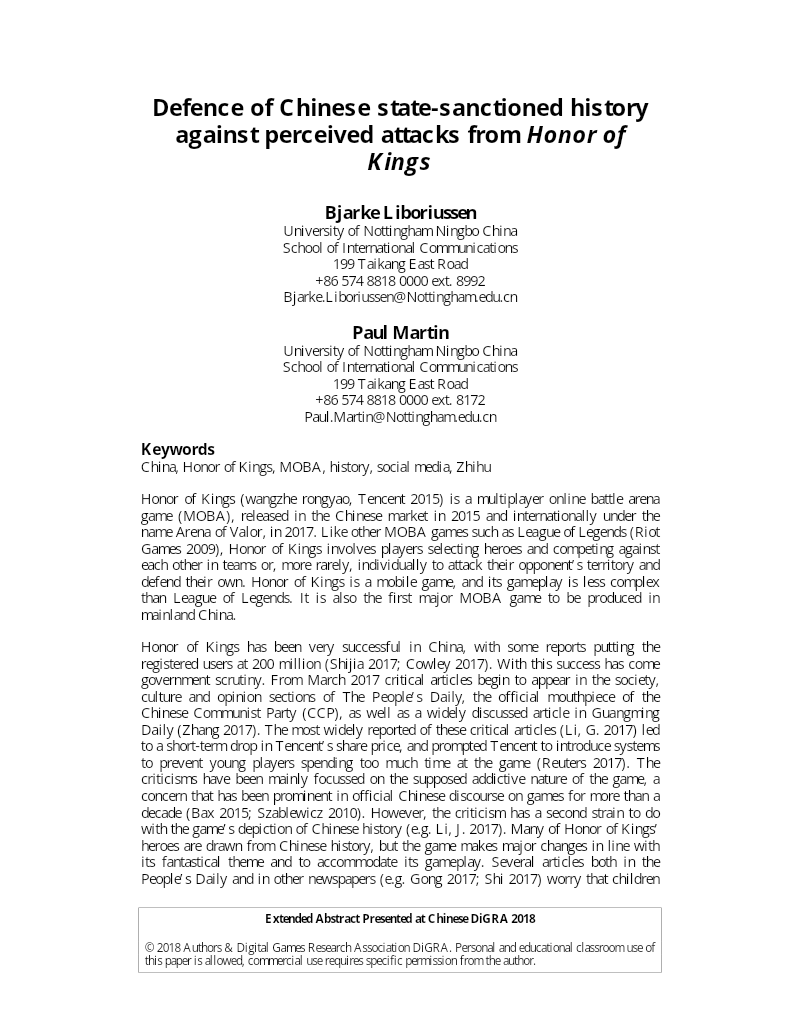
Defence of Chinese State-Sanctioned History Against Perceived Attacks from Honor of Kings
This extended abstract examines how Chinese state media and the Chinese public have responded to Honor of Kings, Tencent's 2015 mobile multiplayer online battle arena game that drew heroes from Chinese history and mythology and reportedly reached around 200 million registered users.
- Official Chinese state media, including People's Daily and Guangming Daily, criticised Tencent's Honor of Kings from March 2017 onward, focusing on its addictiveness and on concern that its fantastical reworking of historical figures could confuse young players about the real past.
- Honor of Kings, Tencent's 2015 mobile MOBA drawing on Chinese history and mythology, reportedly reached around 200 million registered users.
- The study examines public responses on Zhihu, a Q&A platform generally seen as offering relatively open debate, analysing ten of the most relevant questions with 2,674 answers in total, some read nearly two million times.
Fictional Videogames as Framing Devices: Suicide Communication in MMOs
In "Fictional Videogames as Framing Devices: Suicide Communication in MMOs," Gutiérrez Carrera argues that fictional massively multiplayer online games can function as framing devices that reveal online games as social spaces with their own communication norms, norms that can make direct talk about suicide easier to voice.
- The report argues that fictional MMOs can act as framing devices that expose online games as social spaces with their own communication norms, norms that can make direct talk about suicide easier to voice.
- Using three scenes from the fictional MMO Agony of a Dying MMO, whose premise is the final hours of a game's service, the study finds the dying-server framing simultaneously provides an alibi for jokes, an implicit channel for serious statements, and authenticity for players who speak openly.
- Chat logs, logging out, and guild, faction, and friend-list structures make serious remarks ambiguous or emotionally weighty, while the impending dissolution of a social network reduces the face-threatening nature of suicide statements.
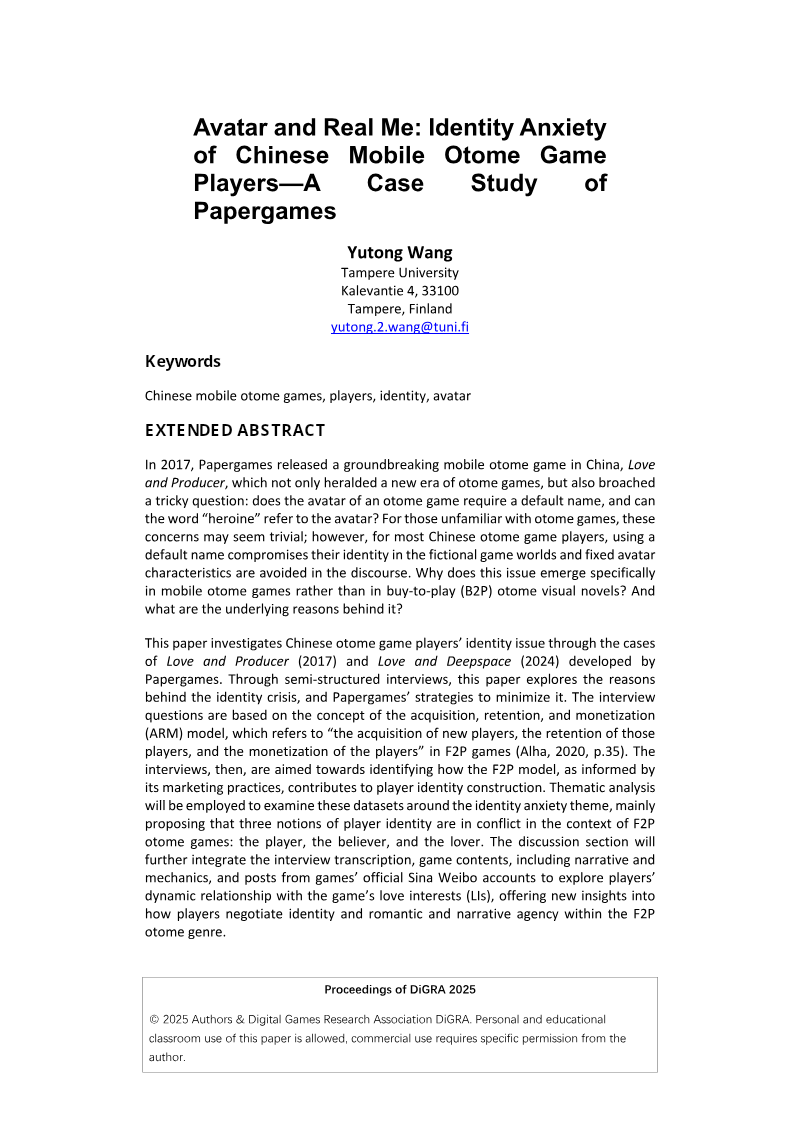
Avatar and Real Me: Identity Anxiety of Chinese Mobile Otome Game Players: A Case Study of Papergames
This paper examines identity anxiety among Chinese players of free-to-play mobile otome games, using Papergames' Love and Producer (2017) and Love and Deepspace (2024) as case studies.
- The paper argues that existing otome game scholarship, which treats avatars as stable and players as closely identifying with them, fails to explain mobile players, who often reject or feel unease toward their avatar's presence in the two-dimensional game world.
- Within free-to-play otome games, the paper proposes that three identities, the player, the believer, and the lover, come into conflict, and it distinguishes mobile otome games from buy-to-play otome visual novels in how player identity is constructed.
- The study uses semi-structured interviews with thematic analysis organized around the acquisition, retention, and monetization model, supplemented by game narrative and mechanics and official Sina Weibo posts from the developers; the interview sample size is not specified in the extended abstract.
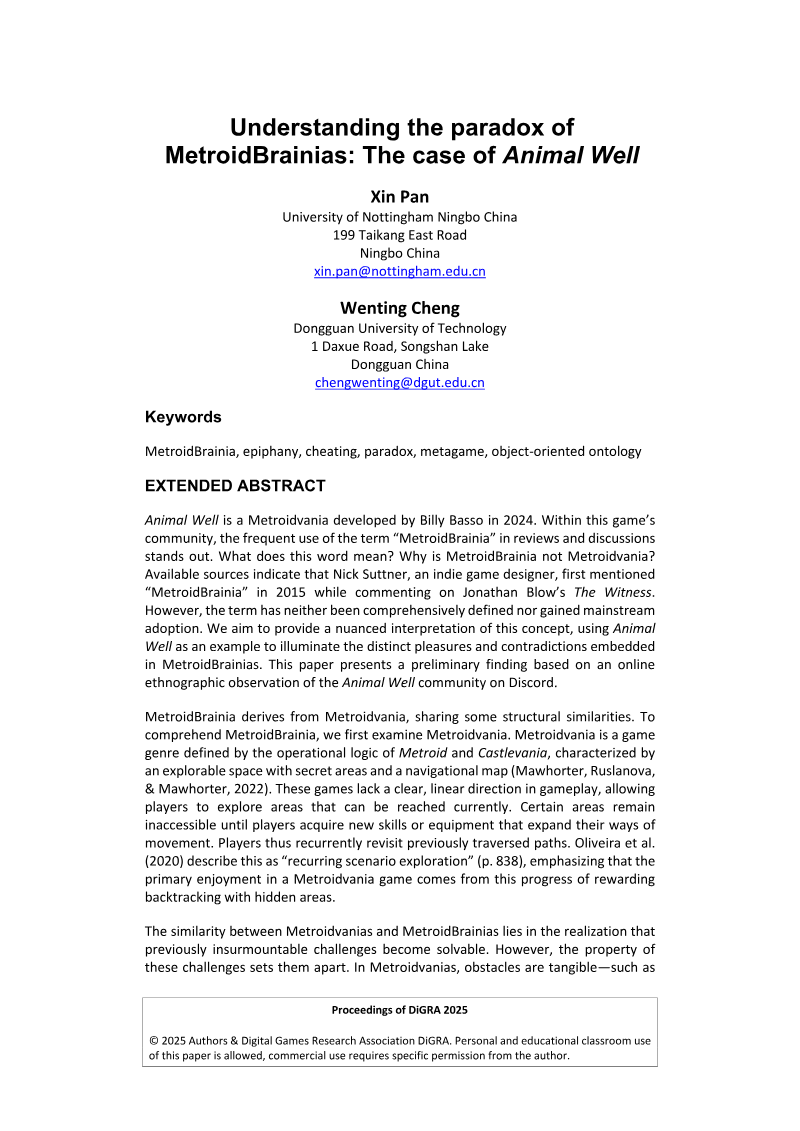
Understanding the Paradox of MetroidBrainias: The Case of Animal Well
This paper examines "MetroidBrainia," an informal term used in discussions of Metroidvania-style games, using the 2024 indie title Animal Well as its case study.
- The term "MetroidBrainia" traces to a 2015 remark by designer Nick Suttner about Jonathan Blow's The Witness, and it has never been comprehensively defined.
- The authors argue MetroidBrainia is better understood as a gameplay element that triggers epiphanies rather than as a genre, with abstract challenges that depend on players' growing understanding of a game's rules and world, unlike the tangible item-locked challenges of Metroidvanias.
- Animal Well's deeper puzzle layers are optional and nearly imperceptible, so many players may experience it only as a Metroidvania, and the designer's explicit announcement of hidden layers may diminish genuine discovery.
Hollywood Goes Mobile: Mobile Games Shine Spotlight on Celebrity Advertising
The integration of celebrity endorsements into mobile game marketing serves as a highly effective strategy for driving user acquisition, revenue growth, and engagement.
- Dream Games' 'Royal Kingdom' saw a 581% surge in downloads and a 213% increase in daily active users (DAU) between April 12 and May 25, 2025, following the launch of celebrity-led ad campaigns.
- The 'Royal Kingdom' campaign, featuring stars from 'Friends' and 'Modern Family', drove a 30% increase in revenue and helped the game climb 88 positions to reach the 25th spot in overall US category rankings by May 25, 2025.
- Historical data shows similar success for other titles: 'Mobile Strike' experienced a 4,300% spike in downloads after hiring Arnold Schwarzenegger in 2015, while 'Coin Master' saw a 43% increase in downloads and 46% increase in DAU after launching campaigns with Jennifer Lopez and the Kardashians in 2020.
CD Projekt 2024 Financial Report
CD Projekt’s 2024 financial results demonstrate a resilient business model despite a year characterized by the absence of major new game releases.
- CD Projekt reported a 2024 net profit of PLN 469.9 million ($121.6 million), marking its third-best annual performance despite a 20% year-over-year revenue decline to PLN 985 million ($255 million).
- The Witcher 4 entered full production in November 2024 and currently employs 411 developers, representing the largest portion of the company's 707-person development staff.
- CD Projekt has entered a strategic partnership with Scopely to develop a new game based on one of its existing IPs, either The Witcher or Cyberpunk.

GameOver: Execs on AI, Steam Sales, Politics, and Pokémon GO LiveOps
This analysis provides a critical overview of current trends and executive decision-making within the global video game industry as of early 2025.
- The AI gaming market is projected to grow to $1.81 billion in 2025, up from $1.47 billion in 2024, with over 60% of studios currently utilizing AI for content generation.
- Over 30 voice actors from Apex Legends have publicly refused to sign agreements allowing their voices to be used for training generative AI models.
- RuneScape has surpassed $2 billion in lifetime revenue, demonstrating the long-term viability of the MMORPG model.
State of the Game Industry: 2025
The GDC 2025 State of the Game Industry survey, as summarized by GameDev Reports, tracks developer sentiment and working conditions across layoffs, generative AI, platforms, financing, and social issues.
- Industry instability persists as only 43% of developers reported no layoffs at their companies, a significant decline from 53% in the previous year.
- Generative AI adoption is widespread, with 52% of developers utilizing AI tools, primarily for business, finance, and management tasks rather than core development.
- PC remains the dominant platform for development at 80%, while mobile development saw a rare post-2020 increase, with 28-29% of respondents now targeting iOS and Android.