1 free read left. Create a free account for unlimited reading + AI research.
Create free accountArticle DiGRA
1 free read left. Create a free account for unlimited reading + AI research.
Create free accountArticleDiGRA
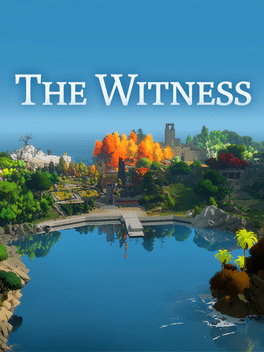
MetroidBrainia is an informal term used in discussions of Metroidvania-style games. The paper traces it to a 2015 remark by designer Nick Suttner about Jonathan Blow's The Witness.
Never defined. The term has never been comprehensively defined.
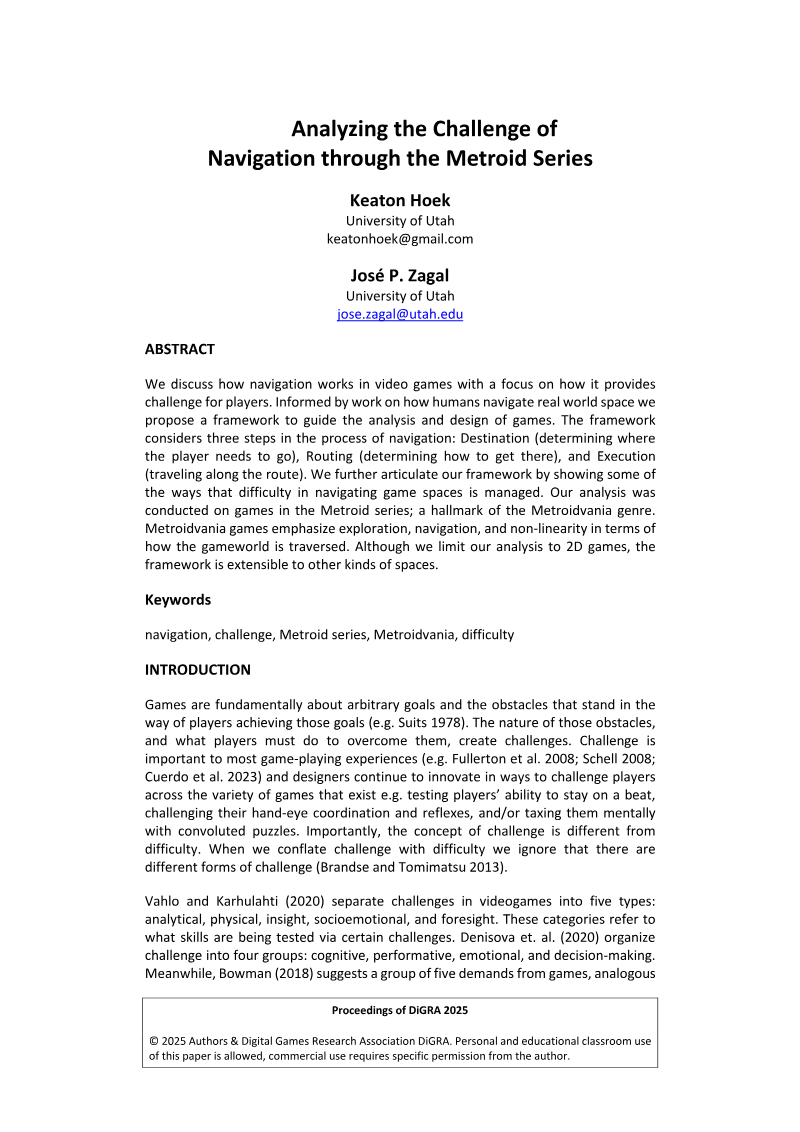
This paper examines "MetroidBrainia," an informal term used in discussions of Metroidvania-style games, using the 2024 indie title Animal Well as its case study. The authors trace the term to a 2015 remark by designer Nick Suttner about Jonathan Blow's The Witness, note that it has never been comprehensively defined, and argue that it is better understood as a gameplay element that triggers epiphanies rather than as a genre. Where Metroidvania challenges are tangible, such as locked rooms solved with acquired items, MetroidBrainia challenges are abstract and depend on players' growing understanding of a game's rules and world. The study rests on a preliminary online ethnographic observation of the Animal Well community on Discord.
The authors identify two central paradoxes. First, Animal Well's deeper puzzle layers are optional and nearly imperceptible, so many players may experience it only as a Metroidvania, and the designer's explicit announcement of hidden layers may diminish the potential for genuine discovery. Second, the game's encouragement of community collaboration appears to promote cheating. The observed community divides into "secret finders" or data miners, who extract hidden game files, and a larger group of "secret seekers" who follow their guides. Applying Karppi and Sotamaa's taxonomy of cheating modes, the authors classify both groups as cheaters, creating a tension between cheating and the epiphanies that define MetroidBrainia.
To address these paradoxes, the authors propose three lines of inquiry: interviews with players about their experiences of cheating, a metagame reading of Animal Well as a game the designer built for himself, illustrated by easter eggs reachable only through cheating and a save-file corruption mechanic, and Graham Harman's object-oriented ontology, which frames the game as perpetually withdrawing from full comprehension. The paper is presented as a conference contribution to DiGRA 2025.
DiGRA · 2026