Mobile reports and market data
Documents

Superstar Session: Hybrid - Revolution: Searching the Missing Link Between Hyper & Casual
The hybrid-casual genre represents a strategic evolution in mobile gaming, functioning as a bridge between the high-volume, rapid-iteration model of hyper-casual games and the deeper, long-term engagement characteristic of mid-core titles.
- Hybrid-casual games bridge the gap between hyper-casual accessibility and mid-core depth by integrating meta-progression systems like character upgrades and skill trees.
- Hybrid-casual titles achieve double the day-seven retention rates of standard hyper-casual games and significantly increase average session lengths.
- In-app purchases in hybrid-casual models can account for 20% to 30% of total revenue, diversifying income beyond the traditional hyper-casual reliance on advertising.
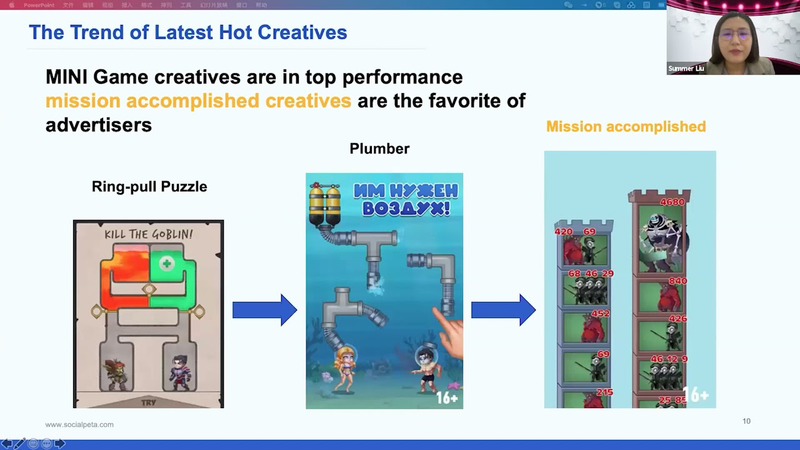
The Key Role of Ad Creatives in Advertising Game & Tips on Creative Optimisation
The mobile gaming industry has entered a phase of extreme saturation, necessitating a shift toward high-volume, data-driven advertising strategies.
- The mobile gaming industry has reached extreme saturation, with the average number of ad creatives per game increasing by 110% year-over-year to 543 as of the first half of 2021.
- Top-tier mobile titles now require over 1,000 unique ad assets throughout their lifecycles to maintain effective user acquisition and revenue growth.
- Developers should validate market demand by testing game concepts with low-budget trailers and creative assets before committing to full-scale production.

Speed Panel: How to Get Brands to Advertise in Your Apps
This panel discussion explores strategies for mobile game developers and publishers to attract brand advertising, emphasizing the shift in brand perception toward mobile gaming as a primary engagement channel.
- Brands now view mobile gaming as a primary engagement channel, a shift accelerated by the COVID-19 pandemic that has moved interest beyond blockbuster titles to include mid-core and smaller games.
- To attract brand budgets, developers must provide standardized data flows, robust attribution, and viewability reporting to satisfy demands for measurable outcomes.
- Developers should prioritize direct integrations with major omni-channel demand-side platforms (DSPs) such as The Trade Desk and Google’s DV360 to increase accessibility for brand advertisers.

Speed Panel: A Whole New Ballgame: How a Top Gaming App Publisher Tackled iOS 14+ & SKAdNetwork
The mobile gaming industry has undergone a fundamental shift in user acquisition and data strategy following the implementation of Apple’s iOS 14+ privacy requirements and the adoption of SKAdNetwork.
- Publishers must shift from granular, long-term tracking to predictive modeling based on user activity within the first 24 hours to compensate for the loss of long-term monetization metrics under SKAdNetwork.
- Successful App Tracking Transparency (ATT) opt-in rates are achieved through concise, localized pre-prompts that are kept separate from other regulatory disclosures like GDPR.
- Strategic timing for ATT prompts is critical, with optimal results often achieved by triggering the request immediately before a user interacts with an advertisement.

Panel: UA & Retention: How to Pick the Ideal Tactic for Your Target Demographic
Effective user acquisition and retention in the mobile gaming sector require a strategic alignment between monetization models and specific payback windows.
- Developers must align monetization models with specific payback windows, prioritizing rapid returns for hyper-casual titles and long-term lifetime value for midcore games.
- Success in user acquisition relies on a formalized, iterative approach to creative testing to identify and scale concepts that resonate with target demographics.
- Machine learning and AI are essential for automating bidding and hitting return on ad spend targets, though they require human oversight to manage channel volatility and performance tracking.

Curated Panel: IDFA Effect' on UA Performance & New Changes for ASO
The mobile gaming industry is undergoing a fundamental transition from granular, device-level user acquisition to an aggregated, privacy-centric model following the implementation of Apple’s App Tracking Transparency framework.
- The implementation of Apple's App Tracking Transparency (ATT) and IDFA deprecation forced a shift toward probabilistic attribution and the use of Apple's SKAdNetwork (SKAN) to maintain user acquisition measurement.
- To address limited data visibility, advertisers are utilizing Conversion Studio tools to measure flexible activity ranges (e.g., levels 1-3) and sequences of events rather than relying on a single 24-hour window.
- Game developers are increasingly shifting UA budgets toward Android and exploring alternative acquisition methods, such as web-to-app flows using landing pages and smart banners to bypass iOS tracking limitations.
Bridge Between Marketability Testing & $100m UA Spend: Go-to-market Strategy Optimised for Growth
A full life-cycle go-to-market strategy integrates continuous marketability testing from the earliest stages of pre-production through global launch, replacing traditional siloed development with an iterative, data-driven framework.
- Integrating continuous marketability testing from pre-production through global launch replaces siloed development with an iterative framework that de-risks projects and builds a library of high-performing creative assets.
- This methodology accelerates time-to-market by three to six months by allowing studios to optimize cost-per-install metrics and creative strategies before the game is fully built.
- Independent data collection via web-based testing and simulated store pages mitigates the impact of platform privacy changes like IDFA, enabling more reliable cash flow projections.

Strategies to Get Ready for iOS 15
The release of iOS 15 introduced transformative App Store features designed to refine organic discovery and user acquisition strategies.
- iOS 15 introduced three core features to drive organic discovery and user acquisition: product page optimization for A/B testing, custom product pages for targeted messaging, and in-app event cards for engagement.
- Successful implementation requires cross-departmental synchronization between ASO experts, creative teams, developers, and user acquisition managers to align technical execution with growth objectives.
- Smaller studios should prioritize product page optimization to refine creative assets through organic testing, while larger organizations should focus on custom product pages to maximize the ROI of paid traffic.

How to Be a Great Product Manager (Philosophy Friday #1)
Product management in the free-to-play gaming industry centers on the synthesis of economic decision-making, product vision, and operational efficiency.
- Product management in free-to-play gaming requires synthesizing economic modeling, product vision, and operational efficiency to drive sustainable, ethical revenue growth.
- Effective product managers must transition from reactive task management to a proactive operating system defined by rigorous processes, root cause analysis, and iterative modeling.
- Success depends on balancing data-driven decision-making with human-centric communication to maintain team morale while ensuring contributions remain objectively measurable.

Moonton's Mobile Legends: Bang Bang Secrets to Success! With Chief Designer Skyhook
The success of Mobile Legends: Bang Bang is rooted in a design philosophy that balances the high-stakes strategy of Real-Time Strategy (RTS) games with the immediate, visceral satisfaction of action-oriented gameplay.
- Mobile Legends: Bang Bang achieved success by distilling complex PC-based MOBA mechanics into a mobile-first experience that lowers the barrier to entry while maintaining a high skill ceiling.
- The development team prioritized accessibility by removing high-friction mechanics like last-hit requirements and implementing screen locking to simplify operational complexity.
- Core gameplay design focuses on a hybrid model where visceral action mechanics provide immediate engagement, while deep strategic layers ensure long-term player retention.

Scaling Up a Merge Game with Antti Hattara, CEO Starberry Games
The merge genre has evolved from a simple casual category into a highly competitive landscape where long-term retention is the primary determinant of success.
- Long-term retention beyond 90 days is now the primary metric for success in the highly competitive merge game market.
- Developers can differentiate their titles by pivoting from simple idle mechanics toward complex city-building simulations.
- Scaling requires a dual strategy of consistent content updates and advanced performance marketing, leveraging automated tools to overcome IDFA deprecation challenges.

Here's How You Capitalize From the Apple vs. Epic Court Ruling
The Epic versus Apple litigation serves as a pivotal catalyst for a structural shift in mobile game monetization, moving the industry away from total reliance on proprietary app store payment systems.
- The Epic vs. Apple litigation has legitimized the use of external payment links and web-based storefronts, allowing developers to bypass traditional 30% platform commission fees.
- Large-scale publishers adopting direct-to-consumer web commerce are reporting revenue increases of up to 40%.
- Moving monetization to web-based channels enables real-time A/B testing on pricing and bundles, bypassing the rigid update cycles imposed by proprietary app stores.
Writers
Games and companies
Games