1 free read left. Create a free account for unlimited reading + AI research.
Create free account
Superstar Session: Hybrid - Revolution: Searching the Missing Link Between Hyper & Casual
Key insights
7 takeaways- 01Success in the hybrid-casual space requires balancing depth with simplicity, as overly complex mid-core mechanics can alienate the mass-market audience.
- 02Hybrid-casual titles achieve double the day-seven retention rates of standard hyper-casual games and significantly increase average session lengths.
- 03In-app purchases in hybrid-casual models can account for 20% to 30% of total revenue, diversifying income beyond the traditional hyper-casual reliance on advertising.
- 04Hybrid-casual games bridge the gap between hyper-casual accessibility and mid-core depth by integrating meta-progression systems like character upgrades and skill trees.
- 05The industry is shifting toward intuitive, relatable themes such as farming, tower defense, and puzzle mechanics to maintain broad appeal.
- 06Hyper-casual remains a vital business pillar for publishers due to its low-cost user acquisition and rapid prototyping capabilities.
- 07Future growth in the sector depends on maintaining low cost-per-install (CPI) metrics while fostering long-term engagement through seasonal content and community features.
Ask AI about this video
Transcript
so as i said beyond the deal is all about what happens once you've got the publisher for your game and uh we're going to explore uh bringing your project um to market so uh first up uh we've got falco i think falco is with us hopefully um and um he's gonna talk about uh one of the areas so hybrid games so the hybrid revolution the missing link between hyper and casual games how you doing man hey can you hear me oscar i can i can hear you fine perfect i'm doing great how are you good not too bad long time no see but then i could say that about everybody it's like the last two years have disappeared almost in fact i think my last event uh that i went to before the derek was when you invited me over to uh uh was it kian i think i can't remember yeah exactly that was right when the news were coming out that you're not allowed to travel anymore exactly so anyway you're the last industry person i saw
outside of my close arrangement so anyway i'm gonna shut up now and let you talk and tell us all about the hybrid scene so thank you very much all right thank you oscar yeah thanks everyone who everybody who showed up bright and early one of the few things that i feel is easier in these digital events because you haven't been to at least most of us haven't been to a big uh party with free alcohol last night so yeah thanks for for showing up and as usual said we're going to talk about hybrid casual games and especially if you're a developer what kind of opportunities are lying in there right now you might think hyper casual that's something that was a while ago but no it's actually more current than ever let me quickly share my screen here um first maybe a quick word about myself i'm falco i'm head of brand marketing for joypack i have been involved in the developer relations business development part of joypack for a long time though so i'm coming from the angle of talking to the developers and now i'm kind of focusing on more actually bringing you
guys more insight in what joypack is doing what we're looking for how we're seeing the market right now versus just um talking about the nitty-gritty of the games joy pack itself is a we're a hyper casual publisher um based in both asia and europe with china being one of our biggest markets so we started out helping people bring their games into into china self-publishing developers mid-sized publishers and so on but we're also working with developers on new products to publish um hyper-casual games worldwide we are also interested in the hybrid revolution we've been talking about this for a for a while but this topic has been changing and that's one of the few things that i want to talk um about today so um let me start with kind of the time frame that oscar myself just talked about the early 2020 when archero um i'm not sure if everybody's familiar action game you control a character with one finger shoots automatically um
but then has a bigger metal layer where you unlock new equipment new skills and so on and there's um more of a long-term goal but still very much presented as a very casual game was on the height of its success launched in in april of uh 2019 it grew steadily over the year and for something that people considered at least partially a hyper casual game it had extremely long stay and had a lot of advantages that i'll be talking about in a in a moment here but um that was like the hot topic everybody wanted to make a game like this and one of the last conferences uh before the lockdown was um the pocket gamer connected in london and uh there we we all talked about it and amongst the publishers we joked like this is our chair of the conference we saw at least like five yeah i saw seven like we're talking about how many are tarot clones we saw um and everybody wanted to get in of it and everybody thought this specific style of game is going to be going to be the next
big thing that kind of maybe even overtakes hyper casual or makes hyper casual as a genre obsolete and have it replaced with this new thing but then what we saw is like a lot of these games were very similar and there were good games there were games like arcade hunter or tails rush like games that are very similar and they had good production values that may be added to the game but none of them really had the very big and very long term success at least in the visible in the charts that that are tarot had a lot of these drill down into more details usually i would say in general it's not always a good idea to make your game more complex because you might actually narrow down your audience rather than adding more that will get more people interested although financially that's not always a bad thing right if you have a very core audience that cares deeply about that that style of game maybe it's better to have a more invested but smaller audience and that's a lot what hybrid casual is about right you kind of want to combine both you want to combine
the mass audience of a hyper casual with a little bit of deeper gameplay the issue was that these clones didn't do as well as people thought people thought okay these are going to take over the market we're going to see great innovations in this kind of sub genre but we really didn't that hyper casual itself grew it changed as hyper casual does we see different kind of games and ideas and themes and settings all the time and it remained pretty consistent and even grew while hybrid didn't have the crazy resolution at least yet that people expected it going to be so um but then over time we saw the focus switch a bit onto other hybrid concepts and now it is it is coming back a bit but first like why hybrid casual why why do we want to change from from hyper to hybrid right like what is the idea there um and the idea is
looking at the weaknesses that hyper casual has hyper casual has a lot of advantages when it comes to the number side of things but it also has some downsides and hybrid casual takes things from um from the casual to mid core style of games and tries to marry those with what hyper casual does well so i'm saying a lot of hyper hyper hybrid uh this time um but yeah so i'll use one of our games here as an example which is more of a hybrid style of game a little bit tower defensive game called dead ahead that we're publishing in china right now and it's doing very well for us there so first of all it's obviously the increase in retention especially long-term retention that people are looking for hyper casual games can easily get their 40 50 percent um they want retention if they're if they're a good game fun game but they're struggling keeping players interested
seven days or even 14 days or even beyond that in the game but um of course these um hybrid casual games that introduce more meta layers more functionalities more concepts from casual and mid-core games to keep people around are meant to increase that number and that's what we're seeing we're seeing about twice the amount of day 7 retention in that ahead that we're seeing in our average hyper casual game same goes for session links how long are people playing how long are they invested in the how much time do they invest into the game generally that's about twice as much per session and even more than three times overall meaning that they also play more often in the uh in the day that they would do with hyper casual which is interesting because you would expect hyper casual being super fast quick fun games that are very likely that you come in to just play a round or two but it is this this kind of meta this further purpose beyond
this one session that keeps people coming back even more than just a very enjoyable quick fun session it's also a way of introducing more attractive in-app purchase options it also kind of works for rewarded ads so overall for the monetization it has an effect because of of course normal ads run better if you have more play time i'm sure if i have to explain that but if people stay in the game longer if they spend more time per day in the game that also means that they will watch more interstitial ads more other ads but then with this layer of this extended purpose so to say they are also more interested in maybe watching a rewarded ad which is better for the publisher financially to get something in the game to unlock an item to unlock a state or something that brings them an advantage because they are more invested in this kind of long-term improvement and the same goes for in-app purchases which are usually non-existent or
are a very low percentage of the money that a hyper-casual game makes right we've seen less than five less than two less than one percent in some cases and with in-app purchases in hybrid games depending on the game because there's a very long range because you could say some uh called something that is mostly hyper-casual with a little bit of mid core or a little bit of meta being hybrid but you can also say something that is mostly a mid-core game and then tries to present itself a bit more so there's a wide gamut of like what what in-app purchases can look like but we are expecting 20 maybe even 30 percent uh or more revenue through in-app purchases rather than through advertisement in the long term in these kind of games but there's also of course the challenge of keeping the cpis low there is an issue with these with these games that all these advantages don't help you if you can't keep the cpis lower otherwise would you just do a midcore game right where you have
extremely high cpi's but then through the rest you still have the chance of making it back so the balance here is is the important thing having the games be hyper casual enough that you can still approach or approach a wide audience while still um taking advantage of all these mechanisms that you see in in midcore game so i already said that um the altera clones kind of died off and then we're looking for something else now because people are getting better at bridging this mid-core gap and it's not only a mid-core gap i think that was one of the fundamental issues in the beginning of hybrid casual games that people were like okay i'm gonna take my average town builder game or action rpg game and i'm i'm going to focus on that and make something that is hyper casual but also that completely skipping over casual games puzzle games arcade games the very healthy kind of segment that exists in the in
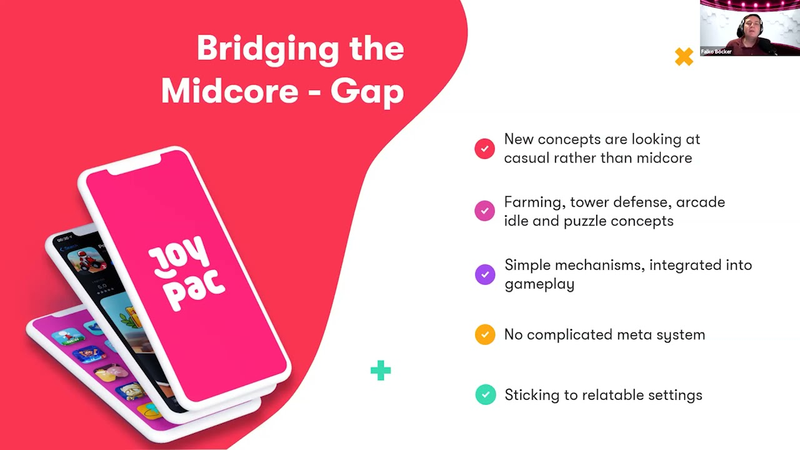
the mobile market as well um completely completely skipped over but i think there's a lot of advantages looking at those games and trying to implement some of their advantages into hyper-casual games and taking that step first because these are way closer together way more aimed at a more mass audience less specific so there's a lot of advantages that you can take out of that and you maybe can you can also stay closer to the typical hyper casual game and introduce more of that without going too far away from your from your basic idea or concept so um [Music] that is one of the steps so we're looking at farming games we're looking at tower defense arcade isle games more puzzle concepts that are coming in but also those simpler mechanics that have a more immediate effect on gameplay in puzzle games you have a little bit of meta but a lot of the stuff is very connected to the gameplay a lot of the purchase decisions happen in the level um a lot of the upgrades are more immediate and i think this is something that hyper
casual games are looking more and more at these days rather than having this complicated meta system that you have to that is fields at least at first very separate from the core core experience and you kind of have to learn it separately and in the the issue that you have with hyper casual is you don't have people for a long time if you don't have this meta system but you also don't want to overwhelm people with a complicated meta system right away you want to introduce it slowly and carefully so there is a limit on on what you can do on the meta side or how it is designed to keep people hooked right away to get all the advantages out of it and then something that i feel is just starting is sticking to the more relatable settings hyper-casual games often live off being something that people do every day in their life a very normal mundane activity that is kind of fun kind of satisfying in itself and a lot of the hybrid approaches
didn't use that at all they went straight to fantasy straight to strategy games and i think that removed them quite far from from the user acquisition advantages that we would have with a with a hyper casual game so it was much more difficult to get the people in there you work much further away from it so you're really doing a lighter midcore game rather than expanded hyper casual games and i think we'll see and we're already seeing with the farming games and so on we're seeing um taking more steps towards these relatable settings and i think there's still a lot of room to kind of play around with that so what happens next and how can you if you have a hyper casual studio or mid-core studio um how can you profit off of this how how where do you fit in and what are publishers going to do and how can that help you and and in general how will that market market change so i think
we talked to a bunch of people we've seen a bunch of articles on pocketgamer right now there's a good article from voodoo right now about this topic as well so feel free to check that out from what we can tell most hyper casual publishers are actively investing into hyper casual game in some shape or form a bunch of them have internal studios that have already been working on this they some publishers like to go out of their existing network of developers but also some talk to the developers that they're already working with so if you've already signed a deal with a publisher and you think this is something that you can do especially well that you can excel with bring this up to your current publishing partner that you have a few of these concepts because they are looking into putting some money into that that might be investing into the development in external studios that could be the internal studios they might also be acquiring external studios for this uh for this purpose my games
just made a purchase that goes into that direction um trying to build this this kind of like internal hybrid casual a little bit more mid-course casual strength so they're building towards this also there's some outside investors just just general investors looking at at this so right now i feel it's a good time for studios to position themselves as that showing the experience that they maybe had in the past and how they could break bring these these genres together um and i think as i said we're not done with these hybrid sub genres yet i think there's more to come i think people will figure out more ways of going at this we were super narrow in the beginning with the arterial clones which was definitely ahead of its time with this but then it kind of stopped for a while and now we're seeing people branch out and i think just with hyper casual where we're finding new genres new ways of um new interpretations of the style of
gameplay every day i feel that we're gonna see this more and more with hybrid style games as well and i said i don't want to cause panic i'm not of the uh one of those people that say like oh this is going completely to replace hyper casual hypercast is going to be gone everything is going to be hybrid games we um we still see that there are some advantages with a hyper casual game some are current and some are a little bit longer lasting and i think won't go away at any at any point soon so first of all right now hyper casual is still most publishers core business we start talking about this voodoo omar games a lot of people are talking about uh this but it's not like we make most of our money with hybrid games right now it's still hyper casual games this is still what most of us publishers are doing best and this is something that we'll keep focusing on for for a while you will see the percentage change hybrid will take potentially a higher
importance within our portfolios but it's not that we're going to stop uh making hyper-casual games anytime soon also hybrid games don't follow the same fast iteration process one of the big advantages of hyper casual games is the speed that in a few weeks you'll have a prototype then a mvp version then a full version out in the market and this really competitive really quick really fast changing environment of course lists of the simplicity of those games and once you start adding more meta that require a little bit longer term thinking a little bit more balancing and more content you'll add time to that as well so um i think there's just a natural limit of how good you can be with that and also there's a learning process of getting that to the most ideal state so we'll take people a little bit to kind of find the right way of prototyping something that you can test very early on like a hyper-casual games but you already have a plan of then quickly
adding these these further mechanics to keep people engaged but still not work on a game three four five months finding that medium there and still having this high output because at least when you're when you're very close to the hyper-casual side of things you need to be able to fairly quickly and cheaply make prototypes that you're happy to throw away in favor of something that is doing better that has more potential so you can't over commit to a to a hybrid casual game like you have to do in some cases with mid core games where you're in deep and then you have to figure it out and get it just right also the cpi question right cpis are rising for hyper-casual game games we're not sure if hybrid casual games will be more on the hyper side or more on the mid puzzle mid core puzzle to mid core side long term so they have to be cheap enough to um kind of make sense when it comes to all
the advantages that they have right their only advantages if they behave like hyper casual games or at least close to them in the market i feel that the other settings and themes will help with that but it's still open if this long term will work um this is a danger for both hyper casual it's like is any hyper casual game being going to be so expensive that you can go hybrid in the first place or the other way around where it's never going to be low enough for a hybrid game that you can compete with a hyper casual game so i think um there is at least an argument that it's not going to be black and white there is going to be a happy medium where both of these types of games can can coexist and then most of these are not all of these games directly compete with each other right like there's some elements that you can add where it's still fairly hyper casual um and uh but but once you're over a certain threshold the game comes so complex that
it doesn't offer the same experience anymore of i'm just going quickly and then play around and i'll be happy with that and if games if there are too many hybrid casual games maybe people will still look for these very short fun mini experiences and yeah you're not completely replacing them i think what we're seeing is that there's a minimum of features that you're going to expect in hyper casual games i think that already happened um we're seeing a lot of level-based games nobody sees endless games anymore because of how the economics work with interrupting gameplay through ads and so on so i think um after all of this hybridization we'll see that there are a couple of features that you can't go without anymore in a hyper casual game but i'm not sure if that necessarily means that that all of these games will be considered hybrid maybe if you compare them to the very first hyper casual boom but um i think there'll be still a very clear distinction about what we what we call hyper what we call hybrid or if
we're going to have a completely new name for that at that point so some summarizing there's a good opportunity for hybrid games right now that are more closer to the casual side not too far over jump to mid core and i think as studios that have some experience with puzzle with meta elements now is a good time to reach out to publishers maybe if you even don't know if they're interested in that most of the hyper casual games are very willing to hear you out and start some experiments and see what they can do in that in that market and um i wouldn't be confused if casual publishers haven't uh talked to many of those are also eyeing more into the hyper side and seeing if they can get closer to this middle ground from their point of view so lots of lots of opportunities for development studios out there and yeah that is it i hope this was interesting for everyone and let me know if you have any questions here but also reach out to me
uh on linkedin or via email um at any time we're happy to to answer all the questions you might have about that i think that's great stuff i mean so in particular obviously the kind of development of the room uh are things like the idfa changes so uh skyrim network and various privacy controls particularly in the uk uh we've recently um had the age-appropriate design code coming forth um so there's a lot of kind of concern about the data attractions on and so forth is that having any impact do you think in terms of the uh the nature of the hybrid design is that affecting the way you're looking at hybrid design itself not right now this is pretty fresh right so um we didn't really make any consequences based on that of course these kind of regulations is always something you're you're looking at and some of the mid core elements that have been strong there are now kind of getting taboo right like the uh the loot box and so on so i think it's something
that that people will will look at but as i said i think it will be more on the casual side of things where i think there's a little bit less worry about these these elements where it's you don't have to go full uh mid-core monetization just yet in hyper-casual games you can still have something very simple it just has to feel worth for a player right if you're a bit more invested even something simple as buying a character skin or something will get more attractive and that might not bring you to 50 in a purchases but it might bring you from one percent to eight percent which would be great already right no exactly i think that's the key thing isn't it you know what we're seeing here with the hybrids uh and as you know i'm a fan of this model uh is that this increasing percentage and i'm still acknowledging the value of the ad i mean that the ads can be incredibly important for not just monetization but also retention and engagement for a wider audience and i think acknowledging that that value is there in fact one of the things i'm trying to do is to get people to think about these games in in layers so the
mechanic the core kind of thing that you do now i use the term context rather than metagame because i've got another reason i use the word metagame context for me is all about the sense of purpose and progression and i i think a lot about things like the hot dog economy so you know how you imbalance can actually make the game more interesting and make grind more more purposeful more more useful more you know enjoyable but also you know the sense of unfinished business that makes me want to keep coming back and keep playing for me i think the transition between hybrid and living game is when you start looking at what i call the metagame i mean so that means things like the social collaboration that means things like the sort of um the community aspects and stuff like that and also seasonality are you seeing um you know these hybrid experiences becoming more like living experiences or do you think they're going to stay more on the sort of um casual hyper side of things yeah i think step by step they will try there are some additional hurdles right because you'll
multiplayer in some form is often one of the main things that brings us into this like more engaged community meta game in that sense you're perfectly right this is i should have said like maybe meta systems rather than meta game because that refers to like yeah that's why people play context yeah yeah i think a lot of hyper casual um publishers will be afraid of going into anything that's multiplayer right we're already taking multiplayer concept and faking the multiplayer in it because it's so much easier and faster and because it comes with so much more but it is a very big driver for monetization in mid-core games as well right so it's something that is definitely interesting but um i think in the in the beginning it will um it will be the more more simple concept i think for idle and a few of those where you see like the meta layer being more in the strategy of playing the game where people getting together and kind of like finding new ways of optimizing the way to play the game i think this will be more
more apparent um and you see this in puzzle games even right like people have strategies strategy guides for candy crush so that kind of stuff i think i think we'll see more of you yeah i agree i mean i think for me what's interesting is if you look at the lessons of the production process for hyper casual games and how that's transitioning into hybrid and i'm actually trying to apply those lessons in living games as well i think what we see is you know um studios doing lots of experiments with hyper casual games to get the kind of first stage working some of the games will get released some of them won't then it's some more experiments where a subset of those games can become and evolve into these more hybrid experiences again some of them will get released some of them won't and then finally where you find those games that work in all those contexts that you can turn into living will be those kind of like the spearhead of the kind of longer term retention experiences so i think we'll see this more diverse portfolios from publishers that are really looking at what works for the audience at least that's my feeling yeah for sure and i mean one of the issues with that was that you didn't
have enough time with one hyper casual games to turn that one game into it right they just didn't live long enough to add those things um so it has to be a different concept that looks at the first concept but it's a separate game i think it's much more realistic to say so once we have things that are a bit more hybrid that that game can become more alive and grow from there kind of like a lot of mid-core games did in the beginning as well right where they didn't have this wealth of of meta and community in the beginning but uh like gradually grew towards that and also we've we can learn some kind of profound lessons from the way for example where arch hero breaks in the middle in terms of its long-term retention you know because i don't really see the need in having multiple heroes well there's some fundamental kind of design principles we can then take from that and apply into our future designs and see if that then works so anyway i should talk about this subject forever as you know uh sadly we don't have beer and we're not sat around the table together however i thought it was delightful um thank you so much for taking the time out to talk to us about the hybrid revolution yeah thanks for having me
have a good day great thanks
Summary
The hybrid-casual genre represents a strategic evolution in mobile gaming, functioning as a bridge between the high-volume, rapid-iteration model of hyper-casual games and the deeper, long-term engagement characteristic of mid-core titles. The primary thesis of this approach is that by integrating meta-progression layers—such as character upgrades, skill trees, and long-term goals—into accessible, mass-market gameplay, developers can significantly improve retention and monetization without sacrificing the broad appeal that defines the hyper-casual sector.
Key findings indicate that hybrid-casual titles often achieve double the day-seven retention rates of standard hyper-casual games, alongside significantly longer session lengths. While hyper-casual games rely almost exclusively on advertising revenue, hybrid models successfully incorporate in-app purchases, which can eventually account for 20% to 30% of total revenue. However, the industry has learned that success requires a delicate balance; overly complex systems can alienate the mass audience, and early attempts to clone successful titles like Archero often failed due to a lack of innovation and an over-reliance on mid-core mechanics that were too far removed from the core hyper-casual experience.
The current industry landscape suggests a shift toward more relatable, mundane themes—such as farming, tower defense, and puzzle mechanics—that feel more intuitive to casual players. Publishers are increasingly investing in internal studios or external partnerships to refine these hybrid concepts. Despite this shift, hyper-casual remains a core business pillar for most publishers, as the rapid prototyping and low-cost user acquisition models remain essential. The future of the sector lies in finding a "happy medium" where games are simple enough to maintain low cost-per-install (CPI) metrics while offering enough depth to foster a "living game" environment through community features and seasonal content.













Comments