2 documents matching your filters
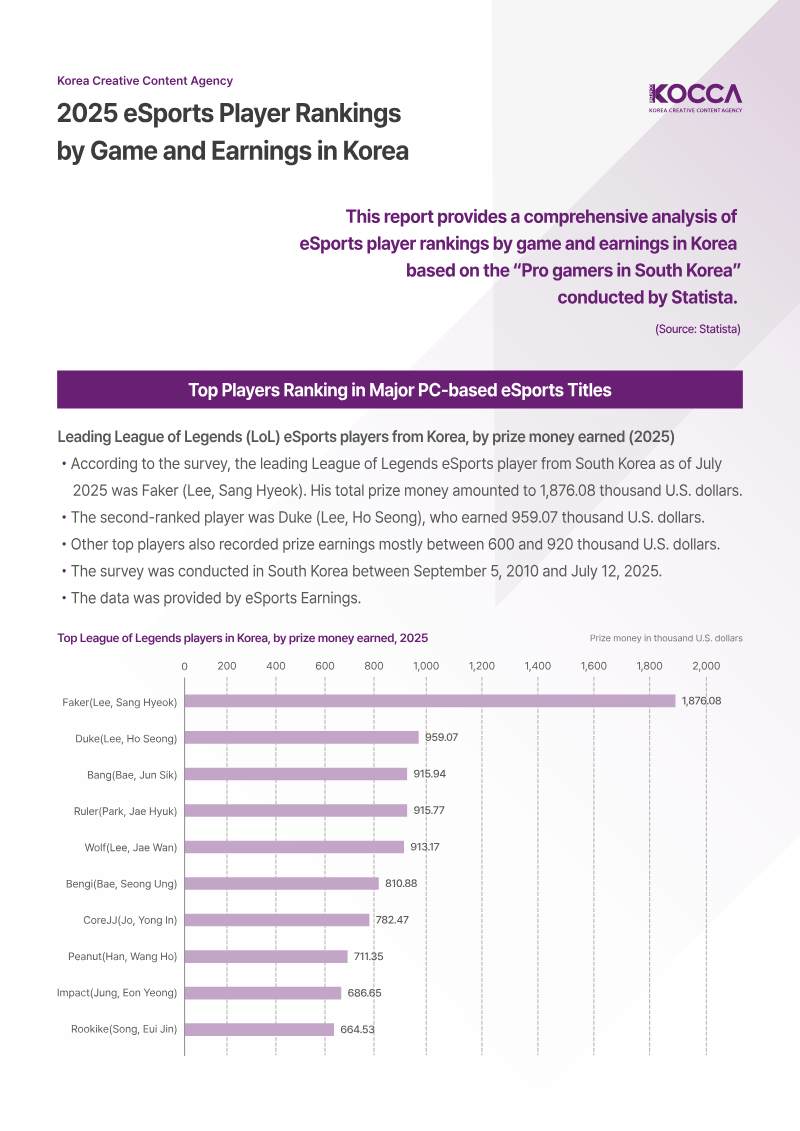
South Korea’s professional gaming landscape is characterized by a title-centered evaluation system where prize earnings are highly concentrated among elite players. Analysis of the country’s top eSports competitors across five major PC-based titles—League of Legends, StarCraft II, Valorant, Overwatch 2, and PlayerUnknown’s Battlegrounds (PUBG)—reveals significant disparities in cumulative wealth based on the longevity and global scale of each game’s competitive scene. League of Legends remains a dominant sector, with Lee Sang-hyeok (Faker) leading all players with approximately $1.88 million in prize money as of July 2025. This exceeds the top earners in other disciplines, such as Cho Sung-choo (Maru) in StarCraft II, who earned $1.39 million, and Park Jung-young (Loki) in PUBG, who secured $1.25 million. In contrast, newer or more recently transitioned titles like Overwatch 2 and Valorant show lower cumulative earnings, with top players Choi Tae-min (MER1T) and Kim Jong-min (Lakia) earning $375,450 and $164,980 respectively. The data, sourced from eSports Earnings and compiled by the Korea Creative Content Agency, utilizes a longitudinal methodology tracking performance from as early as 2010 through mid-2025. While the rankings for League of Legends, StarCraft II, and Valorant reflect 2025 figures, the data for Overwatch 2 and PUBG is current through late 2024. This segmentation highlights a fragmented domestic performance structure where success is measured by game-specific milestones rather than a unified national ranking. The findings underscore a mature market where established titles continue to provide the highest financial returns for top-tier professional talent.
This analysis explores the Multiplayer Online Battle Arena (MOBA) sub-genre within the mobile gaming market, focusing on its rapid financial growth and competitive landscape. Leveraging data from Sensor Tower’s Game Intelligence and Store Intelligence platforms, the report examines global trends from 2019 through August 2021. The central thesis identifies MOBAs as a "winner-takes-all" market dominated by a few high-performing titles that command significant player spending despite a general stagnation in overall sub-genre downloads. The findings reveal that MOBAs are among the fastest-growing segments of the Strategy genre, generating approximately $2 billion in global player spending during the first half of 2021. While Asia remains the dominant force, accounting for 84 percent of total revenue, emerging markets like Brazil, Indonesia, and Russia have become critical hubs for daily active users. Honor of Kings stands as the industry leader, surpassing $10 billion in lifetime revenue, while Mobile Legends and Brawl Stars maintain strong global positions. Notably, the September 2021 launch of Pokémon Unite set a new record for the sub-genre, achieving 15 million downloads in its first two days. The study also highlights a divergence in monetization and engagement strategies. Titles like Brawl Stars favor simplified mechanics and high long-term retention, whereas others utilize "paid advantage" mechanics—such as stat-boosting skins—to drive higher revenue per download at the potential risk of lower retention. In the United States, intellectual property plays a significant role, with licensed IP games accounting for 43 percent of all MOBA installs. Ultimately, the market is characterized by high concentration among top publishers like Tencent, Supercell, and ByteDance, creating a challenging environment for new entrants without established brand recognition.