1 free read left. Create a free account for unlimited reading + AI research.
Create free account
Speed Panel: A Whole New Ballgame: How a Top Gaming App Publisher Tackled iOS 14+ & SKAdNetwork
Key insights
6 takeaways- 01Data indicates that new users do not consistently provide higher opt-in rates than existing users, necessitating a non-intrusive approach that prioritizes user experience over aggressive data collection.
- 02Successful App Tracking Transparency (ATT) opt-in rates are achieved through concise, localized pre-prompts that are kept separate from other regulatory disclosures like GDPR.
- 03Strategic timing for ATT prompts is critical, with optimal results often achieved by triggering the request immediately before a user interacts with an advertisement.
- 04Publishers must shift from granular, long-term tracking to predictive modeling based on user activity within the first 24 hours to compensate for the loss of long-term monetization metrics under SKAdNetwork.
- 05The industry is moving toward a model of enhanced cross-departmental collaboration, requiring tighter integration between marketing, monetization, and product teams to maintain profitability in an aggregated data environment.
- 06The evolution of regulatory frameworks, such as the Age-Appropriate Design Code, is forcing a transition toward a privacy-centric operational model that balances data-driven decision-making with user privacy demands.
Ask AI about this video
Transcript
so next up we have a pre-recording session we're going to have a panel uh this is about a whole new ball game how a top gaming app publisher tackled ios uh 14.5 and star ad network so incredibly topical uh understanding how we actually make sure that we keep ourselves active and how we deal with these things and so we're going to kick off that playback hi everyone hope you're doing great and welcome to our panel today a whole new ballgame in this session we're going to be speaking with a couple of leading gaming studios to better understand how gaming app marketing and product growth is adapting to apple's new user privacy guidelines and sk ad network what they've learned so far and what advice they would offer to their peers so we're going to do a quick introduction so i'm alex cooper and i'm leading the business development in the
nordic region for mobile measurement partner appsflyer and joining me and leading our panel today is my wonderful colleague tamar pollock who heads up and surprised customers in success for emea and the nordics our three panelists pierce growth lead product madness one of the world's top grossing leaders in social casino mobile games such as heart of vegas and cashman casino eram cto at crazylabs a top three casual and hyper casual mobile gaming studio with over 4.5 billion downloads today and finally mikhail head of marketing analytics at pixel federation global leader in strategy games such as train station one and two and puzzle adventure games such as diggy's adventure now one thing i've learned over the past years is video conferencing throws a few challenges your way so i'm going to be smart and just check that everyone is actually here with me today guys can you just say a quick hello yeah i can start hello everyone uh it's
nice to be here and thanks for the invitation alex hi everybody um thanks for having me here and i hope it will be a good panel and hi thanks for having me as well and looking forward to this session right and uh today tamar you are there as well yes i'm here thank you uh all for joining great we're gonna start with the basics so ios 14 has introduced challenges that have never been tackled before as a result mobile marketers need to rethink how to measure attribute and optimize their campaigns in the age of privacy and the challenges are essentially largely divided into a few groups apple's app tracking transparency prompts otherwise known as att and the issuing quest to increase users opt-in rates limited data provided by sk network apple's aggregated attribution solution to determine ltv and roi and three
conversion value mapping which presents the material challenges for example who should control who should change the conversion value and when so let's get straight to the heart of these changes with att the question that marketers are asking themselves tend to focus on one of the three variables firstly timing of the prompt when in the user journey it is shown secondly the purpose string apple's small concession to personalization in the att framework and thirdly what developers can do to drive up opt-in with pre-prompts prior to showing the att framework so we'll go straight into the debate so i'm going to hand it over to you tomorrow take it away great so um the first topic today uh as we know we've we've been talking about uh att and all the ios 14 changes uh in the industry it's been quite a year for for everyone um
and there's been a lot of debates about the the pre-prompt right either to do it not to do it how to do it um and how to tackle basically the pre-prompt and make sure that as many users are opting in um there were a lot of uh talks about for example the layout uh when to show a preform to who to show pre-prompt and i wanna uh start off by um asking you guys if you can share a bit about the testing that you guys did regarding the pre-prompt and what you've seen with the pre-prompt and the testing actually maybe iran you want to start and share a bit what you guys did and some insights maybe to share with the audience yeah sure um so we did quite a lot of testing with the pre-point so we started with having um platform that is um really nice and fancy and trying to explain to to our user exactly what we're gonna do
um really in the style of the game and everything and we tested a lot of that and we found out that it's actually surprisingly reducing the uh consent rate um then later on we reduced the prepon to a really small um and with with not a lot of text and we found out that it's increasing so my recommendation here is to have this um to have it like a really um basic prompt with not too much of a text um and this actually increased like 10 percent i think if i remember correctly the uh concentrate and one more thing that is actually lately and we didn't post it in the in the blog is that um we have been running some tests and uh our recent result is that um if you translate it straight uh platform then you might gain also five percent on top of that so
uh this is just a preliminary uh results of our current uh test but it seems like a translation is a good idea as well for the people interesting also for uh so basically what you're saying is keep it as simple as possible in the right language at the end of the day yeah okay michal you also mentioned in the report that you tested a lot i think language actually was one of the tests you didn't do right did you did you already get to that stage or not yet yeah actually i have to agree with aaron even though their results aren't finalized yet we actually started right away with the localization so we localized into the main languages that we support in the games and so we haven't actually tested whether it has had a positive impact however it was it was translated from the very beginning and uh i guess that's there's a way to do it uh
because like even when the game itself isn't a specific language it only makes sense to show the pre-brand and the prompt itself and uh and that's corresponding language uh piers do you mind sharing a bit about the pre-prompt and how you how you did the testing phase and what kind of findings you found based on yeah sure i'll i'll start by saying that this feels like 100 years ago to be very honest it's been a while uh but you know like looking at the code that i that i presented over here in the report as well it's actually true like in our case and this perspective our categories are specific to us basically our product partners we saw that when we were uh showing existing users a pre-prompt the opt-in actually showed a slight dip because we were doing a b testing and we started right after september we thought that you know let's play around with the product pre-programmed when can we do it can we shift it to inside the game conversation at the start the timing of the prompt and everything we had a huge amount of discussion with the product team as well and this is the final thing that we realized for new users we were showing
your preform before existing users were not showing a pre-prompt at all because we saw a slight tip uh you know when we were showing a pre-prompt so this was an interesting phase uh but uh you know at the end of the day i think iran and they literally summed it up really well just keep it simple i like you know like it's it me it's it's a lot of effort that you put into actually uh get around the whole timing of the att and you know pushing it somewhere else and like showing a lot of pre-prom but if you don't keep it simply fit because at the end of the day what we forget is it's up to the user and users needs to see it in a very very clear manner you don't have to just uh complicate the whole process just to get the opt-in rate so that it's a bad user experience right at the end day so that's that's one thing that i highly recommend have a good user experience don't complicate it very well great um if we take it a few steps back right you have different kind of users of course new users and existing users and there's been you know an assumption that existing users will opt-in more easily probably they know your brand they're
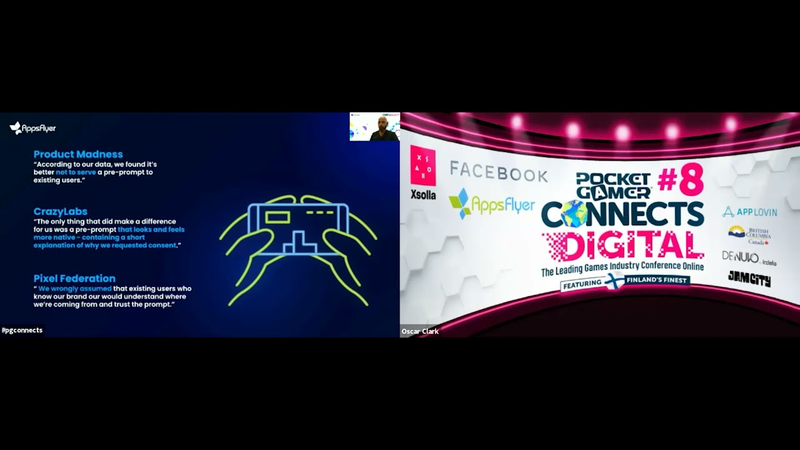
playing uh and so on what are your findings based on that is that actually true that you could figure something out that went against uh your assumptions prior and what kind of testing did you do there um iran you want to show share some insights we did this kind of testing as well um we see a d um a slight decrease in um existing using uh existing users so it's uh surprisingly um we didn't do anything on that so we didn't take any decision uh based on that uh to not show the existing use of the apt because the slide was not that dramatic uh michael do you agree with this uh approach yeah i guess like it depends i can't disagree uh disagree um it's like it's different for every every uh genre or even even different game uh in our case for example like it's mentioned on the slide uh it was
surprising that that for existing users we've seen significantly lower consent rates than foreign new users which was kind of interesting and uh actually like even when we were testing pre-brands no prompts for those existing users we haven't seen like a major change in the conversion rate so uh actually at the at the very end like we showed the prompt to to all existing users since we want to collect as many idf phases possible at the end but uh it didn't really change the strategy between the existing and the new users so something interesting to do to share okay great actually from the gaming side you're uh in the most challenging position right if you look for example at finance e-commerce socials the numbers are a little bit higher um i guess that's also because you have usually more users that are there for a
shorter amount of time maybe they're not aware of who's behind the the game right the brand name in that sense that may create more challenges for you guys something else that i i read that i thought was very interesting is the gdpr part that obviously we're all familiar with in europe and one approach was maybe to merge both i thought it was a very interesting approach actually from a personal experience i would say okay that makes sense right put it all in one message someone will hopefully accept you will have the idfa and and you will continue uh playing uh but actually iran i think uh you figured out that it's uh not necessarily the right way to go yeah we were surprised about it as well so like uh said before it's um we tried various texts um and uh we didn't see any any um
difference now i'm talking about the the purpose thing in the atp pop-up so um we tried various texts in this purpose thing we didn't see any effectiveness and we said okay so if we can um if there is anything uh that we can do like put maybe a legal string there which is aligned to the gdpr level string maybe we can melt two pop-ups so our um european users will not be required to click through several pop-ups privacy pop-ups and um the problem is that um when it comes to legal you need to put you cannot like squeeze everything into lines so it was like six or seven lines um and when we did that we started a decrease in uh in the concentrate and uh and so in overall um we uh the business value i would say because you cannot localize the purpose thing right so you need to put it for the worldwide so the overall consent
rate for worldwide was reduced uh so it didn't really provide any value what we can take out of that is that i would suggest to keep the purpose string in the native pop-up as short as possible no more than two lines because i think the the reason that the concentrate was reduced because we had to introduce like six uh six or seven ninths of legal award instead um so we kind of dropped it interesting usually when you have for example the terms of service etc people just click through right i i mean i i don't think a lot of us actually read the terms of service but maybe when it's in such a short amount of time and a little layout the more text you have will create some maybe we can call it suspicion right and uh maybe that's one of the reasons the pixel or uh product madness test
combining the gdpr with the att product yeah we did uh but we didn't see a reduced consent rate at our end uh we've been running the att and gdpr at the same time uh but you know we haven't seen any videos concerned right at our end at least which is sort of inconsistent with what crazy lab has been seeing but you know as i said i mean it's basically subcategory of the game as well it depends on the kind of users that you have and all those things so uh yeah that's that's that's what we saw um secondly a really important part is the att and the timing right so uh what's very clear is that we you know there's no right and wrong in that sense uh i guess that that sums up kind of the ios discussion to begin with um but i would love to hear your thoughts about what's the best time to actually share the prompt right is it earlier in the funnel of course the pluses there are you have a broader audience more users still active
potentially maybe it's a little bit intrusive uh users don't really know your brand your game yet um and another possibility is to do it later in the funnel which obviously is a smaller audience but potentially a larger amount that will actually opt in i would love to hear your thoughts what kind of testing you did and if you decided to do it earlier in the funnel or later in the funnel with uh with its trade-offs uh maybe you can start actually uh did a lot of testing uh the specific case like so we weren't like that much focus into the messaging and prompt and prefront uh we were testing mostly about mostly the the timing and the placement and uh to summarize those steps we will basically testing whether we should show it right after the install after the gdpr prompt uh so
going very early in the funnel and getting the most broadest audience or we should uh postpone that to the actual interaction uh with an ad because like our games are also ad monetized wanted to tie the prompt to the specific game mechanic and after a couple of days like it was four four iterations of five iterations of of testing we realized that the highest constant rate uh we were able to to achieve in the showing the showing the prompt before an ad view basically so it was actually tied to the game mechanic and uh the messaging was showing like okay we will show you personalized ad if we have data and this made the most sense and we were able to achieve the highest consent rates but this that was our case it doesn't have to be
it's not a universal approach of course it's different for every genre for every for sure so you test it four different ways right like one before the ad one after gdpr and what are the other two we're testing also with uh another game mechanic and showing it after ads because like there was also a we will show an ad that's not targeted and then we will actually ask for for the permission but they didn't work very well so we ditched that and we did also the right after gdpr prompt reason being we've seen slightly higher consent rates however we've seen higher churning rates as well in comparison to the to showing it before and at so we stick to where we basically stuck with the with uh showing the prompt before and aft this is the approach we utilize for every game we have right now live but we will iterate more in the future
and how is that for for product madness yeah for us i mean it's been interesting because as i said i mean we always took the uh user view right in certain sense so what we did was there were a couple of reasons why we started with this approach first of all is again from a user standpoint if you show everything at the start for our user base it's always better because they decide whether they want to do the opt-in or opt-out the assumption was when the when they're involved in the game and if you show the atd prompt a lot of users would be involved in the game and there's a good chance that they might just say yes yes there's a good chance but the problem is that you know at that point the users are engaged in the game they don't care about the power but that particular stage if you're going from level 5 to level 10 or whatever that level is this was the first reason from a user standpoint made a lot of sense to show everything at a start the other two were technical and legal reasons to be honest technical reason the sense that at that point in time we were worried that probe listing might not be there in the in the entire industry and you know absolutely did not have updated attribution at that point in time i think you guys are working on it right now so that was the second reason why we decided to go ahead
with early stage uh you know approach and the third was from a legal standpoint because we had multiple sdks in the system we had firebase we had we had facebook and other stuff and you know the initialization of one sdk was messing around with the other sdks we had to get the att status right away for us to provide the exact same the amount exact amount of data that we needed to send based on the att status and you know a lot of other other discussions we had with the product team in the tech team we decided yes this the support is the best to go so basically within the first minute or so you actually initialize uh yeah because pushing it again as you said i mean it's it's a compromise on your scale as well but if you do it at the start you have 120 seconds uh the sdk timer you know before which you have to collect the atp status and we had to show it in the first 120 seconds in the first 1 to 20 seconds we did experiment should we do it a bit later when they've reached the lobby again users are more involved in the game at that point in time as compared to if you show it at the start but given as i said all the three constraints that i talked about we
decided to show it in the start that's interesting because your the assumption is if you do it later on then people trust you uh and you you know the stickiness is already there but maybe doing it at the beginning and people just want to get it over with right and then start playing go down maybe you also want to share a little bit about the timing and if you tested anything there uh yes we did some testing um we did it really in early phases when when ios 14.5 was introduced um we didn't see any significant uh change and concentrate not enough for us to decide to push it down the uh life cycle of the game because we heavily rely on monetization um first ads has the highest ecpm so uh and we know the value of personalized ads versus the value of non-personalized
ads and the gaps between them so it was uh kind of uh we had some internal discussions about that but um it was kind of a no-brainer that we need to have it as much as uh early in the um game phase uh to get the consent so we can introduce personalized to our users and that brings us actually uh around another um big topic besides att and that's uh sk ad network and the conversion values there are of course different kind of setups uh in a very challenging world uh moving it from user level to an aggregated world one thing that we could see is of course you know apple's thresholds that we're talking about a lot in the industry and uh specifically actually the postbacks with the null values um so i would like to dig into that a little bit deeper and understand what you found there as soon as the postbacks were were coming in we can see your
quote by iran i would love to have you start uh answer that question so i think the the biggest challenge here around the 14.5 announcement was the sk8 network so by far more uh complicated than the att pop-up and the optimization of the apd pop-up um we've been uh struggling and trying to get um to base our uh reports and voice internal reports and gross predictions based on scad network leverages leveraging the conversion values as much as possible getting them back um as an attribution data with user conversion value to indicate the user value and then to build our prediction on top of that so it's been a long year um trying to get all the data um we all know that things didn't work but at the moment things looks pretty good
um but about the conversion values i think that around like like in abstract prospecting around may there was a really big improvement there but up to this point we were really confused because we um we built our prediction model on understanding of the conversion value with understanding that there's going to be some kind of um missing data within that so we built on that as well uh but we were not expecting that amount of of nulls and null conversion values from the data um i think that we are now seeing less and less now so it seems like either the industry is uh the um industry is adopting more discard uh maybe apple fixing uh more issues or bugs on their sides um or um getting a little bit uh better with uh passing this type of information or maybe uh the sites are converging uh
with less and less fragmented so the source source ideas both sides these are um are getting converged more and then the uh privacy threshold is not that effective uh not that not that dramatic um so that's that's that's where we stand at the moment i must state that at the moment it looks from our data it looks like the conversion value is um it's good it's it's not that dramatic anymore like it used to be in the past right i think everyone uh learned to work with with the thresholds even though of course it's it's a bit of a well it's a black box in that sense um product maintenance you you also analyze the numbers right um and for example the source app ids uh and so on uh related to the privacy thresholds were there any interesting insights that you can share with the audience based on that
i mean first of all it took me six years to understand conversion value it was really complicated in the whole process and you know what kind of uh benefit that you can get and maximize uh from conversion value and the whole of scam and because i like to split this discussion into two srns and non-insurance like self-reporting networks like facebook and google and non-insurance which is dsps and uh uh you know other other players like ad network so for non-science we've seen a huge improvement after the changes that happened around i'm assuming may 24th or may 20th and that around that week whatever changes apple did again completely unaware of it uh they made certain changes and you know dsp then our network we started receiving a lot less conversion value and we were pretty happy with the numbers that you were getting in at that point in time it made a lot of sense but facebook and google sort of got affected with that change and uh facebooking will work pretty big for us at our end and you know we started suffering on that front uh so this is where i'm a bit confused even with the impact of privacy threshold that how do how do they change it in such a way that you know
two networks are getting affected i i mean i understood the reason at a later stage but at that point in time we're just questioning how do i create sort of a conversion value which is working for everybody which is working for dsps and ad networks and uh facebook and google and every every single partner out there and that that has been the struggle and i think we're at a much much better stage right now having after having understood uh the situation and with the absolute introduction of custom conversion value which i have been waiting for a while uh you know we i wanted to get that in and you know sort of uh use that to expand the definition of revenue itself within within the conversion value world because i mean we have started using revenue as a big big benchmark and that's that's all we care about in the other day in the first 24 hours uh so you know that that's how we have taken the approach much better right now still not completely convinced by the idea of privacy threshold but yeah we have a talk today that'll say i guess the you know the the summary is that it's a whole new ballgame right obviously everything goes back to testing phases it's a complete shift in
the industry to begin with right yeah um you also mentioned that you learned basically two main things uh based on the sk ad yeah i would start with the first thing uh as mentioned on the slide so uh [Music] the whole thing actually uh made it even even bigger push on the production in the game teams that it was in uh in the past since we need to focus on getting the most amount of data within the first first couple of days or even like first 24 hours and uh this actually meant that some of our games that were focused focused or like actually relying more on the later later monetization like the conversion to player needed to like change dramatically because like if we don't see uh any data coming within the first 24 hours we don't know whether the eu activity that we are running is profitable or profitable or not so uh so this is one thing so we need to
optimize the first days of gameplay even more and the marketing team and the production team needs to work more closely together than any than any time before so there was one thing and then since we were the second thing since we were relying also on later stages of monetization like conversion to play in later games like like day 7 day 14 and whatnot and making predictions from all that amount of data we need to change the way we run the predictions on the specific campaigns on ios and we are still in the pro in the process we don't have a solution yet it's just one thing that that that we needed to rethink straight away thank you so much for your time uh in case anyone wants to read the report feel free to to do so and uh to talk to us directly if you have any
questions uh guys thank you so much great stuff i thought it was fascinating you know particularly i like the fact that they're realizing that these changes around privacy are an idfa and also i think upcoming changes to do with the aadc so that's the age-appropriate design code are going to be profound uh and if that means that the monetization teams the promotional teams have to work close more closely with game developers that's to me a good thing i think that's a that's potentially really exciting uh so anyway that was a fantastic session uh from the x5 guys and the crazy labs and pixel federation you
Summary
The mobile gaming industry has undergone a fundamental shift in user acquisition and data strategy following the implementation of Apple’s iOS 14+ privacy requirements and the adoption of SKAdNetwork. To navigate this landscape, leading publishers have moved away from granular, long-term tracking toward a model defined by early-stage predictive analytics and enhanced cross-departmental collaboration. This transition necessitates a tighter integration between marketing, monetization, and product development teams to maintain campaign profitability within an increasingly aggregated data environment.
Optimizing consent rates under App Tracking Transparency (ATT) requires a focus on simplicity and user experience. Testing indicates that concise, localized pre-prompts significantly outperform complex or lengthy messaging, particularly when publishers avoid merging ATT requests with other regulatory disclosures like GDPR. Timing remains a critical variable, with many studios finding success by triggering prompts immediately before ad interactions. Contrary to some industry assumptions, existing users do not consistently provide higher opt-in rates than new users, reinforcing the need for a streamlined, non-intrusive approach that prioritizes long-term retention over aggressive data collection tactics.
Because privacy thresholds and the prevalence of null conversion values have limited the utility of long-term monetization metrics, publishers are now prioritizing data collection within the first 24 hours of user activity. This reliance on early-stage signals is essential for effective predictive modeling in a post-IDFA world. As regulatory frameworks like the Age-Appropriate Design Code continue to evolve, the industry is moving toward a more strategic, privacy-centric operational model. This evolution ensures that game design and promotional efforts remain sustainable by balancing the necessity of data-driven decision-making with the growing demand for user privacy.

















Comments