Mobile reports and market data
Documents
Modernizing Rendering at Supercell
Supercell has successfully modernized its rendering architecture to ensure the long-term viability of its high-revenue mobile titles, including Clash of Clans and Hay Day.
- Supercell developed a new core rendering framework called 'Thor' to replace legacy OpenGL ES systems, enabling better abstraction and support for modern APIs like Metal and Vulkan across their portfolio of games.
- The transition to Thor allowed Supercell to significantly reduce energy consumption on mobile devices, with internal metrics showing improved power efficiency for high-traffic titles like Clash of Clans.
- To manage the risks of updating billion-dollar live games, Supercell implemented a dual-path rendering system that allowed the new and old pipelines to coexist, enabling a phased, game-by-game migration.

Lessons Learned: Gaming Startups & New Global Risks
The mobile gaming industry has undergone a fundamental transformation, rendering the traditional model of building a high-quality product and scaling it through standard user acquisition obsolete.
- The traditional mobile gaming model of high-quality product development followed by standard user acquisition is obsolete due to the deprecation of IDFA and shifting macroeconomic conditions.
- Success now requires a dual-competency approach that integrates product development with sophisticated performance marketing and community growth strategies.
- Founders often fail by prioritizing analysis paralysis and minor metric optimization over addressing fundamental flaws in core gameplay and broad market appeal.

What’s Next For Move-to-Earn Pioneer Stepn?
Stepn serves as a primary case study in the evolution of move-to-earn gaming, demonstrating how physical activity can be incentivized through Web3 economic models.
- Stepn reached a peak of 3 million monthly active users and $123 million in quarterly profit in early 2022, establishing a model for incentivizing physical activity through NFT-based rewards.
- Find Satoshi Labs is transitioning Stepn from a single app to a multi-application ecosystem where the GMT cryptocurrency serves as the central utility token.
- To lower barriers for mainstream users, Stepn integrated Apple Pay, allowing in-game asset purchases without digital wallets despite the trade-off of a 30% fee and centralized regulation.
Peer-Pressure? A Motivation-Focused Taxonomy of Social Mechanics in Microtransaction-Based Mobile Games
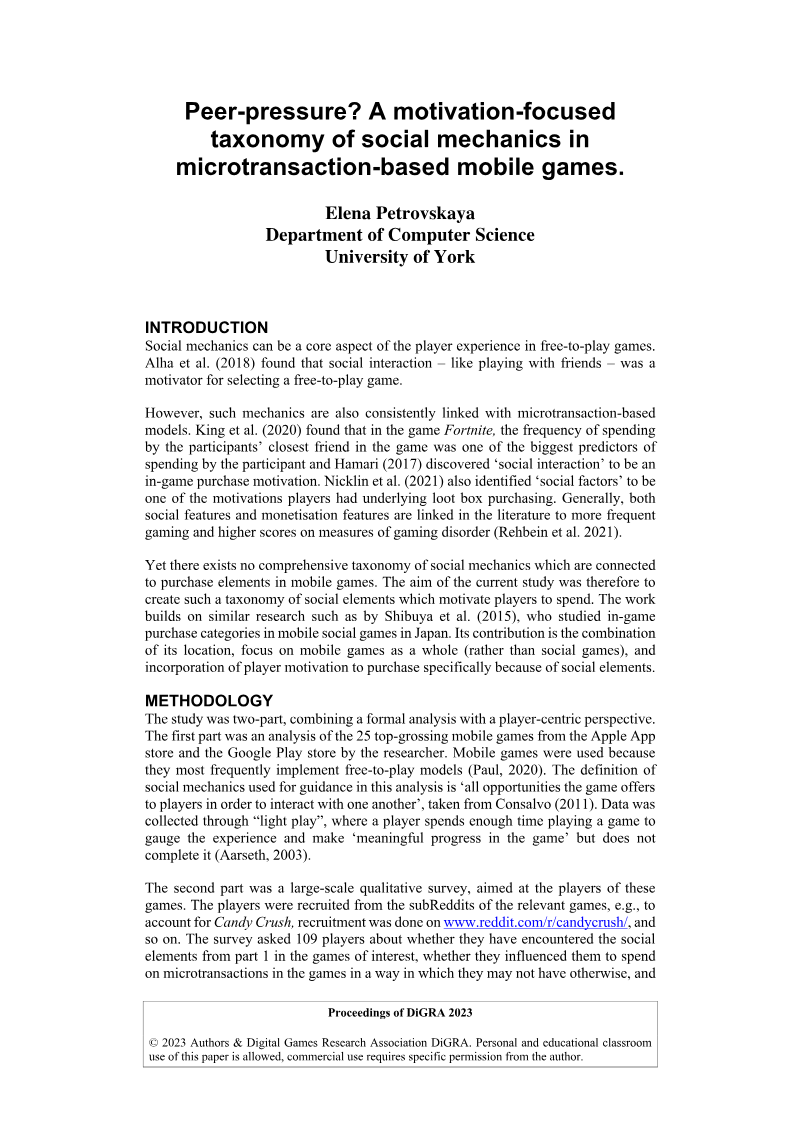
This study aims to develop a comprehensive, motivation-focused taxonomy of social mechanics in microtransaction-based mobile games that influence player spending.
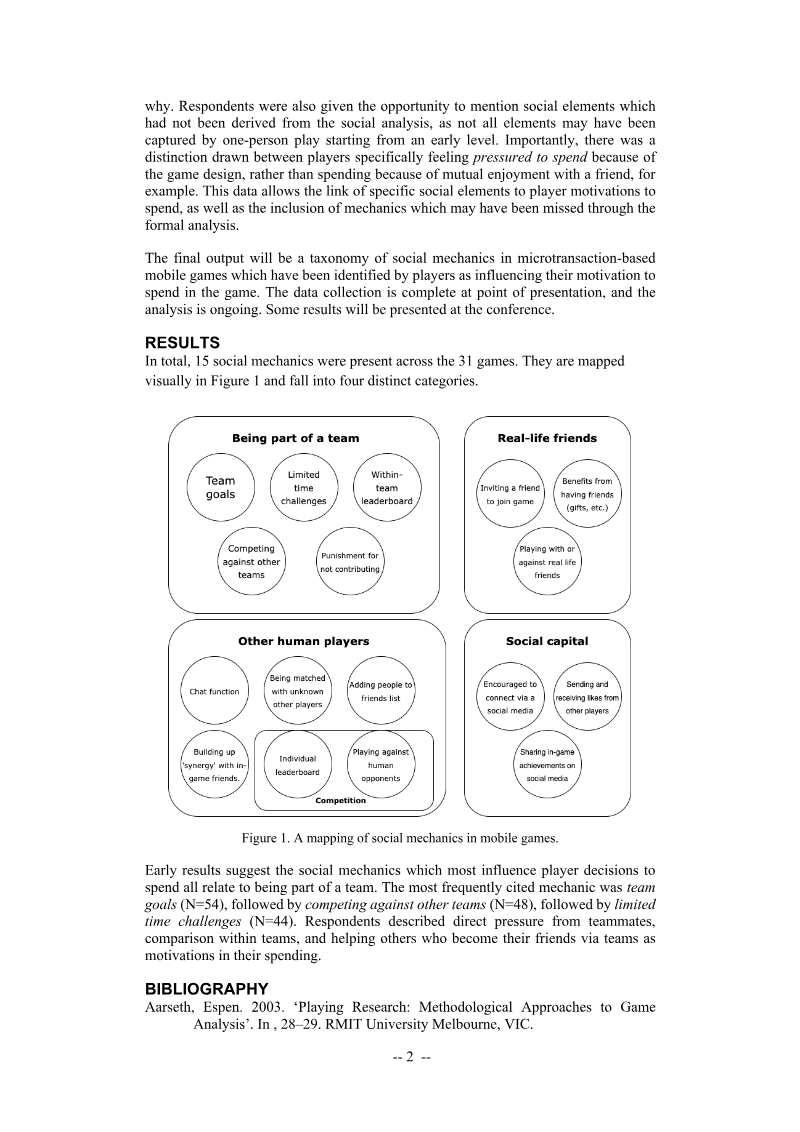
- The study builds the first comprehensive taxonomy of social mechanics tied to in-game purchasing in free-to-play mobile games, identifying 15 mechanics grouped into four categories: being part of a team, competing against other human players, social capital, and real-life friends.
- Team-related mechanics appear to exert the strongest influence on spending decisions, with team goals the most frequently cited motivator (N=54), followed by competition against other teams (N=48) and limited-time challenges (N=44).
- Survey respondents (N=109, recruited from game subreddits) described direct pressure from teammates, in-team comparison, and the desire to help new friends made through teams as reasons for purchasing.

Social Acceptability of Location-Based Games in Cemeteries
A survey of 1,053 Australian adults, stratified by age, gender, and state or territory, examined how socially acceptable digital technologies are in cemeteries, with particular attention to two location-based game concepts: a historical mystery game and a ghost-hunting game played on-site among graves and monuments.
- Respondents were broadly negative toward location-based games in cemeteries, with the two game concepts drawing the highest negative responses among the thirteen cemtech concepts tested: 60% for the historical mystery game and 74% for the ghost-hunting game.
- The main concerns were that play in a place of mourning is disrespectful and disrupts its peaceful atmosphere, and respondents anticipated hostile disapproval from bystanders, with one comment raising the possibility of aggression toward players.
- Positive views existed but were a minority, expressed by 22% of respondents for the historical game and 12% for the ghost game.
Gamification and Undesign: Exploring the Affordances of Digital Detox Apps with Game Features
This study investigates the motivational affordances of digital detox applications that incorporate game features, exploring how these gamified elements influence smartphone use and non-use.
- The study qualitatively analysed three digital detox apps (Forest, Hold, and Freedom) through a two-week walkthrough and thematic analysis, so its findings are interpretive observations rather than generalizable measurements of user behavior.
- Forest and Hold are gamified timers that reward abstinence from the phone with points, coins, achievements, badges, leaderboards, levels, and progress tracking, while Freedom is a blocker that restricts access to apps and websites.
- Gamification affordances (which motivate engagement) appear in great variety across the apps, whereas undesign affordances (which inhibit technology use, often through deliberate friction) are far less varied and mainly take the form of access blocking.
Serious Narrative Microgames as a Remedy for Gamification Limitations: The Case of the Platform for Making Games for Mobile CBT Therapies
This document explores the potential of serious narrative microgames to address limitations of traditional gamification in mobile applications for Cognitive Behavioral Therapy (CBT).
- Traditional gamification mechanics (points, badges, rankings, prizes) are argued to have limited effectiveness in mobile mental health apps, particularly for users without gaming experience or those with conditions like occupational burnout, for whom these mechanics can feel tiring or off-putting.
- The authors propose interactive, narrative-driven serious microgames as a more suitable alternative for supporting cognitive-behavioral therapy (CBT) through digital therapeutics.
- The Prosoma project produced 16 microgames varying in narrative progression, graphic style, and therapeutic purpose, structured as interactive video episodes depicting characters in real-life mental crisis situations, where users learn CBT tools through their decisions.



Grief in Mobile Games
Emma Reay, a researcher at the University of Southampton, presents a close-reading study of five critically acclaimed mobile games published within the last five years that engage with grief: Old Man's Journey, If Found…, The Stillness of the Wind, Florence, and Far From Noise.
- The author argues that the mobile games in the corpus show that loss is connected to attachment rather than skill, with only Old Man's Journey blocking progress until puzzles are solved.
- The author proposes a Typology of Friction with four types, Symmetry, Consonance, Counterpoint and Dissonance, to describe how semiotic planes interact in games.
- The author states that the discrepancy between players' expectations and the engagement modes these games offer produces irresolvable contradictions, which the author calls ludic aporia.
Valletta: Streets of History: Documenting the Process of Developing a Location-Based Game in the Area of Maltese History and Culture
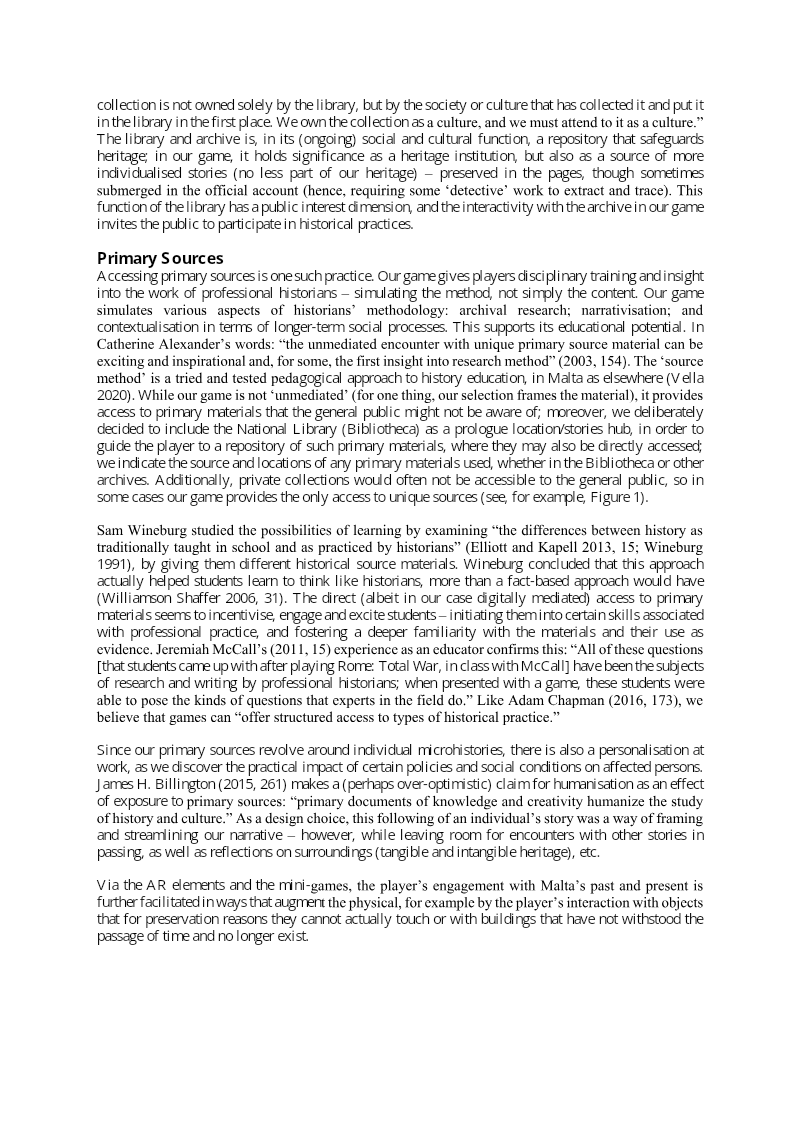
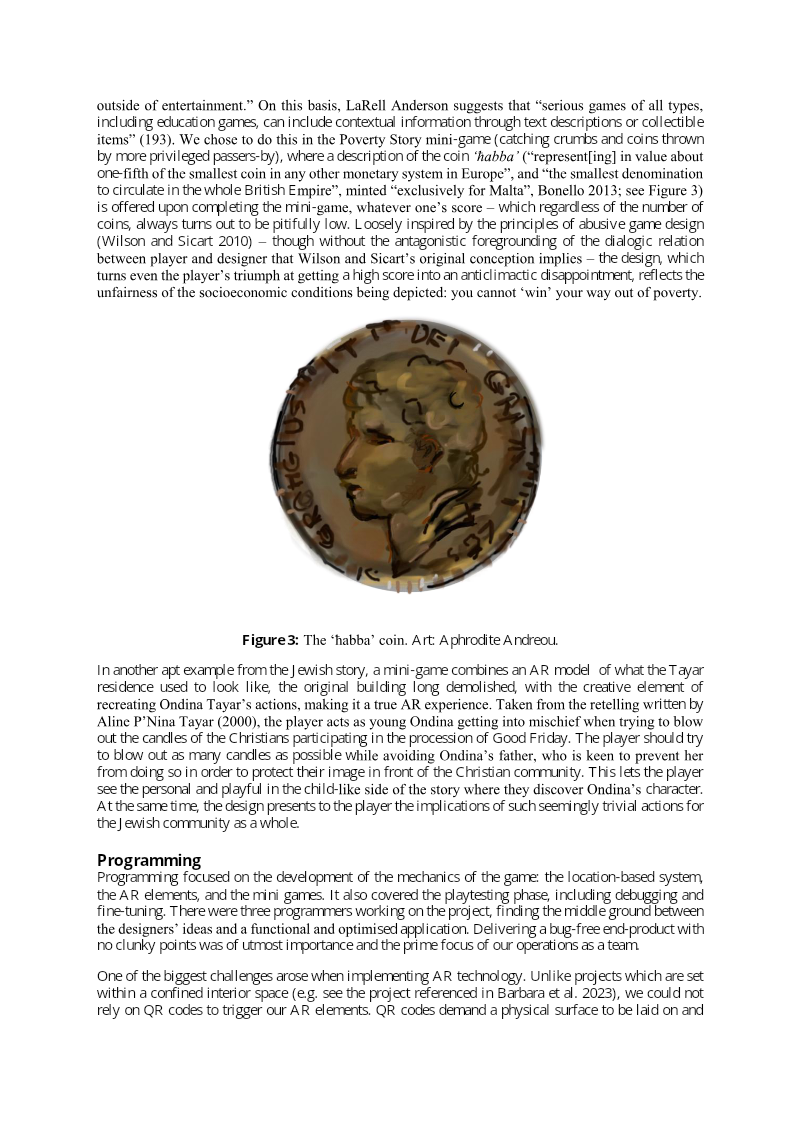
The paper, by a team including authors from the University of Malta and the University of Lincoln, documents the development of Valletta: Streets of History, a mobile augmented reality game about 19th to early-20th century Maltese history set in Valletta.
- The authors say that they used a team-based division of labour during a six-month development phase, with four members on research, design and writing, three on programming, and one artist.
- The team chose AR overlays over QR codes because stickers placed on physical surfaces could be removed by passers-by or the weather.
- The authors state that they selected archival sources on the basis of criteria including being interesting enough to adapt into a story and concerning relatively unknown parts of Maltese history.
Gender Differences in Ethical Stances for Playing AR Games: The Case of Pokémon GO
This study examines gender differences in ethical stances and behaviors among players of Pokémon GO, a location-based augmented reality game.
- Men rated the 25 game actions as slightly more ethical than women overall, though the difference was small.
- Gender differences were far more apparent in actual behavior than in ethical perception, according to the authors.
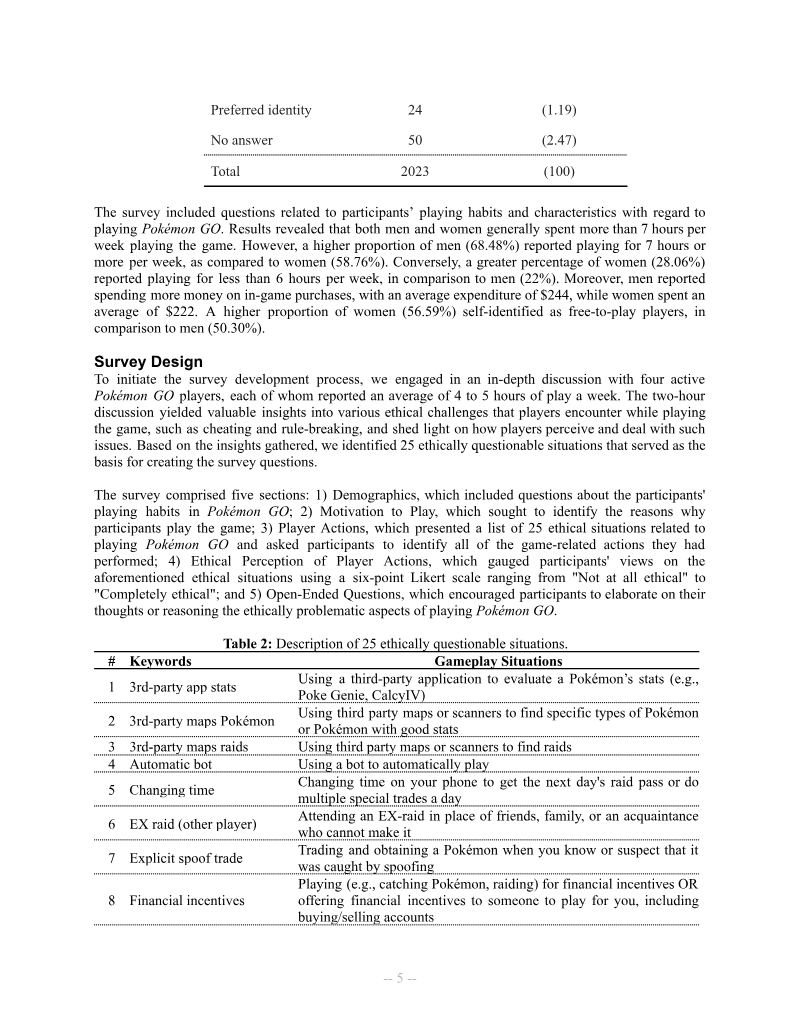
- Of 25 situations, 19 showed significant gender differences in actions performed.
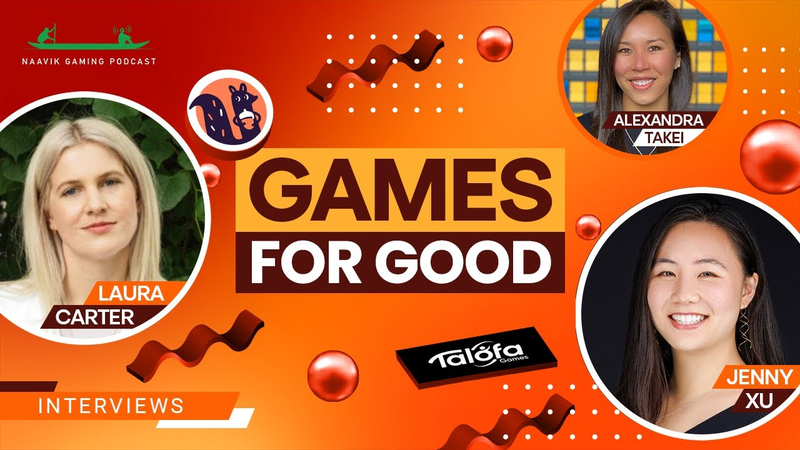
Games For Good
The integration of social impact and physical health into mobile gaming represents a burgeoning shift in the industry, where developers are successfully merging mass-market free-to-play mechanics with corporate social responsibility.
- Integrating social impact into core gameplay loops, such as real-world tree planting, has successfully driven the planting of over 550,000 trees.
- Purpose-driven mechanics significantly enhance player loyalty and organic growth, proving that mission-driven games can be commercially viable when high-quality design is prioritized over didactic messaging.
- Studios that adopt a triple bottom line approach—balancing profit, social impact, and sustainability—are more effective at attracting mission-aligned talent.

Top 5 Mobile Game Launches: Honkai Star Rail, Monopoly Go, Survivor!.io, Marvel Snap, Frozen City
The mobile gaming sector remains a robust and evolving landscape, characterized by high production values and sophisticated live-ops strategies that defy narratives of industry decline.
- Future mobile gaming success is increasingly dependent on cross-platform accessibility and the integration of complex progression systems rather than reliance on traditional app store metrics.
- Monopoly Go utilizes an aggressive, high-spend acquisition strategy backed by major intellectual property, though it faces challenges regarding long-term profitability and extended payback periods.
- Survivor!.io has achieved sustainable growth by leveraging AI-driven creative assets and a balanced monetization model that splits revenue between in-app purchases and advertising.
Writers
Games and companies
Games