1 free read left. Create a free account for unlimited reading + AI research.
Create free accountWhitepaper DiGRA
1 free read left. Create a free account for unlimited reading + AI research.
Create free accountWhitepaperDiGRA
The study asks which gamification affordances these apps use and how they motivate either smartphone use or non-use. It draws on two concepts: gamification affordances and undesign affordances.
This study examines how digital detox apps that incorporate game features attempt to limit smartphone use, and what this reveals about the boundaries between gamified productivity tools and digital games. Its central question asks which gamification affordances these apps employ and how those affordances motivate either smartphone use or non-use. The authors ground their analysis in two concepts: gamification affordances, which motivate engagement, and undesign affordances, which encourage and enable non-use by inhibiting technology use, often through deliberate friction.
The analysis draws on a walkthrough method combined with thematic analysis, applied to three apps selected from the App Store and Google Play: Forest, Hold, and Freedom. Each app was used by the researchers over a two-week period, with app store descriptions, reviews, and screenshots serving as supplementary material. Forest and Hold function as gamified timers that reward users for abstaining from their phones, while Freedom operates as a blocker that restricts access to apps and websites. The sample is small and qualitative, so the findings reflect interpretive observations rather than generalizable measurements of user behavior.
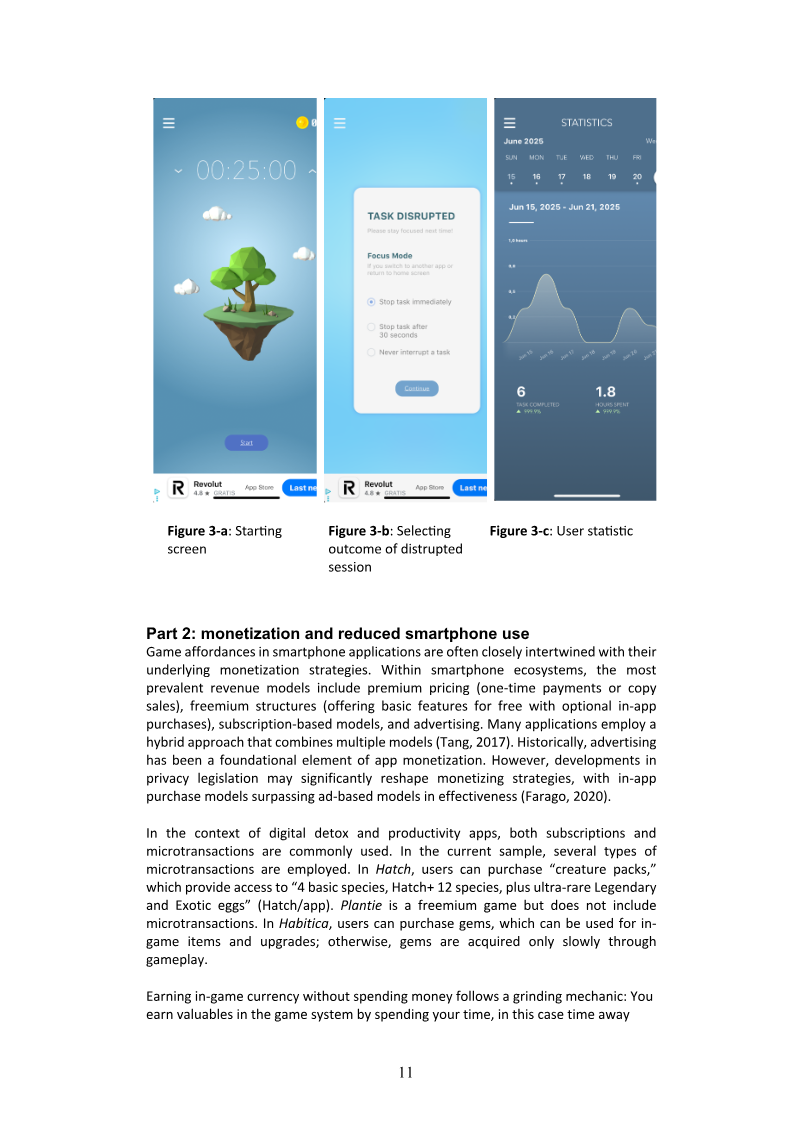
The authors identify a range of gamification affordances across Forest and Hold, including points, coins, achievements, badges, leaderboards, levels, and progress tracking, with the timer serving as a core element shared by all three apps. Undesign affordances appear in far less variety and mainly take the form of blocking access to the phone, websites, or applications. Forest and Hold rely on a "withering" mechanism in which stopping the timer carries a small penalty, such as a wilting plant or forfeited points.
A central finding is that these apps can paradoxically draw attention back to the smartphone and foster new forms of digital engagement. Forest and Hold closely resemble incremental and collecting games such as Cookie Clicker and Pokémon GO, which invite frequent return visits to accomplish goals tied to timers. The authors conclude that while these apps may help users alter or reduce unwanted habits, they may also cultivate new habitual engagement, highlighting the fluid boundary between gamified tools and games themselves.
Each row is a game or company this document names, each column a document, oldest first. A mark means that document names it. Select a row to see those documents.

DiGRA · 2026

DiGRA · 2026



DiGRA · 2026

Two & a Half Gamers · 2026