Mobile reports and market data
Documents

Week in Mobile Games E31 - The Top 50 Mobile Game Makers 2024 revealed!
The global mobile gaming industry is currently navigating a complex landscape defined by economic volatility, shifting regulatory environments, and a strategic pivot toward sustainable growth.
- Scopely is the top mobile developer of 2024, driven by Monopoly GO! generating $3 billion in revenue within its first 15 months.
- Epic Games is aggressively competing for developer loyalty by reducing Unreal Engine royalty fees to 3.5% and offering 100% net revenue for new titles launched exclusively on its store.
- The mobile market is shifting from hyper-casual to hybrid-casual business models to prioritize long-term profitability and improved player retention.

4 CRITICAL LESSONS I've Learned (After 10 Years Of Making Indie Games)
Drawing from over a decade of experience in the indie game industry, this analysis outlines four essential strategies for developers aiming to achieve professional success and financial sustainability.
- Prioritize the validation of the first 15 minutes of gameplay to ensure a high-quality experience that elicits a positive emotional response before committing further development resources.
- Scale game development exclusively by expanding upon the validated core segment rather than building out unproven concepts, which prevents the dilution of overall quality.
- Focus narrative and linear game development on the 'bookends' by front-loading rewards to hook players and ensuring a high-value, satisfying conclusion to maintain engagement through potential mid-game grinds.

TWIG #302 Epic Legal Showdowns, Ubisoft Woes, and MMO Thrills
The global video game industry is currently navigating a period of significant structural volatility, characterized by shifting consumer ownership rights, evolving hardware paradigms, and the struggle to balance profitability with creative output.
- Western AAA publishers are struggling to replicate the dual-skew mobile and PC development models mastered by Eastern firms like HoYoverse, whose title Genshin Impact has generated over $4 billion in mobile revenue.
- The industry is shifting from aggressive expansion to cautious portfolio management as developers face audience cannibalization and the rising costs of maintaining high-fidelity gaming experiences.
- Major publishers are increasingly leveraging artificial intelligence to reduce headcounts and bolster profit margins, contributing to a period of structural volatility and internal instability at firms like Ubisoft.

Game Review Radar #6: The sea of Unfortunate Sharkfins! Exploring Game Updates and Trends
The mobile gaming landscape is currently defined by a volatile cycle of rapid growth followed by sharp revenue and download declines, a phenomenon frequently described as the shark fin performance curve.
- Mobile game revenue often experiences sharp post-launch declines, exemplified by a hardcore RPG that dropped from $40 million in its first month to $6 million shortly thereafter.
- User acquisition (UA) remains a primary driver of success in the mobile market, as demonstrated by a top-10 4X game maintaining stability at approximately 70,000 daily downloads through consistent UA efforts.
- Star Wars Hunters maintains a consistent daily download rate of roughly 13,000 in the U.S., though it faces monetization challenges due to high ad-refresh rates that require filling up to 90 banners per user in markets like India.
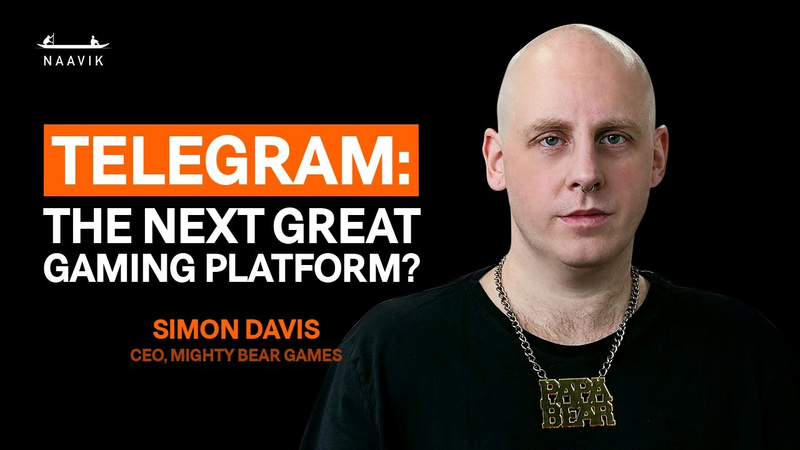
Telegram: The Next Great Gaming Platform?
Telegram is rapidly evolving into a high-growth distribution channel for the gaming industry, offering a compelling alternative to the saturated and high-cost environments of traditional mobile app stores.
- Telegram serves as a high-growth distribution channel that bypasses traditional app store restrictions by using HTML5 and WebGL frameworks to enable rapid three-to-four-week development cycles.
- The platform has demonstrated massive scalability, evidenced by titles like Hamster Kombat reaching over 100 million users through a combination of accessible gameplay and social mechanics.
- Retention metrics on Telegram are competitive, with specific cohorts achieving 22% retention after five weeks due to low-friction access and deep social integration.
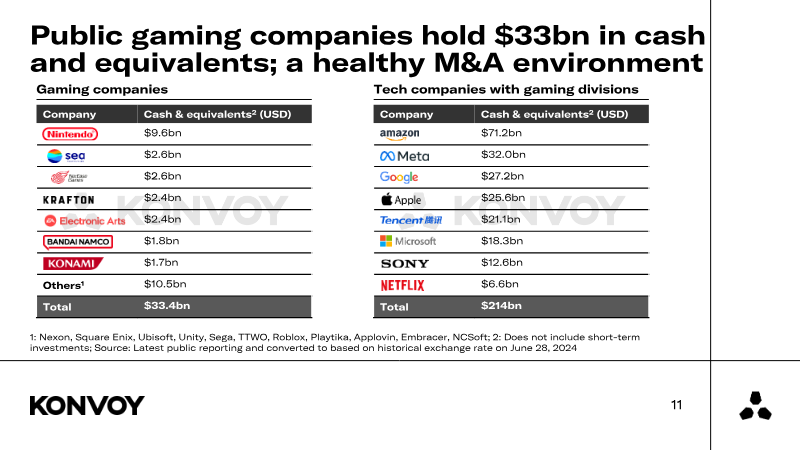
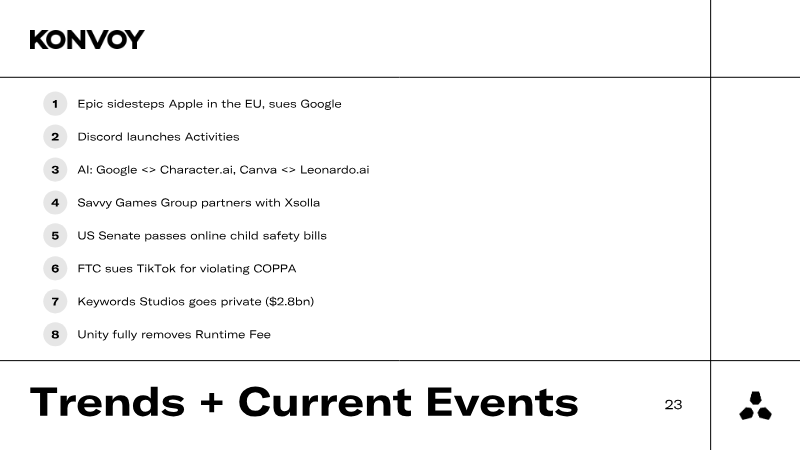

Gaming Industry Report: Q3 2024
Gaming Industry Report: Q3 2024 examines the state of gaming capital markets and industry developments, arguing that public and strategic indicators look healthy even as early-stage venture funding remains depressed.
- The gaming market size in 2024 is $188 billion, showing a 2.1% year-over-year growth. Asia-Pacific accounts for the largest share of gamers with 1,809 million (53%), followed by Europe with 454 million (13%).
- Venture funding in Q3 2024 reached $517 million across 92 deals, marking a 1% increase in funding quarter-over-quarter but a 14% decrease in the number of deals. Total private market funding for 2024 is $3,739 million, with a 15% QoQ increase in Q3.
- Public market gaming ETFs are significantly outperforming the S&P 500, with leading ETFs up 22-36% year-to-date compared to the S&P 500's 21%.

Breaking In & Leveling Up: Meet the Game Industry’s Next Generation
The game industry is currently navigating a critical transition in talent acquisition and workplace culture, driven by a disconnect between the demand for junior developers and the lack of structured mentorship programs.
- The industry faces a hiring paradox where studios demand prior experience that entry-level candidates cannot obtain, forcing new talent to gain initial experience at indie studios or startups.
- Sustainable growth requires eliminating toxic crunch culture and adopting modern management practices, such as four-day work weeks, to improve long-term employee retention and productivity.
- Studios must move away from rigid hiring criteria that prioritize traditional 'hardcore gamer' backgrounds and instead focus on diverse, modern skill sets.

Ad placements & Ad monetization trends in Mobile Games - September 2024
Mobile game monetization is currently defined by a strategic shift toward aggressive ad placement and design loops that prioritize high-volume user acquisition over traditional in-app purchases.
- Mobile game monetization is shifting from in-app purchases toward high-volume ad-driven revenue models, particularly in ultra-casual and puzzle genres.
- Core gameplay mechanics are increasingly being gated behind ad-walls, forcing players to engage with rewarded ads to progress.
- Developers are utilizing high-pressure UI patterns, such as delayed exit buttons and deceptive sliders, to drive conversions toward ad-removal subscriptions.
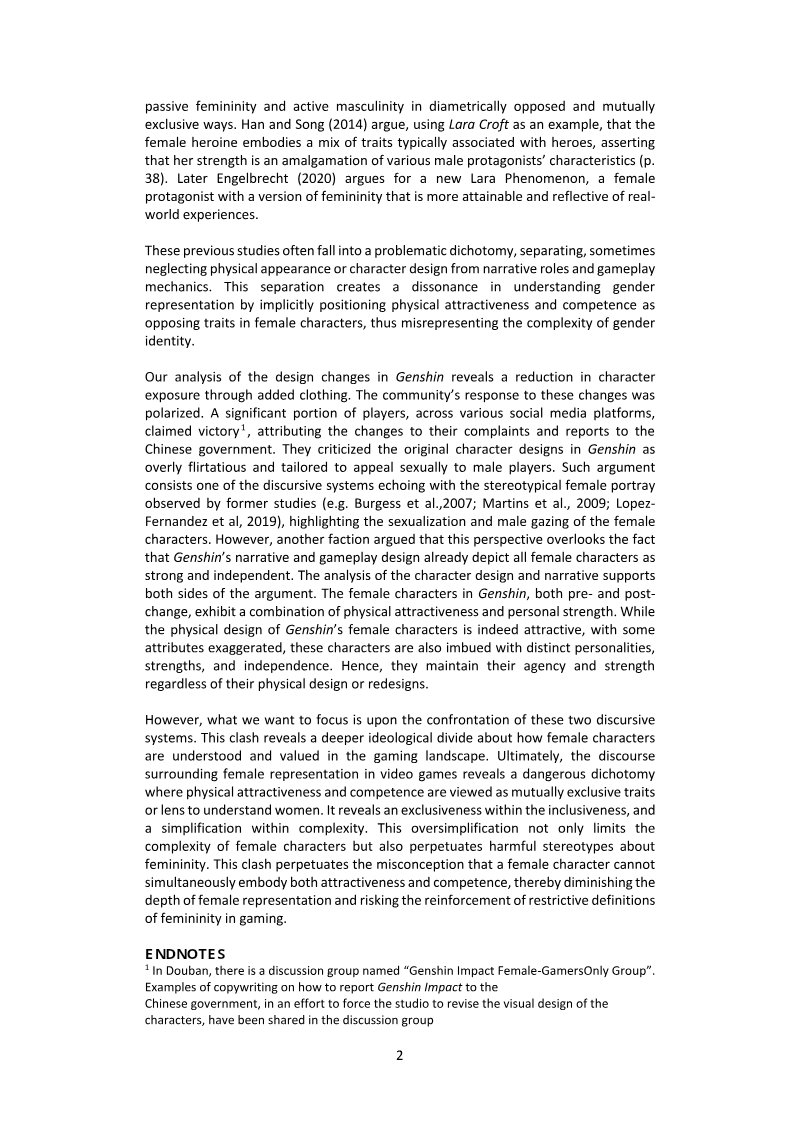
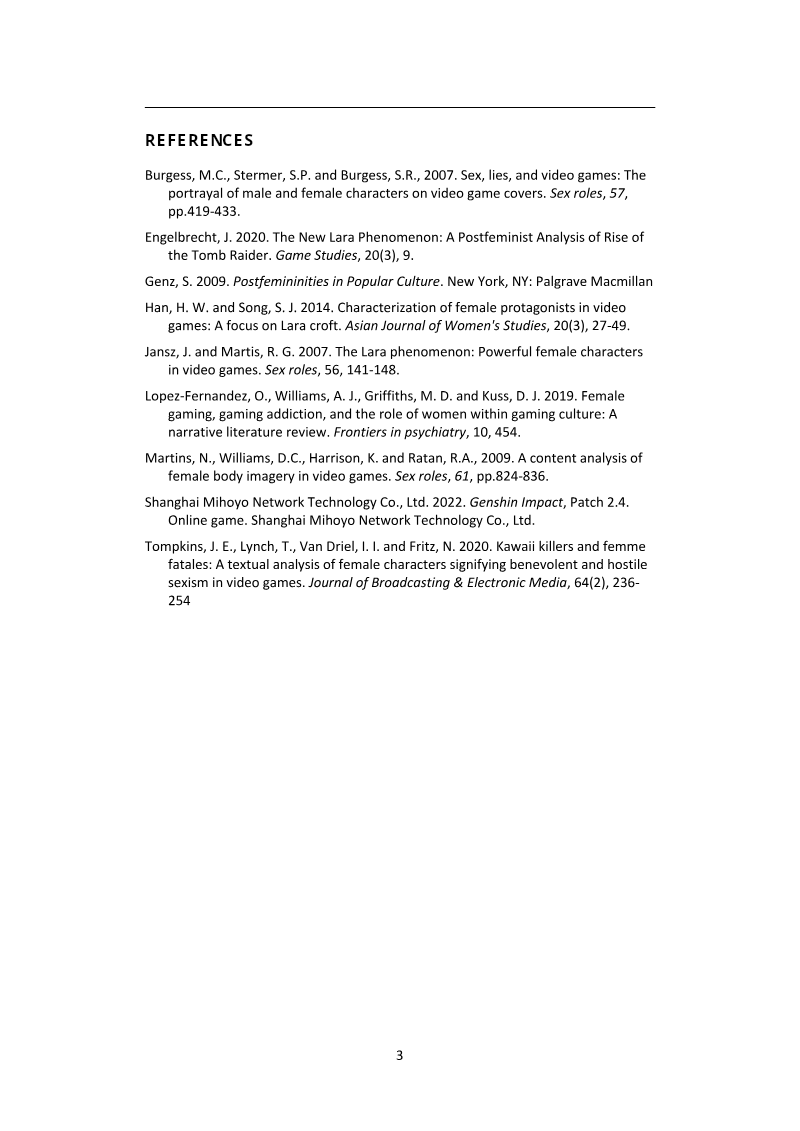
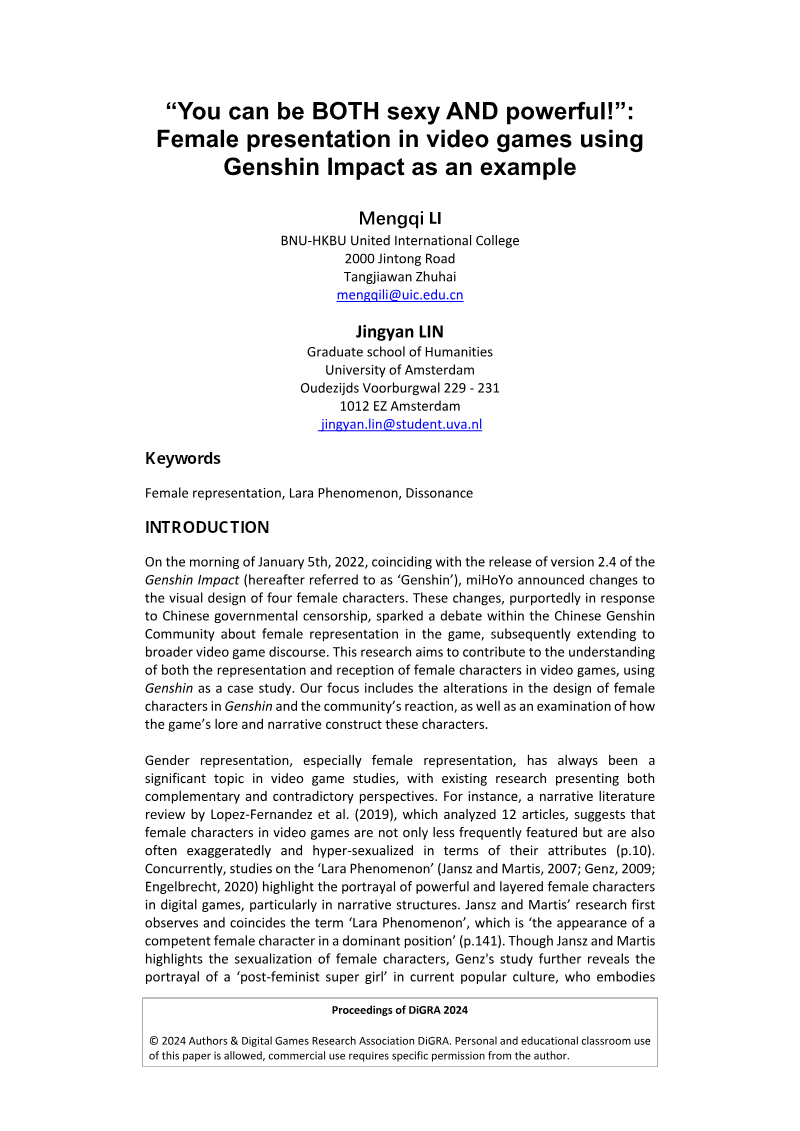
"You Can Be BOTH Sexy AND Powerful!": Female Presentation in Video Games Using Genshin Impact as an Example
The document examines the presentation and reception of female characters in video games, using Genshin Impact as a primary case study.
- miHoYo redesigned four female characters in Genshin Impact in January 2022, announced alongside version 2.4 and framed as a response to Chinese governmental censorship, with the redesigns adding clothing that reduced character exposure.
- The authors' central thesis is that discourse often treats physical attractiveness and competence as mutually exclusive, a dichotomy they argue oversimplifies gender identity and reinforces restrictive notions of femininity.
- The authors' analysis finds that both pre- and post-redesign female characters in Genshin combine physical attractiveness with distinct personalities, strengths, and independence.

Week in Mobile Games E30 - Ubisoft's woes and Genshin Impact hits $6bn in four years(!)
Ubisoft currently faces a period of profound instability characterized by a 20 percent decline in share price, driven by the strategic delay of Assassin’s Creed Shadows and the underwhelming commercial performance of Star Wars Outlaws.
- Genshin Impact has generated $6.3 billion in lifetime revenue over four years, demonstrating the long-term viability of mobile live-service titles despite a recent dip in annual earnings due to market saturation.
- Ubisoft is facing significant financial instability, marked by a 20 percent share price decline following the delay of Assassin’s Creed Shadows and the poor commercial performance of Star Wars Outlaws.
- Dungeon & Fighter Mobile has emerged as a major revenue driver, securing over $800 million in gross revenue within its first four months in the Chinese market.


2024 Integrated Report: Value Creation Story
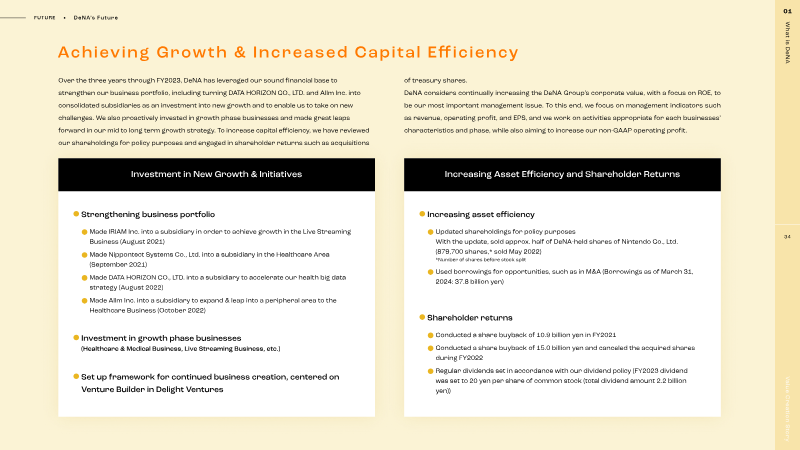
DeNA's 2024 Integrated Report, issued as the company marks its 25th anniversary, explains how DeNA is reshaping itself from a game-dependent business into a diversified portfolio, and why it frames continual challenge and managed failure as the core of its value creation.
- DeNA aims for a non-GAAP operating profit of 15.0 billion yen by FY2026, with additional goals of 5.0 billion yen for Healthcare & Medical and 3.0 billion yen for Sports & the Community over the next three years.
- DeNA has significantly shifted its business portfolio since FY2021, reducing reliance on the volatile Game Business and growing Live Streaming to over 40.0 billion yen (more than 30% of total revenue) and Sports to 20% of total revenue.
- The Live Streaming Business, driven by Pococha (5.77 million downloads as of March 31, 2024) and IRIAM, has grown to over 40.0 billion yen in revenue, with a segment profit of 5.2 billion yen in FY2023.

Diversifying your Mobile Game UA with Influencer Marketing (real data included)
Mobile game user acquisition strategies are increasingly shifting toward influencer marketing as a necessary diversification from traditional channels like Facebook and Google.
- Influencer marketing should be treated as a performance-driven pillar rather than a branding exercise, specifically for games with a minimum US lifetime value of $3 to $4.
- Initial test budgets for influencer campaigns should range between $10,000 and $20,000 to establish data-backed performance benchmarks.
- YouTube and podcasts are the most reliable platforms for user acquisition due to superior attribution, long-term searchability, and the ability to repurpose content for broader advertising.
Writers
Games and companies
Games