Game Studies reports and market data
Documents


The Other Game Researcher: Participating in and Watching the Construction of Boundaries in Game Studies
Marinka Copier's paper argues that the emergence of game studies as an autonomous academic discipline depends on the active construction of boundaries, and that researchers themselves are participants in this boundary-work rather than detached observers.
- Marinka Copier argues that game studies' emergence as an autonomous discipline depends on active boundary-work, and that researchers are participants in drawing these boundaries rather than detached observers, drawing on Thomas Gieryn's boundary-work and Donna Haraway's situated knowledge.
- The paper traces the field's formation through early-2000s debates, including the 2001 founding editorial of the journal Gamestudies, which separated ludology from narratology and argued games deserve study on their own terms.
- Copier treats boundaries between game studies, designers, gamers, and neighboring fields as resting on both content-based and institutional arguments, and treats divides like ludology versus narratology as political constructions rather than fixed categories.
All the World's a Botfighter Stage: Notes on Location-Based Multi-User Gaming
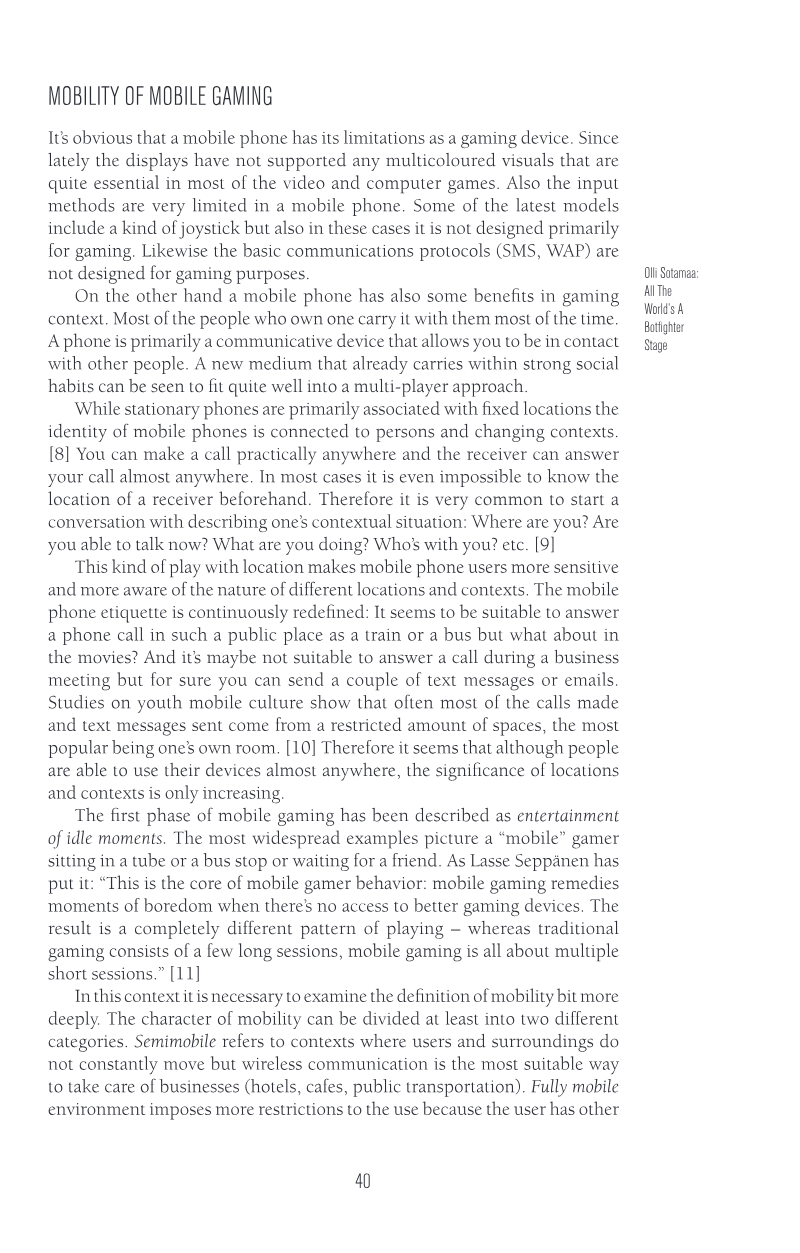
Olli Sotamaa's paper examines how location-based multi-user games such as Botfighters challenge classical definitions of play and game, while reshaping the meaning of mobile gaming and urban space.
- The paper argues that location-based multi-user games like Botfighters challenge the classical view of play as autonomous and separated from real life, because games using city streets as a board intrude on everyday reality.
- Location-based games are classified into three technological groups: GPS-based treasure hunts lacking real-time multi-user features, local network and proximity-sensor experiments mostly from research projects, and GSM cell-identification games that need only standard phones and are likely to reach large audiences.
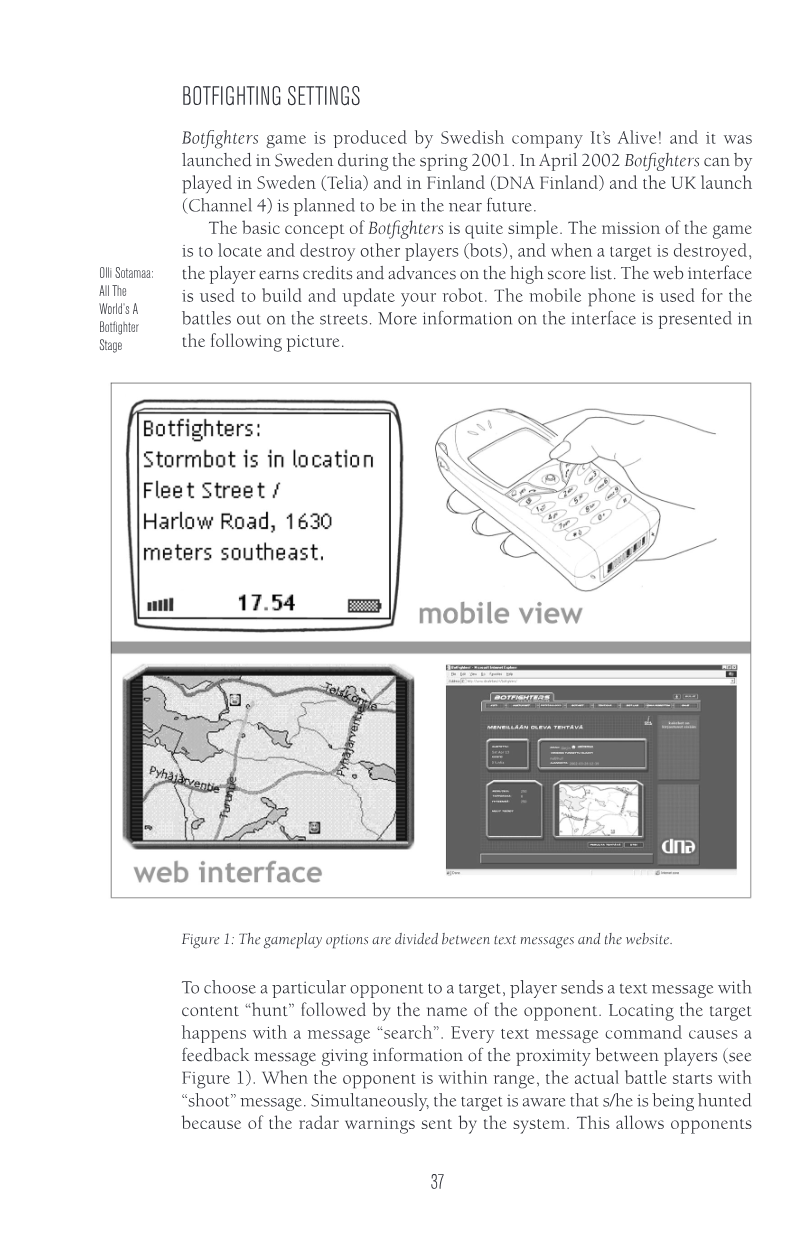
- Botfighters, launched in Sweden in 2001 and offered in Sweden and Finland by April 2002, let players hunt and shoot each other via SMS commands, with a web interface for building robots and tracking scores.
Computer Games / Cinema / Interfaces
King and Krzywinska's "Computer Games / Cinema / Interfaces" examines the formal and industrial relationship between video games and film, arguing that cinematic concepts provide useful analytical tools for some games but that the two media should be compared on their distinct qualities rather than reduced one to the other.
- The authors argue that cinematic concepts are useful analytical tools for some games, but that games and film should be compared on their distinct qualities rather than one being reduced to the other.
- Cinema has shaped games far more than the reverse, since games rarely lend themselves to cinematic adaptation and their narrative and character development remain less developed than film's.
- Games demand more active engagement than film viewing, and the authors propose Aarseth's term "ergotic" as a more precise alternative to "interactive."
The Study of Computer Games as a Second-Order Cybernetic System
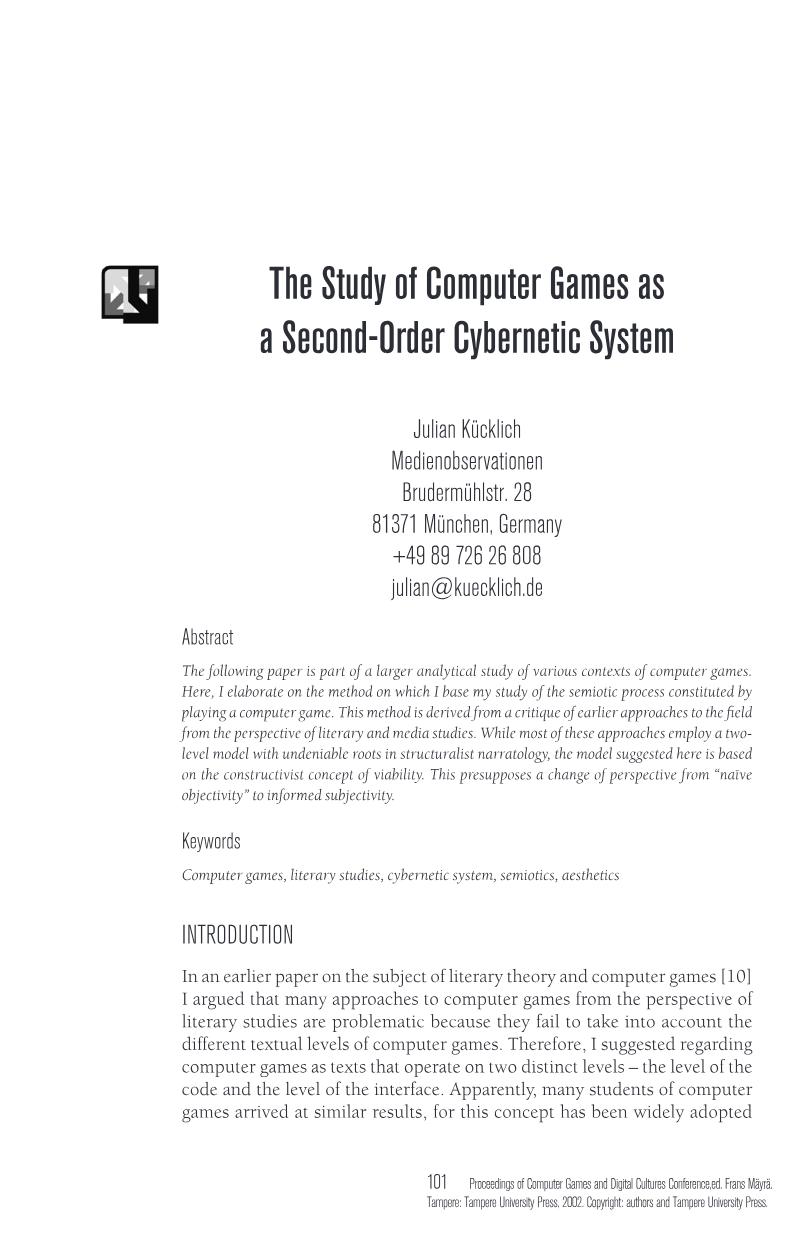
Kücklich's paper argues that the dominant literary and narratological approaches to computer games rest on a problematic two-level model of code and interface, inherited from Aristotelian and structuralist traditions.
- The paper argues that narratology should not be the governing discipline for game studies; games should instead be situated within ludic, representational, and media traditions.
- It proposes a constructivist, second-order cybernetic framework in which game and player form an interdependent whole, shifting focus from the underlying code to the player's experience of play.
- Interactivity and narrativity are treated as synergetic effects of semiosis rather than fixed properties of the software.

Well Played: A Special Issue on Post-Mortems of AR & VR Games
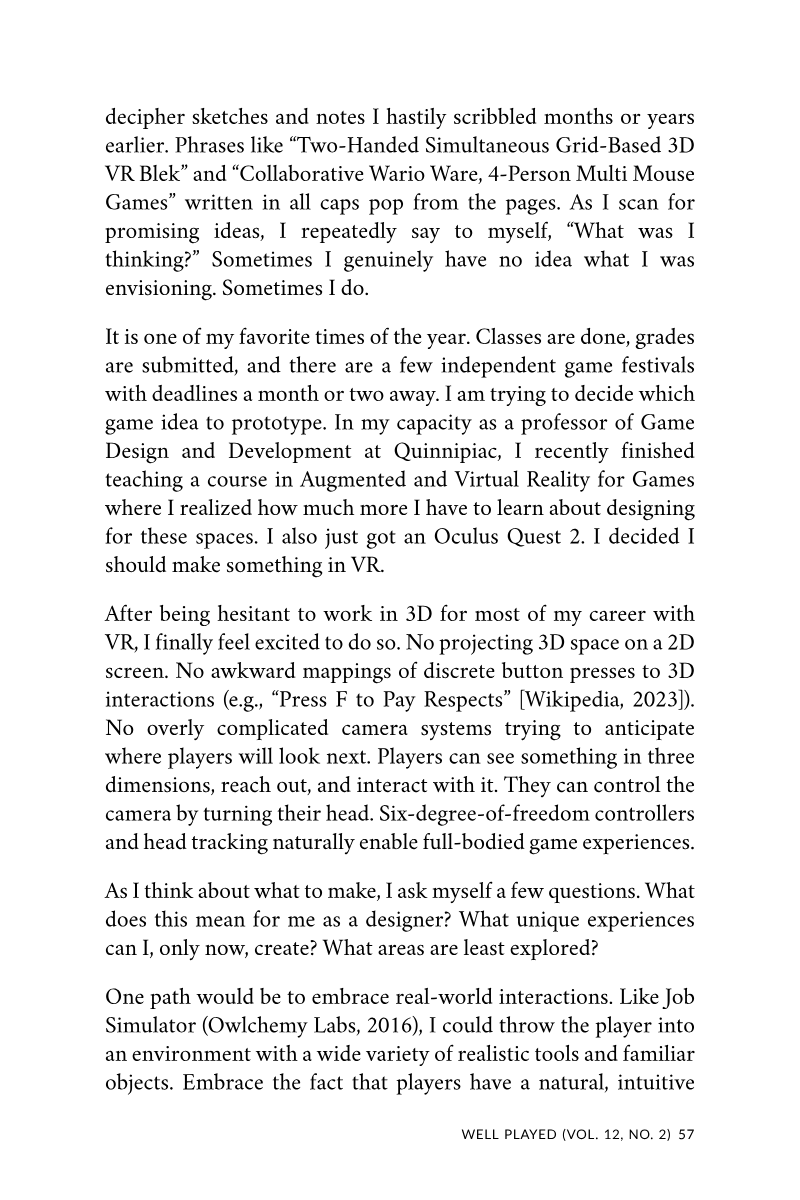
The development of immersive media requires a fundamental shift in design philosophy, moving away from traditional gaming paradigms toward solutions that prioritize physical presence and spatial embodiment.
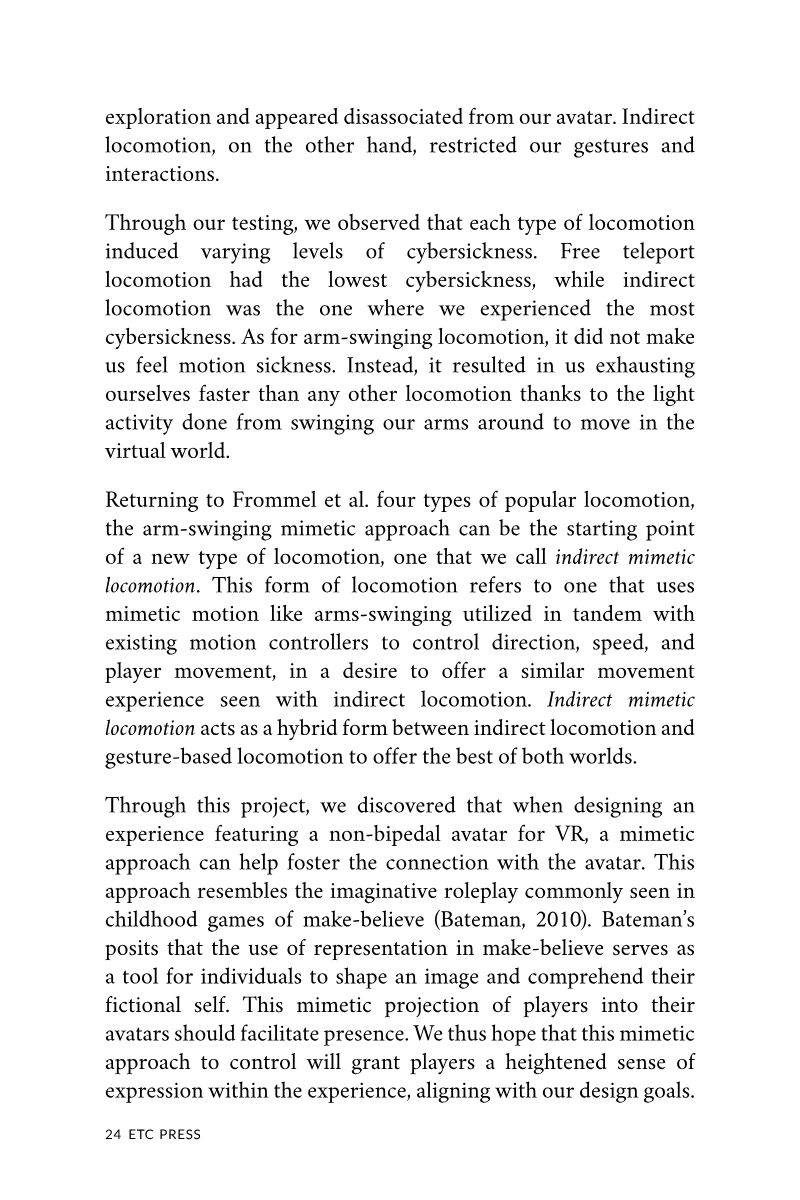
- Successful immersive design requires aligning control schemes with the avatar's physical constraints, such as using mimetic arm-swinging locomotion for quadrupedal characters to reduce cybersickness.
- Reinforcement learning should replace deterministic animation to create reactive, non-scripted AI opponents that behave more organically.
- Developers must prioritize iterative playtesting and qualitative research to manage the unique challenges of player fatigue and varying skill levels in VR environments.

Well Played: A Special Issue on Esports and Community
Esports functions as a critical social infrastructure that bridges the gap between digital engagement and professional development.
- Esports serves as a critical social infrastructure that facilitates professional development, teamwork, and complex problem-solving within collegiate and urban environments.
- Public-private partnerships, such as New York City’s Gaming Pathways program, are actively utilizing esports to create educational and career pipelines for Black and brown youth to diversify the tech workforce.
- The professional esports landscape suffers from high volatility due to rapid game turnover and short career windows, requiring new frameworks to ensure player stability and long-term legacy.
Across Worlds and Bodies: Criticism in the Age of Video Games
Academic game studies currently suffers from a restrictive purity complex that prioritizes formal, rule-based systems at the expense of the medium’s inherent complexity.
- Academic game studies should transition from rigid formalist analysis of rule-based systems to a phenomenological approach that views games as complex, hybrid assemblages.
- Traditional formalist criticism often relies on exclusionary, masculinist ideologies by attempting to isolate game mechanics from audiovisual representation.
- Video games should be analyzed as ergodic, cybernetic circuits where the player, hardware, and virtual content function as a single, inseparable entity.
Visualizing Game Studies: Materiality and Sociality from Chessboard to Circuit Board
This analysis examines the disciplinary genealogy of game studies, arguing that the field has historically struggled with an insular, fragmented identity.
- Game studies must shift its focus from analyzing games as representational texts to examining them as procedural instruments that actively shape social dynamics.
- The evolution of games from physical artifacts like chess to digital, code-based systems has transitioned their role from reflecting social dynamics to governing human behavior.
- Gamification has integrated game logic into public infrastructure, such as transit systems and traffic law enforcement, making game rules function as enforceable law.

Do You Feel Like a Hero Yet?: Externalized Morality in Video Games
Traditional video game morality systems frequently fail to facilitate genuine ethical reflection, instead reducing complex dilemmas to binary, utilitarian mechanics that prioritize ludic progression over meaningful choice.
- Traditional binary morality systems in games fail to foster ethical reflection by reducing complex dilemmas to utilitarian mechanics optimized for reward rather than genuine choice.
- Games that remove karma-based feedback loops, such as 'Papers, Please' and 'Spec Ops: The Line,' force players to confront the consequences of their actions without the comfort of programmed justifications.
- True moral weight in interactive media is achieved by stripping away the illusion of agency and implicating the player directly in the narrative outcomes of their decisions.
Red Dead Masculinity: Constructing a Conceptual Framework for Analyzing Video Game Narratives
Video game narratives function as powerful ideological conduits that shape player identity and social performance.
- Video games function as ideological conduits that shape player identity by facilitating the transfer of virtual worldviews into the player’s physical reality.
- The Western genre, specifically exemplified by Red Dead Redemption, utilizes gameplay rhythm and avatar identification to reinforce specific social performances.
- Red Dead Redemption constructs a 'revisionist' masculine ideal that frames government, technology, and corporate interests as inherently corrupt.
Imperialism in the Worlds and Mechanics of First-Person Shooters
First-person shooters function as significant cultural vectors for imperialist ideologies, systematically reinforcing Western geopolitical agendas through the mechanics of territorial conquest and the pacification of foreign environments.
- First-person shooters function as cultural vectors that reinforce imperialist ideologies by framing non-Western landscapes as hostile environments requiring Western intervention.
- The genre’s core gameplay loops rely on territorial conquest and the pacification of foreign spaces, which procedurally normalizes colonial expansion.
- FPS titles frequently utilize white savior narratives where players master indigenous tools and environments to impose order, sanitizing the real-world consequences of military violence.



Ludic Spolia in Sid Meier's Civilization: Beyond Earth
Ludic spolia serves as a critical framework for understanding the development and reception of Sid Meier’s Civilization: Beyond Earth.
- Sid Meier’s Civilization: Beyond Earth utilizes 'ludic spolia' by repurposing the engine, mechanics, and assets of Civilization V to create a modern architectural palimpsest.
- The transition from Civilization’s traditional linear technology trees to the non-linear technology webs in Beyond Earth represents a deliberate ideological shift away from deterministic progress models.
- By evolving the original series' barbarian and ideology systems into alien and affinity frameworks, the game challenges inherent Enlightenment-era biases and colonialist narratives.
Writers
Games and companies
Games