1 free read left. Create a free account for unlimited reading + AI research.
Create free accountWhitepaper DiGRA
1 free read left. Create a free account for unlimited reading + AI research.
Create free accountWhitepaperDiGRA
The paper argues that location-based multi-user games challenge the classical view of play as autonomous and separated from real life. Games that use city streets as a board intrude on everyday reality.
Olli Sotamaa's paper examines how location-based multi-user games such as Botfighters challenge classical definitions of play and game, while reshaping the meaning of mobile gaming and urban space. The central hypothesis is that games which use city streets as a game board conflict with the traditional view of play as autonomous and separated from real life. The author argues that mobile phones, despite their interface limitations, suit the multi-user location-based approach because they are already embedded in strong social and communicative habits, and that playing in familiar locations layers new meanings onto them.
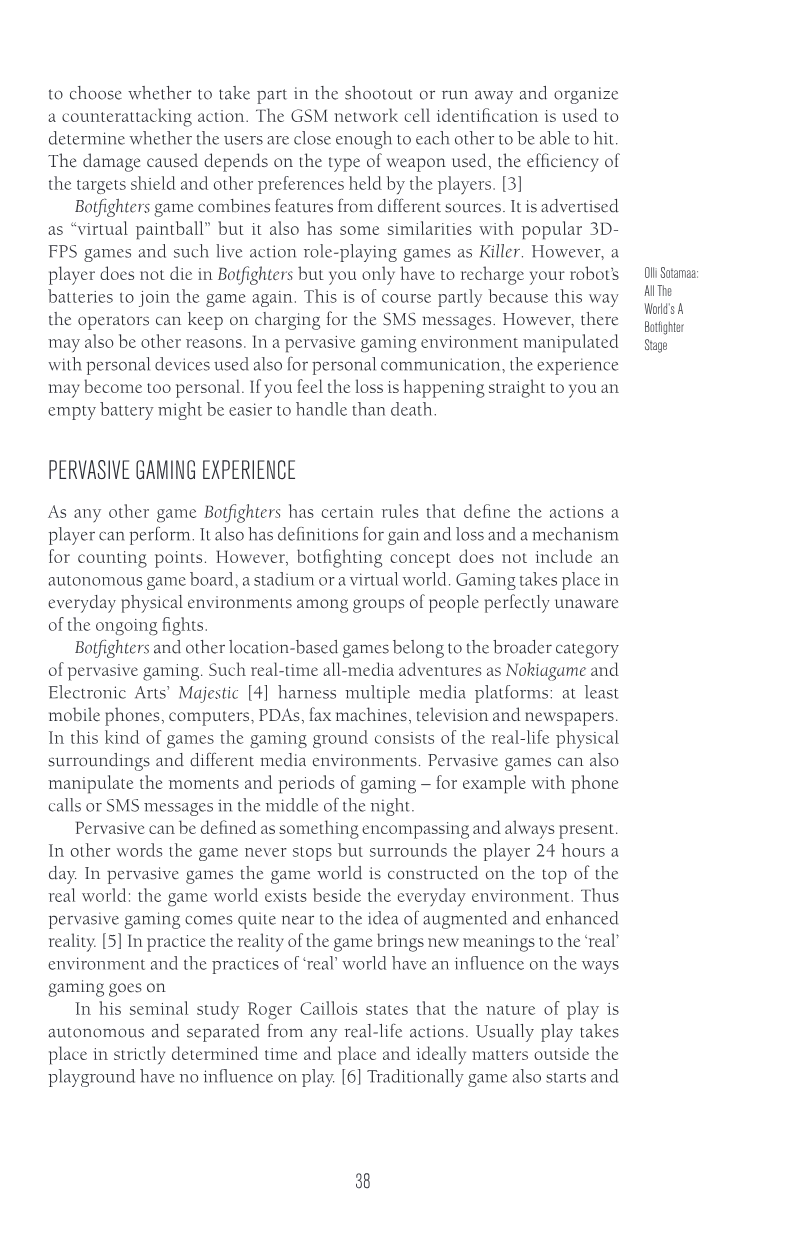
The analysis classifies location-based games by technology into three groups: GPS-based treasure hunts that lack real-time multi-user features, local network and proximity-sensor experiments largely from research projects, and GSM cell-identification games that require only standard phones and are therefore likely to reach large audiences. Botfighters, launched in Sweden in 2001 and offered in Sweden and Finland by April 2002, is examined in detail. Players hunt and shoot one another through SMS commands, with a web interface for building robots and tracking scores. Its design makes "death" an empty battery rather than elimination, a choice the author links to the personal intrusiveness of pervasive play.
The paper situates Botfighters within pervasive gaming, where the game surrounds players continuously and overlays the everyday environment, and it uses Harvey's three levels of spatial practice to show how the game's material infrastructure, representations, and imaginative world relate to the city. The author notes that the game's cell-based accuracy restricts play largely to urban areas and that its surveillance potential among friends raises privacy concerns. The conclusion is that real-world meanings, memories, and fears attached to places shape gameplay, raising questions about how such games should be regulated.

DiGRA · 2026

DiGRA · 2026



DiGRA · 2026



DiGRA · 2026



DiGRA · 2026



DiGRA · 2026



DiGRA · 2026



DiGRA · 2026



DiGRA · 2026

DiGRA · 2026



DiGRA · 2026



DiGRA · 2026
International Journal of Games and Social Impact · 2023