1 free read left. Create a free account for unlimited reading + AI research.
Create free accountReport DiGRA
1 free read left. Create a free account for unlimited reading + AI research.
Create free accountReportDiGRA
The authors argue that film ideas are useful tools for some games. Games and film should be compared on their distinct qualities rather than one reduced to the other.
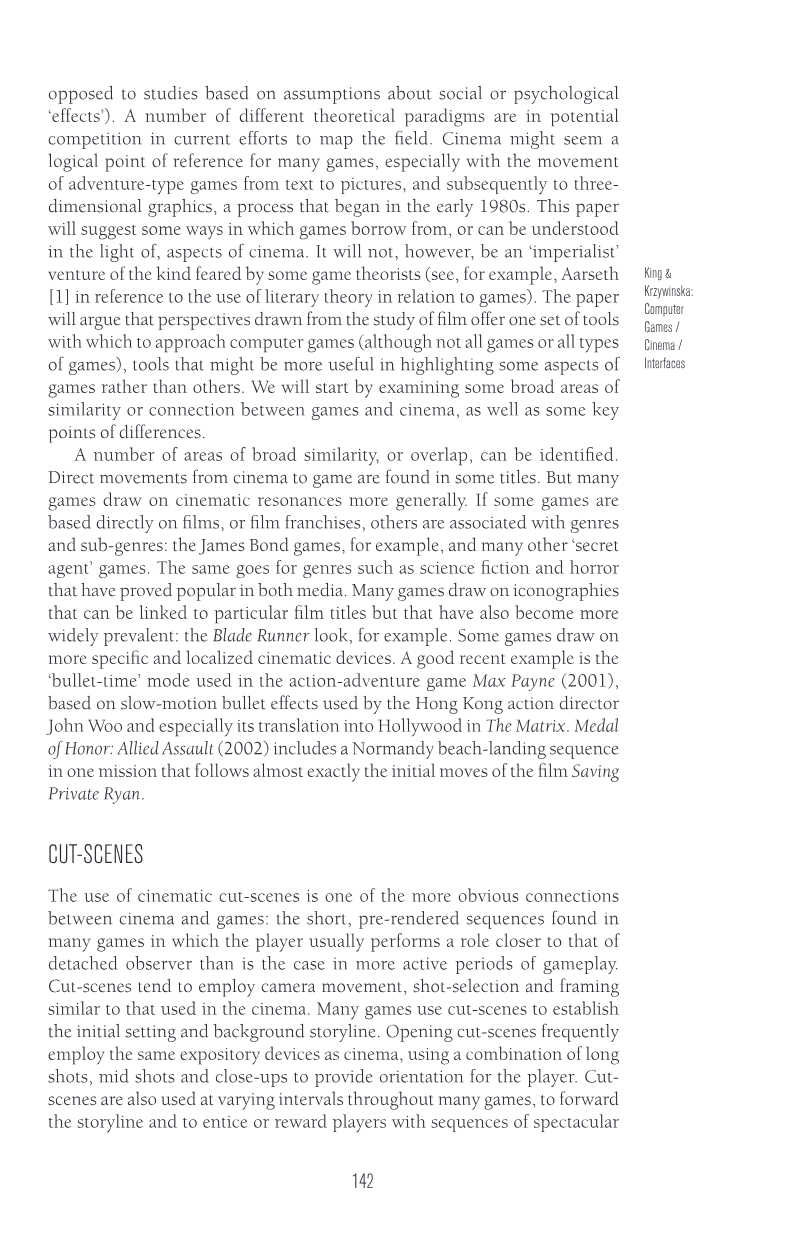
King and Krzywinska's "Computer Games / Cinema / Interfaces" examines the formal and industrial relationship between video games and film, arguing that cinematic concepts provide useful analytical tools for some games but that the two media should be compared on their distinct qualities rather than reduced one to the other. The authors identify points of contact such as cut-scenes, camera perspective, and digital animation, while emphasizing key divergences in framing, the handling of time and space, graphical fidelity, and interactivity. Illustrative examples include the bullet-time mechanic of Max Payne, the fixed camera angles of Resident Evil, and the near-photorealistic graphics of the Final Fantasy film, with the authors anticipating that the gap between cut-scene and gameplay visuals will narrow as graphics processing improves.
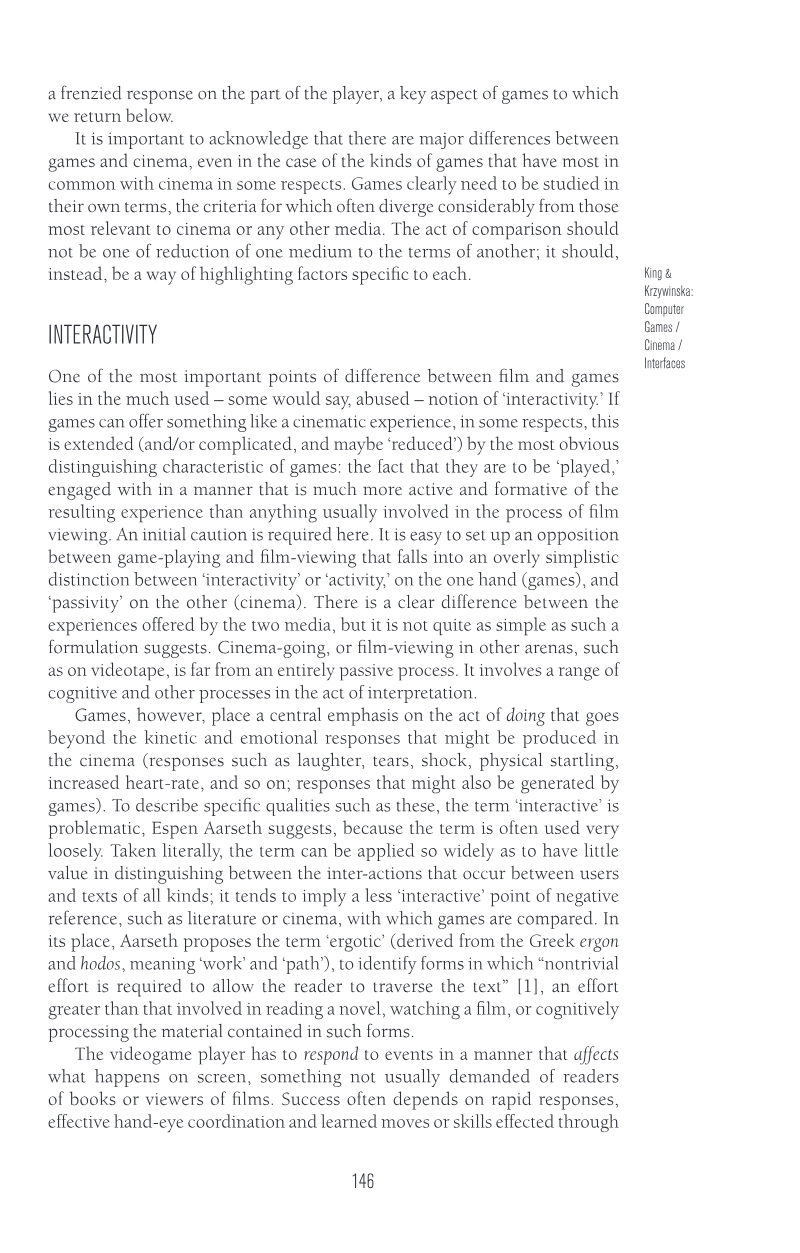
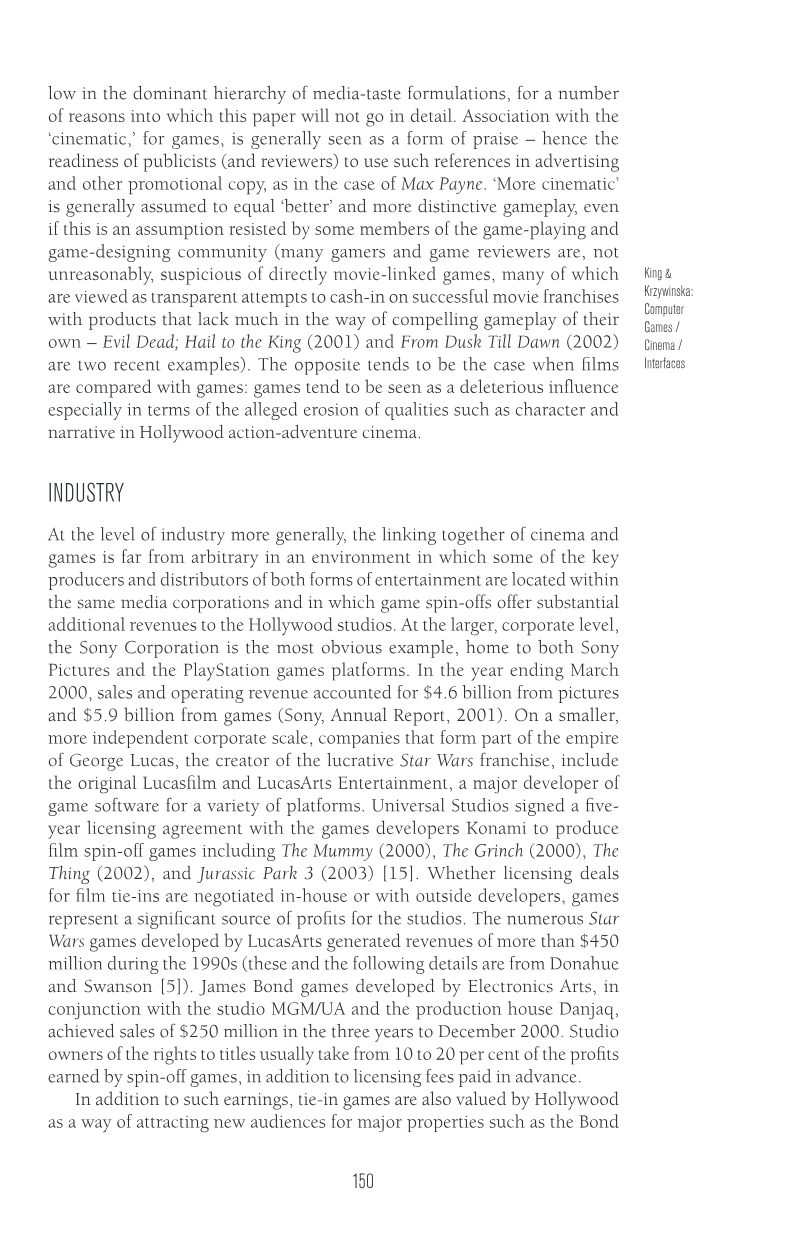
The paper contends that games demand more active engagement than film viewing, and it proposes Aarseth's term "ergotic" as a more precise alternative to "interactive." Narrative, in this account, plays a more secondary role in games, which often struggle to integrate story coherently with gameplay. The authors observe that games frequently remediate cinema for reasons of prestige and marketing, and they document the increasingly close industrial ties between the two sectors, with tie-in titles generating substantial revenue, such as more than $450 million for Star Wars games in the 1990s. They also describe a hit-driven economy in which fewer than 5 percent of roughly 6,000 annual releases account for most profits.
The authors ultimately argue that cinema has shaped games far more than the reverse, since games rarely lend themselves to cinematic adaptation and their core features, particularly narrative and character, remain less developed than those of film. The industry's mirroring of Hollywood is evident in production budgets reaching tens of millions of dollars and in the promotion of "auteur" figures such as John Carmack and other designers whose names are attached to titles. Rejecting the characterization of videogames as "interactive cinema," the paper refrains from speculating about future hybrid forms and instead concentrates on the similarities and differences between the two media as they currently exist.
DiGRA · 2026
University of Malta · 2026