Game Development reports and market data
Documents
Issues and Approaches in Artificial Intelligence Middleware Development for Digital Games and Entertainment Products
The document examines the challenges and solutions in developing Artificial Intelligence (AI) middleware for digital games and entertainment products.
- AI has shifted from a secondary concern to a priority in game development, yet developers still rely on a narrow set of techniques and lack flexible, reusable tooling.
- Dedicated AI middleware, a software layer that supplies agent behavior and decision-making services to game engines, is presented as the likely next step for improving game AI and freeing developers for creative work.
- Dominant practice relies on finite state machines, hierarchical and fuzzy state machines, A pathfinding, steering behaviors, decision trees, and rule-based systems, each trading off speed, expressiveness, and predictability.

Expressive AI: Games and Artificial Intelligence
The document proposes "expressive AI" as a new interdisciplinary agenda that connects game studies, design practice, and technical research, arguing that Artificial Intelligence (AI) in games is not merely a technical detail but a crucial element for creating meaningful player experiences.
- Mateas argues that as graphical gains yield diminishing returns, game development is shifting attention toward artificial intelligence, and proposes "expressive AI" as an interdisciplinary agenda linking games studies, design practice, and technical research.
- Game AI is defined as the production of behavior that players read as intentional, distinguishing it from game physics: Asteroids' asteroids and water simulations generate behavior without inviting psychological interpretation, whereas enemies like Pac-Man's ghosts invite readings of goals, desires, and moods.
- The paper positions game AI as a "white box" vocabulary for analyzing and designing games, complementing the "black box" vocabularies of design patterns and humanistic game studies that deliberately ignore implementation.


Participatory Design and Opposing Interests in Development of Educational Computer Games
This study investigates a participatory design process involving 11-12 year old Danish schoolchildren in the development of an educational mathematics computer game.
- The study examined a participatory design process in which 11- and 12-year-old Danish children helped design a math-education computer game meant to be engaging enough that they would voluntarily play it outside school.
- The children's ideas had little practical effect on the final design, mainly because the developers adopted their own time-travel concept early, where it was perceived as strong and hard to modify.
- A key organizational failure was that the developers did not attend the workshops, so insights from the children reached them only secondhand through researchers as general guidelines that were hard to integrate.

WADs, Bots and Mods: Multiplayer FPS Games as Co-creative Media
This paper examines multiplayer First-Person Shooter (FPS) games as "co-creative media," arguing that the final game product is a collaborative assemblage resulting from the input of both developers and players.
- The paper argues that multiplayer FPS games such as Quake, Half-Life and Counter-Strike are 'co-creative media,' shaped jointly by developers and players rather than by either alone, extending beyond the participatory-media framing common in fan studies.
- Wolfenstein 3-D (1992) and Doom (1993) set the foundation for the genre, and Doom's source-code release and multiplayer capabilities enabled a durable mod scene.
- Player contributions materially influenced development: early public betas and leaked alphas produced bug reports and patches, volunteer-built anti-cheat tool PunkBuster was later adopted by publishers, and mod authors behind ThreeWave CTF and Counter-Strike were hired or commercially acquired.

Enchanting Reality: A Vision of Big Experiences on Small Platforms
"Enchanting Reality: A Vision of Big Experiences on Small Platforms" posits that the mobile gaming industry, despite significant hardware advancements, has largely failed to innovate beyond simple ports and clones, neglecting the unique capabilities of mobile computing for pervasive, location-based gameplay.
- The paper argues mobile gaming has largely cloned or ported console and desktop titles, leaving handheld capabilities such as mobility, GPS, and communications underused.
- Its central thesis is that compelling physical-world games create immersion through "diegetic consistency," where the fictional world aligns with the player's sensory reality.
- The authors propose "enchanted reality" games, in which real-world actions meaningfully alter the virtual world rather than merely triggering isolated events.

Enhancing Gameplay: Challenges for Artificial Intelligence in Digital Games
The document, "Enhancing Gameplay: Challenges for Artificial Intelligence in Digital Games," posits that significant advancements in computing power and increased AI expertise offer an unprecedented opportunity for transformative innovation in digital game AI.
- The paper argues that rapid growth in computing power gives game designers a timely opportunity to pursue radical AI advances rather than incremental refinements, and that AI innovation is essential to avoid industry stagnation and establish games as a serious artistic medium.
- Current titles still rely largely on established techniques such as finite-state machines, A pathfinding, and scripting, with designers prioritizing the appearance of intelligence over realistic behavioral models.
- The paper identifies three priority areas for innovation: storytelling (especially player-driven narratives in MMORPGs), dynamic online learning (illustrated by the rare example of Black & White), and emotional expression, where real-time character animation lags well behind pre-rendered film.
Representing Users in the Design of Digital Games
The document examines the strategies for representing users in digital game design, contrasting the traditional "supplier-driven" artistic approach with a "consumer-driven" model emphasizing user research.
- Digital game designers typically represent their users implicitly rather than through direct engagement, and this tacit approach, often shaped by designers' own tastes, can embed gender bias into game design.
- The study's Irish interviews covered digital game companies that were almost entirely male and targeted young men aged roughly 15 to 40, with industry factors such as risk-averse publishers, console manufacturers, and skilled-labour shortages shaping game types and design priorities.
- In the central case study of the fictional online multiplayer strategy game from games.inc, launched in Germany in December 2001 with about 1,000 subscribers, designers projected their own preferences as technologically literate male gamers aged 25 to 40 instead of conducting formal user research.

3Dxp: DirectSound 3.0 Extension API
This document, "3Dxp: DirectSound 3.0 Extension API," prepared by the Interactive Audio Special Interest Group (IASIG) 3D Working Group in June 1997, proposes a universal API extension for Microsoft's DirectSound 3.0.
- The 3Dxp API was introduced in 1997 as a standardized extension to Microsoft’s DirectSound 3.0 to enable hardware-accelerated 3D audio positioning on Windows PCs.
- The API functions by appending a 132-byte data structure to standard DirectSound buffers, allowing developers to pass 3D parameters like position, velocity, and cone orientation to external renderers.
- A reference wrapper enables automatic detection of 3Dxp-compliant drivers, proprietary solutions such as Aureal’s A3D, or a fallback to standard DirectSound3D.

Du rôle des sociétés de distribution et des boutiques de micro-informatique dans la naissance de l'industrie vidéoludique française
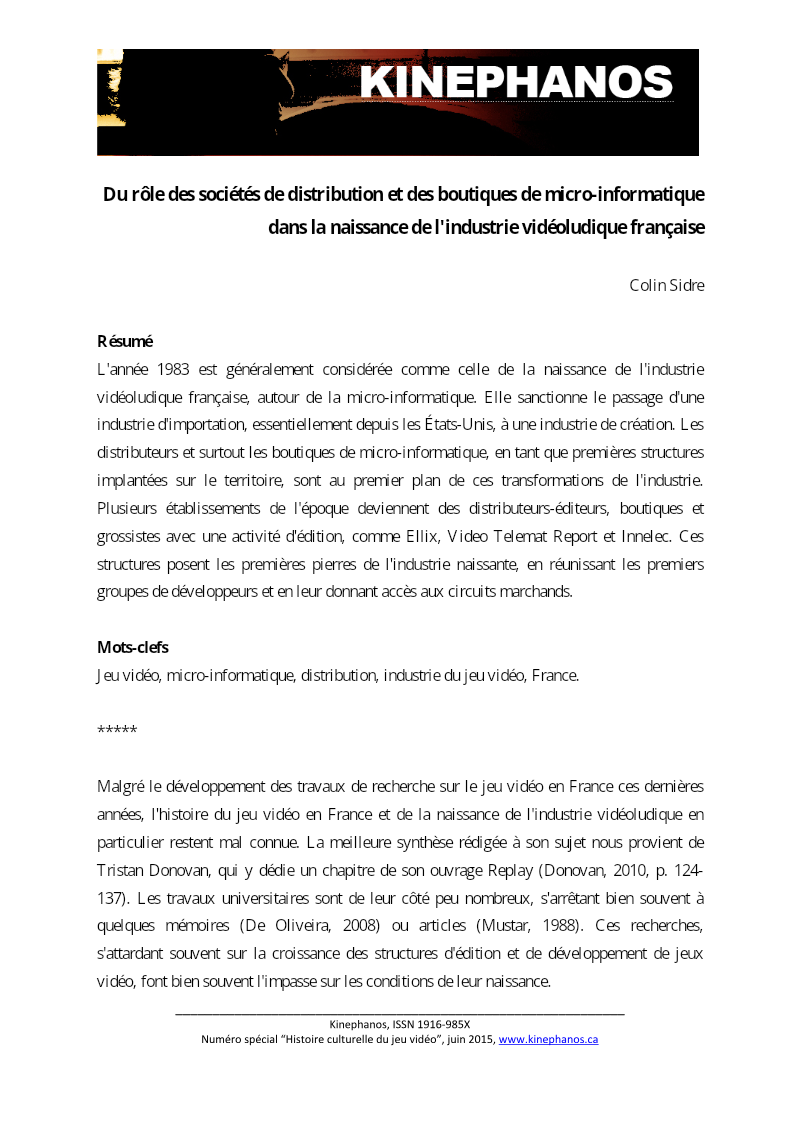
Colin Sidre's article in the Kinephanos special issue on the cultural history of video games (June 2015) examines how distributors and microcomputer shops shaped the birth of the French video game industry, focusing on 1983 and the period from the late 1970s to the early 1980s.
- Before 1983, the French market was primarily one of import, with microcomputer shops often offering imported games and many consumers buying directly from abroad.
- Video Telemat Report, a Paris shop, is described as the most spectacular distributor-publisher of the period, and the author knows of no comparable case in France.
- The author notes that 1983 saw an inflation of distributor-publishers, including Innelec, R.U.N. Informatique, Cobra Soft, Video Telemat Report and Vismo.

Investment Quarterly: Gaming Industry
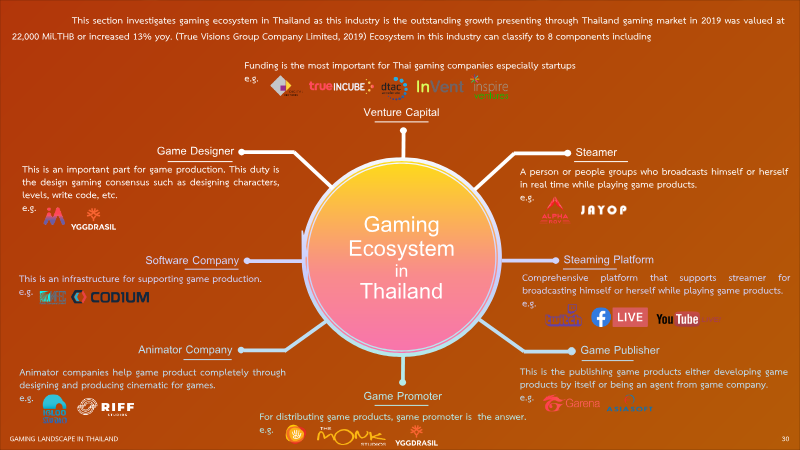
This depa Investment Quarterly examines the gaming industry in Thailand, covering the gaming landscape, supply chain pain points, investment opportunities, government incentives, international best practices, and promoted gaming projects.
- Thailand's gaming market was valued at 22,000 million baht in 2019, up 13% year on year, which the document says is the second fastest-growing market in Southeast Asia.
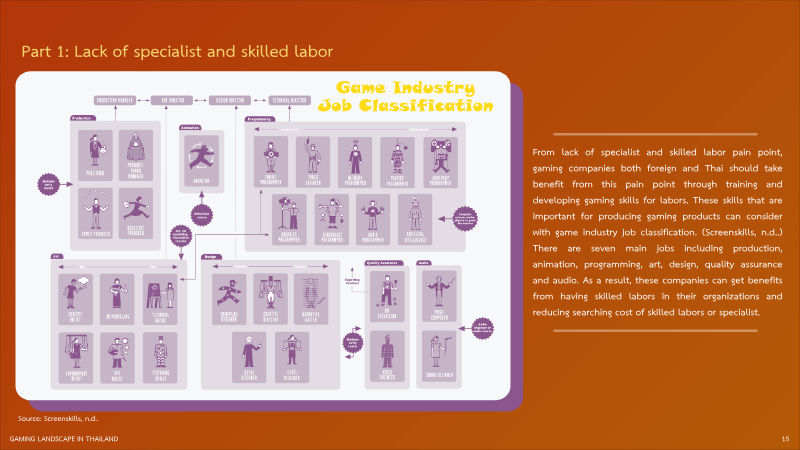
- The document identifies lack of specialist and skilled labor as a main pain point, citing insufficient gaming courses from universities such as coding skill.
- Of the 434,382 ICT workers in 2019, software and applications developers and analysts made up an estimated 11.1% of total ICT jobs.

Well Played: A Special Issue on Post-Mortems of AR & VR Games
This special issue of Well Played (Vol. 12, No. 2), published by ETC Press at Carnegie Mellon University and edited by Drew Davidson, collects four post-mortems on augmented and virtual reality game development.
- Arm-swinging was judged the most effective locomotion for the wolf avatar, and the authors report it produced little cybersickness despite tiring players faster than other methods.
- Free teleport locomotion caused the least cybersickness among the tested methods, while indirect locomotion caused the most.
- The Howl's Adventures team used a prototype on the Oculus Quest, and their research relied on informal internal playtesting with no external participants.
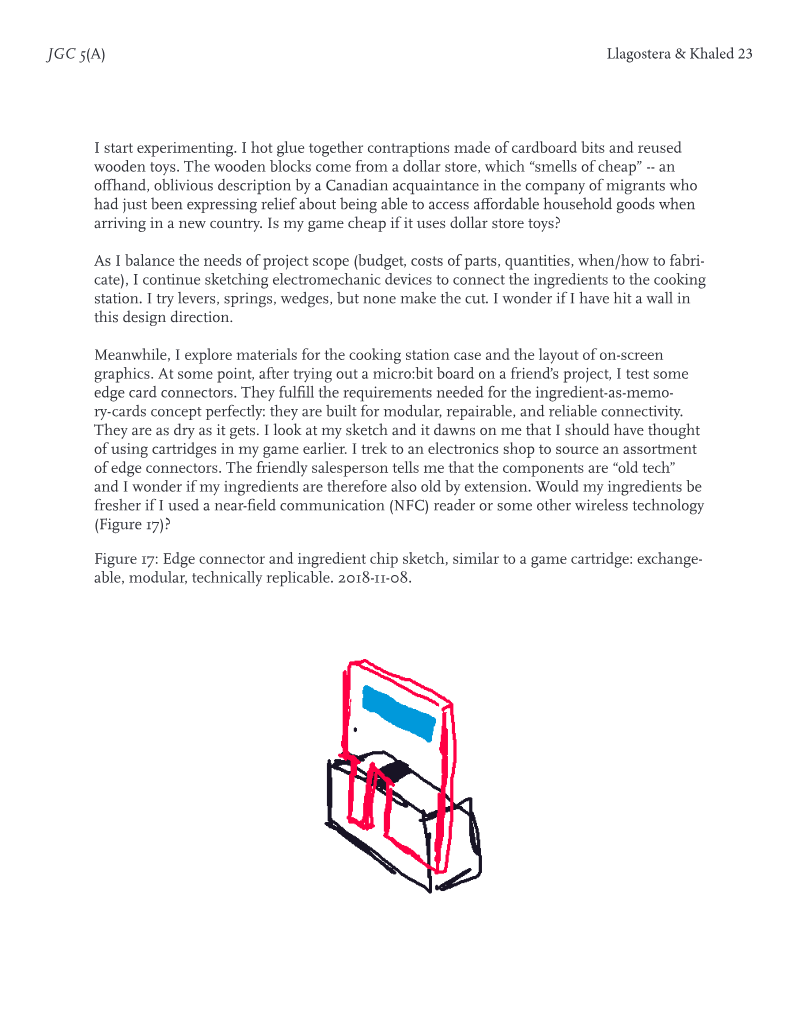

On Cooking a Sour Game
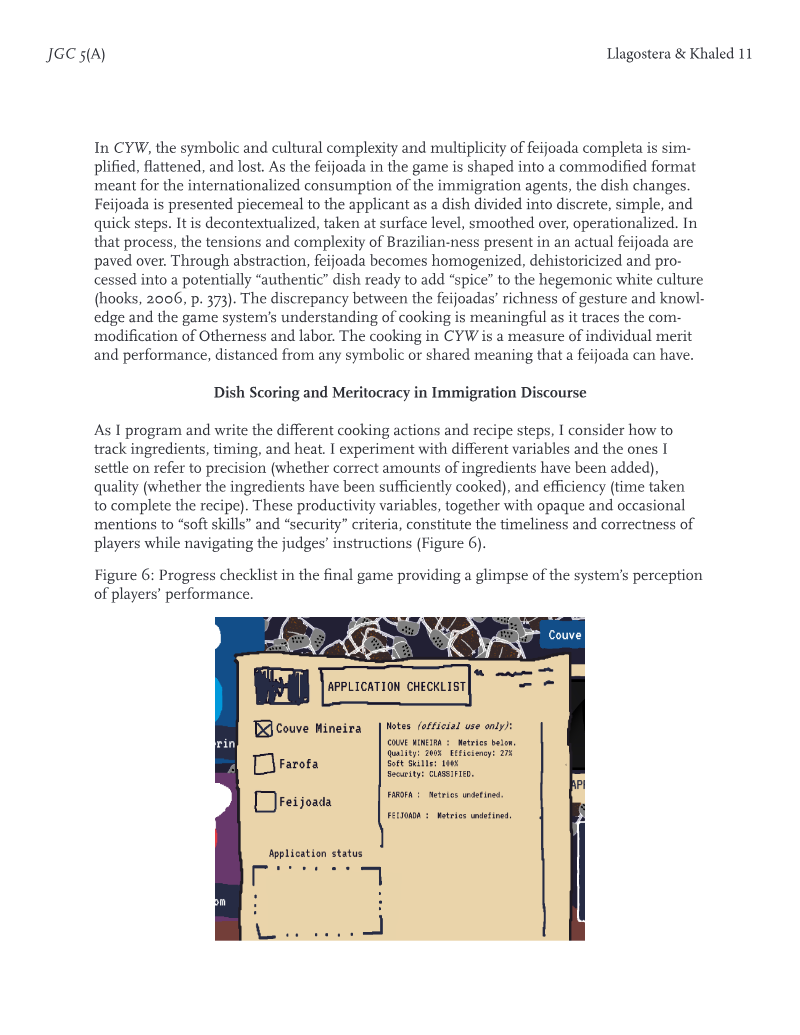
Cook Your Way functions as a critical intervention in game design, utilizing an alternative controller and the preparation of traditional Brazilian cuisine to interrogate the dehumanizing mechanics of global immigration systems.
- Cook Your Way uses a custom physical cooking interface to simulate the high-pressure, dehumanizing experience of navigating the Canadian immigration system.
- The game design rejects traditional empathy-driven narratives and player-empowerment mechanics in favor of structural instability and anticlimax to mirror bureaucratic inefficiency.
- By utilizing modular, transparent hardware, the project forces players to confront the friction and futility inherent in state-sanctioned border regimes.
Writers
Games and companies
Games