1 free read left. Create a free account for unlimited reading + AI research.
Create free accountWhitepaper DiGRA
1 free read left. Create a free account for unlimited reading + AI research.
Create free accountWhitepaperDiGRA
The paper argues designers can pursue radical AI advances rather than incremental refinements. It presents AI innovation as essential to avoid stagnation and to establish games as a serious artistic medium.
Darryl Charles's paper argues that rapid growth in computing power gives game designers a timely opportunity to pursue radical advances in artificial intelligence rather than incremental refinements. Its central thesis is that AI innovation is essential if the games industry is to avoid stagnation, enhance gameplay and emotional engagement, and establish digital games as a serious artistic medium rather than a toy industry. The authors observe that current titles still rely largely on established techniques such as finite-state machines, A pathfinding, and scripting, with designers prioritizing the appearance of intelligence over realistic behavioral models.
The paper identifies three areas where innovation is most needed: storytelling, particularly in massively multiplayer online role-playing games, where player-driven narratives remain limited; dynamic online learning, illustrated by the rare example of Black & White, which also highlights significant challenges in testing and balancing; and emotional expression, where real-time character animation has lagged well behind the quality of pre-rendered film. Unintelligent character behavior is presented as a key threat to player immersion, which the authors regard as central to the medium's broad appeal.
The discussion also addresses obstacles to progress. These include the need for standardization, with the IGDA developing AI interface standards and middleware such as RenderWare AI and AI-Implant emerging; the scaling limits of rule-based systems; and commercial pressure that favors established franchises over experimental designs. Proposed future directions include off-line character evolution, individualized player experiences, and moral dilemmas made possible by more lifelike characters.
The paper concludes that storytelling, dynamic learning, and emotion representation are interdependent research areas that remain young and underexplored. Its scope is conceptual and survey-based: it offers no new quantitative data, but it draws on a broad range of cited sources and examples from prominent commercial titles.
Each row is a game or company this document names, each column a document, oldest first. A mark means that document names it. Select a row to see those documents.
DiGRA · 2022
DiGRA · 2022
DiGRA · 2022
DiGRA · 2022
DiGRA · 2022
DiGRA · 2022

DiGRA · 2022
DiGRA · 2022
DiGRA · 2022
DiGRA · 2022
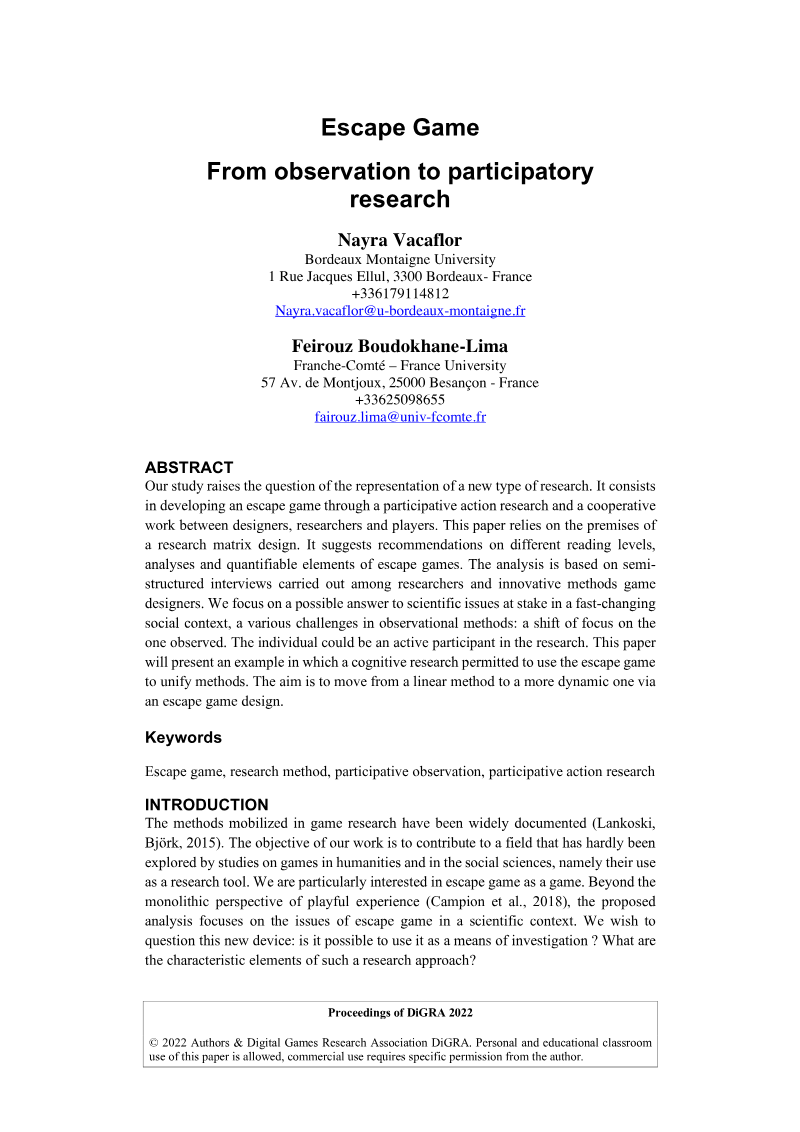
DiGRA · 2022
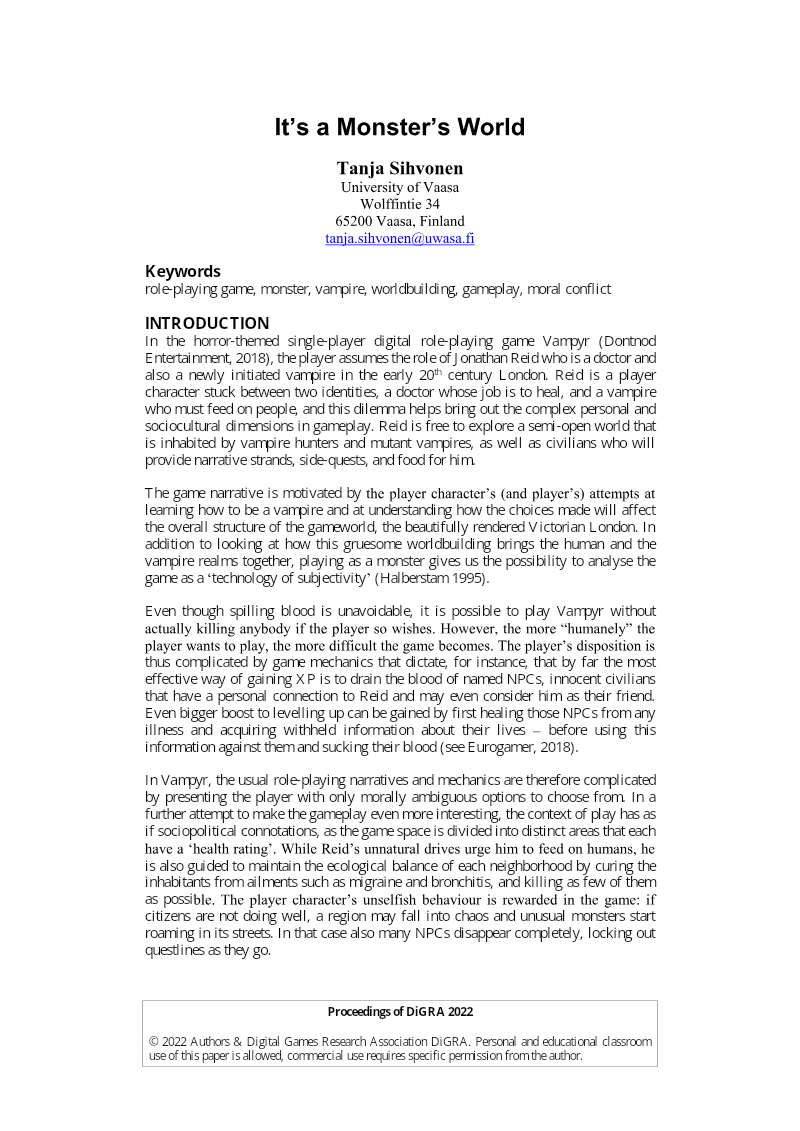
DiGRA · 2022

PocketGamer.biz · 2026