Game Development reports and market data
Documents

Architecting Scalability for Massively Multiplayer Online Gaming Experiences
Scalability in Massively Multiplayer Online Games (MMOGs) is framed here as the capacity to absorb growing player demand without degrading the player experience, a requirement that varies by genre, from fast-paced First Person Shooters to turn-based strategy.
- Scalability in MMOGs is defined as absorbing growing player demand without degrading the player experience, and the required standard varies by genre, from fast-paced FPS to turn-based strategy.
- The report argues that scalability challenges in simulation, communication, content distribution, and structural architecture are interdependent and cannot be solved in isolation, so a generic MMOG infrastructure needs an integrated design.
- Client/Server models remain dominant in deployed MMOGs, while Peer-to-Peer simulation is constrained by load balancing, state coherence, peer unpredictability, and cheating risks.
Realistic Agent Movement in Dynamic Game Environments
This document addresses the challenge of realistic agent movement in dynamic game environments, proposing a novel strategy to enhance traditional pathfinding algorithms using machine learning techniques.
- The paper argues that traditional pathfinding methods such as A and navigation meshes rely on static, pre-processed map representations, which become inadequate once physics middleware lets players and agents alter level geometry in real time.
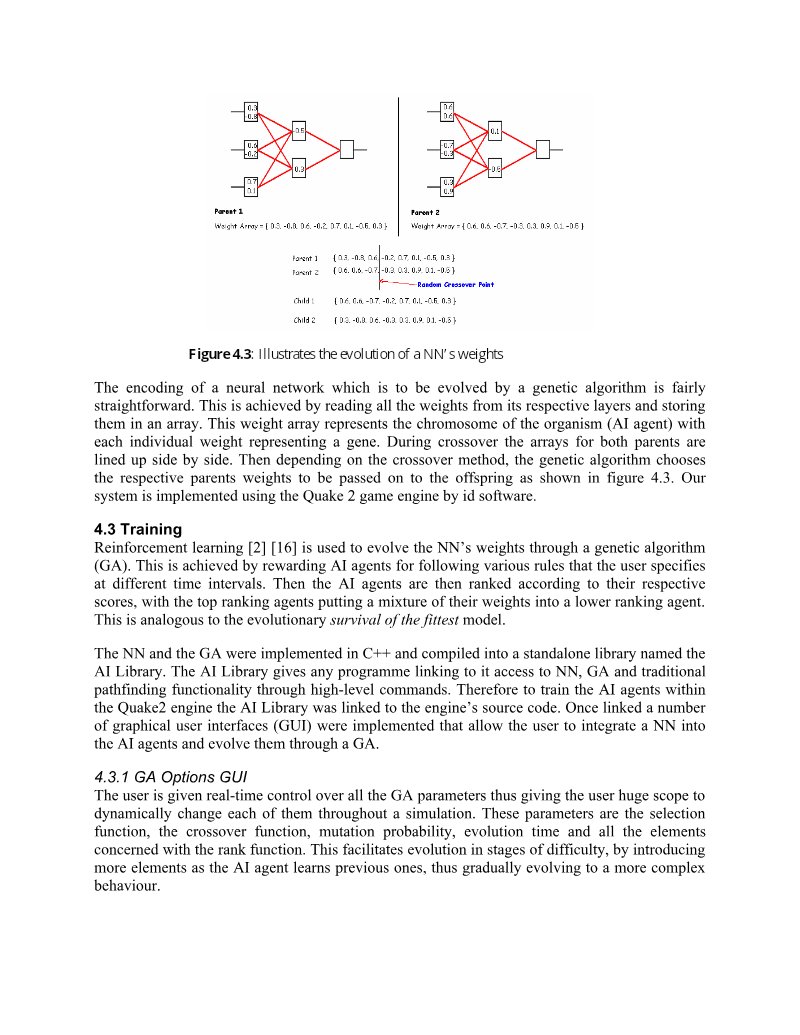
- The authors propose giving agents real-time awareness via four ray-casting sensors spanning a 90-degree field of vision, feeding an artificial neural network that controls movement, with weights evolved by a genetic algorithm guided by reinforcement-style scoring.
- The approach was implemented as a test bed on the Quake 2 engine using a custom C++ AI library, with graphical tools allowing users to adjust evolution and network parameters during training.
The Localization of Digital Games: A Case Study in China
This paper investigates the complexities of digital game localization, specifically focusing on the Chinese market.
- Game localization is more complex than general software localization because games function simultaneously as commercial and cultural products.
- The authors propose a three-dimensional model comprising the In-Game Environment (storyline, gameplay, engagement, interface), the External Environment (social, political, legal, ideological factors), and the Users, who link the two.
- The central contention is that all three dimensions should be considered throughout the entire game design process rather than treated as a late-stage adjustment.
Possibilities of Non-Commercial Games: The Case of Amateur Role Playing Games Designers in Japan
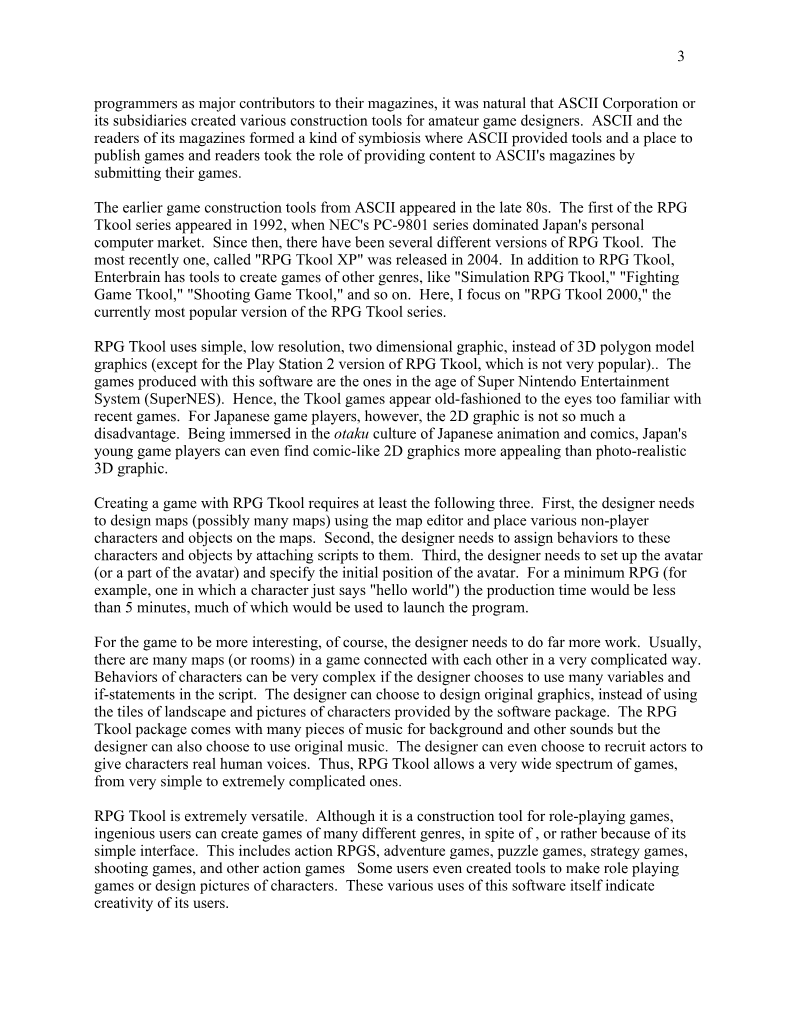
The document examines the unique characteristics and possibilities of non-commercial game development in Japan, specifically focusing on amateur role-playing game (RPG) designers utilizing the "RPG Tkool 2000" tool.
- The study surveyed 102 self-identified Tkool 2000 designers ("Tkoolers"), a freeware RPG toolkit with simple 2D graphics and menu-based scripting that lowers hardware and technical barriers; the author notes self-reported data and possible sampling bias as limitations.
- Tkoolers are predominantly young males, many not especially drawn to computers, and are motivated mainly by fantasy fulfillment, storytelling, and extending games they enjoyed rather than by financial reward.
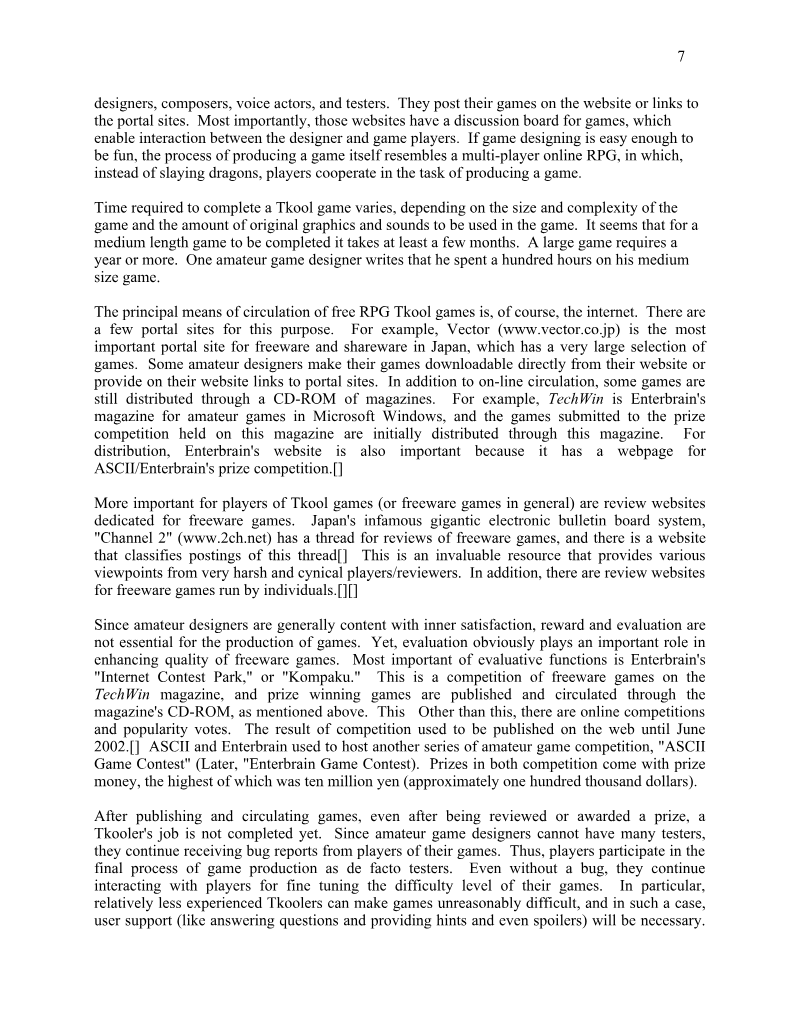
- The internet is indispensable to amateur designers: online communities, graphics and music repositories, and sites and review boards such as 2ch enable collaboration, distribution, and feedback.
Playing in the Sandbox: Developing Games for Children with Disabilities
This study investigates the preferences and needs of children with disabilities regarding computer games, challenging the notion that special games are required for special needs.
- The principal barrier for children with disabilities, especially those with cerebral palsy, is physical rather than a lack of suitable content: console controllers for Xbox and PlayStation require two dexterous hands, and many of these children lack them.
- The author argues these children do not primarily need specially designed games; they want to play the same commercial titles as their peers, so the priority is accessible input hardware for mainstream multiplayer games.
- Informal interviews with cerebral palsy students aged 18 to 21 at a centre attached to a mainstream high school reported that games made them happier, improved self-esteem, and gave a sense of social belonging, with one student believing driving games helped him control a powered wheelchair.


Game Engineering for a Multiprocessor Architecture
This paper proposes a new model for computer game programming to leverage future multiprocessor architectures in game consoles and personal computers, moving beyond the traditional sequential game loop.
- The authors argue future consoles and PCs will likely adopt symmetric multiprocessor architectures, so the traditional sequential game loop should be replaced with a concurrent design organised as a cyclic task-dependency graph run by a scheduler across worker threads.
- The model was implemented in a Concurrent Game Programming Framework providing synchronisation primitives, thread creation objects, and a task manager, and was tested by decomposing a nineteen-task sequential loop from a 3D capture-the-flag car game.
- On a Hyper-Threaded Intel Pentium 4 at 2.80 GHz (two logical processors), the framework with one, two, or four workers produced no performance gain over the sequential loop, which the authors attribute to the model needing roughly three processors before benefits appear.
Game Graphics Beyond Realism: Then, Now, and Tomorrow
This paper surveys the evolution and application of graphical styles in computer games, advocating for the increased adoption of non-photorealistic rendering (NPR) techniques beyond the current emphasis on photorealism.
- The authors argue game graphics should not be limited to photorealism and that developers should explore non-photorealistic rendering (NPR) and other artistic styles.
- They contend that gameplay and story drive player enjoyment far more than graphical fidelity, and that as photorealism becomes costlier to achieve, graphics will lose effectiveness as a unique selling point.
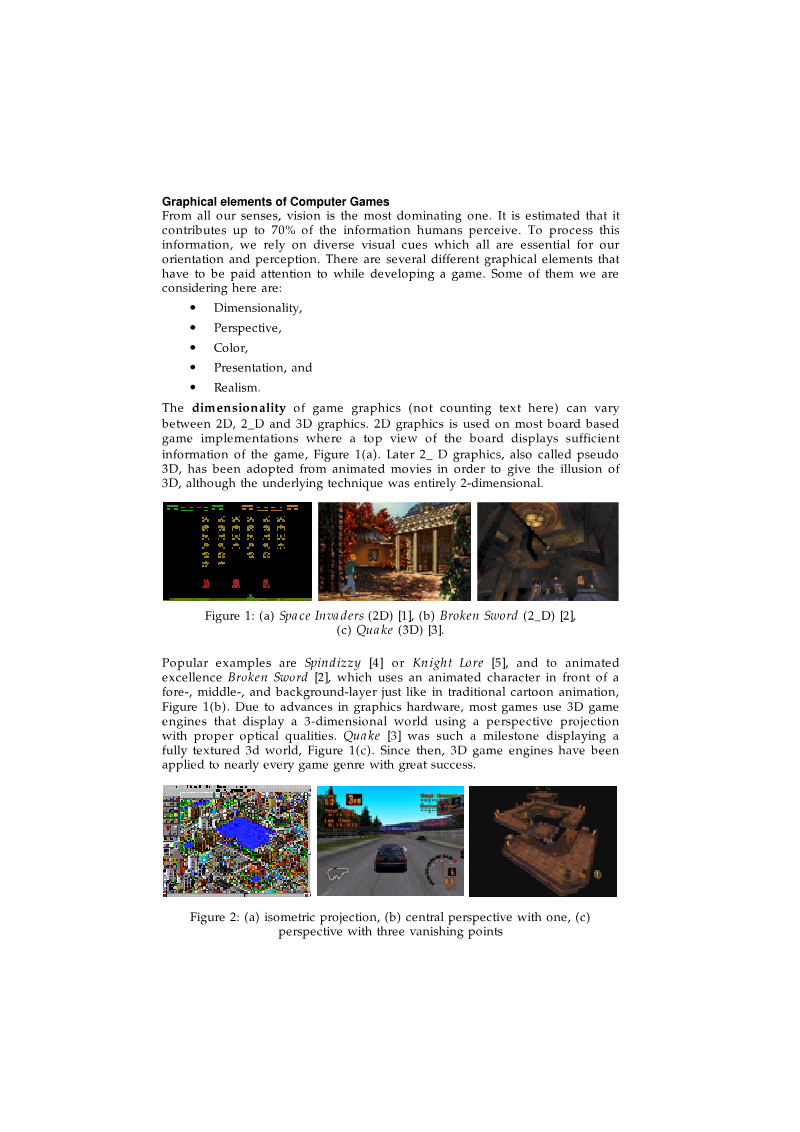
- Immersion depends on believability and consistency rather than strict realism: small inconsistencies such as an incorrect shadow can break the illusion of a photorealistic game, while NPR styles tolerate such imperfections more readily.
Neomancer: An Exercise in Interdisciplinary Academic Game Development
The document details the "Neomancer" project, an interdisciplinary academic game development initiative aimed at providing students with a realistic, collaborative experience.
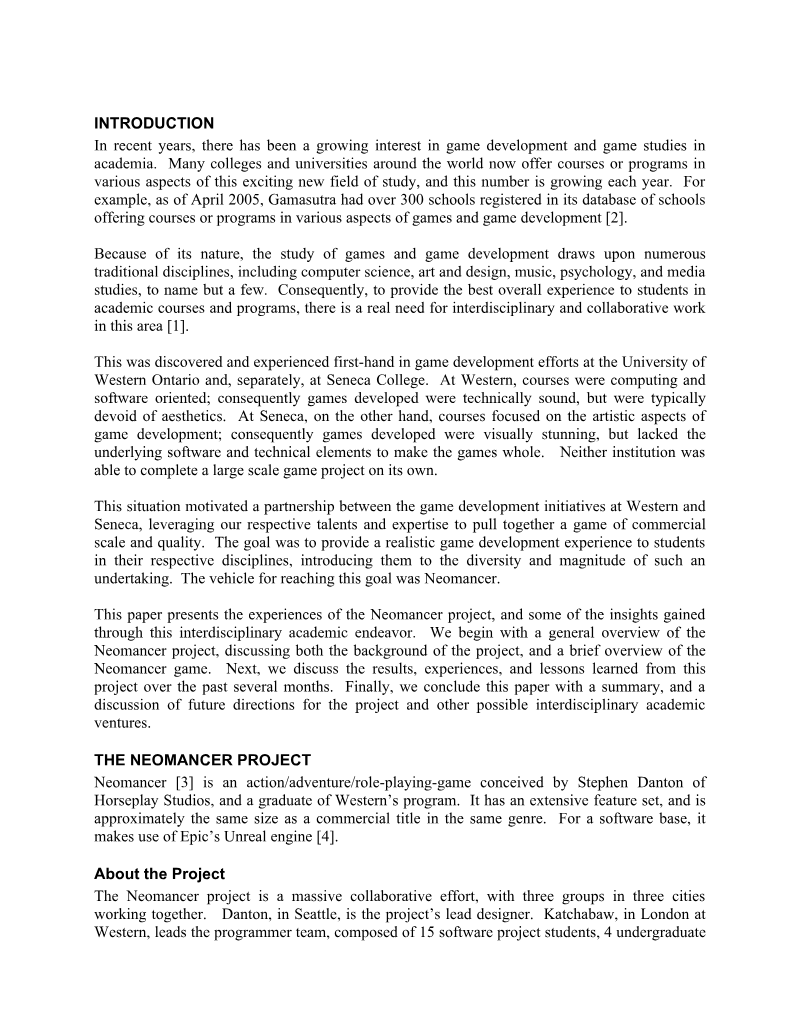
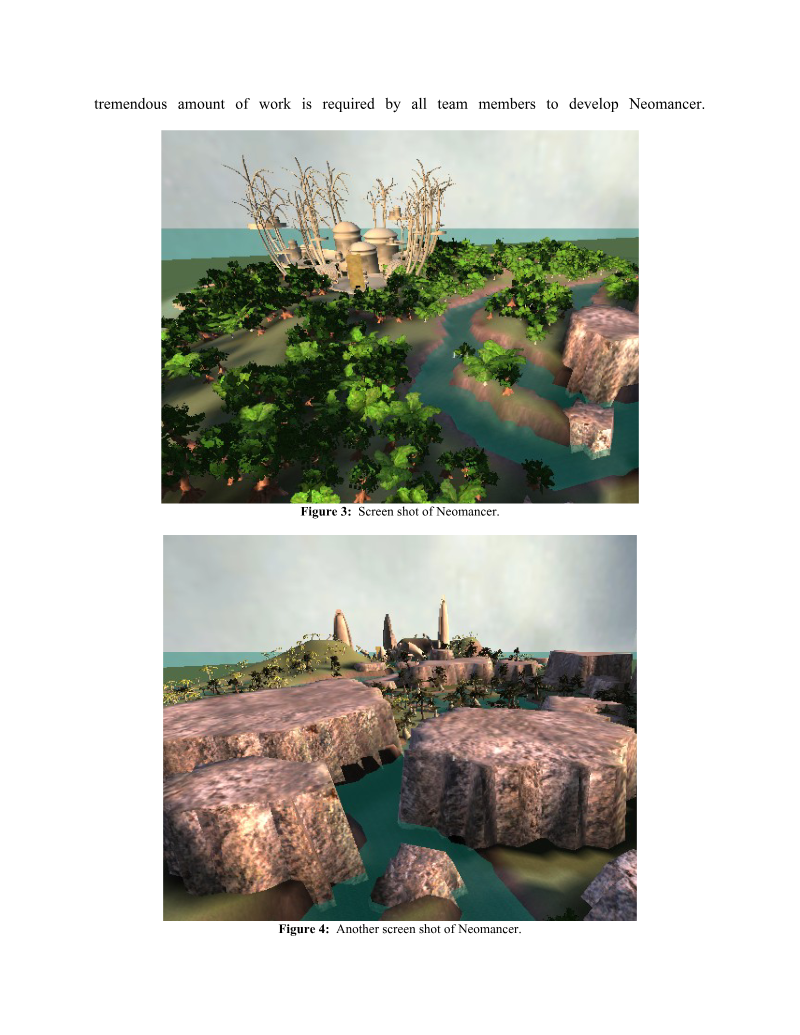
- Neomancer is an interdisciplinary academic action-adventure RPG built on Epic's Unreal engine, set in the fantasy archipelago of Kintorr, and sized to be comparable to a commercial title in its genre.
- The project involves roughly 50 participants from the University of Western Ontario and Seneca College of Applied Arts and Technology, with a lead designer based in Seattle, pooling Western's programming strengths with Seneca's artistic and design capabilities.
- The project began in fall 2004 with a planned two to three year timeline, and its first two milestones were reported as met.
Bringing New HOPE to Networked Games: Using Optimistic Execution to Improve Quality of Service
This paper introduces "New HOPE" (Hopefully Optimistic Programming Environment), a framework designed to mitigate the effects of latency in networked multiplayer games through optimistic execution.
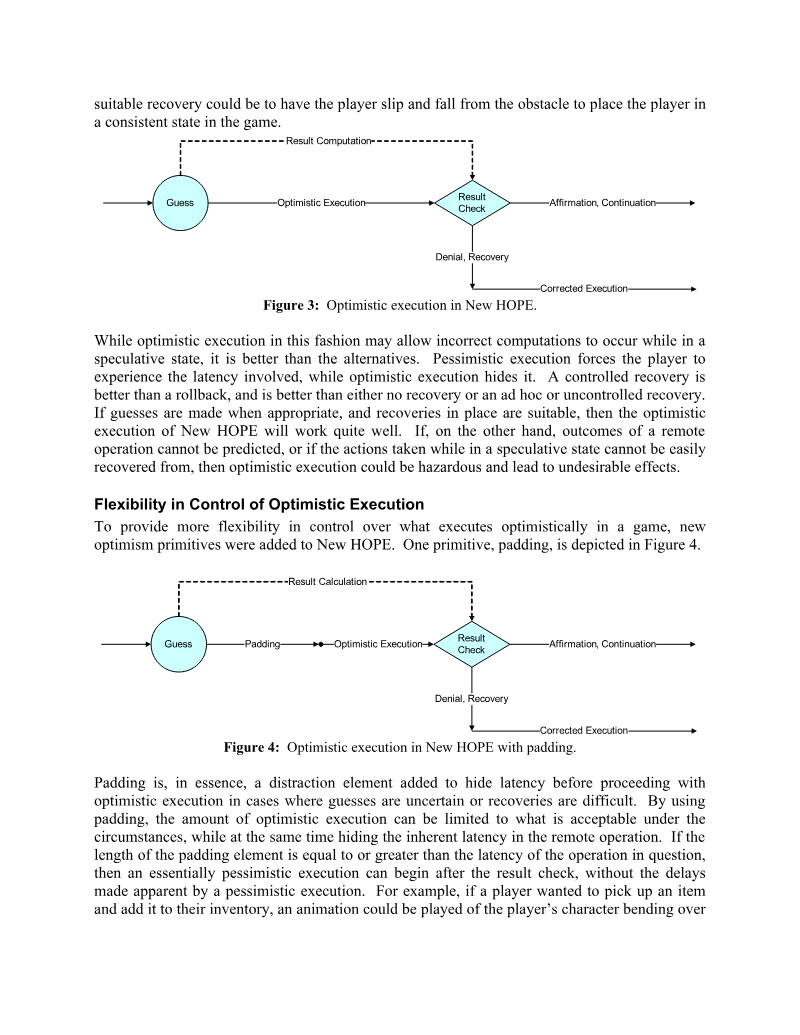
- New HOPE adapts optimistic execution, a framework originally built for transaction-oriented systems, to let predictable game actions proceed without waiting for remote confirmation, hiding synchronization delay from players.
- Unlike original HOPE, which relied on full rollback when predictions failed, New HOPE substitutes controlled recovery procedures that restore a consistent state while keeping gameplay moving forward.
- New HOPE introduces padding (distracting animation that masks latency) and synchronization points (limits on how far speculative execution can proceed) as core primitives.

Frame and Metaphor in Political Games
This paper explores how political rhetoric, particularly ideological bias, is conveyed in videogames through the lens of cognitive linguist George Lakoff's concepts of metaphor and frame.
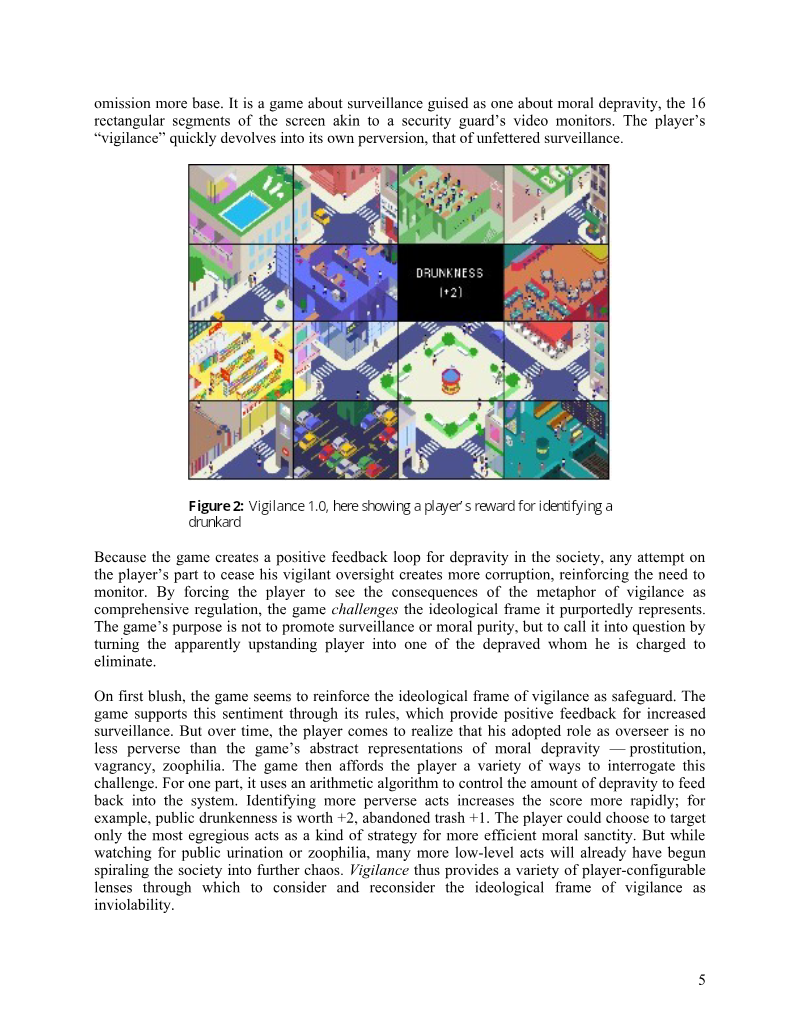
- Ian Bogost's 2005 DiGRA paper argues that videogames can carry ideological bias through procedural rhetoric, operating via rules and systems rather than verbal argument, drawing on George Lakoff's cognitive linguistics and Frank Luntz's message-development work for conservatives.
- Bogost classifies games' relation to ideological frames into three modes: reinforcing them, contesting them, or exposing them.
- The paper's reinforcement example is the Republican National Committee's Tax Invaders, a Space Invaders variant in which a Bush head fires at tax increases framed as invaders, turning the metaphor of taxation as theft into a playable form.
Shadowplay: Simulated Illumination in Game Worlds
The document, "Shadowplay: Simulated Illumination in Game Worlds," argues for the development of a comprehensive vocabulary to discuss simulated illumination in game environments.
- Light in games is argued to be far more than decoration: illumination shapes narrative meaning, directs player attention, modulates mood and risk, and can directly drive gameplay and NPC behavior.
- Silent Hill 2 and Thief serve as the paper's primary case studies, with Silent Hill 2 examined through its pre-rendered cut scenes and low-key horror lighting, and Thief through its tuned sensory system governing AI visibility.
- The author builds a lighting vocabulary by adapting Sharon Callahan's five objectives of digital animation lighting, while noting that free navigation in games exceeds the fixed-frame assumptions of film.


OceanQuest: A University-Based Serious Game Project
The document presents a case study of "OceanQuest," a serious game project developed at the University of Calgary's Digital Media Laboratory, aiming to integrate traditional game goals with educational objectives.
- OceanQuest is a university-developed serious game teaching Grade 8 science about hydrothermal vent ecosystems at the Endeavour field west of Vancouver Island, built under a small budget and a four-month schedule to deliver by February 2004.
- The authors argue that a serious game can satisfy both traditional game goals and educational goals, and treat the difficulty of combining instructional and entertainment design as the central challenge.
- Rather than direct instruction, the design aimed for players to absorb science implicitly through a submarine scavenger hunt narrative in which they search for organisms that may contain a plague cure, mirroring how commercial games teach through play.
Writers
Games and companies
Games