Game Development reports and market data
Documents
I Answer All Your Game Dev Questions | Q&A
This overview provides professional guidance on entering and succeeding in the independent game development industry, drawing on over a decade of experience from a professional developer.
- Prioritize project-based learning over passive study by focusing on core programming logic like loops and conditional statements rather than memorizing syntax.
- Maintain a manageable project scope to ensure completion, as the ability to finish projects is a critical factor in achieving a sustainable, full-time career.
- Build a portfolio of unique, appealing projects rather than relying on academic degrees, as employers prioritize demonstrable skills and interpersonal reliability.
Math for Game Programmers: The Math of Deep Learning
Deep learning functions as a specialized form of differentiable computing, where developers construct large, complex computational graphs to approximate functions that map inputs to outputs.
- Deep learning functions as differentiable computing, utilizing massive computational graphs with billions of parameters to approximate complex functions that map inputs to outputs.
- The primary utility of deep learning is its ability to process high-dimensional data, such as audio, video, and images, to identify complex decision surfaces that traditional rule-based systems cannot.
- Training relies on gradient-based optimization and backpropagation, which use the chain rule to iteratively adjust weights despite the non-convex nature of the problem.
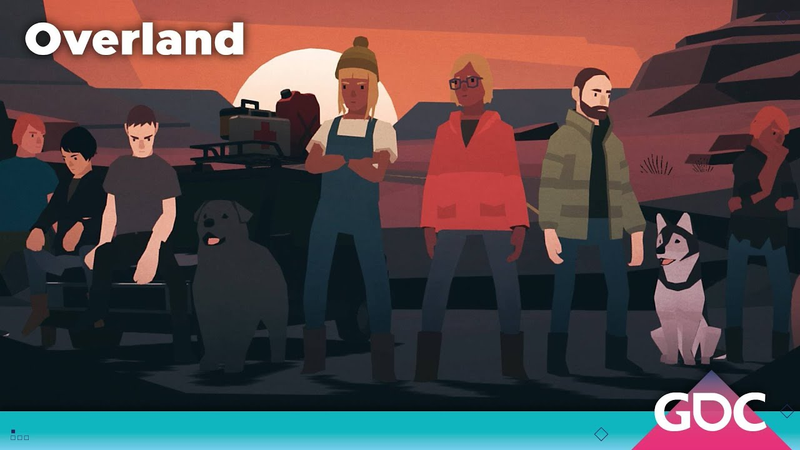
GDC Plays Overland with Finji co-founder Adam Saltsman
Overland serves as a case study in minimalist, turn-based strategy design, prioritizing emotional stakes and tactical vulnerability over the traditional power-fantasy tropes common in the post-apocalyptic genre.
- Overland was designed to evoke player vulnerability and fear rather than the traditional power-fantasy loop found in many post-apocalyptic strategy games.
- The development team prioritized 'proportional warning' for random events, ensuring that players receive a multi-turn heads-up before reinforcements or threats appear on the map.
- Procedural generation in the game utilizes a system of placement masks and 'wild card' modifiers, which act as cascading overrides to determine level layout and resource distribution.
User Generated Content - The Upsides and Pitfalls to Level Editors - Extra Credits
User-generated content serves as a powerful mechanism for extending a game's lifespan and fostering player engagement.
- User-generated content (UGC) extends a game's lifespan by decoupling its longevity from the size of the active player base, allowing small communities to sustain interest for decades.
- Effective UGC ecosystems require a balance between accessibility and depth, as overly complex tools discourage participation while overly simple tools lead to low-quality content.
- The primary operational cost of UGC is the necessity for robust curation and moderation systems to prevent low-quality or offensive material from alienating the player base.
Technical Direction: Communication, ROI and Triage
Effective technical direction centers on the strategic alignment of team autonomy, rigorous project triage, and a disciplined focus on return on investment.
- Prioritize projects using a minimum 5-to-1 return on investment benchmark to ensure resources are allocated to high-impact initiatives rather than low-value legacy refactoring.
- Utilize the 80/50 rule for realistic project assessments to establish clear, value-based expectations and improve the accuracy of technical planning.
- Shift technical leadership focus from granular schedule management to the five core pillars of confidence, cost, commitment, conflict, and cooperation.



Impact of Cloud Gaming and Other Trends in the Indie Ecosystem: Spain
An IDG Consulting study prepared for AEVI in Madrid in October 2019 asks whether the current period is a golden age or the greatest challenge for Spanish indie developers, and examines how cloud gaming fits into the answer.
- Cloud gaming is currently an experimental niche that will not reach mass-market penetration for three to five years due to bandwidth limitations and consumer readiness.
- Indie studios should adopt hybrid monetization models that combine direct sales with subscription or free-to-play (GaaS) approaches to maximize revenue potential.
- The most viable target audience for cloud-based indie titles consists of price-sensitive console users and latency-tolerant mid-core players, including the growing female demographic.
Killer Portfolio or Portfolio Killer 2019: Advice from Industry Artists
A successful portfolio in the modern game industry serves as a testament to an artist’s unique creative vision, technical problem-solving abilities, and professional maturity.
- Prioritize real-time, in-engine assets over static illustrations or cinematic-only reels to demonstrate your ability to function within a professional production pipeline.
- Demonstrate professional maturity by showcasing an iterative design process, including thumbnailing, silhouette studies, and technical breakdowns, rather than just final results.
- Specialize your portfolio for specific roles, as generalist positions are typically reserved for seasoned professionals rather than entry-level candidates.

The Indie-O-Calypse with Jason Rohrer | Game Dev Unchained Episode 206
The contemporary indie game market has undergone a fundamental transformation, moving away from the era of curated storefronts and traditional media influence toward a landscape defined by algorithmic discovery and influencer-led engagement.
- The indie market has shifted from curated, short-form narrative experiences to a model favoring infinite replayability and emergent gameplay that sustains engagement over months.
- Algorithmic discovery and influencer-led engagement on platforms like YouTube and Twitch have replaced traditional gaming journalism as the primary drivers of market success.
- Developers must prioritize high-level polish and a compelling conceptual hook that functions as a visual spectacle to naturally attract streamers and foster organic word-of-mouth.

Colombia 4.0 Conference | Video Games Conference Day in the Life
The Colombian game development industry has undergone a significant transformation over the past eight years, evolving from a nascent sector into a sophisticated and collaborative ecosystem.
- The Colombian game development industry has matured from a nascent sector into a sophisticated, collaborative ecosystem over the past eight years.
- Studios primarily utilize a work-for-hire model for international clients to build technical stability and global networks before transitioning to original intellectual property development.
- The local workforce is characterized by high-level artistic talent and strong cultural alignment with North American media, facilitating seamless international collaboration.
Replicating Chaos: Vehicle Replication in Watch Dogs 2
Achieving seamless vehicle replication in a peer-to-peer multiplayer environment requires a sophisticated balance between network latency management and physics fidelity.
- Watch Dogs 2 utilized a peer-to-peer architecture for its four-player bounty mode, which necessitated distributed authority over entities and created significant challenges for synchronizing high-speed vehicle collisions.
- Vehicle replication relies on projective velocity blending for dead reckoning, which interpolates between local velocity and predicted master snapshots to minimize the spatial gap caused by network latency.
- To mitigate collision discrepancies in a peer-to-peer environment, the team implemented a hybrid approach that allows local physics to simulate impacts for a short duration before blending back into the dead-reckoned trajectory.
Creating Compelling Characters: Insights from a Panel of Character Concept Artists
Character design in modern game development functions as a narrative-driven process that prioritizes contextual integration over static, isolated illustrations.
- Character design should prioritize narrative-driven contextual integration, using cinematic storyboards or vignettes rather than static, isolated lineups to better communicate personality and emotional intent.
- Effective designs must balance aesthetic appeal with functional requirements and narrative logic, grounding costumes in research that reflects the character's specific situation and environment.
- Technical constraints should be treated as creative opportunities to convey character progression or personality, while maintaining visual consistency through deliberate shape language, color blocking, and a clear center of mass.
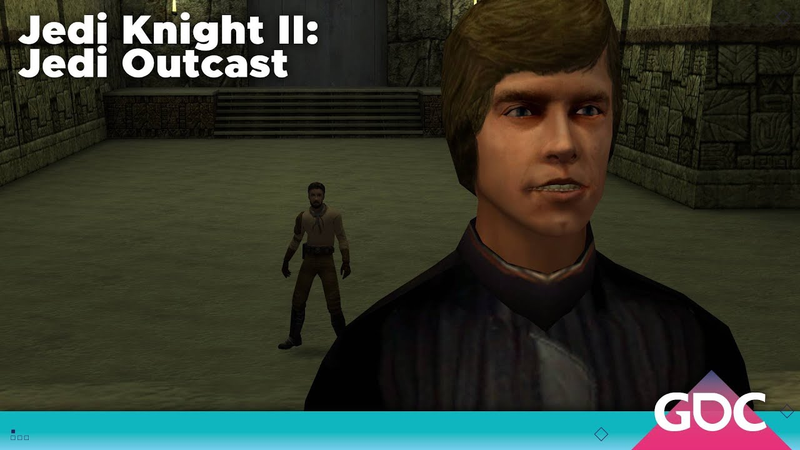
GDC Plays Jedi Knight II: Jedi Outcast with Raven Software
The development of Jedi Knight II: Jedi Outcast represents a pivotal moment in early 2000s action gaming, characterized by a transition from traditional first-person shooters to hybrid combat experiences.
- Raven Software developed Jedi Knight II: Jedi Outcast by hybridizing first-person shooter mechanics with third-person combat systems inspired by Heretic II and Bushido Blade.
- The development team utilized the technical foundation of Star Trek: Voyager – Elite Force to build the game, leveraging proprietary tools like GTK Radiant to manage hardware limitations.
- To ensure performance on early 2000s hardware, the team implemented rigorous asset optimization, level segmentation, and memory-efficient solutions like procedural facial animations driven by audio volume.
Writers
Games and companies
Games