Game Culture reports and market data
Documents



Theatrical Locations in Digital Role-Playing Games: Remediation of Theater in Computer Games
This analysis explores the intersection of digital role-playing games (RPGs) and theatrical performance, focusing on how game designers utilize theatrical locations to influence player immersion and agency.
- Theatrical locations in digital RPGs serve as a primary mechanism for 'remediation,' where game designers borrow theatrical techniques to break player immersion and encourage critical distance from the gameplay.
- In the game 'Pathologic' (Icepick Lodge, 2005), the theater functions as a meta-narrative space where characters and players are positioned between the roles of actor and spectator, ultimately questioning the validity of the player's choices within a simulated environment.
- Developers of 'The Path' manipulate player telepresence by shifting the camera perspective from an immersive third-person view to a detached 'god view' when the avatar enters a theatrical stage, effectively transforming the player from an actor into a director or observer.



Motyw Yūrei w Japońskich Survival Horrorach: Analiza Wybranych Przykładów
This analysis explores the integration of the yūrei—vengeful spirits from Japanese mythology—into the survival horror genre, focusing on how traditional folklore is remediated into modern interactive media.
- Survival horror games effectively leverage the yūrei (vengeful spirit) archetype to bridge ancient Japanese folklore with modern interactive media.
- The 2010 title Calling modernizes traditional ghost stories by using contemporary communication tools, such as mobile phones and internet chat rooms, as conduits for supernatural encounters.
- The 2004 game Kuon grounds its horror in cultural heritage by utilizing historical kaidan (ghost stories) and settings rooted in the Heian period.

Playing with Loss of Control: Weak Subjectivity, Questioning Rationality and Problematizing Identification in Narrative Videogames
The analysis explores the prevailing design paradigms in narrative-driven, single-player video games, which typically position the player as a powerful, rational, and highly capable protagonist.
- Mainstream narrative games are built on a 'logic of progress' where players start with limited agency and evolve into powerful subjects, a structure reinforced by quantifiable metrics like experience points and character levels.
- The prevailing design paradigm encourages strong player identification and emotional attachment, often treating the game world as a 'technology of the self' where players maximize their efficiency and agency.
- Games like 'Spec Ops: The Line' (Yager Development, 2012) subvert traditional player agency by forcing the player to commit war crimes, such as using white phosphorus, which are mandatory for narrative progression.

Game Engines and Game History
Henry Lowood, a Stanford Libraries historian, presents a talk from the History of Games International Conference (January 2014, published in Kinephanos) on the possibilities for game history.
- Lowood reports that the term "game engine" first appeared in print the year after DOOM's launch, and that Google's tool suggests it was a neologism of the early 1990s.
- The author states that id Software invented the game engine around 1991 and revealed the concept no later than the DOOM press release in early 1993.
- Id's Keen engine served as the shared codebase for a second Commander Keen trilogy.
Unrepresented and Under-represented Video Game History
The study of video game history is fundamentally shaped by narrative structures that connect events, innovations, and genealogies.
- The historical record of video games is currently skewed toward North American home console gaming due to the loss of extinct technologies and inaccessible corporate records.
- Video game historiography is shifting from subjective, interview-based journalistic accounts toward comprehensive academic inquiry that incorporates global perspectives beyond the United States.
- Early industry documentation relied heavily on limited secondary sources and subjective databases like the Killer List of Videogames (KLOV).
The Casual Revolution of 1987: Making Adventure Games Accessible to the Masses
Jonathan Lessard, of Concordia University in Montréal, examines the history of computer adventure games in the second half of the 1980s through the lens of accessibility, drawing on his own research on adventure games (Lessard 2013) and on period industry statements, reviews and trade publications.
- Industry figures in the period cited a growing market of non-specialist consumers and the need for simpler games. Tom Frisina of Accolade said consumers "don't like big manuals" and "don't want any obstacles."
- Joe Ybarra of Mediagenics argued that existing products were too demanding, citing learning times of eight hours and completion times of up to 200 hours.
- The graphical user interface introduced by the Macintosh in 1984 prompted adventure games to adopt point-and-click designs. ICOM's Déjà Vu (1985) was awarded "Best Entertainement Product" and "Best New World" at the Excellence Software Awards in 1986.
Looking at the History of Video Games Through the Prism of Ludicisation Processes
Sébastien Genvo, of the Université de Lorraine, presents a conceptual article published in the Kinephanos History of Games International Conference Proceedings (January 2014).
- The article argues that game characteristics should not be treated as unchangeable, and proposes the term "ludicisation" for processes that turn situations into games, distinguishing it from gamification.
- The author states that Spacewar and the commercial Computer Space shared the same fictional reference points, yet the commercial version's values differed, while its model player was not adapted, and Computer Space failed.
- The article holds that a ludic attitude requires a degree of contingency, so that players feel their actions could have significant repercussions on how events develop.
The Construction of Civilization
The study provides a methodological framework for analyzing the history of the Civilization game series, arguing that popular journalistic accounts often oversimplify the development process by focusing exclusively on lead designer Sid Meier.
- The Civilization series evolved from closed systems into open architectures that intentionally integrated modding capabilities under designers like Brian Reynolds and Soren Johnson.
- A cyclical development pipeline emerged where players who learned to program by modifying early titles eventually transitioned into lead architects for later installments in the series.
- Core gameplay mechanics, such as tile-based resource management, are not isolated inventions but are transmedial developments rooted in board game designs dating back to the 1930s.
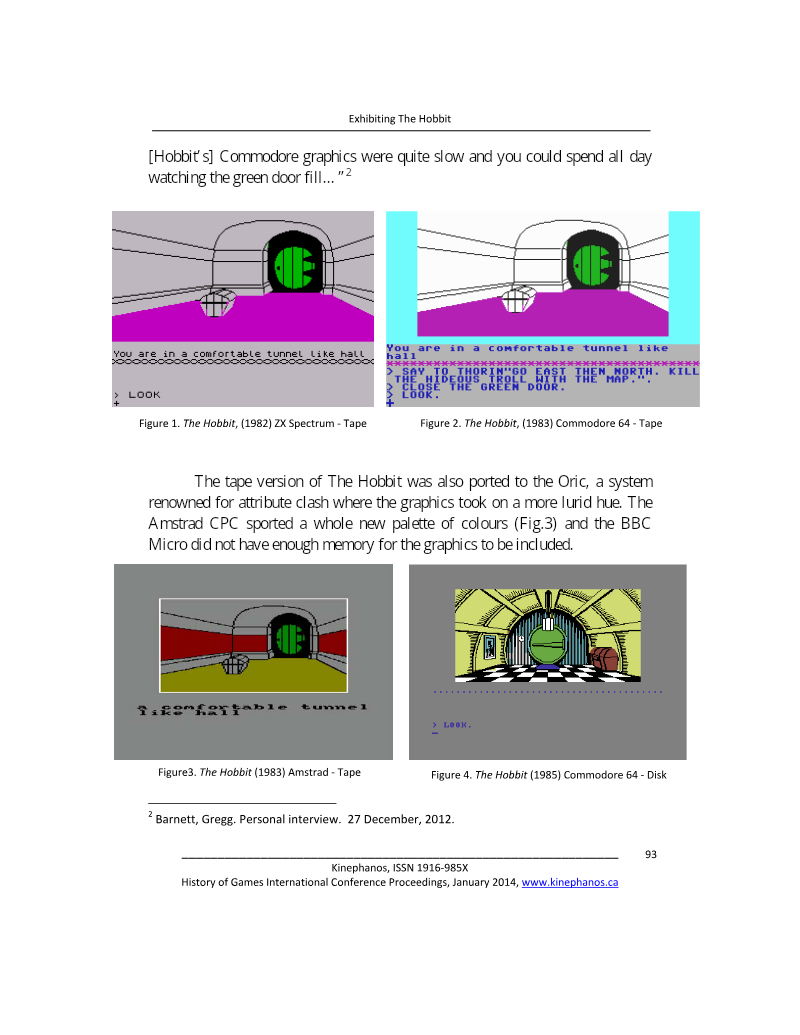
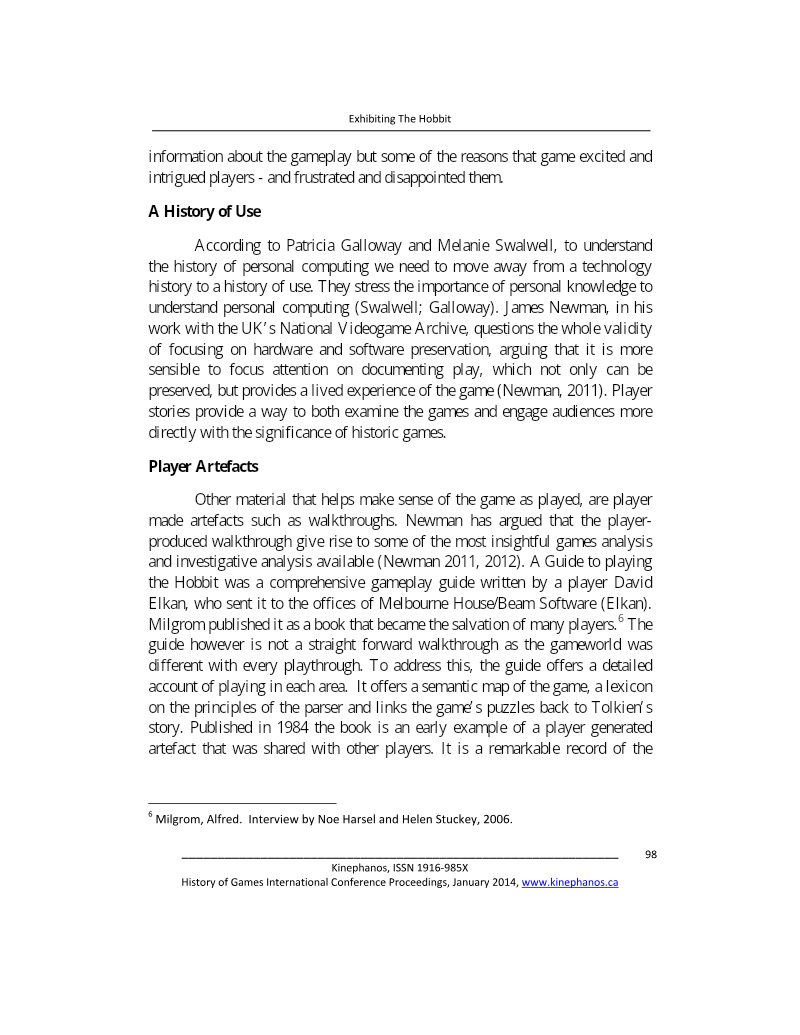
Exhibiting The Hobbit: A Tale of Memories and Microcomputers
Museums face significant challenges when attempting to collect and exhibit videogames, as these works are often defined by their technical variability and the subjective experiences of their players.
- Museums must shift from preserving a single 'idealized' version of a game to embracing the 'multiplicity' of digital works, including various platform ports and hardware-specific constraints.
- Beam Software’s 1982 text adventure, The Hobbit, serves as a primary case study, having been released across more than nine distinct platforms with unique graphics, speed, and sound capabilities.
- Relying exclusively on emulation or a single version of a game risks homogenizing the history of 1980s microcomputing by erasing the technical ingenuity required to adapt software to diverse hardware.
Conserving Portal: Defining and Documenting the Object
Kristin MacDonough, writing for the History of Games International Conference proceedings published in Kinephanos in January 2014, examines how a video game can be conserved in a museum setting, with a focus on documentation.
- MoMA's Department of Architecture and Design announced the inclusion of fourteen video games in its collection in November 2012, with Portal as one of them.
- The author argues that the conservation object for a video game combines the conservation and digital object definitions, so that all of the game's components are part of the object.
- The paper uses the MDA framework, interpreting dynamics as the intangible interactivity to be preserved and mechanics and aesthetics as the states through which it can be approached.
A History of Real-Time Strategy Gameplay: From Decryption to Prediction
Simon Dor, of Université de Montréal, presents a methodological paper in the History of Games International Conference Proceedings (January 2014) on the history of real-time strategy (RTS) gameplay, introducing the actional statement as a tool to describe the institutionalization of RTS strategies.
- The author places Dune II in a paradigm of decryption, where players work out a designed experience, and classical late-1990s RTS in a paradigm of prediction, where players anticipate an opponent's actions.
- None of the 21 Dune II reviews written between 1992 and 1994 that the author examined uses the term "real-time strategy".
- The author argues that a new genre emerges through a long process of institutionalization rather than with a single release date.
The Ends of History and the Tyranny of the Algorithm
Stephen Kline, a media historian at Simon Fraser University, presents a paper from the History of Games International Conference Proceedings (January 2014) that critiques how media history has framed digital play.
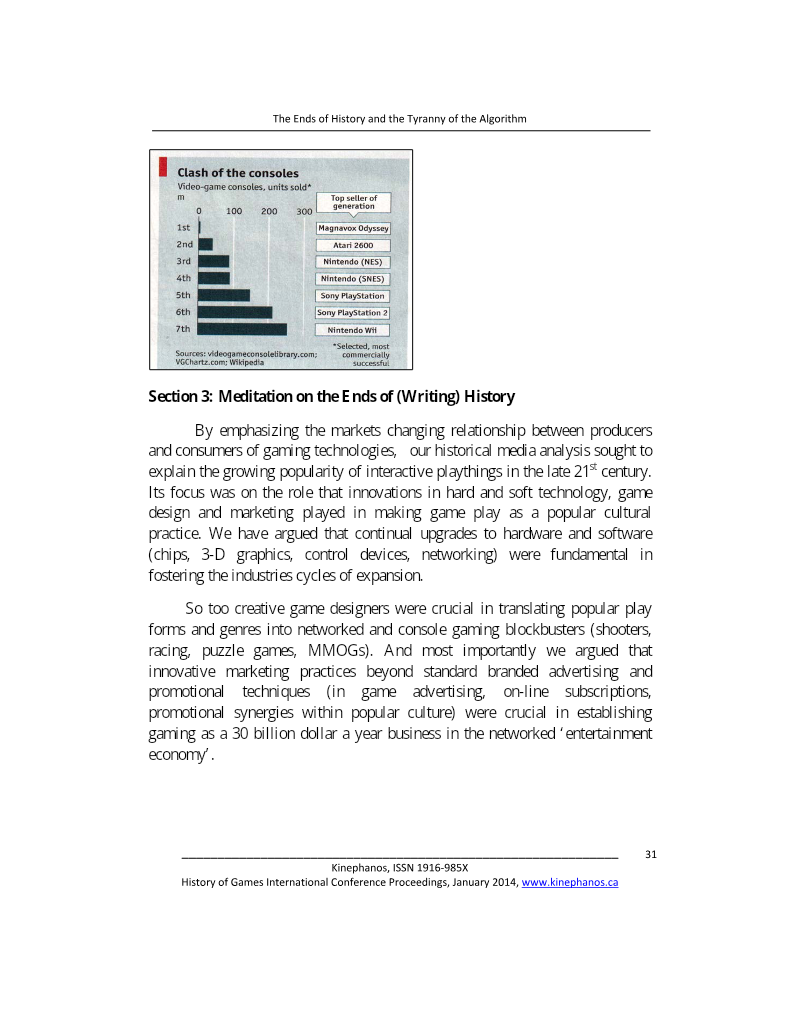
- Citing a reliable source, the author notes that total global video game sales were estimated at $67 billion in 2012, suggesting the sector has continued to grow faster than films, music or newspapers.
- Over the last five years, without major upgrades to core gaming technologies, industry revenues dropped by about 12%, according to the author.
- The balance between shares of income from hardware vs. software sales changed from 58 to 38%, according to the author.
Writers
Games and companies
Games