Game Culture reports and market data
Documents

Learning and Enjoyment in Serious Gaming: Contradiction or Complement?
This study, by Ulrich Wechselberger of the University of Paderborn, examines whether the perceived antagonism between play and seriousness affects the educational potential of serious games.
- In study one, participants rated the serious game as significantly less credible than the traditional instruction on the multidimensional credibility index. Effect sizes were large.
- In study one, among the entertainment dimensions, only immersion differed significantly between the serious game and the traditional instruction, with the serious game rated higher.
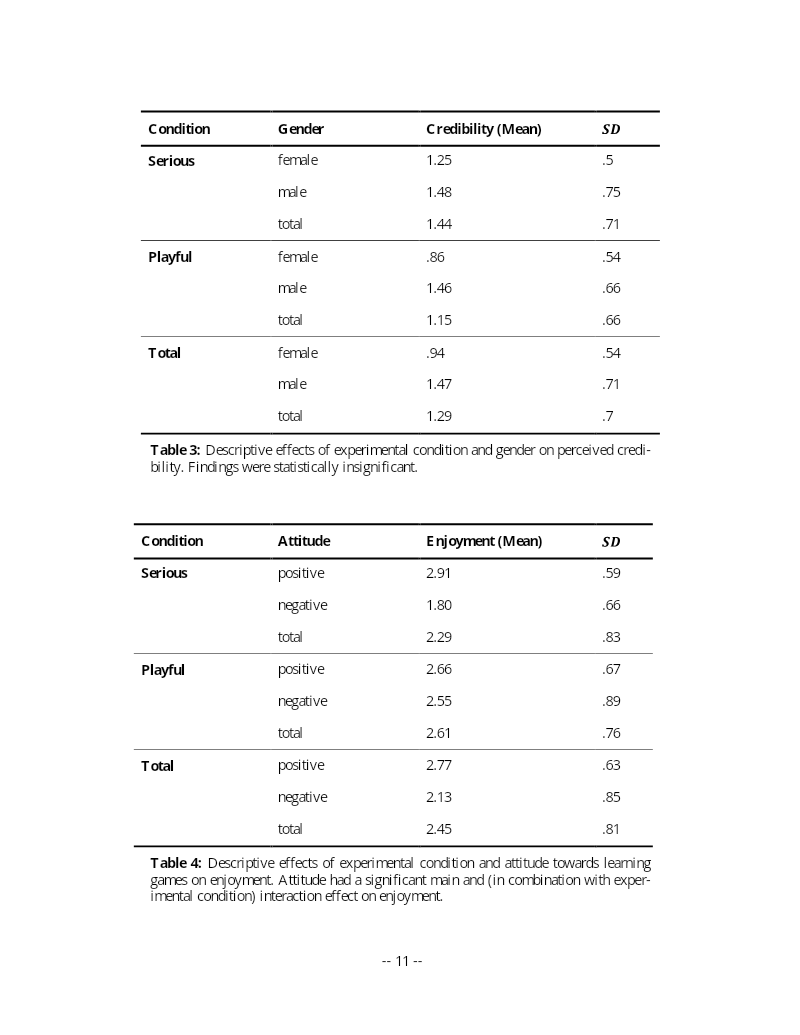
- In study two, the framing manipulation had no significant effect on perceived credibility, neither as a main nor as an interaction effect.
Analysing the History of Game Controversies
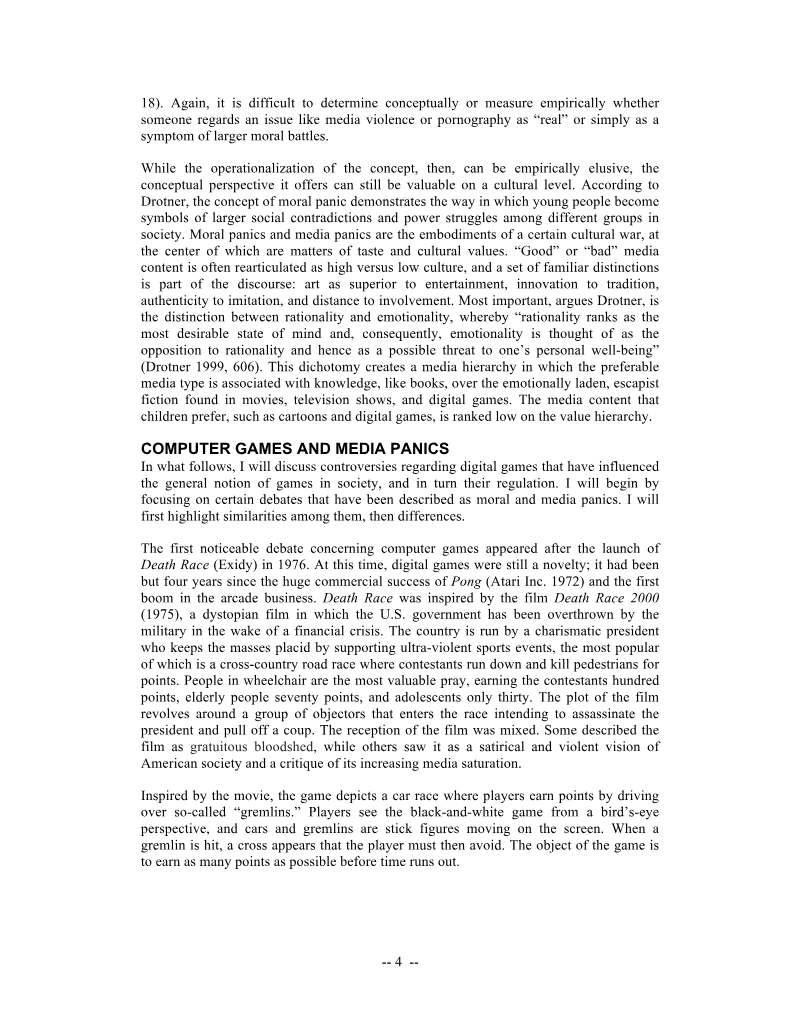
This paper by Faltin Karlsen of the Norwegian School of Information Technology examines controversies surrounding digital games through the lens of media panic and moral panic, drawing on a historical perspective.
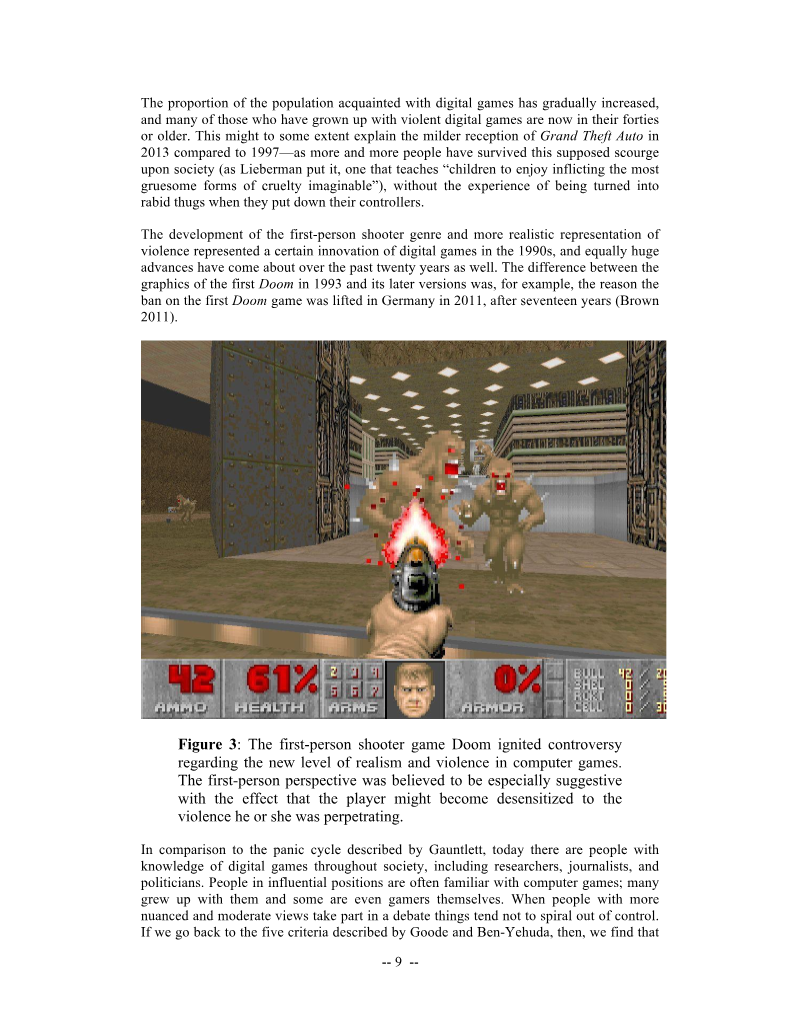
- Public debate over violent game content has been in decline, with Grand Theft Auto 5's 2013 launch met with general praise rather than revulsion at its violence.
- After fifty years and more than five thousand studies, no clear connection has been established between media violence and violence in the general population.
- Between 1994 and 2001, juvenile arrests for murder, forcible rape, robbery, and aggravated assaults in the United States fell 44 percent, citing Kutner and Olson.

Well Played: A Special Issue on Theories of Well Played
This is the front matter and full text of the 2013 ETC Press special issue of Well Played (volume 2, number 2), edited by John Sharp, which collects five essays on theories of "Well Played" in video game writing.
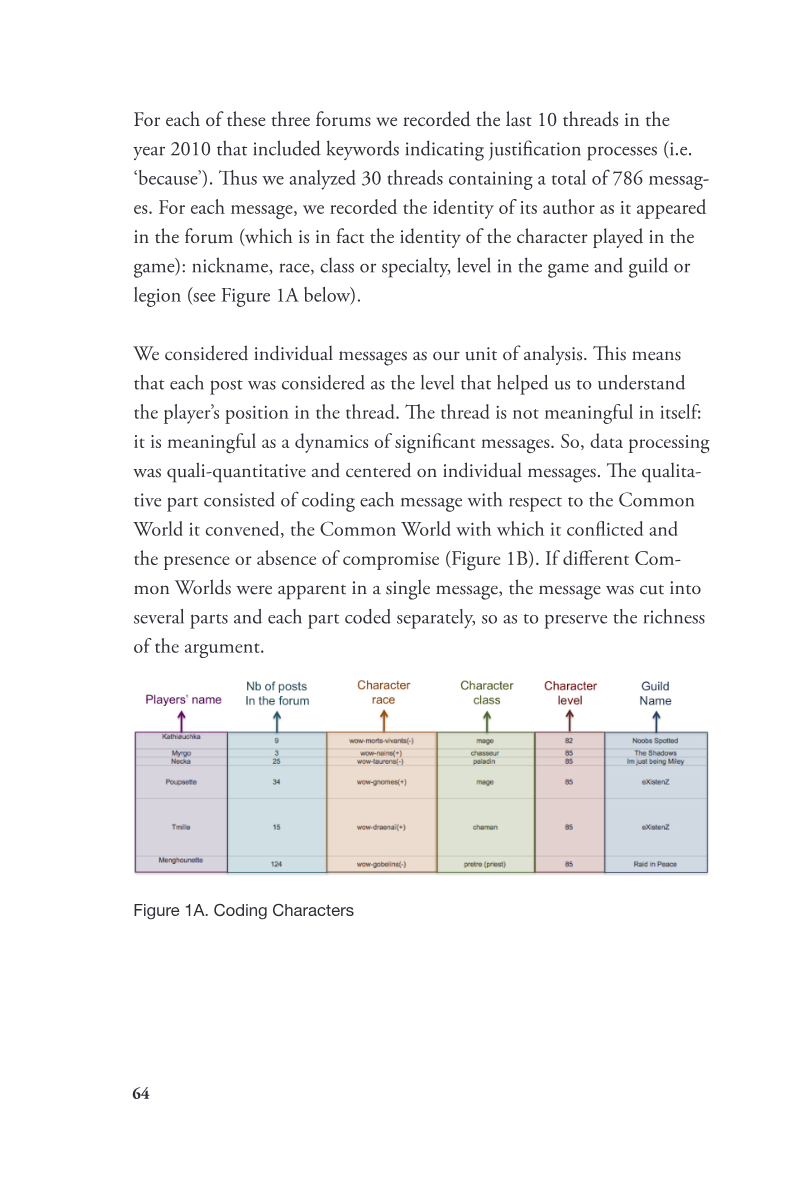
- Philippette and Campion coded 786 messages from 30 threads across three MMORPG forums and found that the Industrial World was the most frequently convened justification in EQ2, at 43.5%.
- Duncan argues that a theory of well-played must account for multiple perspectives, using a 2009 World of Warcraft forum exchange between players and designer Ghostcrawler as the case.
- Haimberg argues that rubric-based scoring can hamper a reviewer's descriptive power, citing a Wilson and Schooler study in which students who analyzed their reasons rated jam less in line with experts.

L'effet-clip au cinéma
Film critics have used the term since the 1980s, usually pejoratively, to describe films supposedly tainted by MTV-style aesthetics.
- The authors argue that no single textual definition of the effet-clip is sufficient, and that it should be approached pragmatically as a production of meaning and affect by the spectator.
- The authors state that the term is typically used in film criticism to characterize an aesthetic, with a pejorative judgment, in the large majority of cases.
- The authors argue that the phenomenon of the effet-clip concerns cinema up to and including the silent era, and that Le Lauréat (1967) can be considered the first mainstream American clip sequence under a genre-based definition.
Cinema as a Sacred Surface: Ritual Rememoration of Transcendence
The author contrasts two scholarly traditions: a thematic approach, associated with Henri Agel, that studies the representation of the sacred in film, and a media-materiality approach, associated with Jean Epstein and Edgar Morin, that treats film itself as part of the sacred.
- The author argues that cinema bears traces of the sacred because the physical film and the flattened projected image act as sympathetic equivalents of the world, rather than because of its narratives or themes.
- The author proposes that movie-going resembles Lacan's concept of rememoration, in which the viewer recalls an archaic state where the sacred was experienced through ritual in a dark space facing a surface.
- The author argues that Plate's metaphor of the mystical experience applies in principle to the viewing experience of any film, not only to films showing dead bodies.
The Gospel of the Winchesters: Neoreligious Fan Practices and Narrative in Supernatural
Charlotte E. Howell, a University of Texas at Austin doctoral student, examines fan practices and narrative in the television series Supernatural (The WB/CW, 2005-present), published in Kinephanos, Vol.
- The show links Supernatural television fans with devotees to the Winchester Gospel, which the author describes as religious if apocryphal, framing fans performing religious acts as an imposition by the narrative.
- The author states that the character Becky Rosen is introduced in a manner similar to how Wincest fanfiction is presented, through grudging acknowledgement and locating it as undesirable.
- Fanfiction sampled by the author includes a fic in which Becky is positioned as God, which the author says grants her omnipotence and somewhat redeems God from God's acknowledged absence in the show.
The Production of Subject and Space in Videogames
Altuğ Işiğan, an independent researcher, writes in the Issue 02 (2013) peer-reviewed journal Game Journal (gamejournal.it) about how video games produce subjects and space.
- The author argues that linear perspective, which game rendering inherits, is treated by developers, researchers and players as a neutral reproduction of human vision, though it is a historically specific visual code.
- The author argues that the player's position is that of a spectator who stays at a fixed point in physical space, rather than one who navigates the space.
- Citing Taylor, the author notes that much critical literature on new media assumes the transparency of the video or computer screen.
The Indie Academy: Promoting Gaming Communities through University Collaboration
Universities often struggle to align their intellectual property (IP) strategies with the realities of the gaming industry, frequently overestimating the commercial potential of academic research.
- Universities should shift their focus from short-term commercialization of intellectual property to prioritizing student talent development and community engagement.
- Rigid legal requirements and bureaucratic delays make traditional university-industry partnerships ineffective for the fast-paced gaming sector.
- Independent developers are more effective partners than large corporations because they are agile enough to experiment with niche IP that larger studios typically ignore.

The Toronto Indies: Some Assemblage Required
The article, by Daniel Joseph of Ryerson and York Universities and published in the Journal of the Canadian Game Studies Association, examines independent video game production in Toronto.
- The author describes Sworcery as a runaway success in the sphere of indie games; it has grossed more than $3 million in sales and was made with a team of about five people.
- The OMDC's Interactive Digital Media Fund provides grants of up to $150,000, capped at 50% of the total production budget.
- The OMDC requires that 75% of funded project money go to proprietary products, with 25% going to joint ventures with foreign-owned IP.
Indie Sports Games: Performance and Performativity
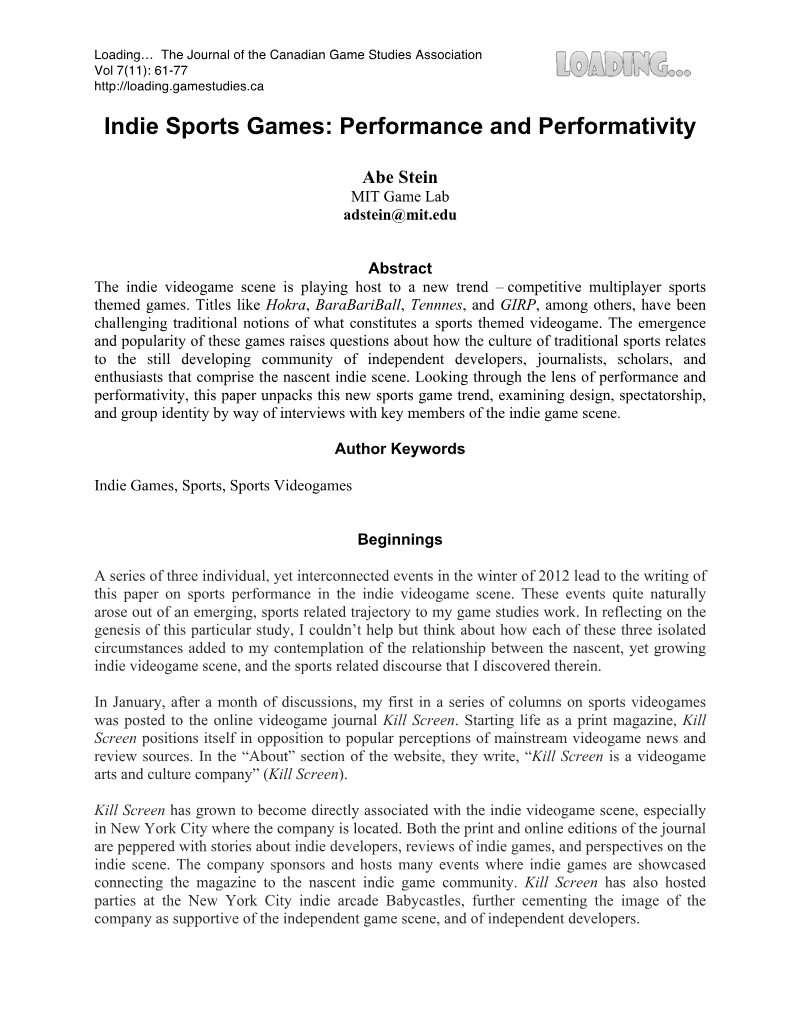
Abe Stein, an MIT Game Lab researcher, examines the emerging trend of competitive multiplayer sports-themed indie games, such as Hokra, BaraBariBall, Tennnes and GIRP, in the Journal of the Canadian Game Studies Association (Vol 7(11)).
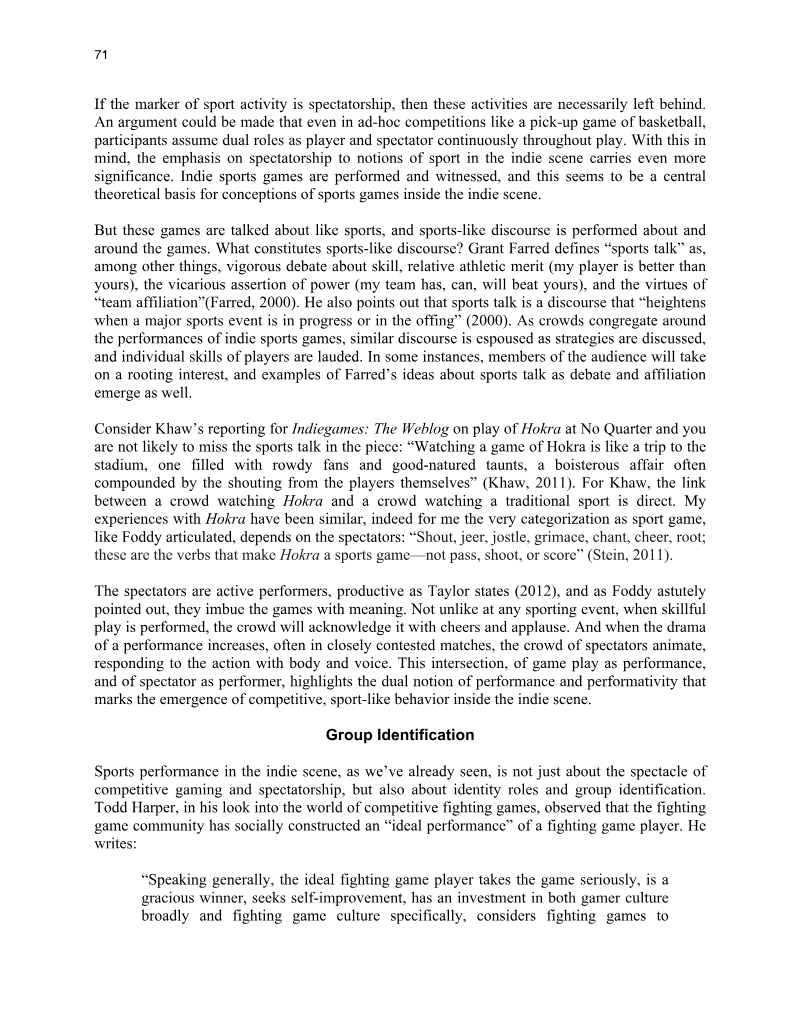
- The author argues that indie sports games are spectator-friendly because of accessible design, and that the games are easy for an audience to understand quickly.
- Interviewed developers were all male, and the author notes few independent female or transgendered developers work on competitive multiplayer independent sports games.
- The author argues that access to events where unreleased indie sports games are played functions as social capital that delimits the community.
An Embodied Cognition Approach for Understanding Role-playing
The authors, Petri Lankoski of Södertörn University and Simo Järvelä of Aalto University, propose that theories of grounded cognition and embodiment can explain the role-playing experience, covering both table-top and live-action role-playing games.
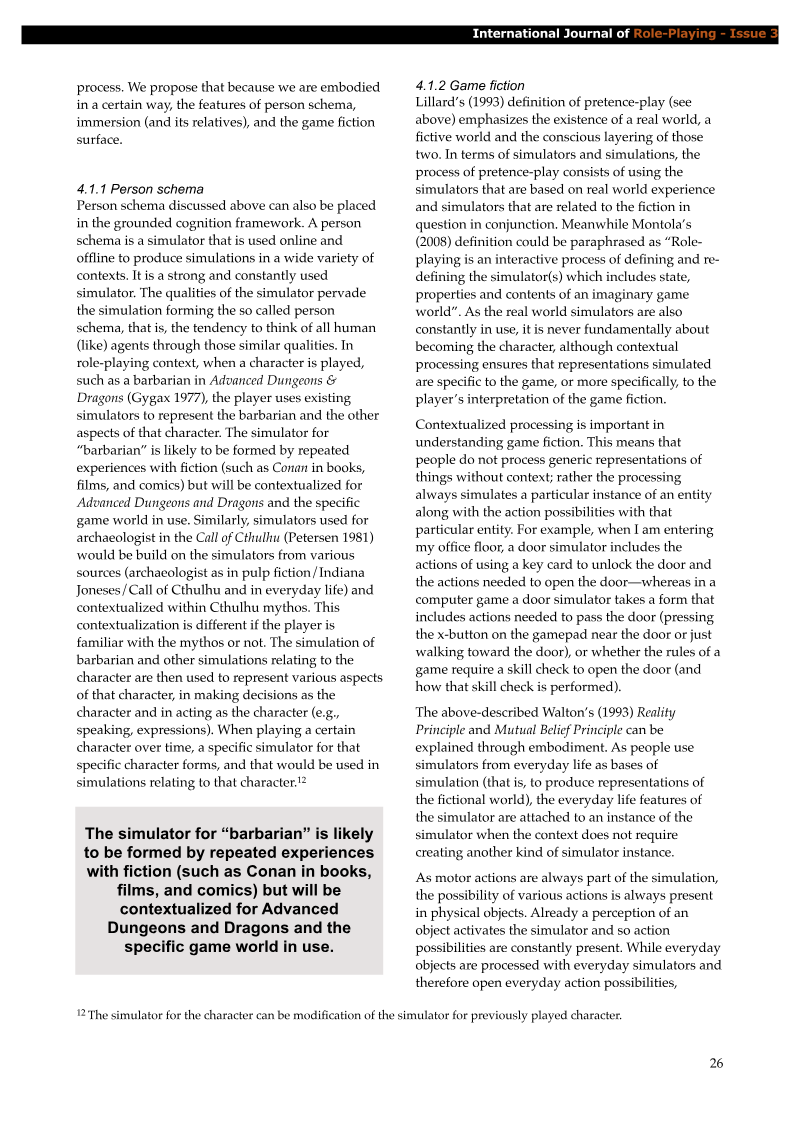
- The authors argue that character immersion and bleed are natural consequences of how the brain works, building this on grounded cognition theory.
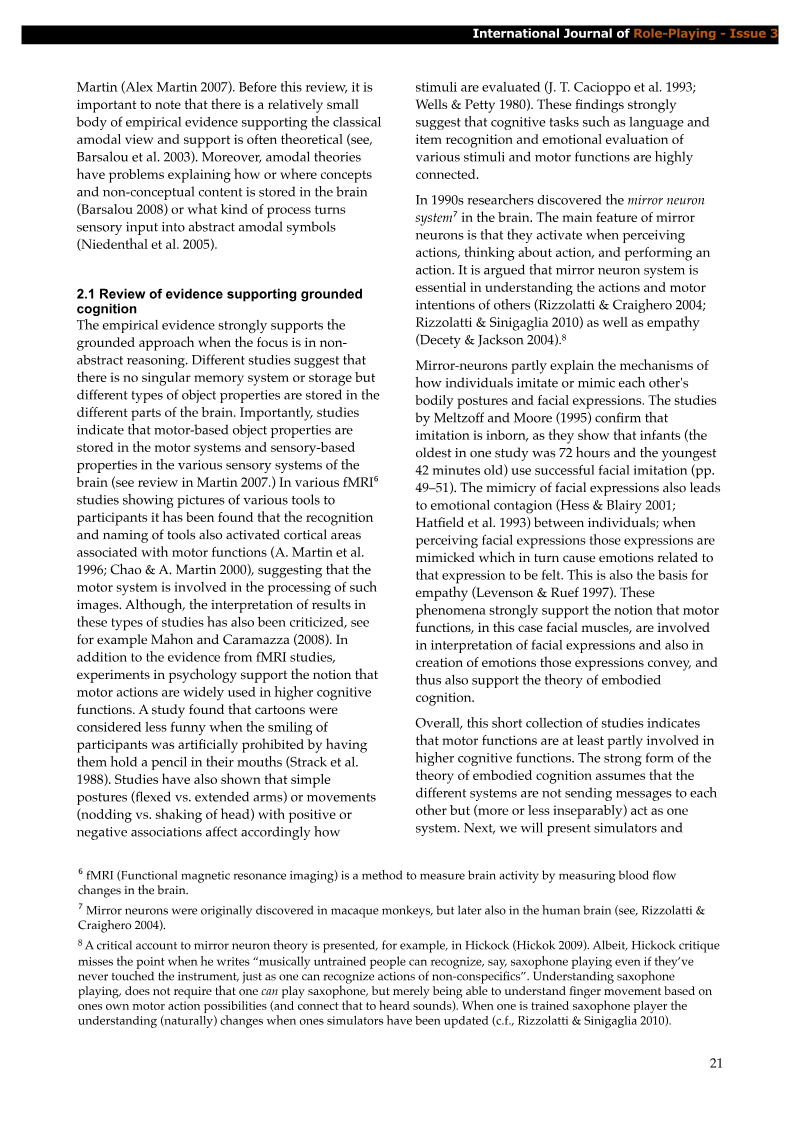
- Grounded cognition theory proposes that action, perceived action, and described action are similar in terms of brain functions while being phenomenologically different, which the authors use to explain how fiction is experienced.
- The authors argue that Fine's account describes engrossment but does not explain it from a psychological perspective.
Remember the Good Old Days?: Nostalgia, Retroscapes, and the Dungeon Crawl Classics
Greg Gillespie, a Brock University scholar who writes as an acafan (a scholar who is also a long-time D&D player), examines the aesthetic construction of nostalgia in Goodman Games' Dungeon Crawl Classics (DCCs), a set of Dungeons and Dragons adventure modules published between 2002 and 2008.
- Goodman Games published the DCCs with a retro aesthetic on top of Third Edition D&D rules, and the author argues this combination makes the modules' past-oriented appeal confounded by a discourse of past and present.
- The author reports that Goodman placed blue dungeon maps inside the covers, a feature TSR originally used to deter photocopying, and Goodman said he used the blue to match the 1980s modules.
- Goodman said he measured the proportions of old TSR modules and tracked down the original font to recreate their look.
Writers
Games and companies
Games