Key insights
6 slides
Challenging narratives
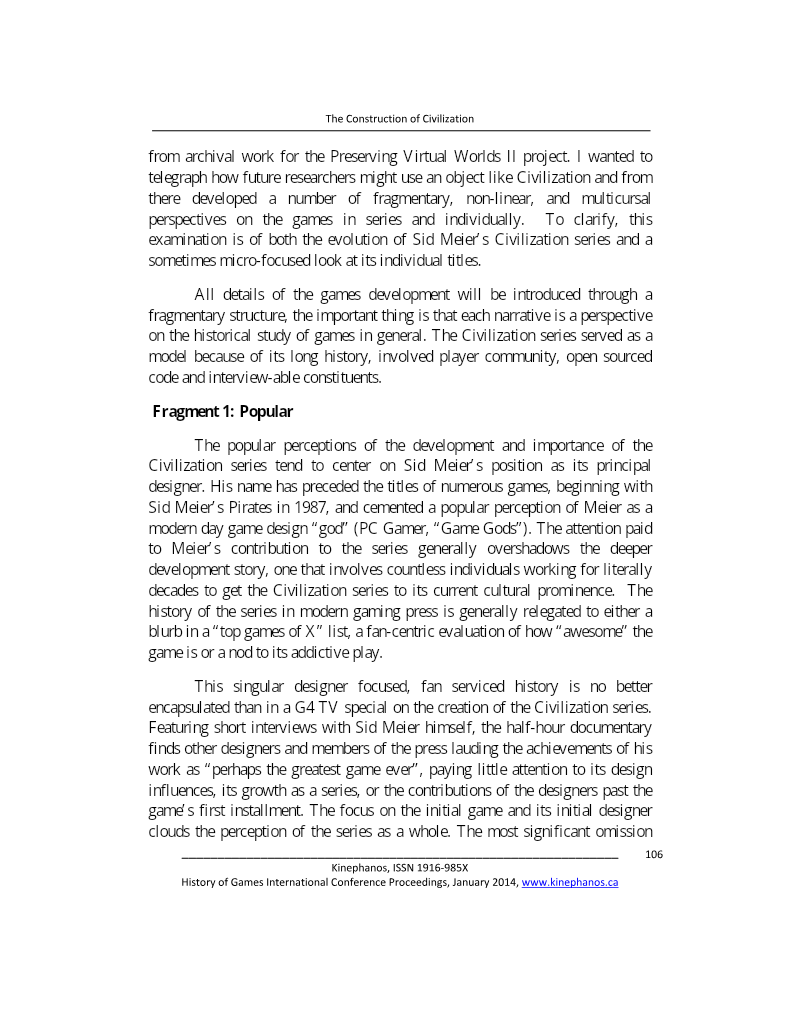
The Civilization series development is a collaborative, iterative process, not solely the work of one lead designer.
Popular accounts often oversimplify the series' history by focusing exclusively on Sid Meier.
1 / 6
- 01The Civilization series evolved from closed systems into open architectures that intentionally integrated modding capabilities under designers like Brian Reynolds and Soren Johnson.See it on page 5
- 02A cyclical development pipeline emerged where players who learned to program by modifying early titles eventually transitioned into lead architects for later installments in the series.See it on page 6
- 03Core gameplay mechanics, such as tile-based resource management, are not isolated inventions but are transmedial developments rooted in board game designs dating back to the 1930s.See it on page 8
- 04The development of the series is a collaborative, iterative process rather than the result of a single lead designer, challenging the popular narrative centered exclusively on Sid Meier.See it on page 2
- 05Technical constraints, such as the use of windowed interfaces in early titles, significantly influenced player engagement and are often lost in modern re-releases.See it on page 11
- 06Rigorous game history requires a multi-faceted methodology that combines archival research, developer interviews, and the use of emulation software to recreate original playing environments.See it on page 12
Ask AI about this report
Summary
The study provides a methodological framework for analyzing the history of the Civilization game series, arguing that popular journalistic accounts often oversimplify the development process by focusing exclusively on lead designer Sid Meier. By examining the series through technical, social, and design-centric lenses, the analysis seeks to move beyond superficial narratives to reveal the complex, collaborative, and iterative nature of game development. The research emphasizes that computer games are sophisticated computational objects that require deeper historical foundation and critical inquiry.
Key findings highlight the evolution of the series' architecture, particularly the transition toward user-modifiable content. Early titles were largely closed systems, but subsequent entries, influenced by designers like Brian Reynolds and Soren Johnson, intentionally incorporated modding capabilities. This shift created a feedback loop where players who learned to program through modifying the games eventually became the architects of later installments. Furthermore, the analysis traces the lineage of core gameplay mechanics, such as tile-based resource management, back to pre-computational board games from the 1930s, demonstrating that game design is a transmedial process of building upon existing ideas rather than a series of isolated "genius" inventions.
The methodology relies on a multi-faceted approach, including archival research, interviews with key developers, and a phenomenological study of the gameplay experience. By utilizing emulation software to recreate original playing environments, the study uncovers forgotten technical nuances—such as the impact of windowed interfaces on player engagement—that are often lost in modern re-releases. Ultimately, the work advocates for a more rigorous, non-linear approach to game history that accounts for the contributions of community members, the evolution of technical constraints, and the experiential reality of the player.