China reports and market data
Documents


Analyzing the Consumer and Market Impacts of Chinese Games Market Policies: China
China continues to dominate the global gaming market, yet a series of regulatory tightening measures—particularly anti-addiction rules for minors and an expanded licensing framework—have introduced significant uncertainty and higher operational costs for both domestic and foreign developers.
- China’s regulatory environment has tightened through strict anti-addiction laws for minors, which now cap playtime, limit in-game spending, and restrict live-streaming access for users under 18.
- The licensing framework now requires detailed content reviews and real-name verification, increasing operational costs and long-term investment risks for both domestic and foreign developers.
- While the licensing process is complex, a new policy allowing a single license for multiplatform releases is incentivizing developers to prioritize cross-platform title development.


Analyzing the Consumer and Market Impacts of Chinese Games Market Policies
China’s gaming market, the largest in the world by revenue and player count, is currently defined by a complex and increasingly restrictive regulatory environment.
- Chinese gaming giants like Tencent and NetEase are aggressively expanding internationally through studio acquisitions and global publishing labels to mitigate domestic regulatory volatility.
- Government regulations restrict users under 18 to one hour of gaming on weekend and holiday evenings, a policy that threatens the long-term pipeline of players and esports talent despite minor spending accounting for less than 2% of major firms' revenue.
- The game licensing process now utilizes a rigorous scoring system evaluating societal values and cultural propagation, following a nine-month approval freeze that ended in early 2022.

Composing for Chinese Instruments
This presentation provides a practical guide for composers looking to integrate traditional Chinese instruments into Western symphonic arrangements.
- Authentic integration of Chinese instruments requires hiring specialized performers rather than relying on standard orchestral musicians to capture nuanced, idiomatic articulations.
- Chinese instruments function differently than Western counterparts, necessitating specific orchestration strategies rather than treating them as direct substitutes for standard string or woodwind sections.
- Composers should transcribe scores into jianpu, a numerical notation system, when working with traditional musicians to ensure accuracy and facilitate the inclusion of authentic ornaments.

TWIG 148: China curbs playtime + Nexters SPACs at $1.9B + Playtika acquires Reworks for $400M cash
The gaming industry is currently navigating significant regulatory shifts in China, where new government mandates restrict individuals under the age of 18 to three hours of video game playtime per week.
- New Chinese regulations restrict minors to three hours of gaming per week, limited to one hour daily between 8:00 p.m. and 9:00 p.m. on Fridays, weekends, and holidays, forcing Chinese developers to pivot toward Western markets.
- Playtika acquired an 80% stake in Reworks for $400 million in cash, with an option to purchase the remainder for up to $200 million to compete in the design entertainment app market.
- Mobile developer Nexters went public via SPAC at a $1.9 billion valuation, aiming to consolidate the Eastern European and Russian markets despite concerns over its reliance on the $20 million monthly revenue generated by Hero Wars.
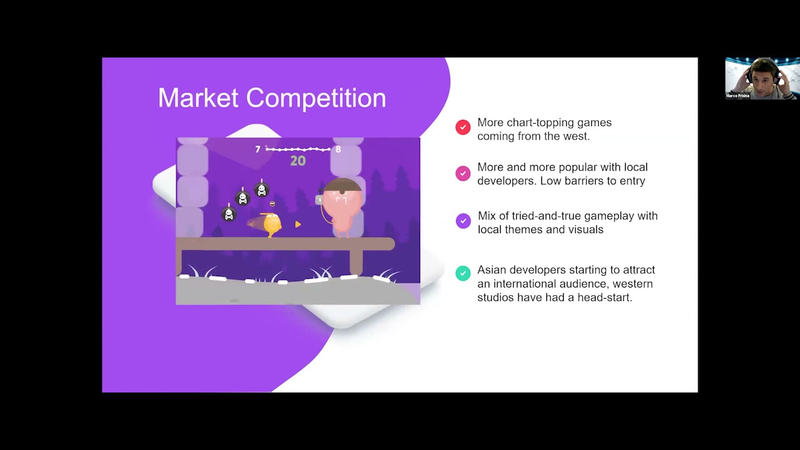
The Continued Rise of Hypercasual in the East & How to Break Your Game into the Chinese Market
China currently stands as the world’s most significant mobile gaming market, valued at $25 billion and representing a quarter of the global industry.
- China's mobile gaming market reached $29 billion in 2020, representing a 30% year-over-year growth and accounting for approximately 25% of the global mobile games market.
- Hypercasual games are the fastest-growing segment in China, leading at least 72% of total game sessions by the end of 2020.
- Foreign developers face significant legal barriers to entry, specifically the requirement for an ISBN certificate, which can take three to six months to obtain and is notably more difficult for non-domestic entities to secure.
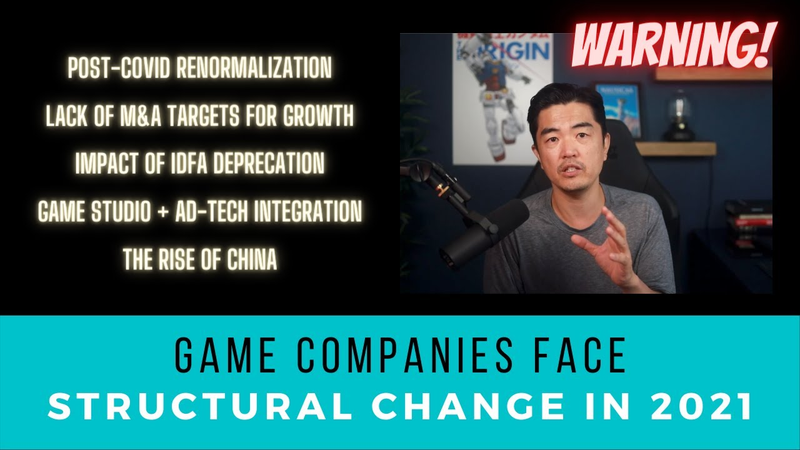
Game Companies Face Structural Change in 2021 | The Warning!
The gaming industry faces a period of significant structural transformation in 2021, driven by five converging factors that threaten to disrupt established business models.
- The gaming industry is transitioning from the 2020 pandemic-driven hyper-growth phase to a more complex, data-constrained environment characterized by normalized user behavior.
- The deprecation of Apple’s Identifier for Advertisers (IDFA) is eroding the efficacy of user acquisition, specifically threatening the monetization models of hyper-casual game developers.
- A scarcity of viable mid-tier M&A targets is forcing major firms to pivot toward riskier, larger public transactions or smaller, pre-revenue acquisitions to maintain growth.

Market Study: China, Japan and South Korea
The Asia-Pacific region stands as the global leader in the gaming industry, generating 49 percent of total worldwide revenue.
- The Asia-Pacific region generates 49 percent of total worldwide gaming revenue, driven primarily by China, Japan, and South Korea.
- Entering the Chinese market requires collaboration with local publishers to navigate mandatory ISBN licensing, strict government censorship, and a fragmented Android ecosystem.
- Japan’s mature market is dominated by mobile revenue and console hardware, where success depends on high-quality RPGs, gacha mechanics, and established brand trust.
Superstar Session: Targeted Approaches to the Casual Game Market in China
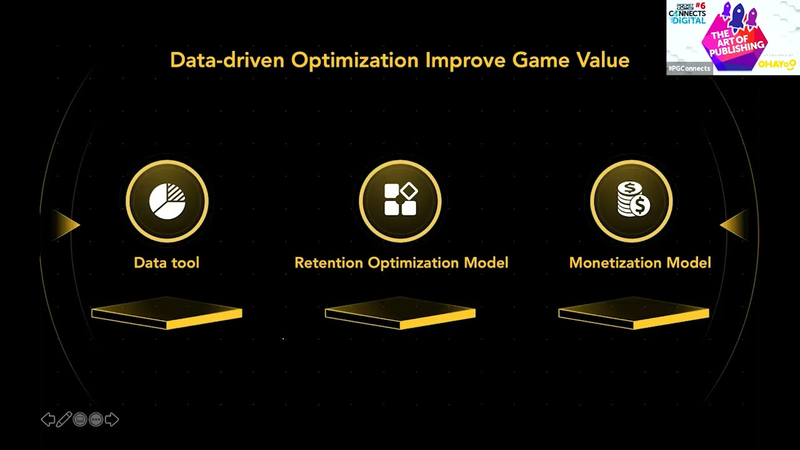
The Chinese casual gaming sector has matured into a robust ecosystem, characterized by 200 million daily active users and an annual revenue trajectory reaching $7 billion.
- The Chinese casual gaming market has reached a scale of 200 million daily active users and generates $7 billion in annual revenue.
- Short-form video platforms are critical for growth, as 91 percent of mobile gamers in China engage with these platforms daily.
- Publishers have successfully scaled over 150 titles using data-centric models that prioritize creative testing and localized optimization.

Loot Boxes: Legal Pitfalls and Loopholes
Global game monetization faces a fragmented regulatory landscape, necessitating a strategic approach to design and compliance.
- In the United States, there is no specific federal loot box regulation, but Apple requires games on the iOS App Store to disclose the odds of receiving items by category prior to purchase.
- China maintains the most stringent regulatory environment, requiring developers to disclose the specific odds for every individual item in a loot box and prohibiting 'compulsion loops' that encourage excessive spending.
- European regulations are currently fragmented by country, with Belgium and the Netherlands being the primary nations that have implemented specific restrictions on randomized, purchasable items.
Market Snapshot: Q1 2021 US, China & Japan
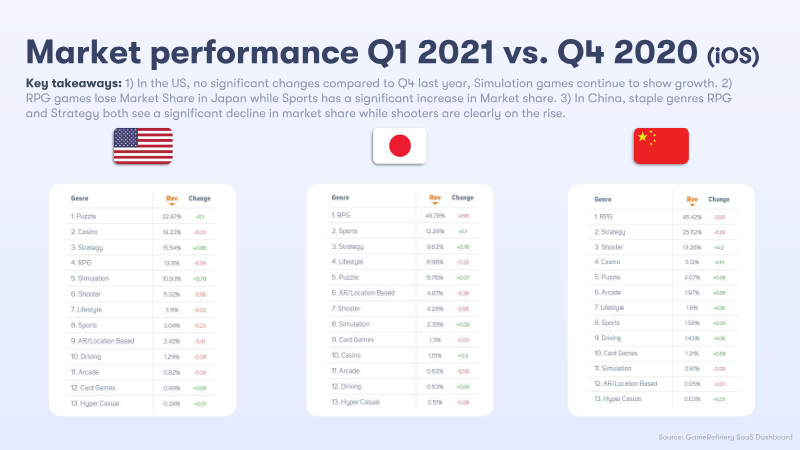
The mobile gaming market in the first quarter of 2021 demonstrated regional divergence in genre performance, with the United States remaining relatively stable while China and Japan experienced notable shifts in market share.
- In Q1 2021, mobile gaming genre preferences diverged globally: US markets favored simulation games, Japan saw a shift from RPGs to sports titles led by Cygames’ Uma Musume Pretty Derby, and China moved toward shooter games.
- Roblox Corporation established itself as the top-grossing publisher in the US market during Q1 2021.
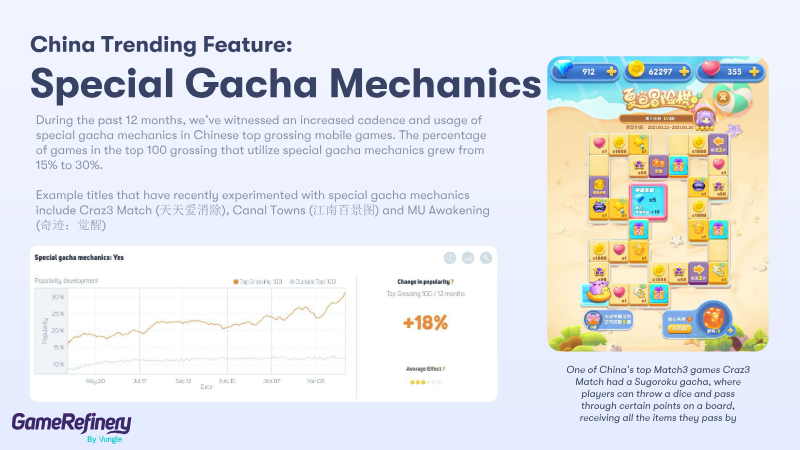
- Monetization strategies varied by region, with collectible albums appearing in over 70% of top-grossing US games, battle passes in over 25% of top-grossing Japanese titles, and special gacha mechanics in 30% of top-grossing Chinese games.

Market Snapshot: Q2 2021 US, China & Japan
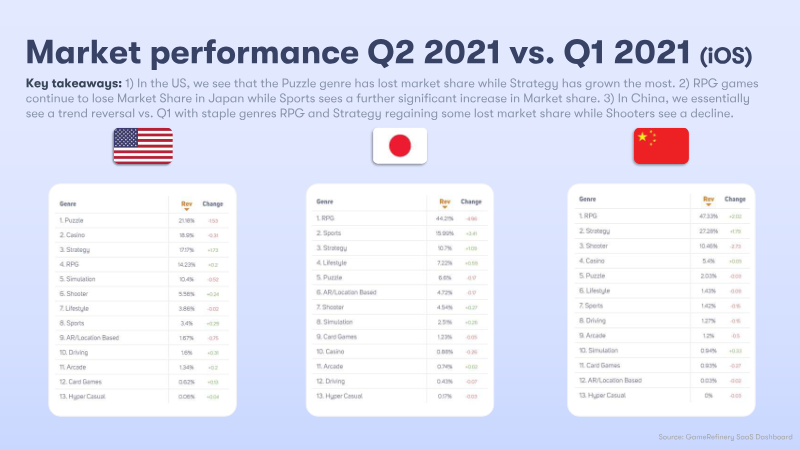
The mobile gaming market in the second quarter of 2021 experienced notable shifts in genre performance and publisher dominance across the United States, China, and Japan.
- Live-service feature updates increased by 37% year-over-year, with Strategy games leading the surge at 208% growth.
- Engagement tactics are shifting toward non-recurring live events and limited-time in-app purchase offers, which saw frequency increases of 143% and 122% respectively.
- In the US, the Strategy genre grew while the Puzzle genre declined, with Supercell emerging as a top-performing publisher.
Mobile Game Genre Report: Role-Playing Games 2021
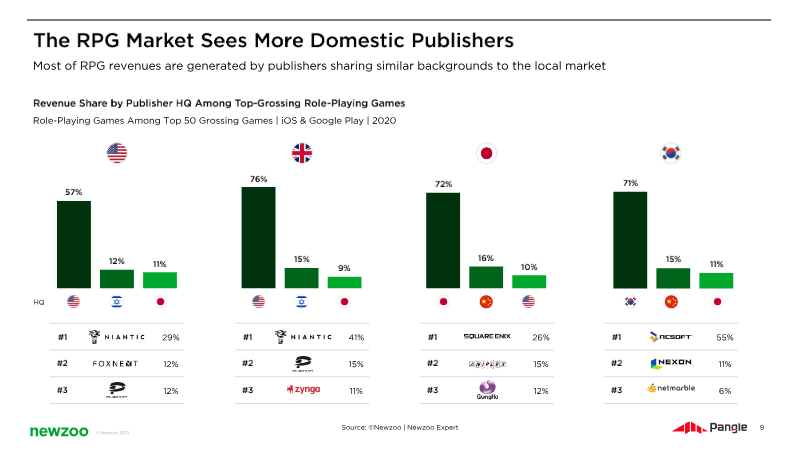
Role-playing games represent the most lucrative segment of the global mobile gaming market, generating $18.5 billion in 2020 and accounting for nearly a quarter of all mobile gaming revenue.
- Mobile RPGs generated $18.5 billion in 2020, representing nearly 25% of total mobile gaming revenue.
- The market is heavily concentrated in East Asia, with China, Japan, and South Korea accounting for over 70% of global RPG earnings.
- Approximately 50% of top-performing RPG titles rely on established intellectual properties, such as the Marvel franchise, to drive player acquisition and revenue.