Market (Overall)·Updated Apr 8, 2026 by Newzoo
Report · January 1, 2022
Published by Newzoo
China continues to dominate the global gaming market, yet a series of regulatory tightening measures—particularly anti‑addiction rules for minors and an expanded licensing framework—have introduced significant uncertainty and higher operational costs for both domestic and foreign developers. The new minor‑protection law caps playtime, limits in‑game spending, and restricts live‑streaming access for users under 18, while the licensing system now demands detailed content reviews and real‑name verification. These requirements are projected to dampen player engagement and increase investment risk over the long term. Regulators enforce licensing through a complex approval process, yet many unlicensed titles persist on platforms such as Steam, VR services, cloud gaming, and mobile ad‑only games. Enforcement remains uneven; fines are issued but monitoring is inconsistent. Console and live‑streaming services often circumvent restrictions via overseas purchases, backdoors, or content renaming, creating a regulatory environment that is difficult to monitor and enforce uniformly. The revised licensing regime now permits a single license for multiplatform releases, encouraging developers to produce cross‑platform titles and streamlining the approval process. The market remains dominated by free‑to‑play mobile games, with LiveOps and regular content updates sustaining high retention. In 2021, half of the top 50 grossing mobile games were launched before 2019. Chinese studios are increasingly exporting their expertise, establishing international studios and publishing arms to tap global markets while leveraging IP‑based mobile games to penetrate China’s competitive scene.
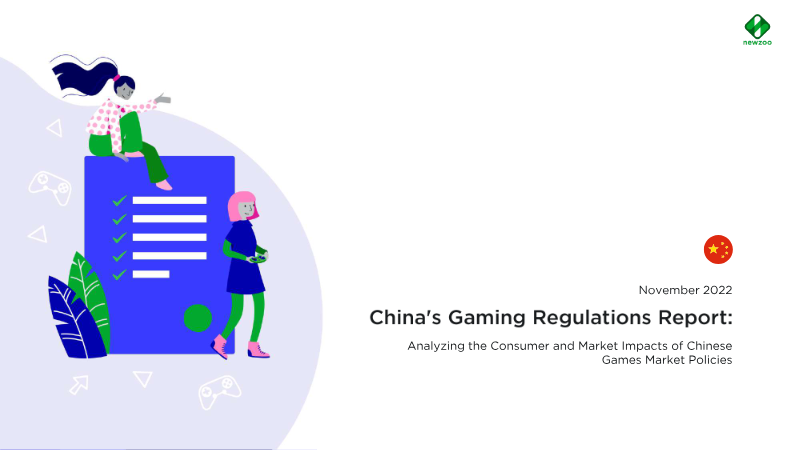
newzoo November 2022 Analyzing the Consumer and Market Impacts of Chinese Games Market Policies
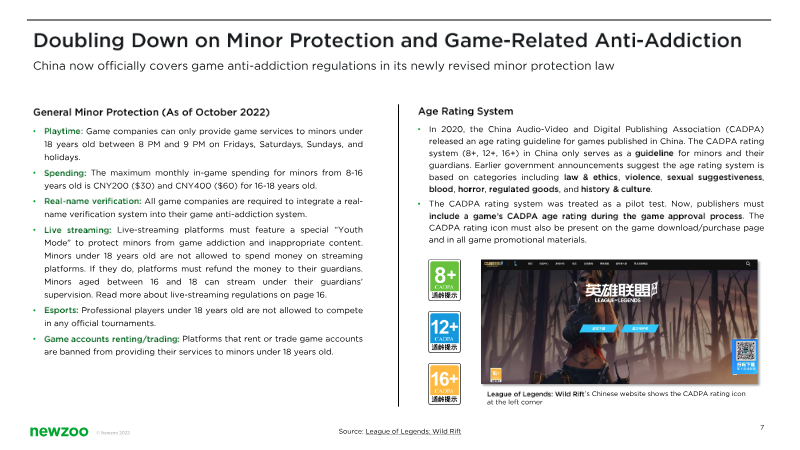
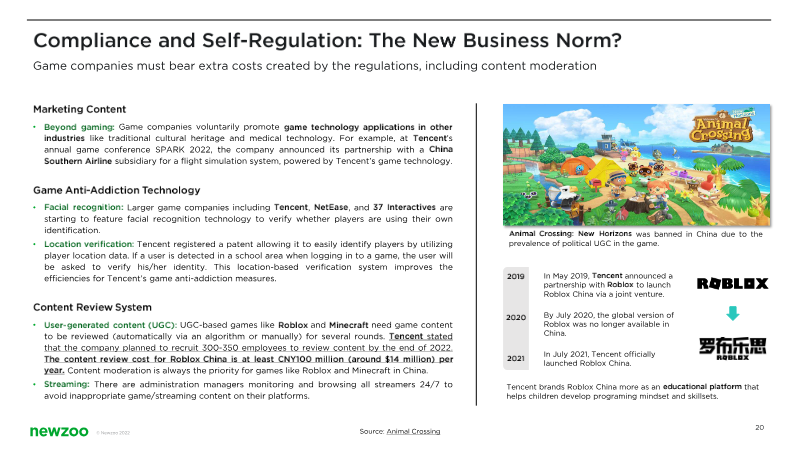
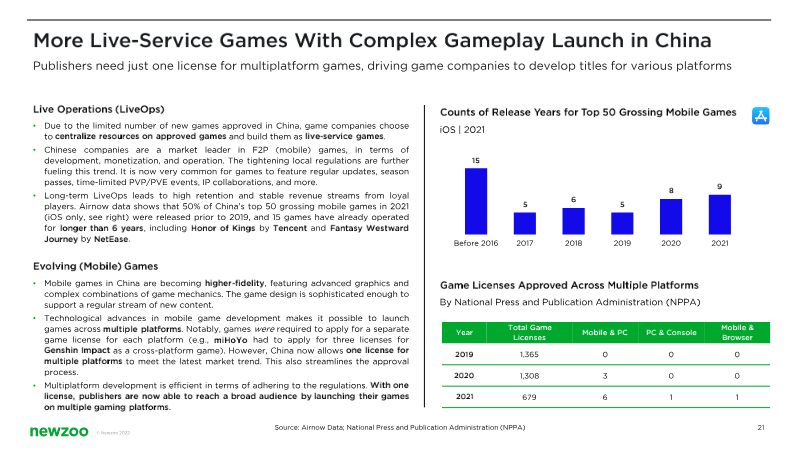
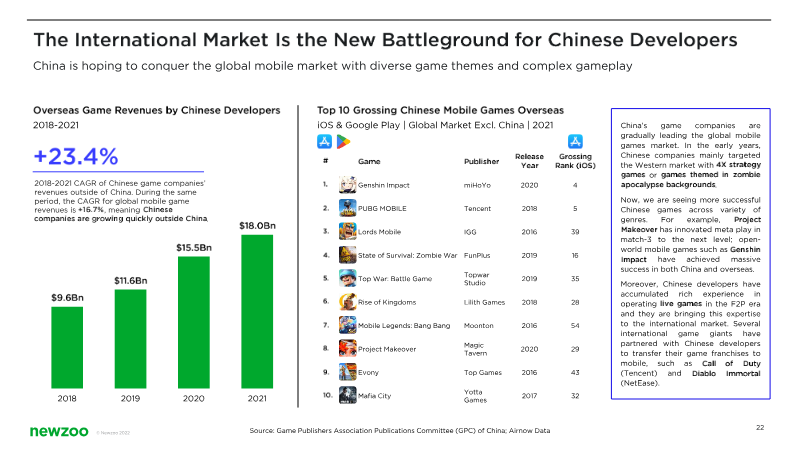
China remains the world’s biggest games market by revenues and players in 2022, but regulatory challenges remain Although young generations in China typically The regulations come at a time when China’s enjoy and accept gaming, the media, government, games market—the largest in the world by and older generations—especially parents—often spending and player numbers—is reaching label games as that negatively unprecedented heights. China-based game of 2022’s global games influences young people. In August 2021, the companies have grown to be among the largest in market revenues will come Chinese government released strict regulations to the world and are brimming with talent. from China. limit play time for gamers under 18 years old, aiming to . Prompted by regulations in their home market, these companies have invested in (and expanded These 2021 regulations were the latest in a long list into) , with notable success of governmental efforts to control from ’s and ’s and . However, the inconsistent implementation and Meanwhile, non-local game companies are hoping enforcement of many policies have left China’s to tap into China’s massive games market but are games market in a state of . Many struggling with the unpredictable regulatory regulations are not standardized. Others are environment. implemented differently from their initial announcements, leading to subjective decision- In this report, we summarize the regulations from making by enforcers. Local interpretations of the past decade, highlight key learnings from – – China Market Analyst regulations can also differ.
environment. implemented differently from their initial announcements, leading to subjective decision- In this report, we summarize the regulations from making by enforcers. Local interpretations of the past decade, highlight key learnings from – – China Market Analyst regulations can also differ. China-based companies’ international strategies, Mobile Market Lead and identify opportunities for international – – Lead Analyst Games , where many games operate without companies looking to enter China. Market Analyst & Writer – Editor in Chief official licenses. – Lead Visual Designer
Table of Contents 1. Game Regulations Overview 4 Timeline & Key Developments 5 Timeline & Key Developments 5 Regulations on Minor Protection 6 Regulations on Minor Protection 6 Regulations on Game Licenses 9 Unregulated Areas Across Mobile, Console, PC, and More 12 Regulations on Live Streaming 16 2. Next Moves of Chinese Companies 19 Compliance and Self-Regulation 20 Live Game Strategy 21 Overseas Expansion 22 3. Strategies for Global Companies 24 Entering the Chinese Market Overview of Approved Imported Games in China 25 Overview of Approved Imported Games in China 25 Opportunities for International Developers 26 Opportunities for International Developers 26
3. Strategies for Global Companies Timeline, key developments, and unregulated areas across platforms Challenge & opportunities
Since the early 2000s, the Chinese government introduced increasingly strict regulations to control China’s games market Initial Regulations Game Licenses Since 2ooo, the fast-growing games market The government introduced The government The maximum in-game General Since 2000, the fast-growing games market The government introduced Minor Protection drew the Chinese government’s attention to the first official rule for online on game consoles. Through spending for minors from 8-16 potential negative influences of gaming games, requiring to partnerships, and years old and 16-18 years old Game Licenses addiction among young people in China. acquire licenses to operate. could release special versions of was set to and • In 2000, the government acquire licenses to operate. game consoles in China. , respectively. in China. • In 2002, it requested that (at the time PC) Mobile Games 1st Game License Freeze before publishing. • From 2005 to 2007, the government asked large game companies to develop an Previously, publishers launched their games Following the significant Due to organizational A nine-month to minimize play time for via ‘’betas’’ to bypass regulations. In 2011, growth of mobile gaming, restructures, the Chinese started in July 2021, minors under 18 years old. Due to technical online games were China’s government required government reportedly to further restrict challenges, companies failed to fully with in- to be from the game approval process implement these systems. game purchases before attaining a license. approved before publishing. March to December 2018. Before 2010 2011 2012 2013 2014 2015 2016 2017 2018 2019 2021
China’s gaming market, the largest in the world by revenue and player count, is currently defined by a complex and increasingly restrictive regulatory environment. Primary governmental concerns center on minor protection and the mitigation of gaming addiction, which officials often characterize as a negative social influence. Key mandates include strict playtime limits for users under 18—restricted to one hour on weekend and holiday evenings—and the implementation of mandatory real-name verification systems. While minor spending accounts for less than 2% of revenue for major firms like Tencent and NetEase, these regulations threaten long-term market growth by reducing the future pipeline of engaged players and esports talent. The administrative process for securing game licenses has become a significant barrier to entry. Following a nine-month freeze on approvals ending in early 2022, the government has adopted a rigorous scoring system that evaluates titles on societal values, cultural propagation, and original design. Foreign entities face additional hurdles, as they must partner with local publishers and navigate an approval process that is often slower than that for domestic titles. Consequently, many developers have shifted focus toward multi-platform releases, as a single license now covers mobile, PC, and console versions, streamlining the path to market. Despite these restrictions, a robust grey market persists. Players frequently utilize virtual private networks (VPNs) and game accelerators to access international platforms like Steam, while console users often purchase hardware and software from overseas markets to bypass local content limitations. Additionally, some mobile developers utilize ad-based monetization models to operate without formal licenses, though regulators have recently begun cracking down on this practice. In response to domestic pressures, Chinese gaming giants are aggressively expanding internationally. This strategy involves establishing overseas development studios, acquiring global talent, and launching international publishing labels. By leveraging their expertise in free-to-play mechanics and live operations, Chinese companies are successfully capturing market share in Western and other Asian markets, effectively diversifying their revenue streams away from the unpredictable regulatory landscape at home.
The report establishes that Africa’s video‑game industry has entered a phase of rapid maturation, driven largely by mobile play in urban centres such as South Africa, Nigeria and Kenya. Mobile accounts for roughly 90 % of the $1.8 billion market in 2024, with a 10 % year‑over‑year rise in players to 349 million. PC and console remain niche but critical for studio visibility, with Steam dominating distribution (≈70 % of PC use) and local platforms like Gara and Jiwe capturing the remainder. Funding for studios is overwhelmingly sourced from international incubators and grants—Pro Helvetia, the French Agence Française de Développement, the British Council’s Ignite Culture and Digital Lab Africa—yet local infrastructure gaps (low internet penetration, limited payment systems, unreliable electricity) continue to constrain broader market development. Key findings show that the fastest‑growing economies—Eritrea, Niger, Egypt, Ethiopia, Nigeria and South Africa—host studios such as Maliyo Games, Kayfc and Legends of Orisha that are producing mobile‑first IP while experimenting with higher‑production PC/console titles. Female representation and gender inclusivity are addressed through programmes like Pro Helvetia’s “She Got Game”, yet overall skill development remains uneven, with many studios still operating at the indie level and lacking robust business training. The esports sector mirrors this mobile dominance, with titles like PUBG Mobile and Free Fire generating substantial prize pools and viewership across hubs such as Morocco, Egypt and Kenya. However, talent development is concentrated in a handful of urban centres, leaving Francophone and non‑English speaking regions underrepresented. The analysis concludes that sustainable growth hinges on three pillars: deeper, studio‑level talent development; reliable data infrastructure for market intelligence; and evolved payment systems that reduce friction. Strengthening African‑European partnerships, expanding local incubation pathways, and ensuring annual data updates are essential to unlock the continent’s commercial potential while preserving African leadership in game creation.
The analysis evaluates how take‑rate structures shape mobile game monetisation in China and whether higher‑quality development can outweigh the pressure of traditional distribution fees. It contrasts Apple’s uniform 30 % commission with the far steeper charges imposed by domestic Android app stores, many of which demand up to 50 % of in‑app purchase revenue, and examines the emerging shift toward direct‑to‑consumer distribution and community‑driven platforms. Apple’s 30 % rate applies to the roughly 25 % of Chinese gamers who use iOS, who nonetheless generate about 40 % of mobile game revenue. In the Android segment, the absence of Google Play has led to a fragmented ecosystem dominated by manufacturer‑backed stores such as those from Huawei, Oppo and Vivo, and by Tencent’s MyApp. These stores justify 50 % take rates by bundling distribution, marketing and cross‑store integration, a model that yields high internet‑service margins for hardware makers—Xiaomi reports a 64.7 % gross profit on services versus 7.2 % on devices. Large publishers like NetEase and Tencent have occasionally negotiated lower fees, but most developers accept the 50 % level to reach a broad audience. A growing number of developers are bypassing high‑fee stores, opting for direct distribution or leveraging community platforms that charge little or no commission. Duoyi’s “Shenwu” achieved a 95 % gross profit on Android by selling directly, while its iOS version retained a 70 % margin after Apple’s cut. Similar success is seen with Lilith Games’ “Rise of Kingdoms,” which generated roughly $100 million in its launch month without major Android store presence, and miHoYo’s “Genshin Impact,” which combined a $100 million development budget with fan‑driven channels such as TapTap (0 % take rate) and Bilibili to secure millions of pre‑registrations. These cases illustrate that high‑quality titles paired with intensive marketing and community engagement can sustain profitability even when forgoing traditional store exposure. The study’s scope covers the Chinese mobile gaming market from 2020 through 2021, focusing on iOS and Android distribution channels, take‑rate policies, and developer responses. Insights draw on Niko
The global games market is entering a period of moderate maturation, with total revenue projected to reach $188.8 billion in 2025, a 3.4% increase over the previous year. The industry now serves 3.6 billion players, reflecting a 4.4% year-over-year expansion. While mobile gaming maintains its dominance, accounting for $103.0 billion or 55% of total revenue, console gaming is poised for the strongest growth at 5.5%, reaching $45.9 billion. PC gaming remains a stable pillar with $39.9 billion in revenue. Despite the growth in player counts, average spend per payer is experiencing a slight decline, signaling a strategic pivot toward maximizing engagement and retention within saturated markets rather than relying solely on aggressive monetization. Strategic success in this environment increasingly depends on long-tail engagement and the effective management of post-launch content. Data indicates that releasing single-player titles during the second quarter yields 34% higher engagement compared to the saturated holiday season. Furthermore, simultaneous multi-platform launches significantly outperform staggered releases, and titles exiting Early Access after a six-month window demonstrate superior acquisition results. Developers are also increasingly leveraging remakes and remasters to mitigate rising development costs, while user-generated content platforms like Roblox continue to expand as foundational ecosystems for daily active users. Geographically, the market continues to diversify, with Latin America emerging as a notable growth region projected to reach $8.3 billion, driven primarily by mobile adoption. The industry’s analytical framework, which focuses on consumer spending on software and services, highlights that player attrition typically stabilizes after 12 weeks. Consequently, long-term commercial viability is now inextricably linked to aligning content updates and discounting strategies with this post-launch retention curve, ensuring that community support remains as critical as initial sales performance.