Niko Partners
Research29 documents
Documents

Article
The Chinese Gaming Market: 2026
The Chinese gaming market reached a significant milestone in 2025, surpassing $50 billion in total player spending for the first time. Analysts project continued, albeit moderate, growth for the sector, forecasting a market value of $53.9 billion in 2026 and reaching $59.8 billion by 2030. This expansion is supported by a growing player base, which is expected to reach 769 million by 2030, solidifying China’s position as the world’s largest gaming market by population. Average revenue per user (ARPU) is also on an upward trajectory, rising from $68 in 2024 to over $70 in 2025, with further increases anticipated.
Industry trends indicate a shift toward more integrated digital ecosystems. Generative AI is being widely adopted for content production and operations, while live-service titles are increasingly functioning as platforms for user-generated content. Mini games have emerged as a particularly high-growth segment, now accounting for nearly 20% of mobile game spending. Furthermore, the regulatory environment appears favorable, with the 15th Five-Year Plan emphasizing digital innovation and a notable increase in the issuance of game licenses.
Methodologically, these insights are derived from a combination of market modeling and consumer surveys, where players are defined as individuals who have engaged in at least 60 minutes of gaming on PC, mobile, or console within a 30-day period. Data reveals that short-video platforms like Douyin and Kuaishou serve as the primary discovery channels for new titles. Despite domestic growth, the global connectivity of the Chinese audience remains high, with two-thirds of players utilizing tools such as VPNs, boosters, or global servers to access games outside the domestic market. Challenges persist, however, as the infrastructure boom in AI has constrained the supply of semiconductors, leading to increased hardware costs for consumers.
- The Chinese gaming market surpassed the $50 billion threshold in 2025, reaching $51.8 billion in total player spending, with projections to hit $59.8 billion by 2030.
- China is set to become the world's largest gaming market by player count, with the total number of gamers expected to reach 769 million by 2030.
- Mini games have emerged as the fastest-growing segment, accounting for nearly 20% of mobile game spending and generating approximately $4.7 billion in H1 2026 alone.
- Short video platforms like Douyin and Kuaishou are the primary discovery channels for new games in China, influencing 41% of players across all platforms.
- Two-thirds of Chinese players (66%) access games beyond the Great Firewall, utilizing methods such as gaming accelerators (33.6%), global servers (30.8%), and VPNs (21.9%).
+3
Niko PartnersSept 2026
Article
Southeast Asia’s Gaming Market: 2026
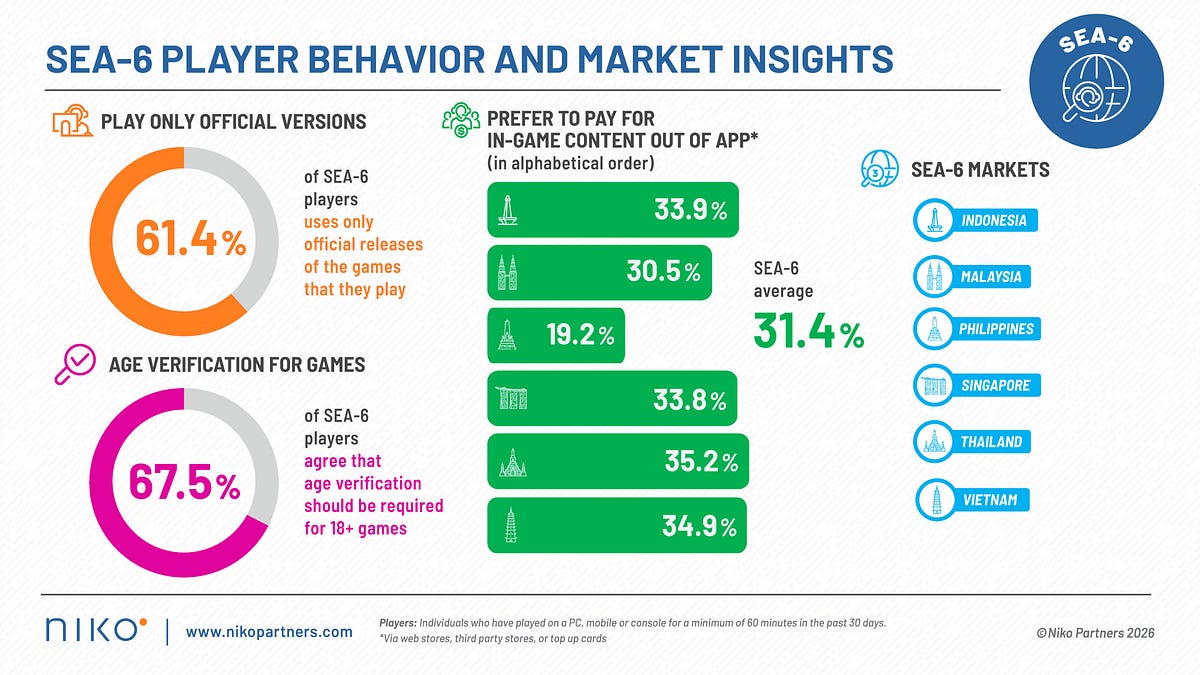
The gaming market across the SEA-6 region—comprising Indonesia, Malaysia, the Philippines, Singapore, Thailand, and Vietnam—is experiencing steady growth, though long-term revenue projections have been tempered. While the market reached $5.63 billion in 2025, representing a 4.7% year-over-year increase, it is now expected to surpass $5.9 billion in 2026. The region is projected to reach a $7 billion valuation by 2030, a milestone that has been delayed by two years compared to previous industry forecasts.
The player base continues to expand, with the region projected to host over 300 million gamers in 2026. Indonesia maintains the largest volume of players, exceeding 126 million, though its contribution to total revenue remains modest with spending expected to reach $1.5 billion by 2030. Conversely, Thailand stands out as the region’s primary revenue driver, with player spending anticipated to exceed $2 billion by the end of 2026. Growth drivers vary by market maturity: while Indonesia, the Philippines, and Vietnam rely on increasing smartphone and internet penetration, the more established markets of Singapore, Malaysia, and Thailand are driven by localization, esports, and live operations.
Methodologically, these findings are derived from an updated market model and player behavior surveys conducted within the region. The data highlights a complex landscape regarding monetization and regulation. While 61.4% of players exclusively use official game versions, piracy remains a significant factor. Furthermore, nearly one-third of players prefer purchasing in-game content through third-party storefronts, a trend most prominent in Thailand. As regional governments increasingly implement stricter regulatory frameworks, such as Indonesia’s IGRS rating system and Vietnam’s licensing requirements, developers must navigate a shifting environment that balances high player engagement with evolving compliance demands.
- The Southeast Asian gaming market (SEA-6) is projected to reach $7 billion in revenue by 2030, growing at a CAGR of 4.8%.
- Regional player spending reached $5.63 billion in 2025, with projections to exceed $5.9 billion in 2026.
- Thailand is the region's largest market by revenue, with player spending expected to surpass $2 billion in 2026.
- The SEA-6 region will exceed 300 million players in 2026, with Indonesia accounting for the largest share at over 126 million gamers.
- Nearly one-third of players in Southeast Asia prefer purchasing in-game content through third-party storefronts rather than official channels, with rates exceeding 35% in Thailand.
Niko PartnersSept 2026

Article
India’s Gaming Market: 2026
India’s gaming market reached a significant milestone in 2025, surpassing $1 billion in revenue for the first time. The sector generated $1.04 billion, representing a 14.8% year-over-year increase. Projections indicate continued expansion, with the market expected to reach $1.2 billion in 2026 and $1.77 billion by 2030. This trajectory reflects a five-year compound annual growth rate of 11.2%, positioning India as the fastest-growing gaming market currently tracked. Notably, these figures exclude the substantial real-money gaming segment, focusing exclusively on traditional video game revenue.
The player base is expanding rapidly, growing from 511 million in 2025 to an anticipated 700 million by 2030. Despite this massive scale, monetization remains a challenge, as the average revenue per user (ARPU) was $2.04 in 2025 and is projected to reach only $2.52 by 2030. Demographic shifts are also evident, with the gender split among players reaching near parity, as the share of female gamers rose to 49% in 2026.
Market preferences are diversifying beyond the dominant Battle Royale genre, which saw its share of mobile revenue decline as other categories gained traction. User engagement is increasingly directed toward user-generated content platforms like Roblox and Minecraft, as well as older PC titles. Payment infrastructure is heavily reliant on the Unified Payments Interface (UPI), utilized by 84.6% of players, while 31.5% of the audience prefers purchasing content through third-party stores or web shops. Furthermore, there is a growing, cautious sentiment among Indian players regarding the integration of generative AI, driven by concerns over economic impact and job security. These findings are derived from comprehensive market analysis and player behavior surveys.
- India’s gaming market reached $1.04 billion in 2025, a 14.8% year-over-year increase, and is projected to grow to $1.77 billion by 2030 with an 11.2% five-year CAGR.
- The player base is expanding rapidly, growing from 511 million in 2025 to a projected 550 million in 2026 and over 700 million by 2030.
- Despite high growth, monetization remains low with an ARPU of $2.04 in 2025, which is expected to rise only marginally to $2.52 by 2030.
- The gender split among Indian gamers has reached near parity, with the share of female players increasing from 43% in 2023 to 49% in 2026.
- While Battle Royale remains the dominant genre, its market share is declining as non-Battle Royale mobile games grew to account for 62.8% of revenue in June 2026, up from 53.2% in 2023.
+2
Niko PartnersAug 2026
Article
Gen Z Esports Fans in 2026
The 2026 analysis of Gen Z esports fans provides a comprehensive overview of the demographic’s engagement, spending habits, and cultural integration within the global esports ecosystem. Conducted in May 2026 by Niko Partners in collaboration with ESL FACEIT Group and Hero Esports, the research surveyed 8,000 Gen Z gamers—born between 1996 and 2013—across eight key markets: the USA, China, Indonesia, Korea, Thailand, Germany, Malaysia, and the UK. The study highlights a global Gen Z esports audience estimated at 400 million, contributing to a broader industry landscape of 640 million fans and $3 billion in annual revenue.
Key findings indicate that the Gen Z esports fan base is increasingly diverse, with the gender ratio shifting toward greater female representation, particularly in mobile-first markets and at major offline events. The demographic is highly active and professional, with over 60% working full-time and nearly 73% possessing some higher education. Engagement is deeply rooted in participation; 76% of fans both play the titles they watch, and 98.6% of the sample are active gamers. Furthermore, these fans demonstrate high susceptibility to marketing, as 85% notice branding during events and 73.6% report that such exposure influences their purchasing behavior.
Media consumption patterns reveal a clear preference for digital platforms, with YouTube and TikTok serving as the primary channels for viewing content, while traditional television usage remains minimal. Fans prioritize production quality and venue atmosphere when evaluating tournaments. Spending is robust, with 76.3% of respondents making an esports-related purchase in the past year, spanning digital items, physical merchandise, and branded peripherals. The analysis concludes that electronics, food and beverage, and sportswear are perceived as the most natural and effective categories for brand partnerships within the esports space.
- The global Gen Z esports audience has reached 400 million fans, contributing to a total industry scale of 640 million viewers and $3 billion in annual revenue.
- Gen Z esports engagement is driven by active participation, as 98.6% of fans are gamers and 76% play the specific titles they watch.
- Esports branding is highly effective, with 85% of fans noticing event sponsorships and 73.6% reporting that this exposure influences their purchasing decisions.
- Over 76% of Gen Z fans made an esports-related purchase in the past year, with electronics, food and beverage, and sportswear identified as the most effective categories for brand partnerships.
- The Gen Z esports demographic is highly educated and professional, with 73% holding higher education degrees and over 60% employed full-time.
+2
Niko PartnersJul 2026

Whitepaper23 pages
The Esports Generation: Who They Are, and Why They Spend
The global esports industry has matured into a significant economic force, reaching an estimated 640 million fans and generating $3 billion in annual revenue by 2026. This ecosystem functions as a primary cultural touchpoint for Generation Z, a digitally native demographic that views competitive gaming with the same level of emotional investment and community identity traditionally reserved for professional sports. Because this audience is currently in a formative stage of brand loyalty, the industry represents a critical environment for companies seeking to establish long-term relationships with high-value consumers.
Engagement within this space is driven less by the games themselves and more by social connectivity, the influence of professional players, and high-quality production standards. Fans demonstrate a high propensity for commercial activity, with over 76 percent having made esports-related purchases within the past year. This demographic is particularly receptive to brand integration, as 85 percent of fans actively notice esports branding, and nearly three-quarters report that these sponsorships directly influence their purchasing decisions. The effectiveness of this channel extends across diverse sectors, including electronics, fashion, and food and beverage, proving that esports serves as a highly efficient gateway for cross-industry marketing.
Ultimately, the esports landscape offers a unique opportunity for brands to leverage the intersection of gaming, music, and streaming to capture a highly engaged audience. By prioritizing authentic engagement strategies that respect the publisher-driven nature of the ecosystem, brands can successfully convert digital interest into tangible loyalty. As these fans continue to prioritize in-game spending and subscription-based services, the industry remains a proven, high-value environment for sustained commercial growth and brand association on a global scale.
- Gen Z esports fans represent a massive, high-value demographic of 400 million potential global viewers, with 76.3% of fans having made an esports-related purchase in the past year.
- The esports industry generates $3 billion in annual revenue, driven by a global audience of 640 million and high engagement from a cohort that is largely employed and well-educated.
- Esports fans are highly receptive to brand partnerships, with 47.1% of fans stating that brand collaborations with teams or athletes positively influence their purchase behavior.
- Digital items like skins and cosmetics are the most popular esports-related purchase (50%), followed by physical merchandise (40.9%) and branded peripherals (33%).
- YouTube (81.8%) and TikTok (56.6%) are the primary international broadcast platforms for esports, while China relies on domestic giants like Bilibili (48.1%) and Douyu (36.2%).
+2
Niko PartnersJul 2026

Article
Asia and MENA Gaming Markets Forecast: 2030
Asia and MENA gaming markets are projected to exceed $100 billion by 2030, with a combined revenue of $103.6 billion and a CAGR of 3.1% from 2025 to 2030. The 13 countries tracked by Niko Partners account for roughly 46 % of global gaming revenue, while the combined player base is expected to grow from 1.77 billion in 2026 to 1.99 billion by 2030, a 3.1% CAGR. China, Japan, and South Korea dominate the region, contributing $91.7 billion in 2030 revenue—88.6 % of the Asia‑MENA total.
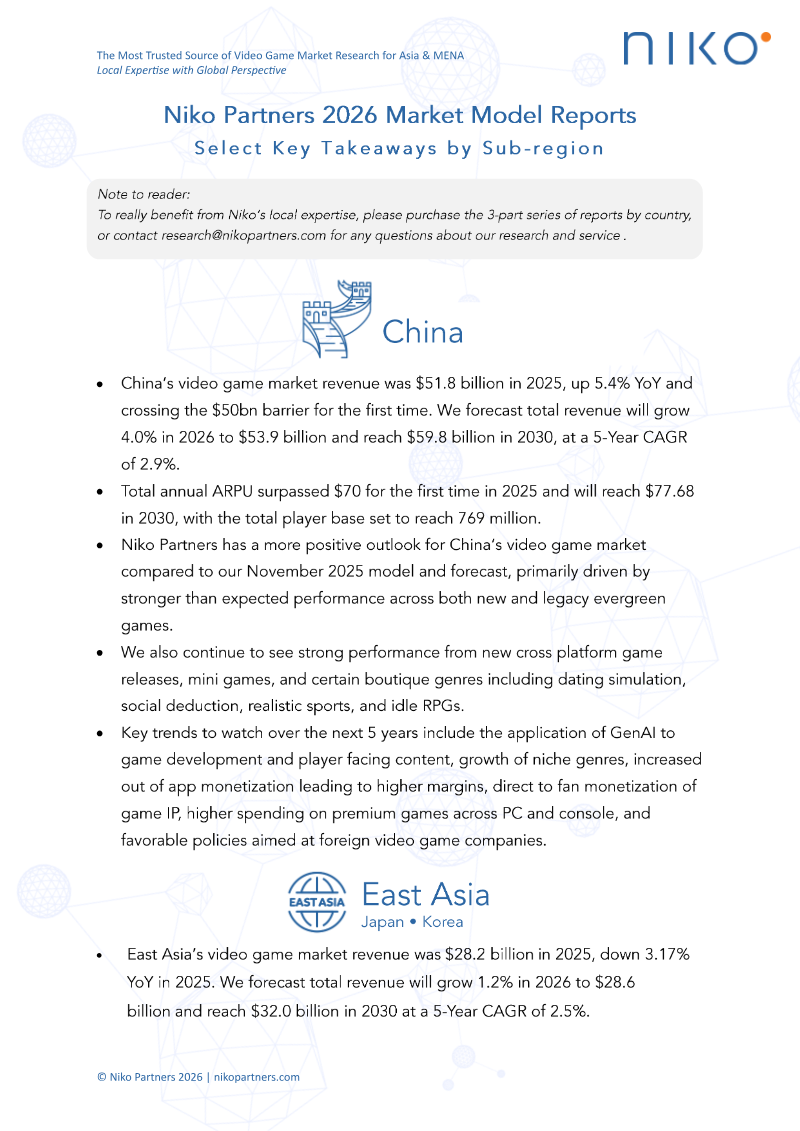
China’s market reached $51.8 billion in 2025, surpassing the $50 billion threshold for the first time. Growth is projected at 4% in 2026 and 2.9% annually through 2030, reaching $59.8 billion. ARPU will rise from $70 in 2025 to $77.68 by 2030, and player numbers are expected to hit 769 million.
East Asia (Japan + South Korea) saw a 3.17% decline in 2025 but is forecast to rebound, reaching $32 billion by 2030 at a 2.5% CAGR. South Korea’s ARPU is projected to exceed $300 by 2028, while Japan lags about $100 lower.
India’s market grew 14.8% in 2025 to $1.04 billion, with a 11.2% CAGR to $1.77 billion by 2030 and player numbers rising from 511 million to 707 million. Regulatory scrutiny, including a recent real‑money gaming ban, has paradoxically spurred higher‑spending engagement.
Southeast Asia’s $5.63 billion market in 2025 is expected to reach $7.01 billion by 2030 (4.8% CAGR), driven by Indonesia, Thailand, and the Philippines. MENA‑3 (Egypt, Saudi Arabia, UAE) is projected to grow at 6.5% CAGR to $2.94 billion, with ARPU rising from $10 in 2025 to $38 by 2030 and UAE alone reaching $100 ARPU.
These forecasts rely on Niko Partners’ proprietary market model, incorporating regional regulatory trends and macroeconomic factors across 13 key countries.
- The Asia and MENA gaming markets are projected to reach $103.6 billion in total revenue by 2030, representing 46% of global gaming revenue with a 3.1% CAGR.
- China, Japan, and South Korea remain the dominant market forces, collectively contributing $91.7 billion in revenue by 2030, which accounts for 88.6% of the total regional market.
- China’s gaming market is forecast to grow to $59.8 billion by 2030, with the average revenue per user (ARPU) increasing from $70 in 2025 to $77.68.
- The MENA-3 region (Egypt, Saudi Arabia, UAE) is expected to experience the fastest growth at a 6.5% CAGR, with ARPU projected to nearly quadruple from $10 in 2025 to $38 by 2030.
- India’s market is set to expand significantly, with player numbers growing from 511 million to 707 million and revenue reaching $1.77 billion by 2030 at an 11.2% CAGR.
+4
Niko PartnersJun 2026
Report4 pages
Market Model Reports: Asia & MENA
The 2026 Market Model Reports provide a comprehensive analysis of video game industry performance and growth projections across Asia and the Middle East and North Africa (MENA). Covering China, East Asia, India, Southeast Asia, and the MENA-3 region (Egypt, Saudi Arabia, and the UAE), the research evaluates revenue trends, player demographics, and macroeconomic influences through 2030. The analysis utilizes proprietary market modeling, player survey data, and regional expertise to assess the evolving landscape of mobile, PC, and console gaming.
Key findings highlight significant regional disparities in growth and maturity. China remains a dominant force, with 2025 revenue reaching $51.8 billion and a projected 2.9% CAGR through 2030. India emerges as the fastest-growing market, having surpassed $1 billion in revenue in 2025 with an expected 11.2% CAGR. Conversely, East Asia experienced a 3.17% revenue decline in 2025 due to macroeconomic pressures in Japan, though South Korea shows signs of recovery. Southeast Asia continues to expand, driven by mobile adoption and internet penetration, while the MENA-3 region benefits from strong government support and rising disposable income, despite potential geopolitical headwinds.
The research identifies several critical industry drivers, including the integration of generative AI, the rise of niche genres, and increased government regulation across Southeast Asia. Higher average revenue per user (ARPU) remains a focal point, particularly in East Asia, which maintains the highest regional spending levels. Overall, the findings suggest that while short-term volatility persists due to economic and geopolitical factors, the broader outlook for these markets remains positive, supported by increased localization, infrastructure development, and shifting consumer spending toward digital entertainment.
- China’s video game market reached $51.8 billion in 2025 and is projected to grow at a 2.9% CAGR to reach $59.8 billion by 2030.
- India is the fastest-growing market tracked, with 2025 revenue of $1.04 billion and a projected 11.2% CAGR through 2030, supported by a player base expected to reach 707 million.
- East Asia remains the region with the highest ARPU, though 2025 revenue declined 3.17% to $28.2 billion due to Japanese market stagnation and macroeconomic conditions.
- Southeast Asia’s market revenue hit $5.63 billion in 2025 and is forecast to grow at a 4.8% CAGR, with Thailand, the Philippines, and Indonesia identified as the fastest-growing sub-markets.
- The MENA-3 region (Egypt, Saudi Arabia, UAE) generated $2.15 billion in 2025 and is expected to see the strongest ARPU growth, reaching $38 by 2030 despite potential geopolitical instability.
+3
Niko PartnersJun 2026

Article
Where Asia’s $103 Billion Game Market Is Actually Growing
The analysis highlights that Asia’s gaming market is projected to grow from $88.9 billion in 2025 to $103.6 billion by 2030, a 3.1% CAGR, with player numbers approaching two billion. The region’s revenue is dominated by mature markets—China, Japan, and Korea—which together account for 88.6% of the regional share in 2030 but exhibit modest growth rates (China 2.9%, East Asia 2.5%). Emerging markets such as India, MENA‑3, and Southeast Asia drive the majority of growth, with India’s player base expanding by roughly 200 million while revenue rises from $1 billion to $1.8 billion, yielding an average spend of about $2 per player versus $371 in Korea.
A significant behavioral shift is observed: over 30% of players across the 13 markets now prefer to transact outside the app, a trend that has already increased out‑of‑app revenue shares in Southeast Asia from 21% to 38% between 2022 and 2024. This early adoption of direct‑to‑consumer models suggests that Western publishers should prioritize building such capabilities sooner rather than later.
Growth is also emerging in non‑mobile segments, notably PC and console markets in Japan (8% growth), mini‑games within super apps in China (nearly 20% of mobile spend), and Switch 2 sales. Genre shifts are evident, with India moving beyond battle royale into casual titles and China embracing dating sims, social deduction, realistic sports, and idle RPGs.
The player demographic is broadening: women now represent 42% of players, with rapid gains in India and MENA‑3, while raw player growth is strongest in India, Indonesia (projected 144 million players), and Vietnam (68 million).
Finally, generative AI is viewed more positively in Asia; studios report development efficiencies but caution against player‑facing applications that may provoke backlash. The overall takeaway is that while mature markets retain most revenue, emerging regions offer growth opportunities for studios willing to adapt to local preferences and leverage direct‑to‑consumer strategies.
- Asia’s gaming market is projected to grow from $88.9 billion in 2025 to $103.6 billion by 2030, driven primarily by emerging markets in India, Southeast Asia, and MENA-3.
- Mature markets (China, Japan, and Korea) will continue to dominate with 88.6% of total regional revenue by 2030, despite experiencing modest growth rates between 2.5% and 2.9%.
- Over 30% of players across 13 Asian markets now prefer out-of-app transactions, a trend that saw Southeast Asia’s direct-to-consumer revenue share jump from 21% to 38% between 2022 and 2024.
- India is a key volume driver with a projected 200 million new players, though average spend remains low at approximately $2 per player compared to $371 in Korea.
- Non-mobile segments are showing renewed strength, including 8% growth in Japan’s PC and console markets and mini-games accounting for nearly 20% of mobile spend in China.
+3
Deconstructor of FunJun 2026

Report10 pages
Take Rates in China
The analysis evaluates how take‑rate structures shape mobile game monetisation in China and whether higher‑quality development can outweigh the pressure of traditional distribution fees. It contrasts Apple’s uniform 30 % commission with the far steeper charges imposed by domestic Android app stores, many of which demand up to 50 % of in‑app purchase revenue, and examines the emerging shift toward direct‑to‑consumer distribution and community‑driven platforms.
Apple’s 30 % rate applies to the roughly 25 % of Chinese gamers who use iOS, who nonetheless generate about 40 % of mobile game revenue. In the Android segment, the absence of Google Play has led to a fragmented ecosystem dominated by manufacturer‑backed stores such as those from Huawei, Oppo and Vivo, and by Tencent’s MyApp. These stores justify 50 % take rates by bundling distribution, marketing and cross‑store integration, a model that yields high internet‑service margins for hardware makers—Xiaomi reports a 64.7 % gross profit on services versus 7.2 % on devices. Large publishers like NetEase and Tencent have occasionally negotiated lower fees, but most developers accept the 50 % level to reach a broad audience.
A growing number of developers are bypassing high‑fee stores, opting for direct distribution or leveraging community platforms that charge little or no commission. Duoyi’s “Shenwu” achieved a 95 % gross profit on Android by selling directly, while its iOS version retained a 70 % margin after Apple’s cut. Similar success is seen with Lilith Games’ “Rise of Kingdoms,” which generated roughly $100 million in its launch month without major Android store presence, and miHoYo’s “Genshin Impact,” which combined a $100 million development budget with fan‑driven channels such as TapTap (0 % take rate) and Bilibili to secure millions of pre‑registrations. These cases illustrate that high‑quality titles paired with intensive marketing and community engagement can sustain profitability even when forgoing traditional store exposure.
The study’s scope covers the Chinese mobile gaming market from 2020 through 2021, focusing on iOS and Android distribution channels, take‑rate policies, and developer responses. Insights draw on Niko
- Chinese Android app stores, dominated by manufacturers like Huawei, Oppo, and Vivo, typically charge a 50% commission on in-app purchases, significantly higher than Apple’s 30% rate.
- Hardware manufacturers rely heavily on these high take rates for profitability; for example, Xiaomi reports a 64.7% gross profit margin on services compared to only 7.2% on hardware sales.
- While iOS users account for only 25% of the Chinese gaming population, they generate approximately 40% of total mobile game revenue.
- High-quality titles are increasingly bypassing traditional Android stores to avoid 50% fees, with developers like Duoyi achieving a 95% gross profit on Android by utilizing direct distribution.
- Community-driven platforms like TapTap, which charge a 0% take rate, are becoming viable alternatives for major releases, as demonstrated by miHoYo’s successful launch of Genshin Impact.
Niko PartnersFeb 2026

Report8 pages
India Player Behavior & Market Insights: August 2026
The Indian gaming landscape is undergoing a significant demographic and structural transformation as of August 2026. Female participation has reached near parity, climbing to 49% of the total player base, up from 43% in 2023. This shift is accompanied by a diversification in revenue streams, as non-battle royale mobile titles have successfully expanded their market share from 53.2% to 62.8% over the past three years. Younger demographics are increasingly gravitating toward user-generated content platforms like Roblox and Minecraft, driven by a preference for integrated social interaction and viral, minigame-based gameplay loops.
Payment behaviors in the region remain heavily localized, with the Unified Payments Interface serving as the primary transaction method for 84.6% of players. This reliance on digital infrastructure far outpaces traditional credit card usage, which sits at 31.5%. Furthermore, a notable segment of the market, totaling 31.5%, actively bypasses standard app stores in favor of web stores, third-party platforms, and top-up cards to acquire in-game content. These trends suggest a maturing ecosystem where players prioritize convenience and alternative payment channels over legacy distribution models.
Sentiment regarding generative artificial intelligence has shifted toward increased caution among both players and developers. This cooling of enthusiasm is largely attributed to economic anxieties surrounding the potential displacement of jobs within the industry. As the market continues to evolve, stakeholders must navigate these changing consumer attitudes toward technology while adapting to a gaming population that is increasingly diverse, socially connected, and technologically savvy. These insights reflect a broader trend of market stabilization and professionalization within the Indian digital entertainment sector.
- Female participation in the Indian gaming market has reached near parity, rising to 49% of the total player base as of August 2026, up from 43% in 2023.
- Non-battle royale mobile titles have successfully expanded their market share from 53.2% to 62.8% over the past three years.
- The Unified Payments Interface (UPI) is the dominant transaction method, utilized by 84.6% of players, significantly outpacing credit card usage at 31.5%.
- Approximately 31.5% of the market now bypasses standard app stores, opting instead for web stores, third-party platforms, and top-up cards.
- Younger demographics are increasingly shifting toward user-generated content platforms like Roblox and Minecraft, favoring integrated social interaction and minigame-based loops.
+3
Niko PartnersJan 2026
Whitepaper19 pages
Monetization Landscape for Video Games in MENA
The gaming market across the MENA-3 region—comprising Saudi Arabia, the United Arab Emirates, and Egypt—is undergoing a period of rapid expansion, with total revenue projected to reach $2.7 billion by 2028. This growth is fueled by a confluence of high internet penetration, significant government investment, and a young, tech-savvy demographic. While the region presents a lucrative opportunity, it remains highly fragmented, necessitating nuanced monetization strategies that account for stark economic differences, such as the preference for premium and subscription models in wealthy Gulf states versus the dominance of free-to-play structures in Egypt.
A critical barrier to entry in this market is the low penetration of traditional credit cards, which has historically hindered revenue conversion. To address this, developers are increasingly shifting toward Direct-to-Consumer platforms. This strategic pivot allows companies to bypass high app store commissions while integrating essential local digital wallets and alternative payment methods. By adopting these flexible, localized payment infrastructures, developers can effectively reach the region’s significant unbanked and underbanked populations, ensuring broader accessibility and higher conversion rates.
Recent performance data underscores the efficacy of this localized approach, as evidenced by a 12.6% increase in regional sales and a 45% surge in games distributed through D2C ecosystems over the past two years. Long-term success in the MENA region depends on a developer’s ability to navigate these complex payment landscapes while simultaneously prioritizing cultural adaptation. By combining region-specific pricing strategies with multi-platform engagement, stakeholders can better capitalize on the region’s burgeoning digital economy and secure a sustainable foothold in this high-growth market.
- The MENA-3 gaming market (Saudi Arabia, UAE, and Egypt) is projected to reach $2.7 billion in total revenue by 2028.
- Direct-to-Consumer (D2C) distribution has surged by 45% over the past two years, helping developers bypass app store commissions and integrate local payment methods.
- Localized payment strategies, including the integration of digital wallets, have contributed to a 12.6% increase in regional sales.
- Monetization models must be bifurcated by economic region, favoring premium and subscription services in wealthy Gulf states while prioritizing free-to-play structures in Egypt.
- Low traditional credit card penetration remains a primary barrier to entry, necessitating the adoption of alternative payment infrastructures to capture unbanked and underbanked demographics.
+1
Niko PartnersJan 2025
Report3 pages
2025 Half-Year Market Model Update: Asia & MENA
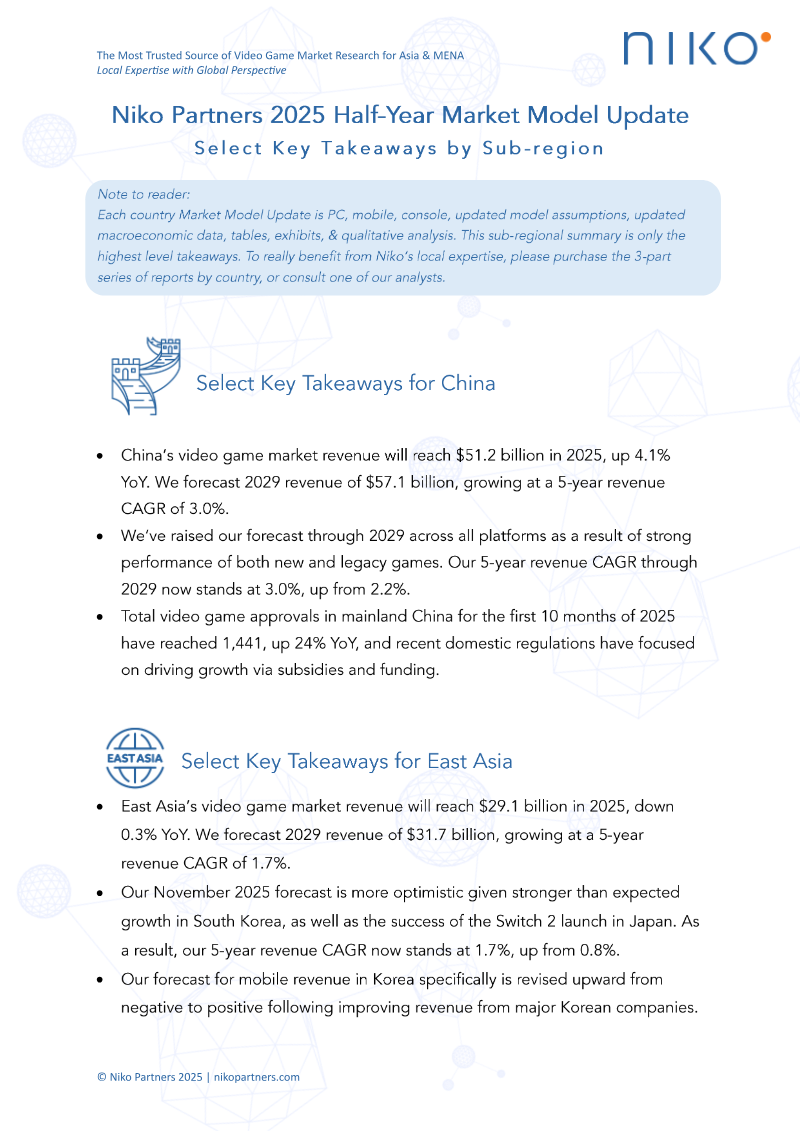
The 2025 Half-Year Market Model Update provides a comprehensive assessment of the video game industry across Asia and the Middle East and North Africa (MENA) region. By synthesizing macroeconomic data, platform-specific performance metrics, and regulatory developments, the analysis offers updated revenue forecasts through 2029 for key markets, including China, East Asia, India, Southeast Asia, and the MENA-3 region. The primary objective is to adjust long-term growth expectations based on recent industry performance, government policy shifts, and evolving consumer behavior.
Regional performance varies significantly, with India emerging as a high-growth market, projected to reach $1.1 billion in 2025 with a robust 12.9% five-year compound annual growth rate (CAGR). China remains the dominant market, with 2025 revenue expected to hit $51.2 billion, supported by a 24% year-over-year increase in game approvals. Conversely, East Asia and Southeast Asia show more moderate growth trajectories, with five-year CAGRs of 1.7% and 3.5%, respectively. The MENA-3 region is forecasted to reach $2.2 billion in 2025, though long-term projections have been tempered by economic headwinds in Egypt and slower mobile growth in Saudi Arabia and the UAE.
Methodologically, these insights are derived from proprietary market models that integrate platform-specific data for PC, mobile, and console segments. The analysis highlights the critical role of government intervention, such as the PROG act in India and regulatory subsidies in China, in shaping market expansion. By updating previous forecasts to reflect current fiscal realities and hardware cycles, such as the Switch 2 launch in Japan, the findings offer a refined outlook for stakeholders navigating the complex regulatory and economic landscapes of these diverse geographic segments.
- China remains the dominant regional market with projected 2025 revenue of $51.2 billion, bolstered by a 24% year-over-year increase in game approvals.
- India is positioned as a high-growth market expected to reach $1.1 billion in 2025 with a 12.9% five-year compound annual growth rate (CAGR).
- The MENA-3 region is forecasted to reach $2.2 billion in 2025, though long-term growth is tempered by economic headwinds in Egypt and slowing mobile performance in Saudi Arabia and the UAE.
- East Asia and Southeast Asia exhibit moderate growth trajectories, with five-year CAGRs of 1.7% and 3.5%, respectively.
- Market expansion across these regions is increasingly driven by government policy, including the PROG act in India and regulatory subsidies in China.
+5
Niko PartnersJan 2025