Market (Overall)·Updated Mar 15, 2026 by GameRefinery
Report · January 1, 2021
Published by GameRefinery
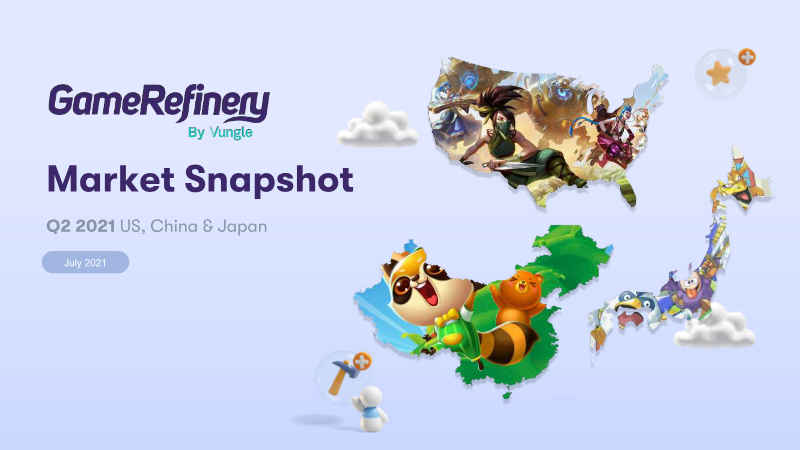
The mobile gaming market in the second quarter of 2021 experienced notable shifts in genre performance and publisher dominance across the United States, China, and Japan. The primary objective is to provide a comparative analysis of these regional markets, highlighting evolving trends in genre market share, publisher success, and the increasing importance of live-service feature updates. The analysis utilizes a proprietary taxonomy and motivation framework, supported by a survey of over 7,000 mobile gamers in English-speaking western countries, to categorize games and identify player archetypes. Key findings indicate that the United States saw a decline in the Puzzle genre’s market share, while the Strategy genre experienced significant growth. In Japan, the Sports genre continued to gain momentum, largely driven by the success of titles like Umamusume Pretty Derby, while RPGs faced a decline. China exhibited a trend reversal from the previous quarter, with RPG and Strategy genres regaining market share at the expense of Shooters. Publisher performance was marked by strong results from Supercell in the US and Cygames in Japan, while Leiting Games nearly doubled its market share in China. A critical trend identified is the 37% year-over-year increase in feature updates, with Strategy games leading this surge at 208%. Developers are increasingly prioritizing engagement through non-recurring live events and limited in-app purchase offers, which saw frequency increases of 143% and 122%, respectively. These features are becoming essential for retention and monetization across major genres. Furthermore, player motivation data reveals that games appealing to fast-paced action and competitive play continue to dominate the top-grossing charts in the US, with specific archetypes like King of the Hill and Skill Master remaining highly relevant.
Mid-core GameRefinery uses a three-layered Puzzle Arcade Card Games Action Puzzle Platformer RPG Card Battler Board Games Shoot/Beat 'em Up Action RPG approach to categorize games Bubble Shooter Other Arcade Tower Defence RPG Sports & Driving Match 3 Puzzle Tower Defense Turn-based RPG Merge Games Fighting Other Puzzle MMORPG • Word Games Using a Category → Genre → Subgenre hierarchy we Trivia Games Hyper Casual Coloring Games HC - Puzzle are able to differentiate games in a meaningful way and Hidden Objects HC - Tap offer accurate insights for all individual game types Solitaire/Mahjong HC - Steer HC - Swipe/Drag currently found in the market Lifestyle HC- .io HC - Other • Customisation Our taxonomy is created together with industry Interactive Story experts and is based on thorough testing and data- Music/Band Simulation analysis of the market Adventures Breeding AR / Location Tycoon/Crafting Based Sandbox Time Management AR / Location Based Idler Puzzle RPG Sports Idle RPG Arcade Sports Survival Realistic Sports Sovereign Games Strategy Driving 4X Strategy Driving Asymmetric Survival Arcade Build & Battle Realistic Driving MOBA Tactical Battler Casino Shooter Casino Battle Royale Classic FPS/TPS Bingo Snipers Casual Casino Tactical Shooter Other Casino Poker/Cards Slots GameRefinery’s Genre Taxonomy
Short Q2 2021 Market Overview Joel , Julkunen VP of Games This quarter we're seeing slight but interesting shifts in the mobile games market. Looking at the genre level, we see that in the US, the Strategy genre is gaining more ground now, nearly neck and neck with Puzzle and Casino, while in Japan, Sports continues to take even more market share. China sees a bit of a trend reversal vs. Q1 with staple genres RPG and Strategy regaining some lost market share while Shooters see a decline. Supercell saw its strongest quarter in a while, surpassing King in terms of 0 market share driven by the performance of Clash of Clans and Clash Royale. The growth of the Sports genre in Japan can in great part be credited to Cygames, who continues to rock the charts with Umamusume Pretty Derby taking up over 9% of Japan's market share. As a first for a Snapshot report, in this report, we take a look at differences between game updates YoY. We're seeing a 37% increase in the number of feature updates, partly driven by genres such as Strategy (208% increase), where those investments are clearly translating into a growing market share.
Key points JoelJulkunen VP of F Games • In the US, we see that the Puzzle genre has lost market share while Strategy has grown the most. RPG games continue to lose Market Share in Japan while Sports sees a further significant increase in Market share. In China, we essentially see a trend reversal vs. Q1 with staple genres RPG and Strategy regaining some lost market share while Shooters see a decline. • Supercell had a strong quarter driven by the performance of Clash of Clans and Clash Royale. Cygames continues to rock the charts with over 9% of Japan's market share. Leiting Games nearly doubles its market share in China. • We're seeing an increasing cadence of feature updates in games with a 37% increase YoY. Live Events – Non-Recurring and Limited IAP offers are the two features that see the most increasing frequency of updates YoY with 143% and 122% increases respectively. More and more games are leveraging these for player engagement and monetization, particularly when it comes to Puzzle, RPG, and Strategy genres. • Looking at what player archetypes mobile games in the US top 200 grossing most appeal to, the situation in Q2 2021 is much the same as it has been for the past few quarters. Archetypes that associate with fast-paced action and competing against other players continue their triumph.
ategy genres. • Looking at what player archetypes mobile games in the US top 200 grossing most appeal to, the situation in Q2 2021 is much the same as it has been for the past few quarters. Archetypes that associate with fast-paced action and competing against other players continue their triumph. King of the Hill regains its #2 spot, while Skill Master and most highly appealing archetypes see a slight dip as games that appeal to other archetypes gain ground in the charts.
Market • Genre market share US, JP, CN • Publisher share and top growth US, JP, CN • Hot games in Soft Launch worth keeping an eye on
Market performance Q2 2021 vs. Q1 2021 <sub>(iOS)</sub> Key takeaways: 1) In the US, we see that the Puzzle genre has lost market share while Strategy has grown the most. 2) RPG games continue to lose Market Share in Japan while Sports sees a further significant increase in Market share. 3) In China, we essentially see a trend reversal vs. Q1 with staple genres RPG and Strategy regaining some lost market share while Shooters see a decline. Genre Rev Change Genre Rev Change Genre Rev Change 1.Puzzle 21.18% -153 1. RPG 44.21% -4.96 1. RPG 47.33% +2.02 2. Casino 18.9% -0.31 2. Sports 15.99% +3.41 2. Strategy 27.28% +1.79 3. Strategy 17.17% +1.73 3. Strategy 10.7% +1.09 3. Shooter 10.46% -2.73 4.RPG 14.23% +0.2 4. Lifestyle 7.22% +0.59 4. Casino 5.4% +0.05 5. Simulation 10.4% -0.52 5.Puzzle 6.6% -0.17 5. Puzzle 2.03% -0.03 6. Shooter 5.56% +0.24 6. AR/Location Based 4.72% -0.17 6. Lifestyle 1.43% -0.09 7. Lifestyle 3.86% -0.02 7. Shooter 4.54% +0.27 7. Sports 1.42% -0.15 8. Sports 3.4% +0.29 8. Simulation 2.51% +0.26 8. Driving 1.27% -0.15 9. AR/Location Based 1.67% -0.75 .Card Games 1.23% -0.05 9.Arcade 1.2% -05 10. Driving 1.6% +0.31 10. Casino 0.88% -0.26 10. Simulation 0.94% +0.33 11. Arcade 1.34% +0.2 11. Arcade 0.74% +0.02 11 Card Games 0.93% -0.27 12. Card Games 0.62% +0.13 12. Driving 0.43% -0.07 12. AR/Location Based 0.03% -0.02
The mobile gaming market in the first quarter of 2021 demonstrated regional divergence in genre performance, with the United States remaining relatively stable while China and Japan experienced notable shifts in market share. In the US, simulation games continued to grow, and Roblox Corporation solidified its position as the top-grossing publisher. Conversely, Japan saw a decline in RPG market share alongside a significant rise in sports titles, driven by the breakout success of Cygames’ Uma Musume Pretty Derby. China’s market moved away from traditional RPG and strategy dominance, favoring a surge in shooter games. Data analysis reveals distinct trends in monetization and feature implementation across these regions. Collectible albums have become a staple in the US, utilized by over 70% of top-grossing games. In Japan, battle pass mechanics are gaining traction, appearing in over 25% of top-grossing titles. Meanwhile, Chinese developers have doubled the year-over-year utilization of special gacha mechanics, which now appear in 30% of top-grossing games. Social features, particularly guild mechanics and co-op modes, remain essential for retention across puzzle, RPG, and strategy genres. The analysis utilizes a proprietary genre taxonomy and a motivation framework to categorize player archetypes. In the US market, the top 200 grossing games primarily appeal to five distinct archetypes, with a rising trend toward the Skill Master archetype, indicating an increased consumer appetite for competitive gameplay that rewards reflexes and skill. These findings are based on iOS market performance data, publisher share metrics, and an evaluation of soft-launch titles, providing a comprehensive view of the mobile landscape during the transition from late 2020 to early 2021.
The Q1 2021 market snapshot delivers a data‑driven overview of the global mobile‑gaming landscape, focusing on iOS performance in the United States, Japan and China and comparing it with the preceding quarter. By applying GameRefinery’s three‑layered genre taxonomy to the top‑grossing 200 titles, the analysis quantifies shifts in genre share, publisher dominance and emerging feature trends, while also profiling player archetypes and their motivations. Across the three regions the overall market shape remained stable, yet distinct regional dynamics emerged. In the United States simulation games continued to grow and Roblox solidified its position as the leading grossing title, surpassing Playrix and King. Japan saw a measurable decline in RPG share accompanied by a sharp rise in sports, highlighted by Cygames’ Uma Musume Pretty Derby capturing a sizable slice of the charts. China experienced a double‑digit drop in RPG and strategy share, while shooters gained traction. Revenue‑share changes are illustrated by puzzle maintaining a 22.9 % share in the US (+0.1 pp), RPG falling to 45.4 % in China (‑2.7 pp) and sports expanding to 12.3 % in Japan (+27 pp). Monetisation patterns diverged by market: collectibles albums appear in over 70 % of the US top‑100 grossing games, battle‑pass systems are present in more than a quarter of Japan’s top‑100, and special‑gacha mechanics doubled YoY to exceed 30 % of Chinese leaders. Feature analysis shows guild mechanics, co‑op modes and PvP as critical for puzzle, RPG and strategy titles, while social‑collectible systems drive retention in casual segments. Player‑archetype profiling reveals that fast‑paced, competitive “King of the Hill” and “Thrill‑Seeker” types continue to dominate the US top‑200, with a rising “Skill‑Master” segment indicating growing demand for reflex‑based competition. Demographically, puzzle games attract primarily female players aged 25‑44, whereas strategy and RPG titles skew male in the same age bracket. Soft‑launch monitoring flags titles such as Clash Quest, Tom and Jerry: Chase and Pokémon Unite as promising entrants that could
The strategy genre remains a cornerstone of the mobile gaming market, currently ranking as the third-largest genre in the United States on iOS with a 17% revenue market share. The landscape is heavily dominated by the 4X strategy subgenre, which accounts for 20 of the top 25 grossing strategy titles. While the market is crowded with aging titles, recent growth is driven by genre-blending, where developers integrate mechanics from other categories—such as merge, match-3, or RPG elements—to broaden player appeal. Market analysis reveals that 4X strategy games rely on three primary pillars: long-term power progression through permanent boosts and deep economies, complex live operations featuring recurring events, and robust social frameworks centered on competition and collaboration. High-performing examples include State of Survival, which reached the top of the 4X subgenre through massive IP collaborations, and Top War, which successfully scaled using merge mechanics. Conversely, the MOBA subgenre continues to face challenges in the U.S. market; despite a strong launch, League of Legends: Wild Rift struggled to maintain its top-grossing position, leaving the subgenre's future performance to newer entries like Pokémon UNITE. Player motivation data, derived from a survey of over 7,000 respondents across English-speaking Western territories, indicates that strategy players are primarily driven by strategic planning, resource optimization, and social competition. Successful titles capitalize on these drivers by offering deep technology trees, competitive guild mechanics, and diverse PvP modes. While Supercell remains the only major player finding significant success outside the 4X subgenre with titles like Clash of Clans, the broader trend suggests that sustained revenue in this space requires a sophisticated mix of deep monetization loops and constant feature innovation.
The global mobile gaming market is currently undergoing a period of stabilization following unprecedented pandemic-era growth, characterized by a slight 6% year-over-year revenue decline to $21.2 billion in early 2022. Despite this correction, the industry maintains a high baseline of approximately 14 billion quarterly downloads and is projected to reach $117 billion in annual revenue by 2026. While casual titles account for 78% of total downloads, the financial core of the industry remains the mid-core segment, specifically RPG and strategy genres, which generate 60% of all player spending. Growth is increasingly concentrated in Asia-Pacific markets, though Western regions are showing significant engagement spikes driven by major intellectual property launches. The RPG and MMORPG sectors remain the primary engines of monetization, particularly in Asian markets which contribute 80% of total genre revenue. However, the successful launch of titles like Diablo Immortal, which earned $28 million in its first six weeks in the United States, signals an expanding Western appetite for these complex mobile experiences. Simultaneously, the card battler sub-genre has emerged as a top-five growth category, benefiting from cross-media synergies and established franchises. This expansion is supported by a strategic shift in advertising, as developers increasingly leverage social platforms like YouTube and Instagram to capture a higher share of voice among target demographics. Market leadership in the strategy and RTS segments is shifting, with China surpassing the United States in player spending for real-time strategy titles. While established leaders like Clash Royale maintain global dominance, the success of newer entries demonstrates that local market expertise and the integration of popular IPs are essential for sustained growth. As the industry moves toward a projected 73 billion annual downloads by 2026, the reliance on sophisticated advertising networks and the ability to monetize mid-core audiences will define the competitive landscape of the mobile gaming ecosystem.