Half-Life: Alyx
Game
15 documents in the library are about Half-Life: Alyx, from writers such as Game Dev Unchained, Newzoo and Sparkers. Each has a summary and key insights with the page they come from.
Connections
Each row is a game or company named alongside Half-Life: Alyx, each column a document, oldest first. A mark means that document names it. Select a row to see those documents.
Documents about Half-Life: Alyx
Deceptive Design in VR Games: Lies That Invite Surprise and Pleasure
This paper examines deceptive design in virtual reality games, a topic it argues has received no dedicated research despite existing work on deceptive design in digital games and dark patterns in VR applications.
- Deceptive design, as defined by Gualeni and de Mosselaer (2021), is the intentional construction of false player expectations to create more surprising and pleasurable experiences, differing from dark patterns because it aims to improve rather than extract value from the player.
- Deceptions are classified as overt (revealed to produce shock or surprise) or covert (kept hidden because they make the experience more enjoyable), and as narrative, aesthetic, or mechanical in nature.
- The paper introduces a new 'Level of VR Dependence' categorisation: deceptions are either low (identical if moved to non-VR games), mixed (heavily altered), or high (break completely outside VR) in dependence on VR affordances.

Digital Arts, Digital Games and Volumetry: State-of-the-Art and Current Scenario
This paper examines the convergence of digital arts, digital games, and volumetric technologies, arguing that volumetric video and volumetry, interactive three-dimensional visualization techniques rooted in mid-twentieth-century computing and photogrammetry, can broaden the creative and social reach of digital games.
- Volumetric video offers six degrees of freedom and deeper immersion than conventional 2D or 360-degree video, but the research on it remains exploratory and inconsistent in its terminology.
- The main barrier to volumetric media is its heavy data demand, with point cloud video reaching roughly 5 Gbps, which keeps the technology outside the mainstream.
- The paper argues that volumetric visualization techniques, rooted in mid-twentieth-century computing and photogrammetry, can broaden the creative and social reach of digital games.

Valve's "Secret Weapon"
Valve's reliance on frequent, early, designer-led playtesting is presented as a central driver of the studio's design quality, with Portal as the main case study.
- Valve treats game mechanics as scientific hypotheses, using frequent playtesting to validate design decisions with observed player behavior rather than relying on verbal feedback.
- The studio mandates weekly playtesting cycles from the earliest stages of production to identify pacing issues and design flaws before they become systemic.
- Designers are required to conduct their own observations in silence to ensure they gain firsthand, unbiased insight into how users interact with the game world.

VR Games Market Report 2022
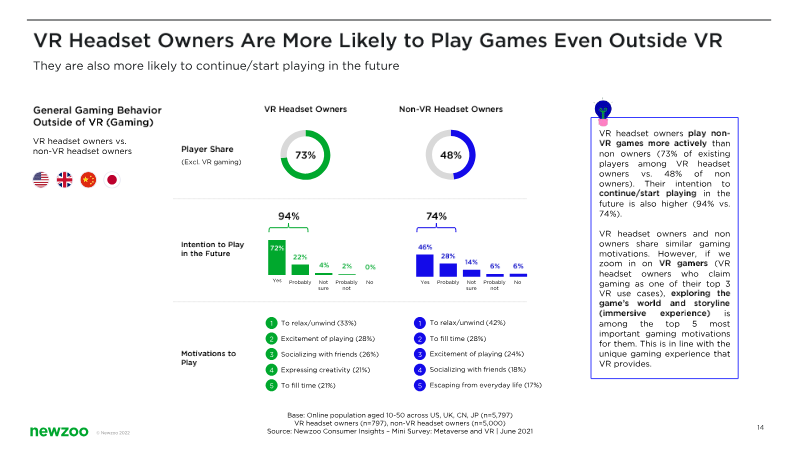
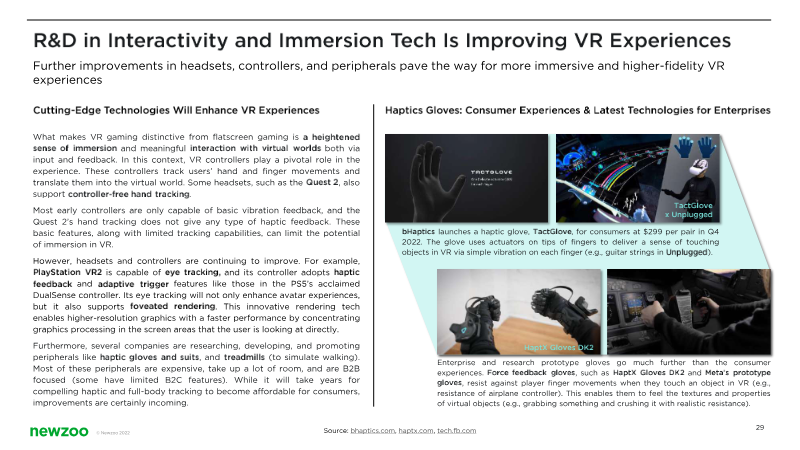
Newzoo's 2022 VR report argues that virtual reality has grown steadily since its 2020 resurgence and that gaming is both the primary gateway to the technology and its main growth driver.
- The global active VR hardware install base is projected to reach 46 million units by 2024, driven by a 42% compound annual growth rate.
- Gaming is the primary driver of the VR ecosystem, with 72% of headset owners using devices for gaming and nearly 60% engaging with them on a weekly basis.
- Standalone headsets, such as the Meta Quest 2, are the primary catalysts for market expansion by increasing accessibility compared to traditional PC-based hardware.

Mobile Games
The primary purpose of this analysis is to evaluate the potential impact and viability of Valve’s rumored handheld gaming device, internally codenamed SteamPal.
- Valve is developing a handheld gaming device, codenamed SteamPal, which is expected to feature Linux-based software, gamepad controls, a touchscreen, and a dockable design.
- Valve has shifted its internal strategy toward hardware development by significantly increasing its hardware engineering team and adopting a model of designing hardware and software in concert, as seen with the Index headset and Half-Life: Alyx.
- The device faces market skepticism due to the historical failure of the portable PC category and concerns regarding Valve's inconsistent track record with previous hardware initiatives like Steam Machines and the Steam Link.

Global Games Market Report 2021: The VR & Metaverse Edition
Newzoo's 2021 global games market analysis frames 2020 as a record year fueled by COVID-19 and forecasts a modest correction in 2021, with revenues slipping 1.1% year over year to $175.8 billion.
- The global games market is projected to reach $175.8 billion in 2021, a 1.1% year-on-year decline caused by hardware shortages and AAA game delays.
- Mobile gaming remains the industry's largest segment, generating $90.7 billion and accounting for 51% of total market revenue despite privacy-related marketing hurdles.
- The industry is forecast to reach $218 billion in total revenue by 2024, driven by the long-term growth of the metaverse and social gaming hubs.

A 2020 Vision for XR: is this the Year AR & VR Break Through? | PGC Digital #1
The year 2019 marked a critical transition for extended reality, moving the industry away from low-end mobile VR toward high-quality, standalone hardware like the Oculus Quest.
- The industry is shifting from short-form mini-games toward deep, persistent, and social multiplayer experiences, which experts identify as the primary catalyst for mass adoption.
- The transition from low-end mobile VR to high-quality standalone hardware like the Oculus Quest has successfully expanded the user base beyond early adopters to include families and casual players.
- The COVID-19 pandemic has accelerated demand for immersive digital solutions in remote collaboration and cultural archiving, while driving record engagement for high-fidelity titles like Half-Life: Alyx.

CoVID 19 Updates, Magic Leap Scam, Stadia, VR, PS5, Valorant CS GO | Game Dev Unchained Episode 223
The global game industry is currently navigating a period of significant transition, characterized by the normalization of remote work environments and a critical re-evaluation of high-profile technological ventures.
- The industry is shifting away from speculative, hype-driven hardware models toward sustainable, content-led growth, as evidenced by Magic Leap’s failure to meet consumer expectations and its subsequent pivot to enterprise applications.
- High-quality, first-party exclusive content is now the primary driver for platform adoption, superseding artificial marketing hype in securing long-term consumer engagement.
- Virtual reality is reaching a maturation point, with titles like Half-Life: Alyx successfully driving hardware adoption for platforms such as the Valve Index and Oculus Quest.

WFH Orders, Magic Leap Selling, Naughty Dog Crunches, Gamestop | Game Dev Unchained Episode 219
The global pandemic served as a catalyst for a forced, rapid transition to remote work, exposing significant infrastructure vulnerabilities within major AAA studios.
- The gaming industry is transitioning toward a service-oriented model, yet remains hindered by traditional development habits that prioritize short-term output over long-term workforce sustainability.
- Systemic crunch culture at high-profile studios like Naughty Dog persists because commercial success and critical acclaim are used to justify unsustainable labor practices.
- The rapid shift to remote work during the pandemic exposed significant infrastructure vulnerabilities in AAA studios, specifically regarding VPN security and hardware shortages.

Crunch Culture, Google Stadia, Over Saturation of Games, and Virtual Reality | Roundtable News
The game industry currently faces a complex intersection of labor challenges, shifting distribution models, and evolving hardware paradigms.
- Crunch culture remains a systemic industry issue driven by poor management and scope creep, despite reports of marginal reductions in excessive work hours.
- Cloud gaming services that leverage existing user libraries, such as Nvidia GeForce Now, are better positioned for success than platforms like Google Stadia, which struggle due to restrictive pricing and a lack of exclusive content.
- Market saturation on digital storefronts like Steam requires independent studios to prioritize distinct brand identities and high-quality experiences over direct competition with AAA titles to remain viable.

Why 2020 Could Be a Year Long Remembered in Video Games
The video game industry entered 2020 positioned for a transformative year, driven by a convergence of hardware transitions, evolving distribution models, and high-profile software releases.
- The 2020 release of the PlayStation 5 and Xbox Series X is expected to be a major industry driver, supported by backward compatibility that allows players to carry over existing digital and physical game libraries.
- Streaming services are entering a critical phase in 2020 with the launch of Microsoft’s Project xCloud and EA’s Project Atlas, positioning them as alternatives for casual gamers who prefer not to own dedicated hardware.
- Subscription models are expanding beyond Microsoft’s Game Pass Ultimate, with Ubisoft, Square Enix, Apple (Apple Arcade), and Antstream Arcade signaling a shift toward bundled, recurring-revenue gaming services.

2020 Global Games Market Report
The global games market is forecast to generate $159.3 billion in 2020, up 9.3% year on year, driven by pandemic lockdown engagement and the late-year launch of the PlayStation 5 and Xbox Series X. Mobile remains the largest segment at $77.2 billion (+13.3%), with 2.6 billion mobile players, only 38% of whom pay.
- The global games market generated $159.3 billion in 2020, a 9.3% year-on-year increase, with projections to exceed $200 billion by 2023.
- Mobile gaming is the industry's dominant segment, accounting for $77.2 billion or 48% of total global revenue.
- The Asia-Pacific region is the primary market hub, generating $78.4 billion, while the Middle East and Africa represent the fastest-growing geographic regions.
Companies behind it

As the documents state it.