
International Journal of Games and Social Impact
Open-access journal from Lusófona University on games, game design and their social impact.
Documents

Press Play to Start: The Challenges of Exhibiting Video Games at the Museum
Museums are increasingly grappling with how to exhibit video games as art, a shift that has accelerated since MoMA's 2012 acquisition of fourteen games for its Architecture and Design collection and the Smithsonian's The Art of Video Games that same year.
- Games resist conventional art presentation because their interactivity, dependence on evolving technology, and commercial origins do not fit the neutral 'white cube' gallery model, a tension framed through theorists Brian O'Doherty and Lev Manovich.
- Institutional recognition of games as art accelerated with MoMA's 2012 acquisition of fourteen games for its Architecture and Design collection and the Smithsonian's 2012 exhibition The Art of Video Games.
- Curators must 'translate' games' digital culture, community-based contexts, and interactive logic for diverse audiences, a framework associated with Domenico Quaranta, while funding pressures and audience appeal shape which titles are selected.

Collective Aesthetics Through I-Position and Self-Engagement: Advancing Usability for Inclusive Solo Board Games
This paper argues that the usability and aesthetic value of board games have been studied almost exclusively in multiplayer contexts, leaving solo play and self-engagement underexplored despite their potential to support neurodivergent, disabled, and introverted players.
- The paper argues that board game usability and aesthetics have been studied almost exclusively in multiplayer contexts, leaving solo play and self-engagement underexplored despite their potential to support neurodivergent, disabled, and introverted players.
- Drawing on Goleman's four domains of emotional intelligence and Hermans' Dialogical Self Theory, the authors propose that solo board games let players inhabit multiple "I-positions" and experience "psycho-aesthetic escapism," a freedom often constrained by group-oriented mechanics.
- Usability is reframed around identity positionality and self-engagement rather than mechanics or interface alone.

Art Devices - Play Devices: Immersion vs. Estrangement in Art-Games
This paper examines the tension between immersion and estrangement in art-games, drawing on Viktor Shklovsky's concept of ostranenie ("making strange") and Bertolt Brecht's Verfremdungseffekt.
- The paper argues that games built purely on immersion risk becoming passive entertainment that treats players as spectators, while games built purely on estrangement risk becoming too abstract or unplayable.
- The proposed alternative is 'complicity,' a dialectical state in which players are absorbed in a game's fiction yet remain critically aware of its constructed rules and power dynamics, letting games work as participatory, political, and didactic art.
- The framework draws on Shklovsky's 'ostranenie' ('making strange') and Brecht's Verfremdungseffekt, with Brecht adding an explicit political mission to Shklovsky's aesthetic formalism.

Digital Arts, Digital Games and Volumetry: State-of-the-Art and Current Scenario
This paper examines the convergence of digital arts, digital games, and volumetric technologies, arguing that volumetric video and volumetry, interactive three-dimensional visualization techniques rooted in mid-twentieth-century computing and photogrammetry, can broaden the creative and social reach of digital games.
- Volumetric video offers six degrees of freedom and deeper immersion than conventional 2D or 360-degree video, but the research on it remains exploratory and inconsistent in its terminology.
- The main barrier to volumetric media is its heavy data demand, with point cloud video reaching roughly 5 Gbps, which keeps the technology outside the mainstream.
- The paper argues that volumetric visualization techniques, rooted in mid-twentieth-century computing and photogrammetry, can broaden the creative and social reach of digital games.

Still Not Game: Experiencing a Game Engine as an Artistic Studio Space
Linda Loh's "Still Not Game: Experiencing a Game Engine as an Artistic Studio Space" argues that Unreal Engine, a tool built primarily for game development, can serve as a legitimate studio environment for contemplative digital art rather than merely a means of making games.
- Linda Loh argues that Unreal Engine, a tool built primarily for game development, can function as a legitimate studio environment for contemplative digital art rather than only as a means of making games.
- The author learned the engine without any prior gaming experience, using it to create abstract, luminous, transcendent virtual spaces that resist conventional game logic such as narrative progression, achievement, and the default game-like aesthetic.
- The creative process is described as recursive and serendipitous: an initially finished virtual world became an accumulating, chaotic space that generated new possibilities, with the digital environment acting as both collaborator and medium.

Tactile Texts: A Multisensory Storybook Game for Reimagining Reading through Material and Collaborative Play
"Tactile Texts" presents Shadow Castle, a hybrid two-player storybook game that pairs a conductive fabric book with a companion tablet to address aliteracy, the capacity to read without the motivation to do so.
- The paper frames aliteracy, the ability to read without the motivation to do so, as stemming from affective and motivational barriers rather than skill deficits, and draws on Self-Determination Theory and Material Engagement Theory to argue that arts-based, game-based, and multisensory approaches can build intrinsic motivation.
- Only about 3 percent of 2024 educational gamification articles retrieved via an OpenAlex search addressed reading or literacy, and only eight included art, which the authors cite as a notable research gap.
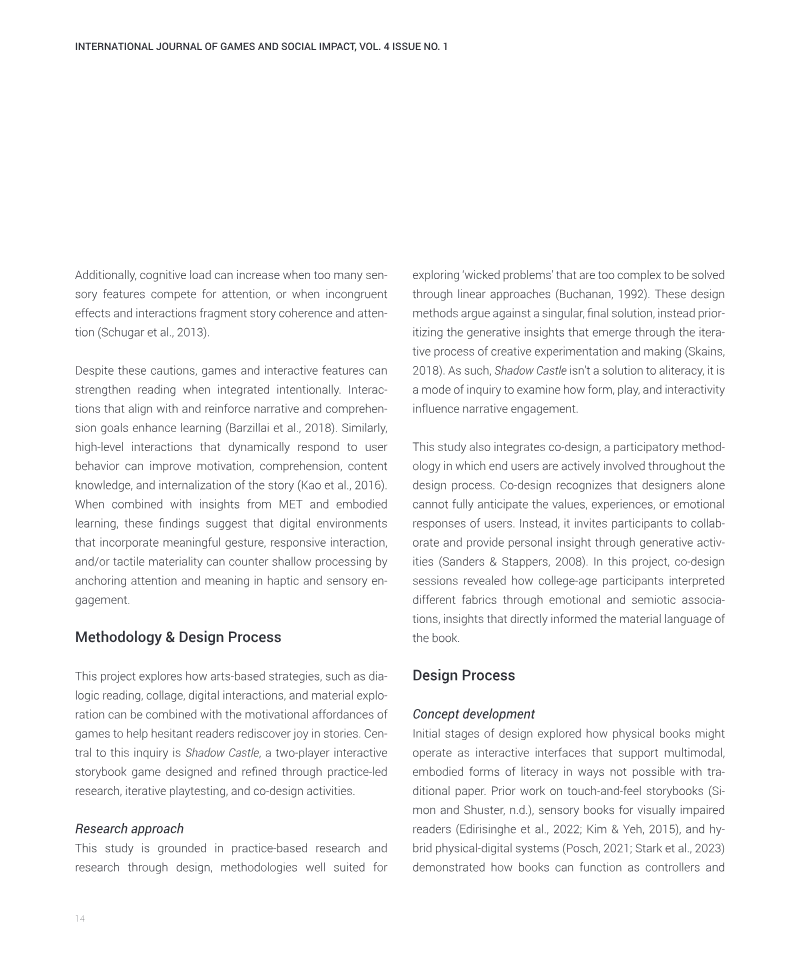
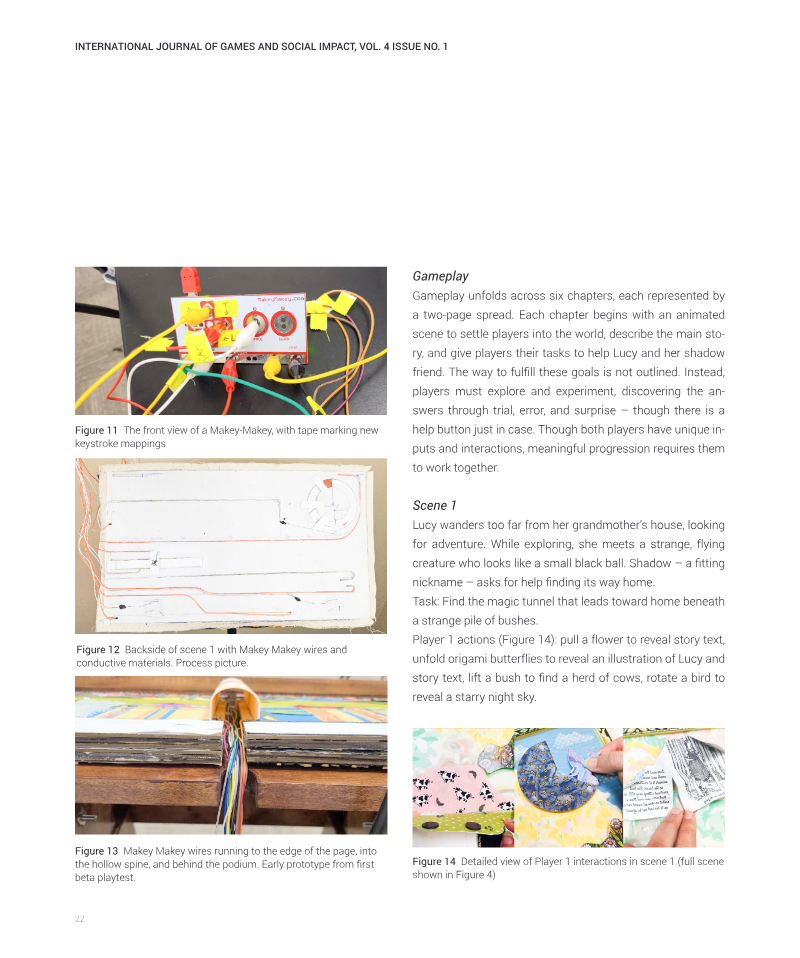
- Shadow Castle is a two-player hybrid game pairing a conductive fabric storybook (built with Makey Makey circuitry) with a companion tablet, splitting control so one player manipulates sensor-embedded pages while the other uses keyword-absorbing abilities to prompt verbal collaboration.

Gaming in the Crossfire: How Toxicity Affects Player Experience in PUBG
A 2025 qualitative study published in the International Journal of Games and Social Impact examines how toxic behaviour shapes the experience of players of PUBG, a team-based battle royale game that has received comparatively little scholarly attention relative to MMORPGs and general online gaming.
- The study, a 2025 qualitative analysis of 30 active PUBG players aged 16 to 30 plus Reddit and Discord discussions from February 2023 to August 2024, concludes that toxicity harms both individual enjoyment and community health, and that remedies must combine technological, community-driven, and policy-based interventions.
- The research identifies four core forms of toxicity in PUBG: verbal harassment, trolling, gender-based discrimination, and cheating, with the authors attributing them largely to the Online Disinhibition Effect, where anonymity and weak social cues lower inhibitions while competitive pressure amplifies hostility.
- Participants reported frustration, withdrawal from play, and reduced retention, and younger players in particular said hostile communication habits carried over into their offline lives.

History-Themed Games from the Players' Perspective: An Analysis Through a Social Media Platform
A 2025 study published in the International Journal of Games and Social Impact examines whether young people believe they can learn history through digital games, drawing on Reddit discussions among history-themed game enthusiasts in both Turkish and English.
- Players on Reddit are divided on whether history can be learned through games: of those expressing a view, 27 said yes, 17 said no, 15 said it depended on context, and 22 were undecided.
- The most cited benefit is building general historical knowledge and interest, which accounts for 47 percent of reported gains, with some users crediting these games for academic success.
- Inaccurate or incomplete information is the main criticism, making up 58 percent of concerns, alongside curriculum incompatibility, limited classroom technology, and propaganda.

Heroes, Helpers and Villains: Representations of the Carnation Revolution through Cultural Game Jam Outputs
Nine game prototypes created during the third Óbidos Cultural Game Jam in February 2025 form the basis of this study, which examines how participants represented Portugal's 1974 Carnation Revolution and the 1973 Captains' Meeting that preceded it.
- The study analyzes nine game prototypes produced during the third Óbidos Cultural Game Jam in February 2025 under the theme "That's Not Fair," part of the Horizon Europe EPIC-WE project, which depicted Portugal's 1974 Carnation Revolution and the 1973 Captains' Meeting.
- Games are sorted by protagonist perspective into three categories: "Heroes" following conventional individual monomyth agency, "Helpers" casting players as minor figures whose small acts contribute to collective change (e.g., Bufo Catcher), and "Villains" placing players as secret police or regime enforcers (e.g., Blue Brigade, Message of the Red Cloves).
- The typology reveals a progression from celebratory narratives toward more critical and morally ambiguous forms of engagement with history.

Designing With Ambiguity: Iterating Equity in Game Jam Design
"Designing With Ambiguity" argues that game jams can be deliberately designed as equitable, participatory spaces rather than treated as neutral events whose inclusiveness is judged only by their outcomes.
- The most substantial finding is that inclusion shifted from an add-on, such as accessibility features, to a fundamental reconfiguration of jam structure, roles, and culture, arguing that the decisive choices about inclusion happen upstream: who is invited, what roles participants hold, and whose values are foregrounded.
- The pilot, a six-hour session with 40 participants, produced cognitive overload and favoured already-confident participants, which led the authors to shift toward longer, more dialogic formats.
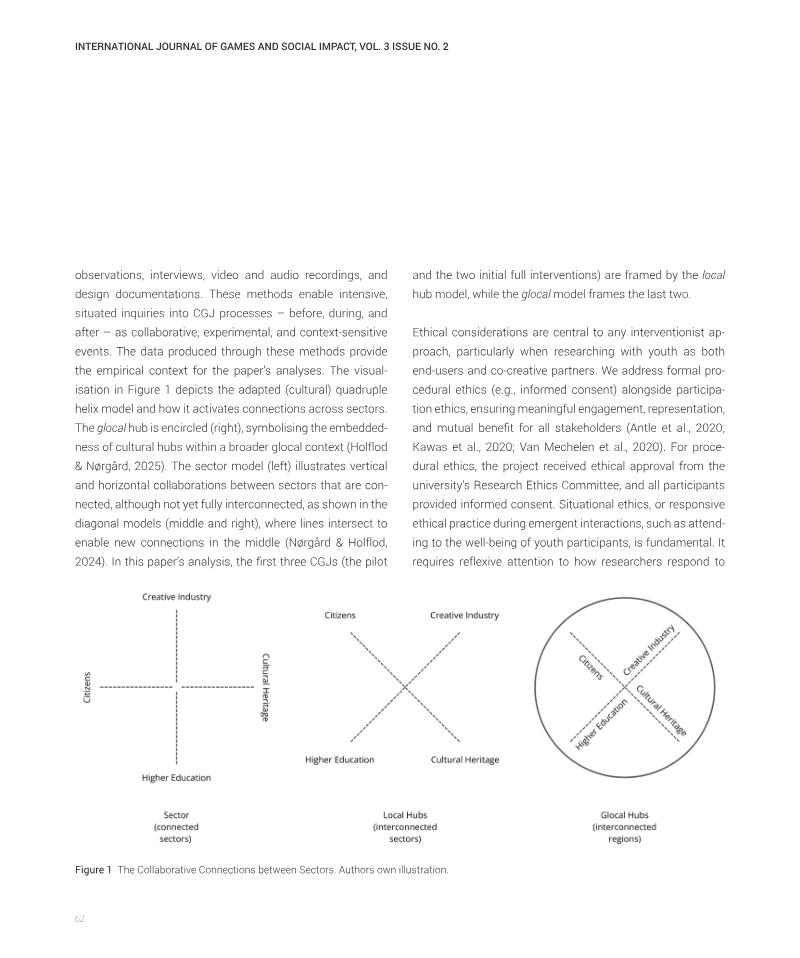
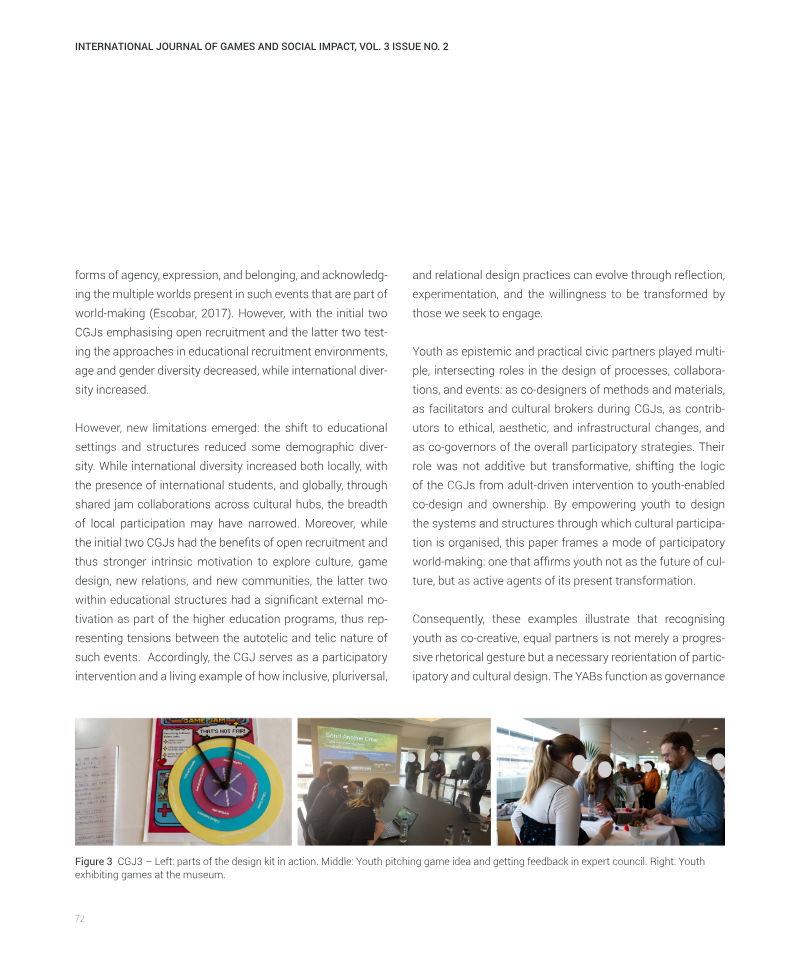
- Across the four subsequent Cultural Game Jams (2023–2025) with youth aged 16 to 25 across European cultural heritage sites, formats grew from one to seven days and from 40 to 61 participants.

Cornerstones for Creativity and Success: Finnish Game Cultural Organisations' Public DEI Definitions and Practices
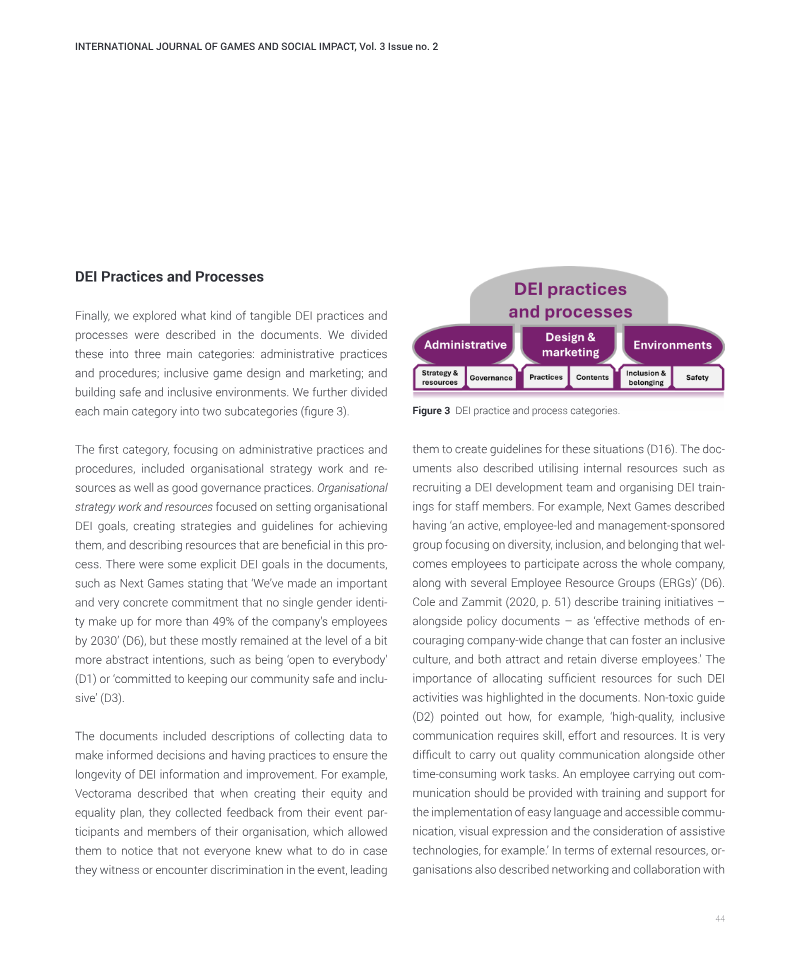
A study by Friman, Taino, Laakso, Myöhänen, and Sotamaa from Tampere University examines how Finnish game cultural organisations publicly define and practise diversity, equity, and inclusion (DEI).
- The study analysed 18 public DEI documents from 11 Finnish game cultural organisations, using reflexive qualitative content analysis, to address a research gap that has focused mainly on North America.
- Codes of conduct are the most common type of DEI document, alongside DEI guides, DEI statements, and DEI strategies, and they broadly reflect research-based recommendations such as clear reporting procedures, zero-tolerance policies, and inclusive event practices.
- Organisations usually frame DEI in terms of societal impact (countering stereotypes, fostering change) and success (economic and talent-related benefits), yet the terms are rarely defined explicitly, with most definitions tracing back to the City of Helsinki's Non-Toxic project.
A Qualitative Content Analysis of African Video Games Developed by Students
This study examines how students developing African-themed video games represent African culture, arguing that Western depictions have long dominated the field and that authentic, culturally grounded alternatives are both possible and necessary.
- African game development grew from about 100 developers in 2010 to more than 3,000 by 2022, within a market valued at $2.6 billion in 2021.
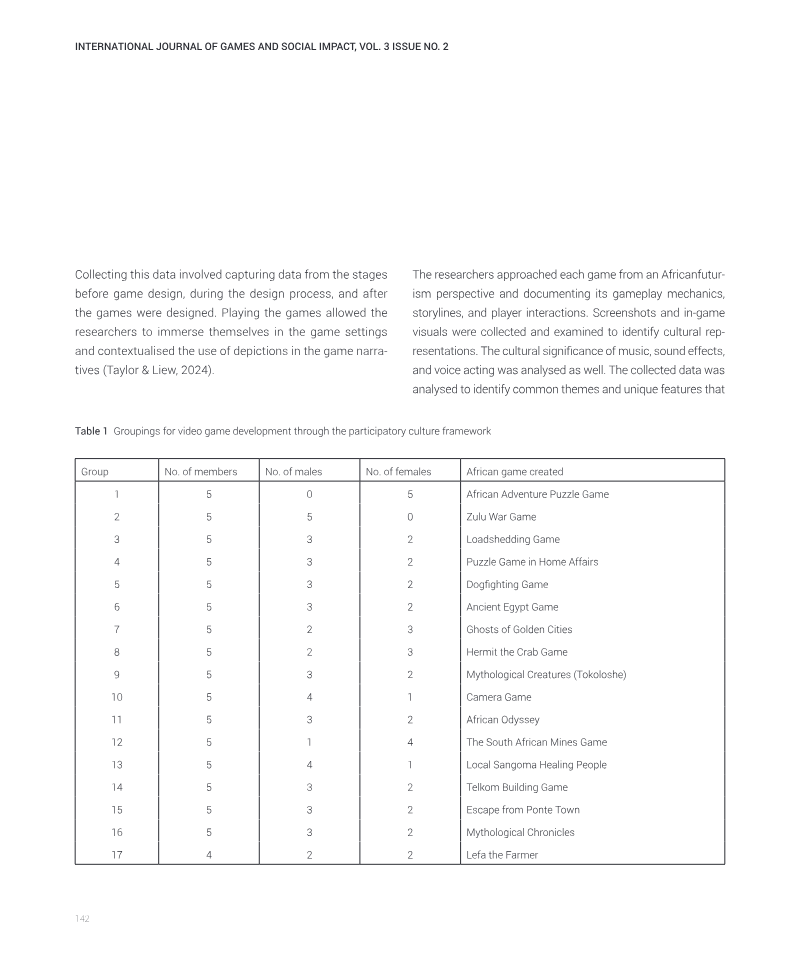
- The study analyzed 17 student-developed African-themed games created by 84 students organized into 17 groups through a participatory, inquiry-based project.
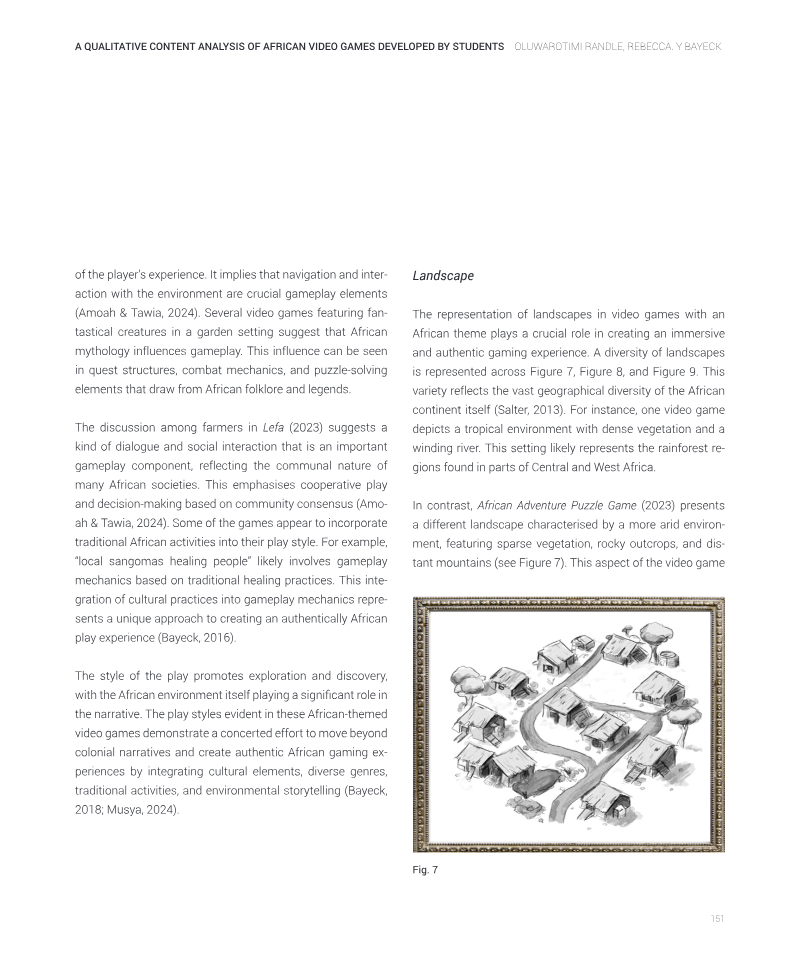
- Using Krippendorff's qualitative content analysis, the authors identified eight recurring markers of representation: aesthetics, music and dance, mythological creatures, religion, race, play style, landscape, and language.