Half-Life: Alyx
Game
Documents about Half-Life: Alyx
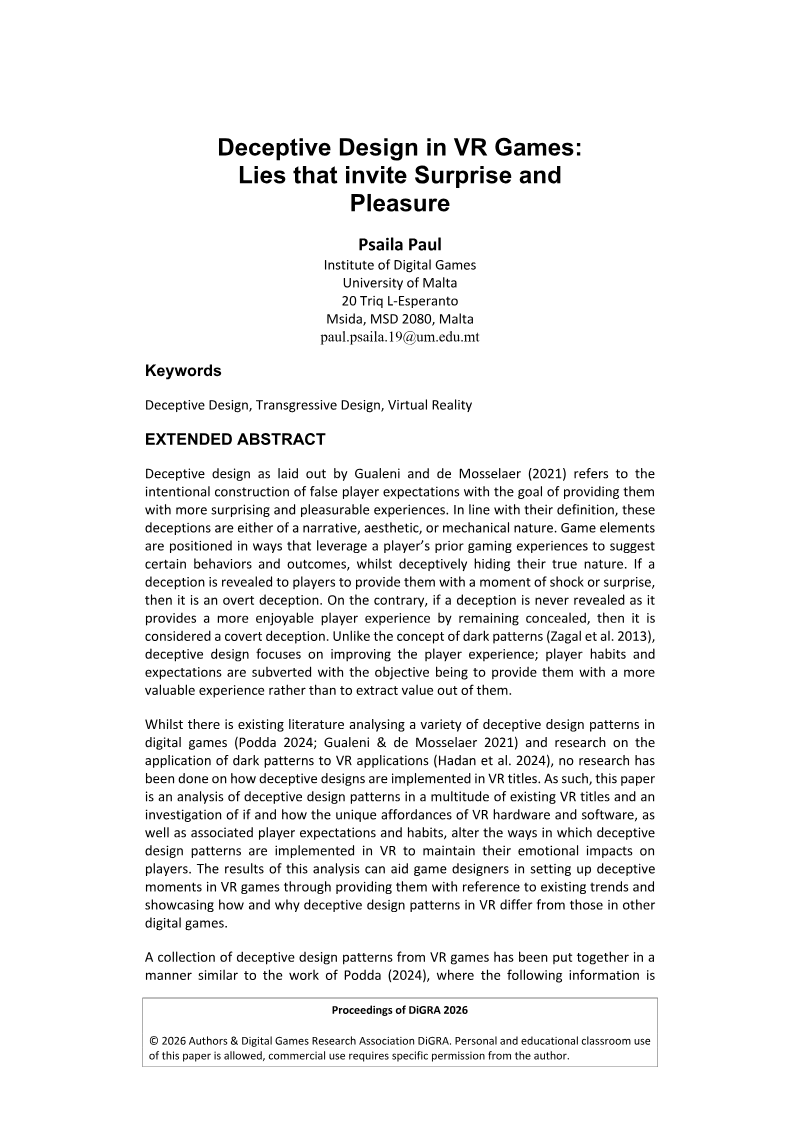
Deceptive Design in VR Games: Lies That Invite Surprise and Pleasure
This paper examines deceptive design in virtual reality games, a topic it argues has received no dedicated research despite existing work on deceptive design in digital games and dark patterns in VR applications.
- Deceptive design, as defined by Gualeni and de Mosselaer (2021), is the intentional construction of false player expectations to create more surprising and pleasurable experiences, differing from dark patterns because it aims to improve rather than extract value from the player.
- Deceptions are classified as overt (revealed to produce shock or surprise) or covert (kept hidden because they make the experience more enjoyable), and as narrative, aesthetic, or mechanical in nature.
- The paper introduces a new 'Level of VR Dependence' categorisation: deceptions are either low (identical if moved to non-VR games), mixed (heavily altered), or high (break completely outside VR) in dependence on VR affordances.

Valve's "Secret Weapon"
Valve's reliance on frequent, early, designer-led playtesting is presented as a central driver of the studio's design quality, with Portal as the main case study.
- Valve treats game mechanics as scientific hypotheses, using frequent playtesting to validate design decisions with observed player behavior rather than relying on verbal feedback.
- The studio mandates weekly playtesting cycles from the earliest stages of production to identify pacing issues and design flaws before they become systemic.
- Designers are required to conduct their own observations in silence to ensure they gain firsthand, unbiased insight into how users interact with the game world.

Mobile Games
The primary purpose of this analysis is to evaluate the potential impact and viability of Valve’s rumored handheld gaming device, internally codenamed SteamPal.
- Valve is developing a handheld gaming device, codenamed SteamPal, which is expected to feature Linux-based software, gamepad controls, a touchscreen, and a dockable design.
- Valve has shifted its internal strategy toward hardware development by significantly increasing its hardware engineering team and adopting a model of designing hardware and software in concert, as seen with the Index headset and Half-Life: Alyx.
- The device faces market skepticism due to the historical failure of the portable PC category and concerns regarding Valve's inconsistent track record with previous hardware initiatives like Steam Machines and the Steam Link.

Why 2020 Could Be a Year Long Remembered in Video Games
The video game industry entered 2020 positioned for a transformative year, driven by a convergence of hardware transitions, evolving distribution models, and high-profile software releases.
- The 2020 release of the PlayStation 5 and Xbox Series X is expected to be a major industry driver, supported by backward compatibility that allows players to carry over existing digital and physical game libraries.
- Streaming services are entering a critical phase in 2020 with the launch of Microsoft’s Project xCloud and EA’s Project Atlas, positioning them as alternatives for casual gamers who prefer not to own dedicated hardware.
- Subscription models are expanding beyond Microsoft’s Game Pass Ultimate, with Ubisoft, Square Enix, Apple (Apple Arcade), and Antstream Arcade signaling a shift toward bundled, recurring-revenue gaming services.

The Fate of Virtual Reality Hangs in the Balance
The virtual reality (VR) gaming sector faces a critical juncture as it struggles to transition from a niche enthusiast product to a mainstream consumer technology.
- The future of VR gaming is currently dependent on Sony and Valve, as Microsoft and Nintendo have effectively signaled their exit from the space.
- Valve’s upcoming release of 'Half-Life: Alyx' in March 2020 is positioned as a potential 'killer-app' to drive VR adoption, despite high hardware costs exceeding €1,000 for the Valve Index.
- Microsoft has officially pivoted away from VR, with Executive Vice President Phil Spencer stating that there is no consumer demand for the technology in their ecosystem.
Companies behind it

As the documents state it.