Market Forecast reports and market data
252 game industry reports, presentations and talks about market forecast from writers such as PocketGamer.biz, Newzoo and Deconstructor of Fun, newest from 2026. Every document has a summary and key insights with the page they come from, and 4,577 charts and tables are extracted as data.
Key figures
Southeast Asia’s market revenue hit $5.63 billion in 2025 and is forecast to grow at a 4.8% CAGR, with Thailand, the Philippines, and Indonesia identified as the fastest-growing sub-markets.
Niko Partners, 2026 · Market Model Reports: Asia & MENA, p. 3
Subscription services are forecast to reach 318 million active users and a $21.6 billion valuation by 2030, while the esports market is expected to hit $87.7 billion in the same period.
Game Publishing & Marketing Summit, 2025 · The Global State of Game Publishing & Marketing 2025 Industry Report, p. 32
Documents

🚨📢BREAKING NEWS: Mobile Gaming Hits $121B + Makers Fund's $250M + AppsFlyer's $400M Loan
The global games market is projected to reach $213.9 billion by 2026, representing a 6.1% year-over-year increase.
- The global games market is projected to reach $213.9 billion by 2026, with mobile gaming serving as the primary driver at $121.1 billion, representing a 6.8% year-over-year increase.
- Industry growth is shifting from player acquisition to monetization and retention, as annual player base growth is expected to decelerate to 3.2% by 2029 with market penetration stabilizing at 62%.
- AppsFlyer has secured a $400 million credit line from Bank Leumi to support operational flexibility and growth initiatives, following a June valuation of $2.7 billion.



Global Games Market Report: 2026
The global games market is projected to reach $213.9 billion in 2026, representing a 6.1% year-over-year increase.
- The global games market is projected to reach $213.9 billion in 2026, a 6.1% year-over-year increase, driven by deeper monetization of existing players rather than new user acquisition as market penetration nears saturation.
- Mobile gaming will remain the largest segment, generating $121.1 billion (56.6% of total revenue), despite a decline in download volume.
- Console revenue is forecast to hit $46.9 billion, boosted by the launch of Grand Theft Auto VI and maturing hardware, while PC gaming will generate $45.9 billion with a 55% conversion rate.

The Death Of Physical Games Is A Sign Of What's Coming
The video game industry has transitioned from a high-growth sector into a mature market, fundamentally altering how major publishers approach revenue and consumer engagement.
- The video game industry has transitioned from a high-growth market to a mature market, meaning companies no longer expect significant expansion in the number of new console users.
- To maintain revenue growth in a stagnant user base, companies like Sony are shifting to digital-only distribution to eliminate retail costs and capture higher margins per sale.
- Sony’s strategy for the PlayStation 5 focuses on maximizing revenue from its existing 125 million monthly active users rather than aggressively pursuing new hardware adoption.

TWIG #398: Gaming's 2026 Reality Check, The GTA 6 Leak Nightmare and Why Jobs Are Still Vanishing
The global gaming industry is entering a period of stabilization and consolidation, with total revenue projected to reach $214 billion by 2026.
- The global gaming industry is projected to reach $214 billion in revenue by 2026, maintaining a steady six percent growth rate despite market cooling and workforce reductions.
- Console spending is forecast to surge by 17.5 percent, a growth trajectory heavily influenced by the anticipated release of Grand Theft Auto 6.
- Venture capital investment is shifting away from traditional game development, prioritizing AI infrastructure and project-specific financing instead.

The Legend of Zelda: Ocarina of Time remake is the most anticipated game of 2026 (that isn’t GTA)
The 2026 gaming landscape is defined by a tension between the enduring appeal of legacy intellectual property and the evolving expectations of modern players.
- The remake of The Legend of Zelda: Ocarina of Time is the most anticipated non-GTA title of 2026, with projected sales of approximately 10 million units.
- The industry is experiencing structural instability, evidenced by inconsistent financial performance where some publishers report growth while others face year-over-year declines and workforce reductions.
- Long-term engagement remains a viable commercial strategy, highlighted by Human: Fall Flat reaching 60 million units sold a decade after its initial release.

🚨📢 BREAKING NEWS: GTA 6 Pre-Orders Hit $260M + Tencent & Superplay for $1.5B + PubMatic-Zynga Deal
The gaming industry is currently navigating a period defined by significant capital shifts and balance sheet pressures, with major titles and corporate acquisitions serving as bellwethers for broader market health.
- Grand Theft Auto 6 generated $260 million in global digital pre-orders during the final week of June, with projections estimating 51 million units sold and $3.3 billion to $5.2 billion in revenue by its November launch.
- Analysts warn that if GTA 6 fails to meet performance expectations, the resulting industry-wide valuation decline could negatively impact the broader mobile gaming market.
- Tencent is reportedly in talks to acquire Superplay from Playtika for $1 billion to $1.5 billion to help Playtika manage $2.3 billion in debt maturities due between 2028 and 2029.

TWIG #393: GTA 6's Impossible Attach Rate, Playtika's Earn-Out Disaster, and Unity 7's Big Swing
The gaming industry is currently grappling with a disconnect between aggressive financial projections and historical market realities, particularly regarding the highly anticipated launch of Grand Theft Auto 6.
- Analysts project that GTA 6 would require an unprecedented 60% attach rate to meet expectations of 85 million units sold within two months, a figure that significantly exceeds historical AAA benchmarks.
- The gaming market is highly consolidated, with 94% of total console and PC revenue currently generated by a small group of established franchises.
- Playtika has suspended dividends due to severe balance sheet strain caused by poorly negotiated earn-out obligations following its acquisition of Superplay.
GTA 6's First Week: The Strongest Pre-order Campaign on Record
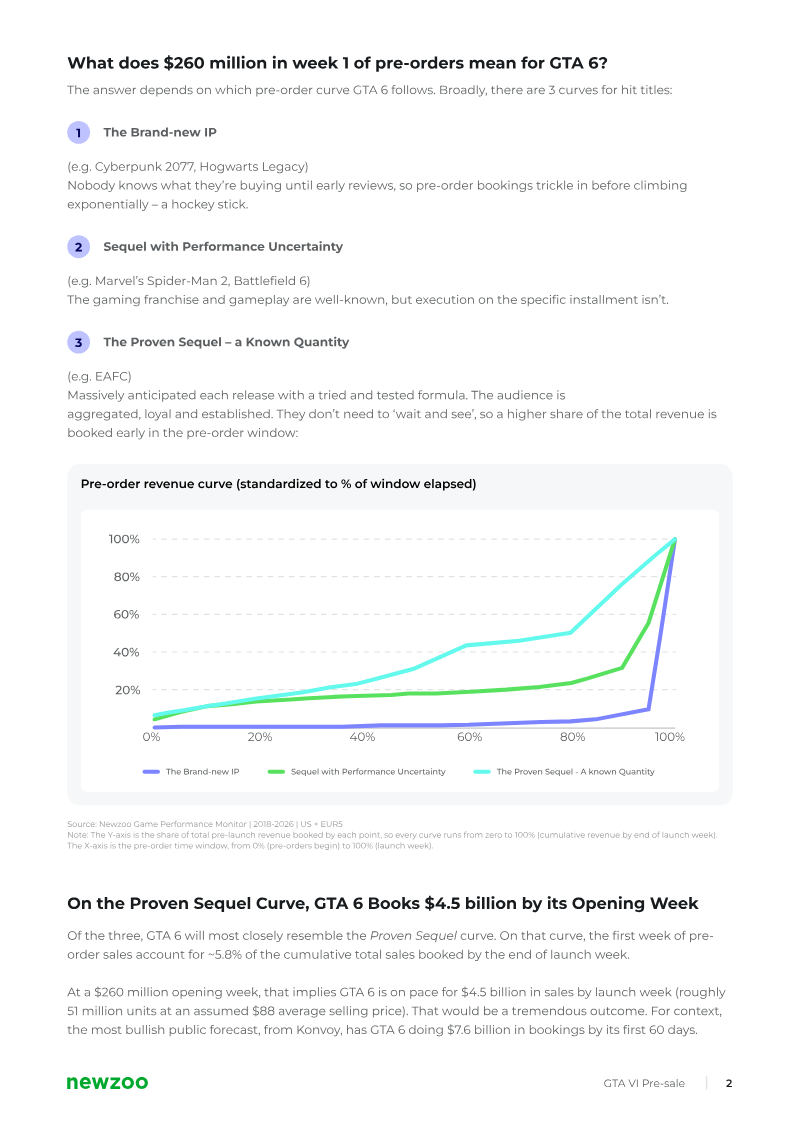
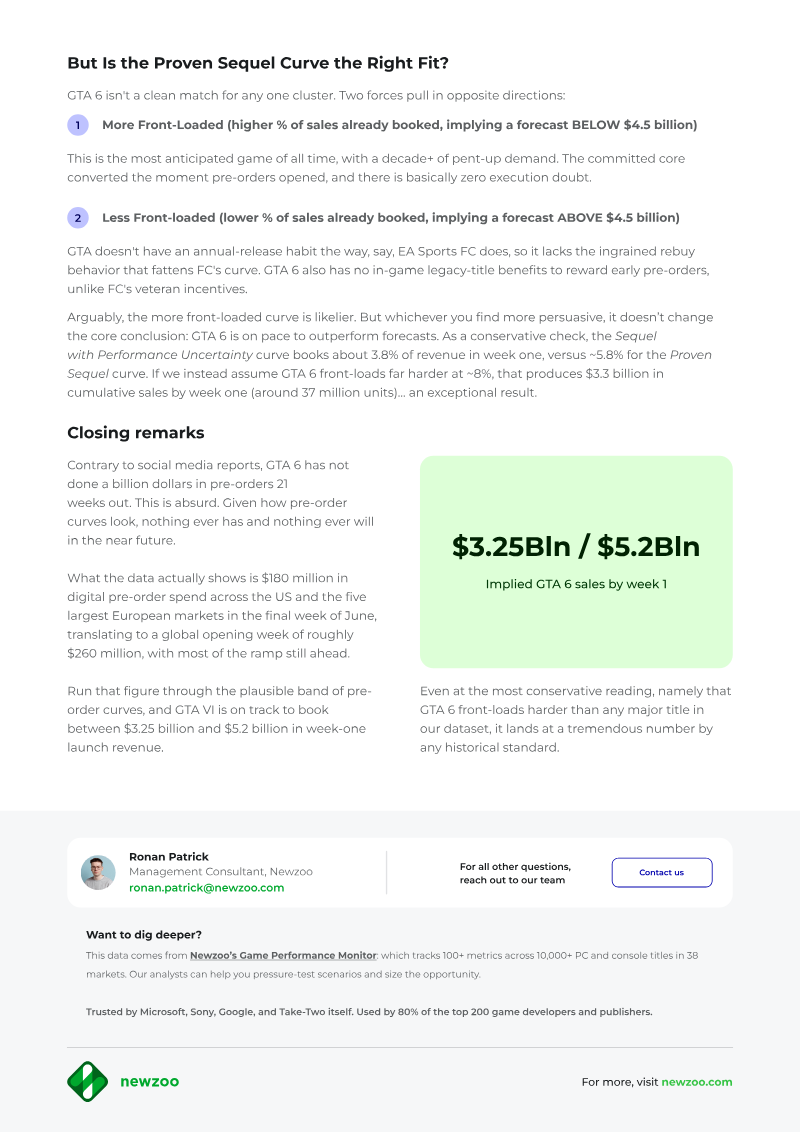
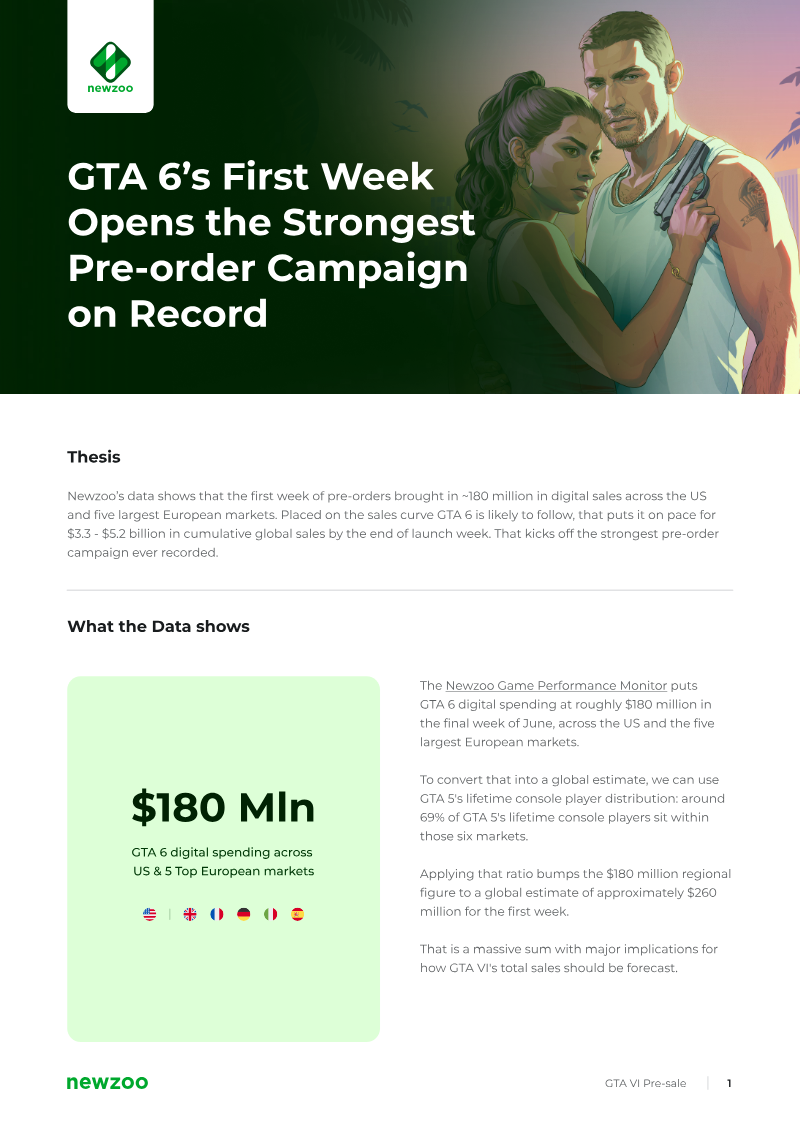
Grand Theft Auto 6 is currently positioned to achieve the most successful pre-order campaign in industry history, with projected cumulative global sales ranging between 3.3 billion and 5.2 billion dollars by the end of its launch week.
- Grand Theft Auto 6 is projected to achieve the strongest pre-order campaign in industry history, with estimated global sales between $3.3 billion and $5.2 billion by the end of its launch week.
- Digital pre-order spending for GTA 6 reached approximately $180 million in the final week of June across the US and the five largest European markets.
- This regional pre-order data translates to an estimated $260 million in global pre-order revenue for the opening week, based on historical console player distribution.

Why PlayStation Is Killing Discs (Despite The Fan Revolt)
PlayStation’s decision to discontinue physical disc production by 2028 has triggered significant consumer backlash, highlighting deep-seated concerns regarding digital game ownership, preservation, and the loss of the secondary market.
- Sony will discontinue the production of physical PlayStation game discs starting in January 2028.
- Transitioning to an all-digital model significantly increases Sony's profit margins; for a $70 first-party game, Sony keeps $70 on a digital sale compared to approximately $45.50 on a physical sale after retail cuts and manufacturing fees.
- For third-party games sold on the PlayStation Store, Sony captures a 30% platform fee (roughly $21 per $70 game), whereas they only receive a $10.50 licensing fee for physical discs sold at retail.
Market Model Reports: Asia & MENA
The 2026 Market Model Reports provide a comprehensive analysis of video game industry performance and growth projections across Asia and the Middle East and North Africa (MENA).
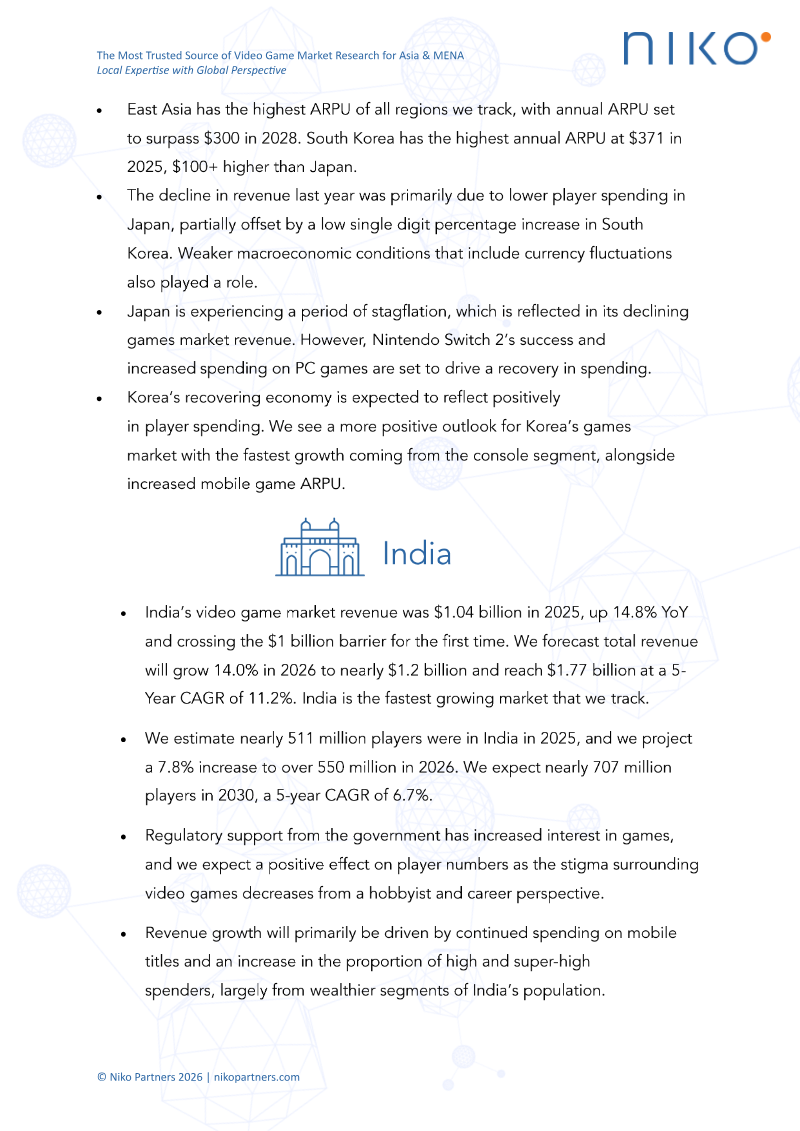
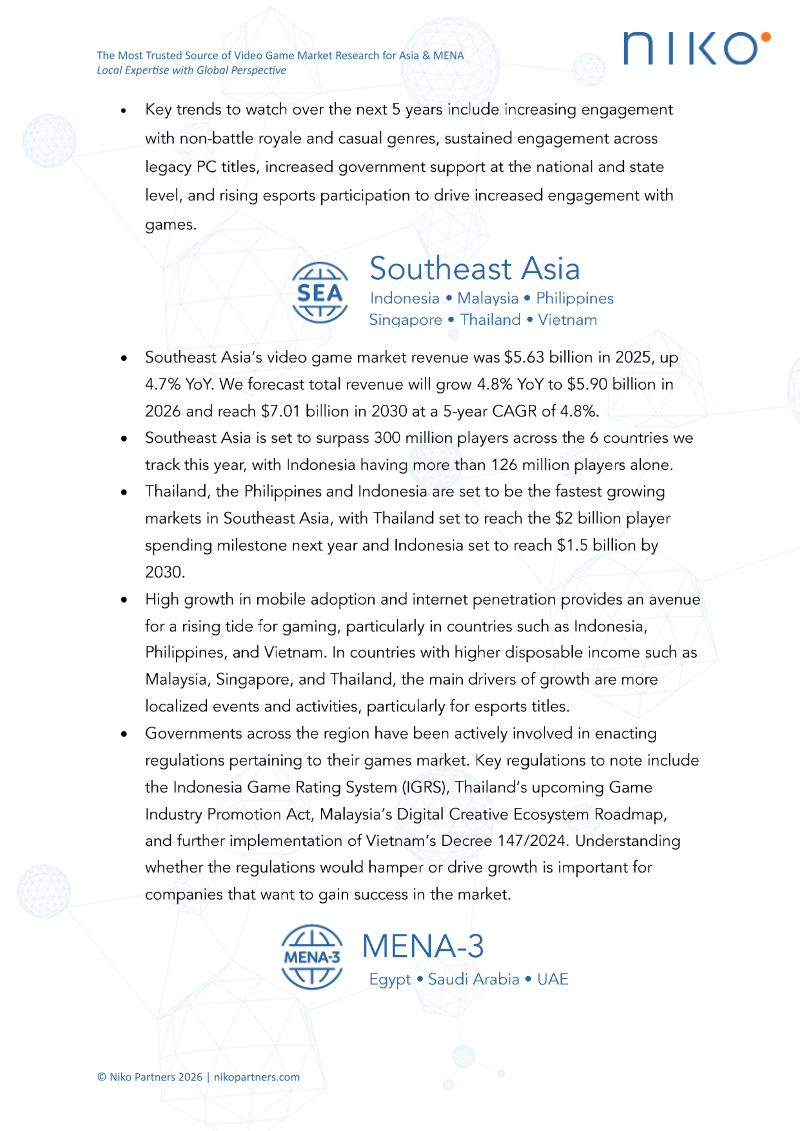
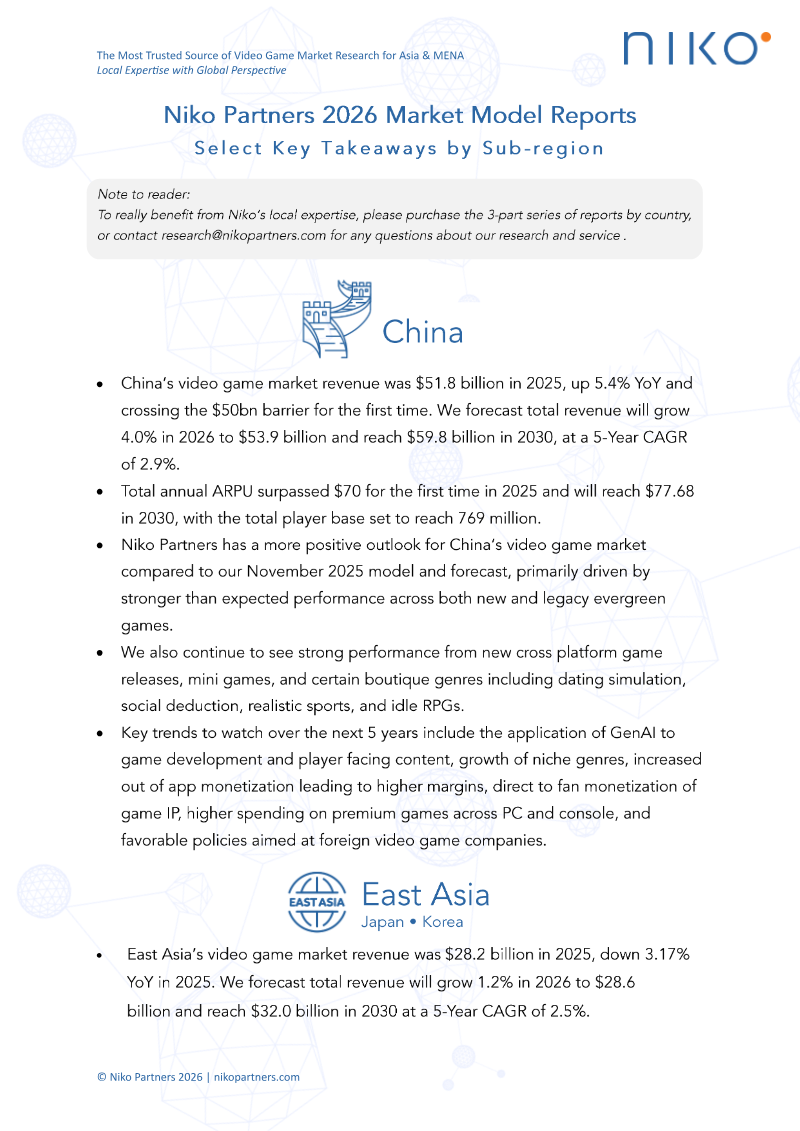
- China’s video game market reached $51.8 billion in 2025 and is projected to grow at a 2.9% CAGR to reach $59.8 billion by 2030.
- India is the fastest-growing market tracked, with 2025 revenue of $1.04 billion and a projected 11.2% CAGR through 2030, supported by a player base expected to reach 707 million.
- East Asia remains the region with the highest ARPU, though 2025 revenue declined 3.17% to $28.2 billion due to Japanese market stagnation and macroeconomic conditions.
Vietnam Gaming 2026 Outlook
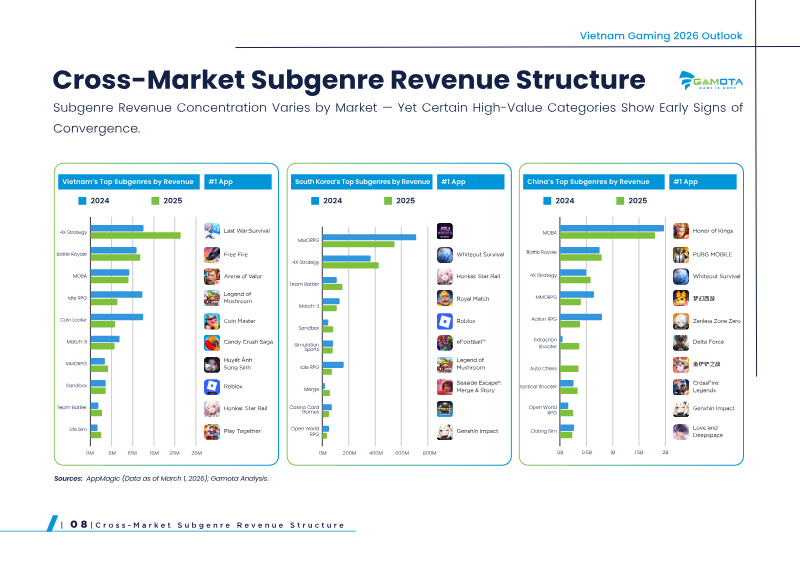
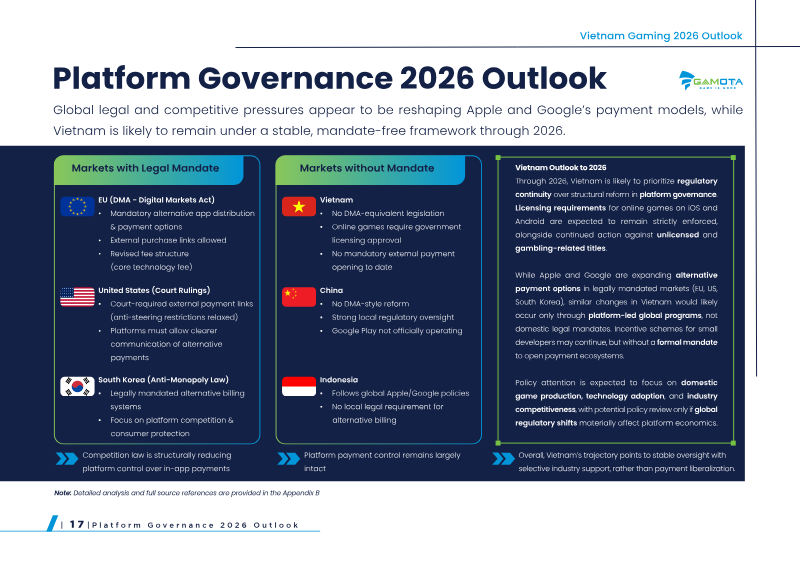
The Vietnam Gaming 2026 Outlook provides a comprehensive analysis of the mobile and PC gaming sectors in Vietnam, projecting sustained market expansion through 2026.
- The Vietnamese mobile gaming market is projected to reach 1.34 billion annual downloads and $287.45 million in in-app purchase revenue by 2026.
- Vietnam is currently in a high-growth user acquisition phase, though monetization per user remains less mature than in China or South Korea, signaling significant untapped revenue potential.
- Success in the Vietnamese market requires adapting game mechanics to favor convenience-driven progression over grind-heavy systems, even for globally popular genres like 4X Strategy, MMORPGs, and Match-3.

Call of Duty ‘at risk’ from GTA 6, EA set for World Cup boost, and Switch 2 hits UK milestone
The global gaming industry is currently navigating a period of intense volatility and strategic realignment, driven by the anticipation of major blockbuster releases and shifting consumer hardware trends.
- Grand Theft Auto 6 is identified as a primary market disruptor expected to threaten the player retention rates of established shooter and sports franchises.
- The Nintendo Switch 2 has reached a milestone of one million units sold in the UK within 39 weeks, matching the historical performance of its competitors.
- UK PlayStation 5 sales have experienced a 50% year-over-year decline following recent price adjustments.