THQ
Company
55 documents in the library are about THQ, from writers such as Embracer Group, THQ Nordic and Game World Observer. Each has a summary and key insights with the page they come from.
- Reports
- 13
Connections
The documents about THQ on the inner ring, the other games and companies they name on the outer one. Select a cover to see it up close and open it in a new tab; drag to move, pinch or Ctrl + scroll to zoom.
Key figures from the reports
THQ Nordic AB acquired Goodbye Kansas Game Invest for 42 million SEK to expand its Nordic development footprint and internal capabilities.
THQ Nordic, 2019 · THQ Nordic AB Acquires Goodbye Kansas Game Invest: Investor Presentation, p. 1
THQ Nordic acquired Australian publisher 18POINT2 in February 2019 for a total consideration of 2.4 million EUR, split equally between cash and shares, plus a potential earn-out of 0.4 million EUR.
Embracer Group, 2019 · THQ Nordic AB (publ) Acquires 18POINT2: Investor Presentation, p. 2
THQ Nordic acquired Italian developer Milestone s.r.l. on August 14, 2019, for a total upfront consideration of EUR 55.8 million, comprised of EUR 44.3 million in cash and EUR 11.5 million in B-shares.
THQ Nordic, 2019 · THQ Nordic AB Acquires Milestone s.r.l.: Investor Presentation, p. 1
THQ Nordic AB reported strong Q1 2019 financial growth, with net sales rising 36% to SEK 1,142 million and operational EBIT increasing 193% to SEK 204 million.
THQ Nordic, 2019 · THQ Nordic AB Interim Report: Q1 2019, p. 1
THQ Nordic achieved a 158% year-over-year increase in net sales to SEK 1,631 million and a 217% increase in operational EBIT to SEK 396 million for the quarter ending March 31, 2019.
THQ Nordic, 2019 · THQ Nordic Q5 FY18/19 Report, p. 5
Documents about THQ
Why None of Us Saw Cyberpunk Coming Apart I Michal Nowakowski. joint CEO, CD PROJEKT RED
CD Projekt Red’s evolution from a regional distributor to a global AAA powerhouse is rooted in a strategy of intellectual property ownership and creative independence.
- CD Projekt Red restructured its development operations by abandoning proprietary technology in favor of Unreal Engine 5 to mitigate technical risks and streamline production.
- The studio transitioned from a siloed, waterfall production model to a unified, multi-platform approach that utilizes rigorous gating milestones to prevent future launch failures.
- Despite a 75% decline in stock value following the technical failures of Cyberpunk 2077, the studio achieved long-term commercial recovery with 35 million base game units sold and 10 million expansion units sold.
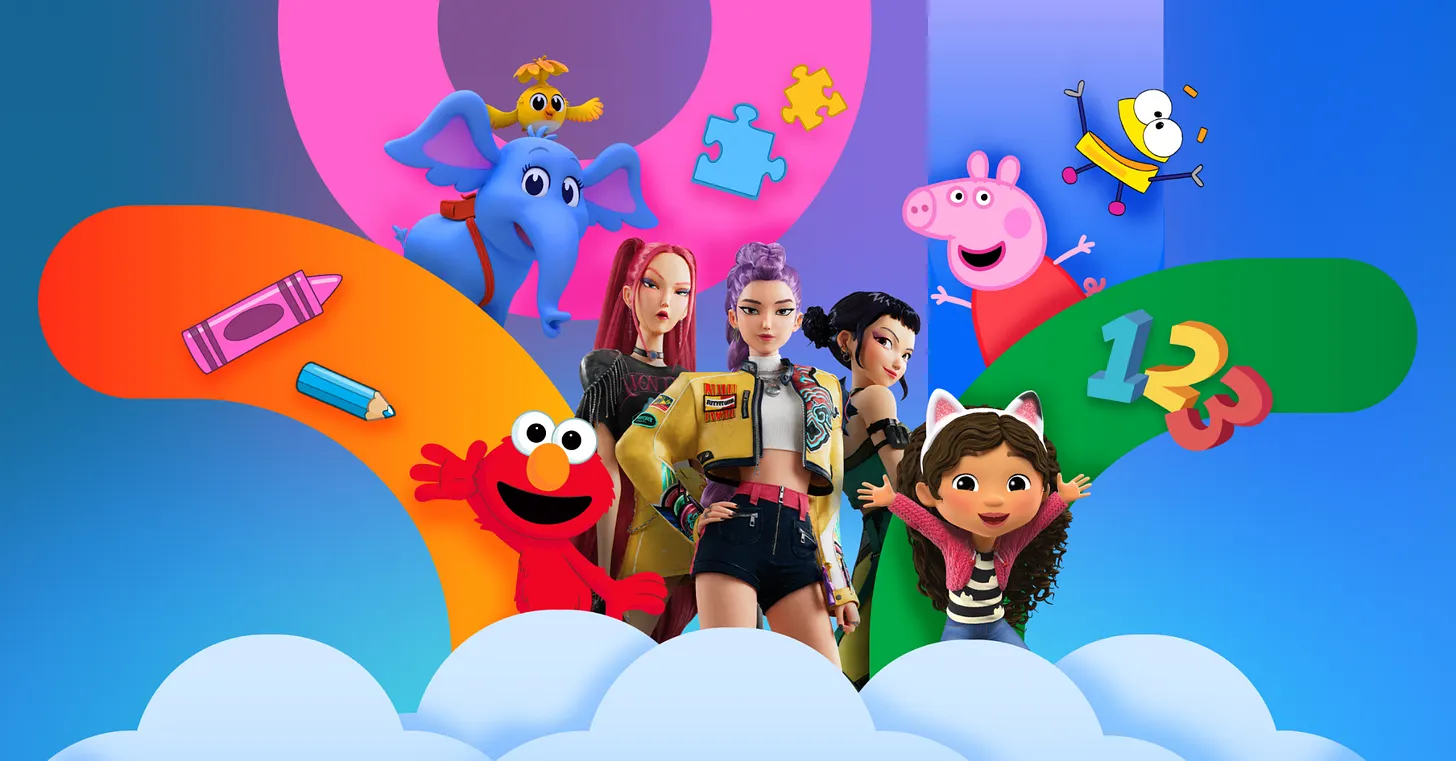
The Future of Kids Gaming
The kids’ gaming sector, defined as content for children ages 4 to 12, is undergoing a strategic shift as industry players move to capture the critical early childhood window before users transition to user-generated content (UGC) platforms like Roblox.
- The kids' gaming market is defined by a parent-controlled purchasing dynamic for children aged two to eight, a critical window before players transition to peer-driven UGC platforms like Roblox.
- Subscription-based aggregation is the dominant business model for kids' content, with platforms like Netflix Playground and Apple Arcade leveraging bundled, ad-free, and safe experiences to drive subscriber retention.
- Traditional publishers have largely retreated from the kids' segment, shifting their focus toward teen and adult audiences, which has created a vacuum filled by specialist studios and big tech firms.
Gothic 1 Remake Has Almost Recouped Its Development and Marketing Costs Already
The Gothic 1 Remake, developed by Alkimia Interactive and published by THQ Nordic, has achieved significant commercial success shortly after its June 5, 2026, release.
- The Gothic 1 Remake, developed by Alkimia Interactive and published by THQ Nordic, is nearing the break-even point for its total development and marketing costs.
- The game achieved over 500,000 unit sales during its debut week following its release on June 5, 2026.
- Steam version revenue for the title has reached $21.5 million in gross earnings, excluding platform commissions and taxes.

Seven Things You Probably Didn't Know About Naughty Dog Co-founder Jason Rubin
Jason Rubin’s career trajectory serves as a foundational case study in the evolution of the North American video game industry from the 1980s through the modern era of virtual reality and artificial intelligence.
- Jason Rubin co-founded Naughty Dog and, with Andy Gavin, developed early games like "Ski Crazed" and "Dream Zone" before creating "Crash Bandicoot," which became a major PlayStation IP in 1996, competing with Mario and Sonic.
- Sony acquired Naughty Dog in 2001, and the studio released the critically and commercially successful "Jak and Daxter" series on PS2, with Naughty Dog sharing their efficient environment instancing system with Insomniac Games for "Ratchet and Clank."
- Rubin and Gavin left Naughty Dog in 2004, and Rubin later worked at Meta (formerly Oculus) in various senior roles, leaving in 2026 as the company shifted away from VR, a move that didn't align with his personal passions.

Naughty Dog co-founder Jason Rubin on Crash Bandicoot, trying to save THQ, and the state of VR
The evolution of the video game industry is defined by a persistent tension between creative autonomy and the logistical constraints of corporate oversight.
- The success of the Crash Bandicoot franchise demonstrates that high-quality design and strategic platform targeting can overcome restrictive management environments and manufacturing bottlenecks.
- Efforts to revitalize legacy publishers like THQ reveal that deep-seated operational and financial systemic issues often negate the output quality of individual development teams.
- The industry-wide shift toward edgier content and increased production budgets was largely driven by the competitive pressure to match the market success of titles like Grand Theft Auto.
Former THQ Vice President: The Development of Titan Quest 2
The development history of Titan Quest 2 reveals that the project was originally greenlit by THQ in 2006 following the commercial success of the first title.
- THQ originally greenlit the development of Titan Quest 2 in 2006 following the success of the first game, but the project was canceled shortly after.
- The cancellation was driven by the THQ marketing department, which rejected an Xbox 360 demo produced by Iron Lore Entertainment in just three months.
- Marketing teams cited poor performance in Emsense biometric testing—which measured heart and breathing rates—as a primary justification for halting the project.


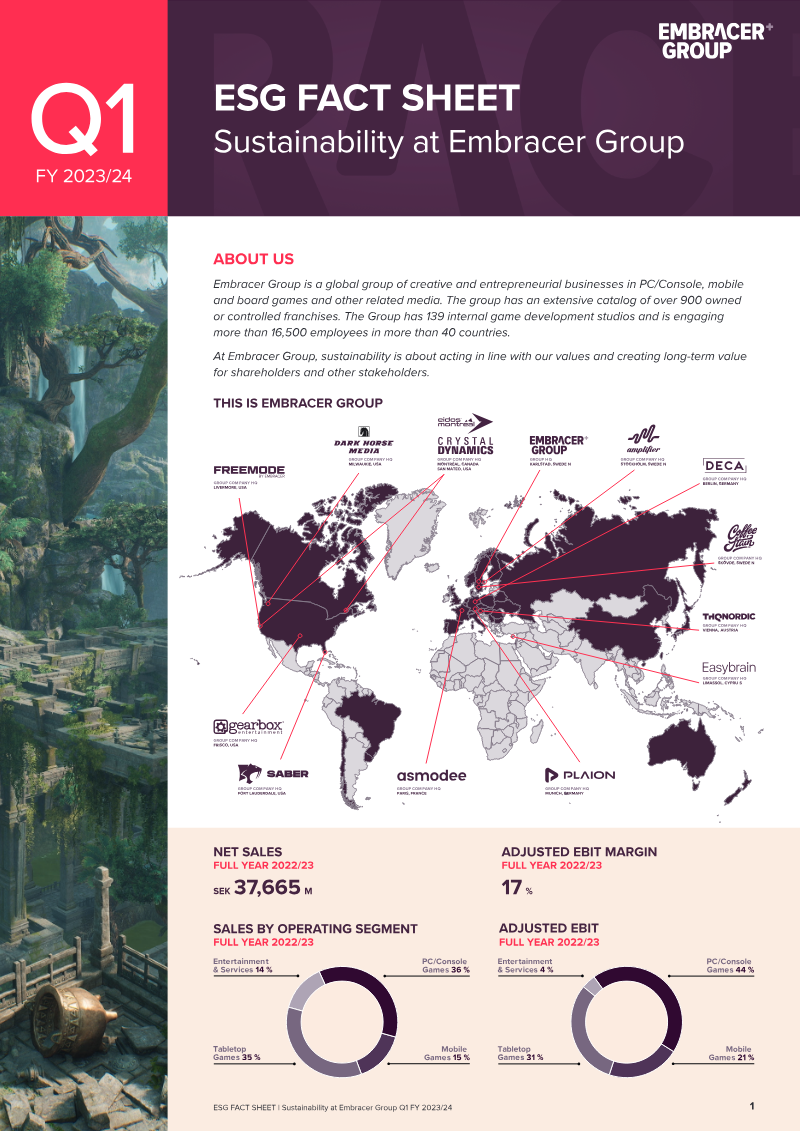
Q1 ESG Fact Sheet: Sustainability at Embracer Group FY 2023/24
The ESG Fact Sheet for the first quarter of the 2023/24 fiscal year outlines Embracer Group’s strategic progress and performance metrics across its global operations.
- Embracer Group aims to reduce its carbon emissions by 45% by 2030, following a 2022/23 baseline of 687,102 tCO2e, with the majority of the footprint attributed to Scope 3 emissions.
- The company has set a target to double the number of female Managing Directors and Studio Heads by 2025, starting from a current management representation of 23%.
- The group currently employs over 16,500 people across 139 internal studios in 40 countries, with women accounting for 26% of the total workforce.

Cloud9 Esports Appoints Tim Mulligan to VP, Head of Sales
Cloud9 Esports has appointed Tim Mulligan as its new Vice President and Head of Sales, effective January 2024.
- Cloud9 Esports has appointed Tim Mulligan as its new VP, Head of Sales, effective January 2, 2024.
- Mulligan joins Cloud9 from XSET, where he previously served as VP, Head of Sales for over a year.
- In his new role at Cloud9, Mulligan is responsible for revenue generation, sponsor relationship management, strategic planning, and brand representation.
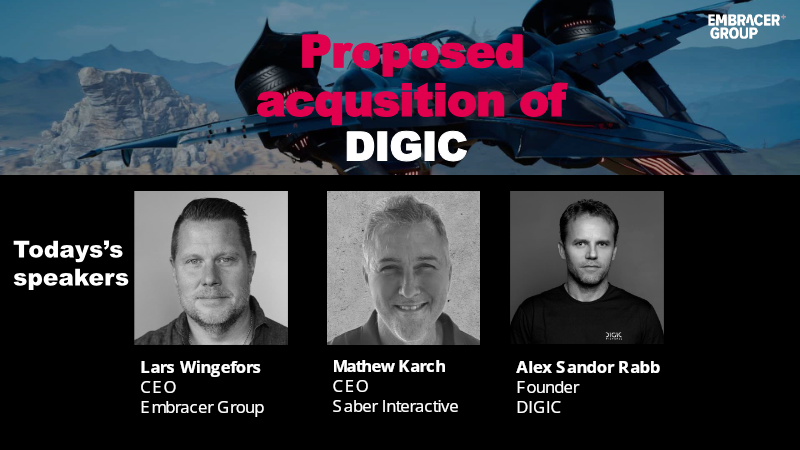
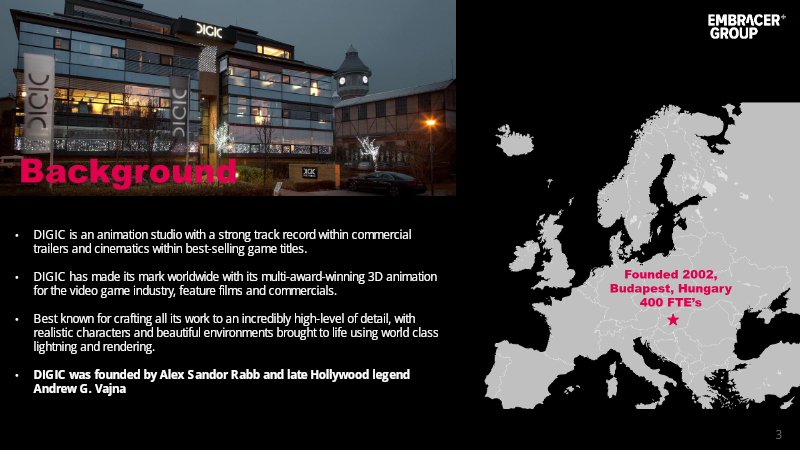

Embracer Group Acquires DIGIC Pictures
Embracer Group has finalized the acquisition of DIGIC Pictures, a Budapest-based animation studio specializing in high-end 3D cinematics and commercial trailers for the global video game and film industries.
- Embracer Group has acquired Budapest-based animation studio DIGIC Pictures, integrating the 400-employee firm into its Saber Interactive business unit.
- DIGIC Pictures reported net sales of SEK 240 million and an operational EBIT of SEK 50 million for the 2021 calendar year.
- The studio is projected to contribute between SEK 60 million and SEK 80 million in annual operational EBIT through the 2023/2024 period.
Plus: Biomutant Attacks, Elite's Odyssey Perplexes
This analysis examines the performance and market expectations for premium PC and console games during the third week of May 2021.
- THQ Nordic’s Biomutant generated significant AAA-level anticipation, securing approximately 182,000 Steam followers and two million wishlists despite being developed by a team of only twenty people.
- The launch of Elite Dangerous: Odyssey underperformed on Steam, debuting with a 36% positive review rating due to widespread technical bugs and performance issues.
- Sony’s PC port of Days Gone demonstrated strong market momentum, accumulating over 3,000 positive reviews on Steam within its first four days of release.
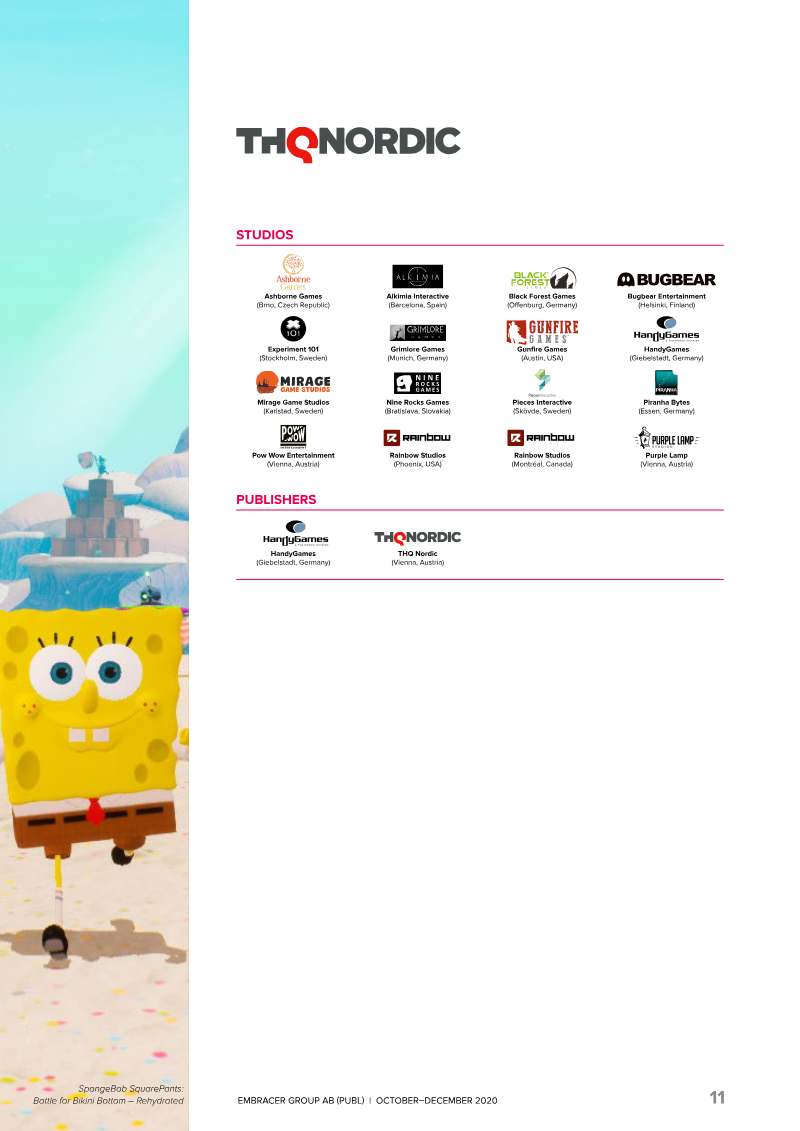
Embracer Group Interim Report 3: October-December 2020
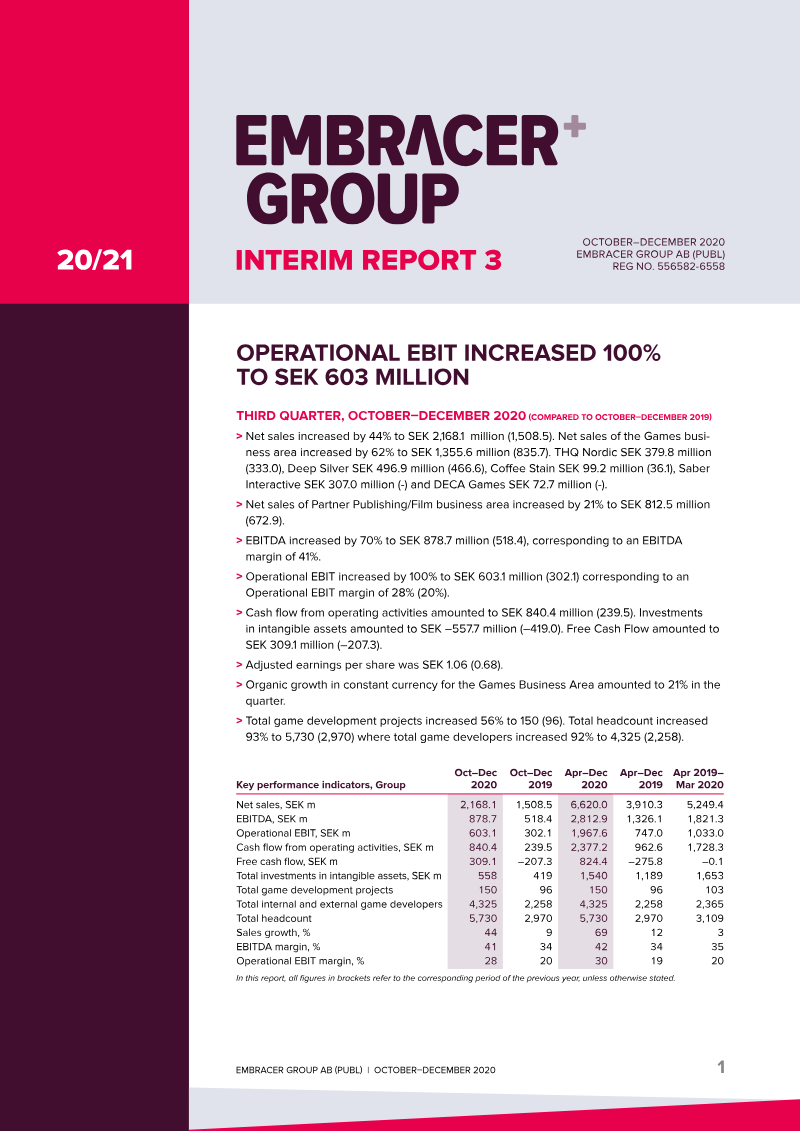
Embracer Group achieved substantial financial and operational expansion during the final quarter of 2020, characterized by a 44 percent year-over-year increase in net sales to SEK 2,168.1 million.
- Embracer Group reported a 44% year-over-year increase in net sales to SEK 2,168.1 million for the quarter ending December 2020, driven by 21% organic growth in its games business.
- Operational EBIT doubled to SEK 603.1 million, though the company posted an overall operating loss of SEK 60.8 million due to high amortization costs from its aggressive acquisition strategy.
- The company significantly scaled its operations by integrating ten new entities, reaching a total of 56 internal studios and over 200 owned franchises by the end of 2020.

Embracer Group M&A Update: February 3, 2021
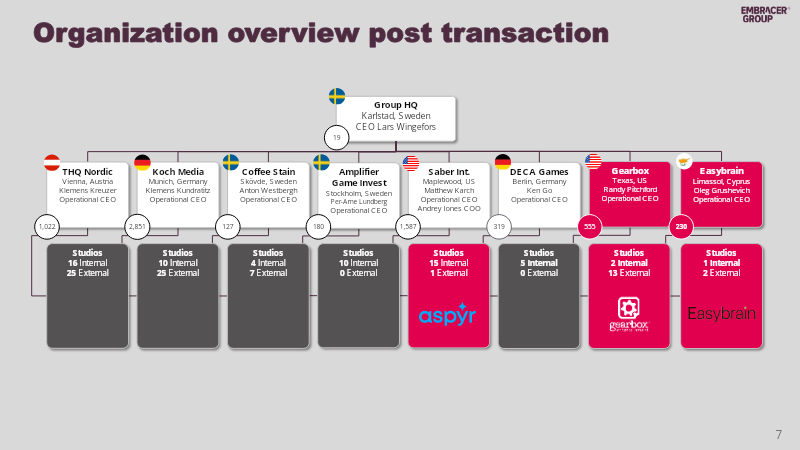
The February 2021 Embracer Group update outlines the strategic acquisition of Easybrain Group Limited, The Gearbox Entertainment Company, and Aspyr Media.
- Embracer Group acquired Easybrain Group, The Gearbox Entertainment Company, and Aspyr Media for an aggregate day-one purchase price of approximately SEK 9.3 billion.
- The acquisitions include a performance-based earn-out consideration of up to SEK 12.5 billion, contingent on the entities achieving over SEK 23 billion in accumulated operational EBIT over seven years.
- The expansion increases Embracer’s portfolio to 244 intellectual properties and grows its total workforce to approximately 5,719 developers.