Embracer Group
Game Co.8 documents
Swedish gaming holding company. THQ Nordic, Gearbox, Crystal Dynamics, Eidos, Saber Interactive. 100+ studios.
Documents
Financial24 pages
Embracer Group Interim Report: Q1 FY 2026/27
The Embracer Group’s interim report for the first quarter of the 2026/27 fiscal year outlines a period of operational stabilization and growth, characterized by a 24% year-over-year increase in net sales to SEK 3,943 million. The company maintains its full-year guidance, projecting a Cash EBIT of at least SEK 1.0 billion. This performance is underpinned by a strategic focus on core intellectual property and a disciplined approach to capital expenditure and operational costs.
The organization operates through two primary segments: Fellowship Entertainment and Embracer. Fellowship Entertainment reported a resilient quarter with SEK 810 million in net sales, driven by the enduring performance of catalog titles such as Kingdom Come: Deliverance, Metro, and Dead Island. Conversely, the Embracer segment experienced significant momentum, achieving 63% organic growth and SEK 3,134 million in net sales, bolstered by the release of Gothic 1 Remake and strong results within the Entertainment & Services division.
Financial health remains a priority, with the company achieving a positive free cash flow of SEK 3 million for the quarter, a notable improvement from the negative figures reported in the same period of the previous year. Net cash stood at SEK 3.5 billion as of June 30, 2026, supported by ongoing efforts to optimize the cost base through divestments and restructuring. The company’s pipeline for the remainder of the fiscal year includes several high-profile releases, such as Warhammer 40,000: Dawn of War IV and Tomb Raider: Legacy of Atlantis, which are expected to drive continued revenue generation.
The report reflects a shift in reporting methodology, with revised definitions for key performance indicators to improve clarity and consistency across the group. These adjustments include updated classifications for headcount, external titles, and catalog revenue. By focusing on these refined metrics and maintaining a consistent release rhythm, the company aims to sustain its current trajectory of improved earnings and cash flow throughout the remainder of the 2026/27 fiscal year.
- Embracer Group reported a 24% year-over-year increase in net sales to SEK 3,943 million for Q1 FY 2026/27, maintaining a full-year Cash EBIT guidance of at least SEK 1.0 billion.
- The Embracer segment achieved 63% organic growth with SEK 3,134 million in net sales, driven by the release of Gothic 1 Remake and strong performance in the Entertainment & Services division.
- The company reached a positive free cash flow of SEK 3 million for the quarter, marking a significant turnaround from the negative cash flow reported in the same period last year.
- Net cash stood at SEK 3.5 billion as of June 30, 2026, supported by ongoing cost optimization, divestments, and restructuring efforts.
- Fellowship Entertainment generated SEK 810 million in net sales, sustained by the performance of catalog titles including Kingdom Come: Deliverance, Metro, and Dead Island.
+1
Embracer Group
Financial62 pages
Embracer Group Full Year Report: FY 2025/26 Q4
Embracer Group’s fiscal year 2025/26 performance reflects a strategic pivot toward structural simplification and capital efficiency. The primary objective of this transition is to finalize the separation of the organization into two distinct entities, Fellowship Entertainment and Embracer, by 2027. This reorganization aims to optimize the management of a vast intellectual property portfolio while fostering a leaner, decentralized operational model. By shifting focus toward long-term brand equity and operational stability, the company seeks to move past a period of significant divestment and cost-cutting measures.
Financial results for the fiscal year indicate a 25% year-over-year decline in net sales and a decrease in adjusted EBIT compared to the previous period. Despite these top-line contractions, the company achieved a positive free cash flow of 50 SEKm, bolstered by strong performance in the Mobile and Entertainment & Services segments. Key titles such as KCD2 and REANIMAL provided necessary momentum, while the company’s workforce of over 1,600 developers continues to advance a high-profile pipeline including Metro 2039, Darksiders 4, and new Tomb Raider entries. To better align with its new operational focus, the company is introducing "Cash EBIT" as a primary performance metric, with a target of at least 1.0 SEK billion for the upcoming fiscal year.
The group maintains a healthy net cash position of 2,585 SEKm, even after executing a 750 SEKm share buy-back. This liquidity, combined with ongoing leadership restructuring and governance updates, positions the company to navigate the complexities of its impending corporate split. By prioritizing capital discipline and the activation of underleveraged assets, the organization is positioning itself to stabilize margins and improve long-term shareholder value across its global operations.
- Embracer Group is executing a strategic split into two distinct entities, Fellowship Entertainment and Embracer, with completion targeted for 2027.
- Net sales declined 25% year-over-year, though the company achieved a positive free cash flow of 50 SEKm driven by the Mobile and Entertainment & Services segments.
- The company is shifting its primary performance metric to 'Cash EBIT' with a target of at least 1.0 SEK billion for the upcoming fiscal year.
- Embracer maintains a net cash position of 2,585 SEKm, following a 750 SEKm share buy-back program.
- The current development pipeline includes high-profile titles such as KCD2, REANIMAL, Metro 2039, Darksiders 4, and new entries in the Tomb Raider franchise.
Embracer Group
Financial1 pages
Embracer Group FY2025 Annual Report
Embracer Group’s FY 2025/26 annual report outlines a strategic pivot toward an IP‑centric, disciplined operating model that will culminate in the 2027 split of the business into two listed entities—Fellowship Entertainment and Embracer. The group generated SEK 15.9 billion in sales, reflecting a 3 % decline in organic growth, and achieved an adjusted EBIT margin of 6 %. However, a substantial SEK 7.4 billion goodwill impairment drove reported EBIT into a loss of SEK 7.1 billion, prompting the company to adopt cash‑EBIT as its primary profitability metric and to emphasize cost‑synergy initiatives.
The restructuring has already produced the spin‑off of Asmodee and Coffee Stain, while Fellowship Entertainment will be separated to sharpen focus on high‑value IPs such as The Lord of the Rings and Tomb Raider. Embracer now operates through three segments—PC/Console, Mobile, and Entertainment & Services—and manages a portfolio of over 400 owned IPs with more than 6,000 employees. A SEK 750 million share buyback, supported by a net cash position of SEK 3.8 billion, signals the group’s commitment to returning capital while pursuing selective acquisitions and IP‑led publishing.
Market dynamics in 2025–26 show modest growth across platforms: the console market is projected to expand by 3 % in 2025 and 5 % in 2026, buoyed by major releases such as GTA VI and subscription services; PC gaming outpaces the overall market with a 12 % YoY increase in 2025, driven by premium titles and a thriving indie ecosystem; mobile gaming remains the largest segment at $113 bn, growing 11 % in 2025 and expected to rise 7 % in 2026. Global playtime remains flat, yet live‑streaming viewership has risen 6 % YoY, underscoring sustained consumer engagement.
- Embracer Group will split into two listed entities, Fellowship Entertainment and Embracer, by 2027 as part of a strategic pivot toward an IP-centric operating model.
- The company reported a SEK 7.1 billion EBIT loss for FY 2025/26, driven by a SEK 7.4 billion goodwill impairment, leading to a shift toward cash-EBIT as the primary profitability metric.
- Embracer generated SEK 15.9 billion in sales with a 3% decline in organic growth, while maintaining a net cash position of SEK 3.8 billion and initiating a SEK 750 million share buyback.
- The group now manages over 400 owned IPs, including high-value assets like The Lord of the Rings and Tomb Raider, across three core segments: PC/Console, Mobile, and Entertainment & Services.
- The PC gaming market is projected to grow 12% year-over-year in 2025, significantly outpacing the console market's projected 3% growth for the same period.
Embracer Group
Financial26 pages
Interim Report: Q3 FY 2024/25
The interim report for Embracer Group’s third quarter of FY 2024/25 presents a snapshot of the company’s financial performance, operational highlights, and strategic developments over the October‑December 2024 period. Net sales rose to SEK 7,364 million, a 7 % year‑over‑year increase, driven by healthy organic growth and an improved margin in the PC/Console segment. Adjusted EBIT fell 11 % to SEK 1,175 million, reflecting higher operating costs and the impact of divestments. Free cash flow for the quarter was SEK 907 million, up from a negative figure in the same period last year, largely due to the divestment of Easybrain and a focus on unlocking hidden value in existing assets.
Key operational milestones include the successful launch of “Kingdom Come: Deliverance II,” continued emphasis on operational efficiency, and the spin‑off of Asmodee onto Nasdaq Stockholm. The company’s portfolio now spans 64 internal studios and 5,170 employees, with a slate of ten AAA PC/Console titles in development and a robust pipeline of mid‑sized releases slated for FY 2025/26.
Financially, Embracer’s leverage covenant remains comfortably met, with net debt falling to a negative SEK 3.2 billion by year‑end 2024, supported by strong liquidity of approximately SEK 12.7 billion. Capital expenditures are projected to decline, while marketing spend is expected to rise as the company pursues growth in mobile and tabletop segments. Overall, the report signals a strategic shift toward portfolio optimization, cost discipline, and targeted expansion in high‑margin segments.
- Embracer Group achieved net sales of SEK 7,364 million in Q3 FY 2024/25, a 7% year-over-year increase driven by organic growth and improved margins in the PC/Console segment.
- Adjusted EBIT declined 11% to SEK 1,175 million due to higher operating costs and the impact of recent divestments.
- Free cash flow turned positive to SEK 907 million, supported by the divestment of Easybrain and a focus on unlocking value from existing assets.
- The company reached a net debt position of negative SEK 3.2 billion with SEK 12.7 billion in liquidity, ensuring all leverage covenants remain comfortably met.
- Strategic milestones include the successful launch of 'Kingdom Come: Deliverance II' and the spin-off of Asmodee onto Nasdaq Stockholm.
+1
Embracer Group
Financial19 pages
Embracer Group Interim Report: Q2 July–September 2025
Embracer Group AB reports a Q2 (July–September 2025) performance that fell short of expectations, with net sales declining 19 % year‑over‑year to SEK 3,850 million and adjusted EBIT slipping to SEK 109 million. The decline is largely attributed to a 6 % organic contraction in sales and higher depreciation‑amortisation costs, while the group’s free cash flow improved to SEK 1,292 million after a negative SEK 524 million in the prior year. Net cash at 30 September stood at SEK 11.9 billion, reflecting a modest increase in available liquidity.
Operating segments show divergent trends: PC/Console Games experienced a 13 % sales drop and negative EBIT, driven by under‑performance of titles such as Killing Floor 3 and mid‑size releases, whereas Mobile Games grew 17 % with a 25 % organic lift from the PLAION portfolio. Entertainment & Services posted modest gains, buoyed by licensing and merchandising from Middle‑Earth Enterprises.
The group’s return on investment analysis indicates a weighted average ROI of 1.9× across completed projects, with the top‑5 titles contributing over SEK 535 million in gross profit. Strategic actions include divestments of Easybrain and a shift toward an IP‑first structure, alongside planned share buybacks.
Looking ahead, Embracer forecasts adjusted EBIT of at least SEK 1 billion for FY 2025/26, expecting Q3 to outperform Q2 due to stronger seasonal performance in Entertainment & Services and a continued focus on mid‑size PC/Console releases. The company remains committed to operational discipline, core IP investment, and targeted cost initiatives as it prepares for a Nasdaq First North listing in December 2025.
- Embracer Group reported a 19% year-over-year decline in net sales to SEK 3,850 million and an adjusted EBIT of SEK 109 million for Q2 2025.
- The PC/Console segment underperformed with a 13% sales drop and negative EBIT, while the Mobile Games segment grew 17% with a 25% organic lift from the PLAION portfolio.
- Free cash flow improved significantly to SEK 1,292 million compared to a negative SEK 524 million in the prior year, with net cash reaching SEK 11.9 billion as of September 30, 2025.
- The company is executing a strategic shift toward an IP-first structure, which includes the divestment of Easybrain and planned share buybacks.
- Management forecasts an adjusted EBIT of at least SEK 1 billion for FY 2025/26, anticipating stronger Q3 performance driven by seasonal gains in Entertainment & Services.
+3
Embracer Group
Financial80 pages
Annual General Meeting FY 2022/23
Embracer Group experienced a period of intense expansion during the 2022/23 fiscal year, characterized by a 121 percent increase in net sales to SEK 37,665 million. This growth was largely fueled by high-profile acquisitions, including Asmodee, the Tomb Raider franchise, and The Lord of the Rings intellectual property. However, the rapid scaling of the organization introduced significant operational pressures, including margin compression and underperformance within the PC and console segments. Consequently, the company initiated a comprehensive restructuring program in June 2023, shifting its strategic focus toward improving capital efficiency, reducing net debt, and streamlining operations through studio closures and project cancellations.
The global gaming landscape remains a complex environment, with the mobile sector commanding nearly half of the $188 billion market. Within this competitive framework, subsidiaries such as Coffee Stain have emerged as models for sustainable growth by leveraging decentralized, agile development teams. By prioritizing small, autonomous units, these entities have successfully mitigated development risks and maintained high product quality. This operational philosophy is now being integrated into the broader corporate governance structure, which emphasizes rigorous financial reporting and internal controls to support the company’s transition toward a more self-sufficient and regulated business model.
Despite a 682 percent increase in share price since the initial public offering, the company faced a 58 percent decline in market value over the 2022/23 fiscal year. In response, the leadership team is prioritizing enterprise risk management and the appointment of board members with deep expertise in technology and global finance. By balancing a robust portfolio investment of SEK 11.4 billion with a newfound commitment to fiscal discipline, the organization aims to stabilize its financial trajectory and capitalize on the long-term growth potential of the international interactive entertainment market.
- Embracer Group initiated a comprehensive restructuring program in June 2023 to address operational pressures, focusing on reducing net debt and streamlining operations through studio closures and project cancellations.
- Net sales grew by 121 percent to SEK 37,665 million during the 2022/23 fiscal year, driven by major acquisitions including Asmodee, the Tomb Raider franchise, and The Lord of the Rings IP.
- The company experienced a 58 percent decline in market value during the 2022/23 fiscal year, despite a 682 percent share price increase since its initial public offering.
- The mobile sector currently accounts for nearly half of the $188 billion global gaming market, influencing the company's strategic focus on sustainable growth models.
- The organization is shifting its governance toward a decentralized model, adopting the agile, autonomous team structure successfully utilized by subsidiary Coffee Stain.
+1
Embracer Group
Report9 pages
ESG Fact Sheet: FY 2023/24
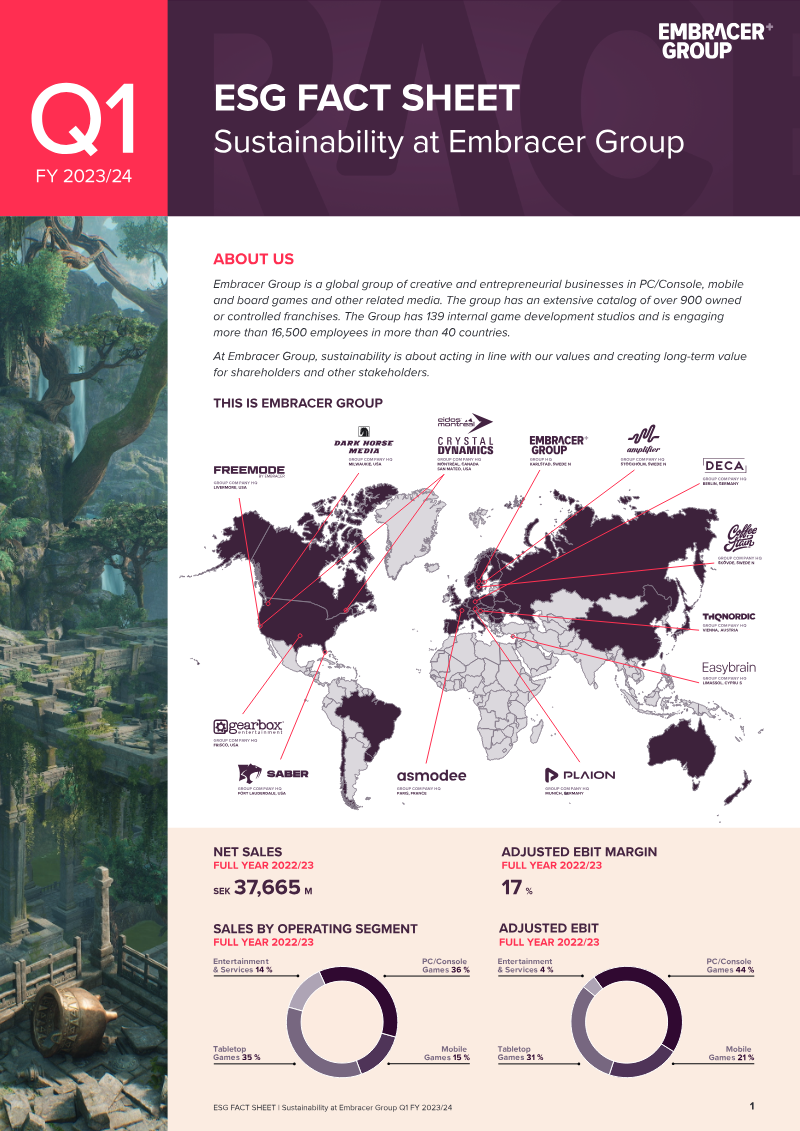
Embracer Group’s FY 2023/24 ESG Fact Sheet outlines the company’s sustainability framework, titled Smarter Business, which focuses on three core pillars: Great People, Solid Work, and Our Planet. Operating across more than 40 countries with 139 internal studios, the organization aims to integrate ethical governance and long-term value creation into its global operations. The company’s sustainability strategy is supported by 16 group policies and 12 guidelines, with oversight provided by the Audit and Sustainability Committee and an internal Ambassador Group.
Key performance indicators for the 2022/23 financial year highlight both progress and areas for development. Within the Great People pillar, the company reported a 26% female representation rate and an employee satisfaction score (eNPS) of +29. To foster leadership diversity, the board has committed to doubling the number of female managing directors and studio heads by 2025. Regarding environmental impact, the company has conducted a comprehensive greenhouse gas inventory, reporting total emissions of 687,102 tCO2e. The firm has aligned its climate strategy with the Paris Agreement, targeting a 45% reduction in carbon emissions by 2030 compared to a 2021/22 baseline.
The company utilizes a structured methodology for tracking progress, including annual global employee surveys and standardized sustainability due diligence during acquisitions. Furthermore, the organization actively participates in industry-wide initiatives such as the UN Global Compact, Women in Games, and PlayCreateGreen. By integrating these partnerships with internal training programs on privacy and ethics, the company seeks to manage operational risks while promoting digital well-being and accessibility across its portfolio of over 900 franchises.
- Embracer Group has committed to a 45% reduction in total carbon emissions by 2030, using the 2021/22 financial year as its baseline.
- The company reported total greenhouse gas emissions of 687,102 tCO2e for the 2022/23 financial year.
- Female representation across the organization stands at 26%, with a board-level mandate to double the number of female managing directors and studio heads by 2025.
- The organization maintains an employee satisfaction score (eNPS) of +29 across its 139 internal studios.
- Sustainability oversight is managed through 16 group policies and 12 guidelines, with governance provided by an Audit and Sustainability Committee and an internal Ambassador Group.
+3
Embracer Group
Financial9 pages
Q1 ESG Fact Sheet: Sustainability at Embracer Group FY 2023/24
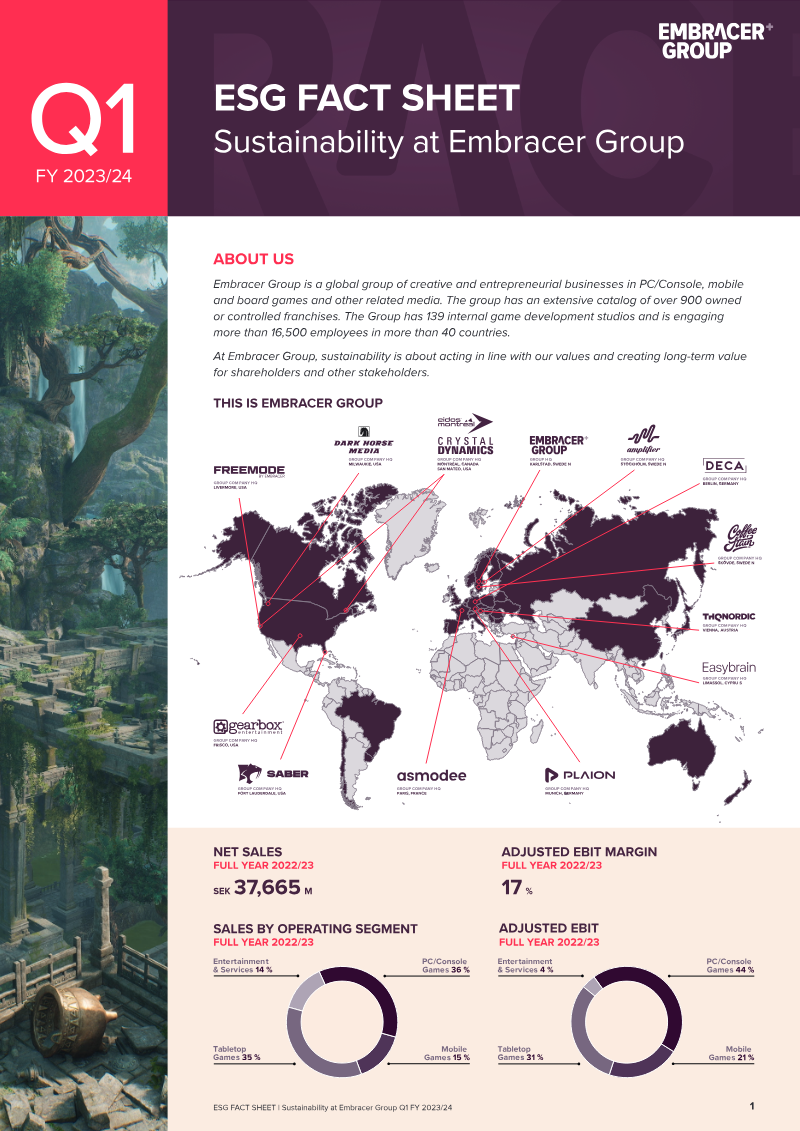
The ESG Fact Sheet for the first quarter of the 2023/24 fiscal year outlines Embracer Group’s strategic progress and performance metrics across its global operations. The document serves to communicate the company’s "Smarter Business" sustainability framework, which is organized into three primary pillars: Great People, Solid Work, and Our Planet. The scope of the report covers the group’s 139 internal studios and over 16,500 employees across 40 countries, reflecting data from the 2022/23 fiscal year as a baseline for future goals.
Key findings highlight a commitment to diversity and environmental responsibility. The group has set a target to double the number of female Managing Directors and Studio Heads by 2025, noting that female representation currently stands at 26% of the total workforce and 23% of management. Environmentally, the company aims to reduce carbon emissions by 45% by 2030 in alignment with the Paris Agreement. Data shows total emissions for the 2022/23 period reached 687,102 tCO2e, with Scope 3 emissions accounting for the vast majority of the footprint.
Operational updates for the quarter include the launch of an internal Corporate Sustainability Reporting Directive (CSRD) readiness project and enrollment in the UN Global Compact Gender Equality Accelerator. The group also emphasizes social responsibility through accessibility initiatives and community management, noting that 50% of its studios now have routines for addressing diversity and inclusion within game content. Governance is maintained through 16 group-wide policies and a structured sustainability organization that integrates representatives from each operative group, such as THQ Nordic, Plaion, and Asmodee, into the broader corporate strategy.
- Embracer Group aims to reduce its carbon emissions by 45% by 2030, following a 2022/23 baseline of 687,102 tCO2e, with the majority of the footprint attributed to Scope 3 emissions.
- The company has set a target to double the number of female Managing Directors and Studio Heads by 2025, starting from a current management representation of 23%.
- The group currently employs over 16,500 people across 139 internal studios in 40 countries, with women accounting for 26% of the total workforce.
- Half of the company's studios have implemented formal routines to address diversity and inclusion within their game content.
- The organization has launched a Corporate Sustainability Reporting Directive (CSRD) readiness project and joined the UN Global Compact Gender Equality Accelerator to formalize its ESG strategy.
Embracer GroupMar 2024