VideoDeconstructor of Fun
Why None of Us Saw Cyberpunk Coming Apart I Michal Nowakowski. joint CEO, CD PROJEKT RED
14 Sept 202663 min video

Transcript
CD Projekt Red is the only studio outside US, Japan, and UK that has built a globally competitive AAA franchise. And if I go through the games you guys have made, Witcher 1 launched in 2007 selling about 10 million copies. We got Witcher 2 4 years later selling about 50 million copies. And then the Witcher 3 was the breakout hit. Launched again 4 years later in 2015 selling approximately 65 million copies. I'm very interested to understand how did the company change as the business scale so rapidly?
Okay. Just just for the record, all the numbers you've given are correct, but they are since the launch date till today. Not like Not like on the launch not to create any misconceptions about people thinking like that. 10 million Witcher 1, you know, back in 2007. I wish, but that wasn't the case. Um how the company uh came to Witcher 1 maybe is is is an interesting question on its own. And this is the beginning I'm going to maybe elaborate a little bit here because then the the story is a little bit easier to comprehend from like that
uh more global perspective is uh we used to be uh a video game distributor uh on the Polish market. And then subsequently on the Czech and Slovakian markets. And also Hungarian market for a brief moment of time. Which means we were essentially licensing or importing games of the likes of Interplay, uh Acclaim, uh Sega, THQ, and and whatnot, you know, into the markets and selling them in the in the boxes on the actual physical shelves. Uh mostly for PC because this is where the market was actually in the um uh you know, back in the day uh in the Eastern Europe. But also subsequently in the in the console markets. So, this was where we began. And then uh very early on we had a dream of making our own games. That came from several uh angles. Like we got to meet a lot of founders of uh development companies. And we were very charmed with with, you know, with the success they enjoyed, with the creativity behind it. Um
Uh especially with the role-playing games, we shared that passion as well. A lot of us used to be a tabletop role-playing gamers, myself included, back in like the '90s '90s and the late '80s. Um and uh we also felt from purely business perspective that at a certain point um we might be squeezed out of the market by the companies as the markets are going to be growing. That's what we thought back in the day. Uh you know, EAs, Activisions of this world are going to open up their own offices, and there's not going to be that much need for a a company like ours, which was doing a service of not just putting the games on the shelves, but also doing the marketing. Important point, we had publishing since that times. This is a very important part of the DNA of the company, actually. So, uh that's what we were thinking, and one thing led to another. We figured, "Okay, how do we go about creating our own content?" And the idea at first was to port something, not really create something from scratch, but port a game. And the first target we picked was uh
Baldur's Gate: Dark Alliance. Baldur's Gate was a massive breakout hit for us back in the distribution uh uh days. But as I mentioned, PC was the dominant market, and unfortunately for us, Dark Alliance was a uh you know, was a console game, PlayStation 2 and Xbox and so on. And the market for that was very niche. Um so, we came to Interplay saying that, "Hey, how about we, you know, uh are you going to make a port of PC?" to PC and said, "No, the market isn't up there, you know." "So, how about we create one?" And they were like, "Well, how would you go about that?" And we said, "You don't ask any questions, and we'll just do it." "Are you going to hack it?" And we said, "Well, just just let us handle it." So, we essentially had to uh bring uh PlayStation 2 dev kits into Poland. Uh Poland was then not sanctioned to have PlayStation 2 kits within the region at all. Like you couldn't get them. So, we smuggled one from uh uh from the UK, as far as I recall. And we set up a team of about three people to start the development process of the port.
That never came to be but not because we somehow failed. Maybe we would have but but but that was not the reason that interplay fell apart. And and suddenly you know the the the the kind of agreement we had to you know to bring this port to life made no sense anymore because there was no interplay. There was nobody to talk to. So what do you do? You're left with a team with a massive team of three people that you know illegally brought into the country PS2 dev kit. Um The the the first idea was let's let's make a game of our own RPG because why not? Because we love RPGs. And that led us to the to the moment where we started thinking what do we base it on? And we were all growing up in the 80s and the 90s reading Andrzej Sapkowski the creator of The Witcher short stories and eventually novels. And I think it was Michał Kiciński one of the one of the original co-founders who said like why don't we talk to him? He before actually licensed the IP to
one gaming studio in Poland. They never finished the game. So we knew he's open. We went to him ask him for for that but we said we want to buy the rights from you. To which he said yes but there was like there was some condition like we have to make a game. I'm not sure he 100% um thought we're going to finish the game hard to say. Um But but you know one thing led to another. We we bought the IP in the in the area initially in the area of of video games and started working. Um and and and then subsequently we are in touch with um We were surrounded we were lucky we were blessed with being surrounded by a lot of really good willing people. Like BioWare folks who who were pretty impressed with us bringing you know making localization into Polish of the Baldur's Gate 1 and 2 without any external help. Uh and they were giving us a lot of advice. Uh they licensed the engine the Aurora engine on which the first Witcher was was built. Uh
Although we changed it a lot uh uh back in the day that's another story. Um but uh you know all those small things combined with the fact that we had this this this very uh native to our company knack of uh DNA of working hand-in-hand uh of marketing and development to bring something to to the market also from the commercial angle and the PR angle let us to what was essentially Witcher 1 launch. Um and uh the reason Witcher 1 actually went beyond the first one is is a small interesting story on its own as well because it only happened because we uh were lucky to land a publisher that allowed us to keep the IP. Which back in the day when everything was gated through through major uh publishers in order to get to the shelves in order to have a deal you know to have a display of your box on on the shelf of GameStop on the shelf of you know game in the UK
or whatever other retailer you had to be with someone who's going to bring you you know EA Activision again and so on. So we spoke with a lot of these people. And uh their response was always all right we we like it. We have a few you know notes here and there but like uh the IP's ours uh and uh and we're like no I mean we uh we can't do that like like this is really core value for us to you know to keep the IP to grow it even further. So this is this is you know the deal is a pass. And I'm not sure where where it would have ended if it wasn't for the fact that we stumbled upon Atari which was in deep deep trouble uh at that time. And that turned out to be a perfect match for us. They needed product.
Yeah.
Uh to to, you know, to bring revenue and so on. And they cared more about that than about keeping the IP. And they Of course, they negotiated, but when we said, "Okay, if if it's not, then we're just, you know, we're just leaving." I don't think we actually had any other option at that point, but it is what it is. They agreed, and the rest is history. I
mean, Atari allowed us to keep the IP. We launched the game through them. And it was a moderate success, but big enough to allow us to continue.
This episode is sponsored by Moloco. More than 2 billion daily active users, over 2.8 million independent apps globally. That's the reach Moloco ads unlock for performance marketers who don't want to stop at the usual walled gardens. It's all powered by Kara, Moloco's compound [music] AI system continuously learning from billions of events and getting smarter with every campaign. Hop over the walled [music] garden. Check out moloco.com. That's m o l o c o.com.
How did that came about that you understood the value of our IP so early?
From the very beginning. Uh [sighs] because we we were Okay, in our distribution days,
we were, of course, focusing on um distributing the boxes. Our business relationships uh with with the publishers and so on. These were not the people who were making the games, but because we were very focused on localization, so like translating the games into Polish, Czech, Hungarian, eventually as well. We made a lot of effort to be in touch with the developers. And uh when we were talking to them, we heard so many regret stories that I wish that thing was mine, because, you know, I made it a success. But my my reward from the success is just many levels lower. Uh you know, because because I don't own it. I don't own anything I create. Probably, yeah. I mean, I know Remedy guys, by the way, very well. They they don't really go back to those times that much because, you know, they they got their own stuff going on right now, but I would imagine that must have been the feeling. Yes, I mean, they created something that was amazing, but
everything was in the Take-Two.
Yeah.
At that moment in time, they did an amazing job as well, but end of the story, they're not the owners of the IP period, yes. So, I think I think that lesson was was very important. So, I think what I'm saying is is we were a very unique and bizarre mix of people who were both creatively uh and business-wise set up and intertwined in a very proper way, and that's how the whole company has been evolving since the day one.
Yeah. That's what I'm saying. Like that you had that understanding of the foundation of the business that you didn't and you didn't discount it. You kept with it.
True. And and I don't think we well, I I don't I don't don't think. I know we didn't think that it's going to become as big as it did. We we didn't. Like we our our big dreams were something much smaller. I cannot even tell you what it was because I don't remember, but definitely not where we are right now. But I can tell you for sure that
the goal we were setting from the beginning back in the, you know, early 2000s was uh I still remember when we put it on the blackboard was our goal is to become the biggest um the or the most significant I forgot how we phrase it, a role-playing games developer in the world.
Mhm.
And you know, when we showed it in the company, everybody was maybe not necessarily sold on
European skeptical.
Yes, and and of course, it was met with a lot of skepticism globally as well. You went through E3 the show that doesn't exist, but we know what it used to be in the US, LA, before that Atlanta actually. Uh Uh and and people just were like "Yeah, nice, but like whatever. Let's Let's talk about, you know, that that changed later on." And I By By the way, I wouldn't say we're, you know, we're we're the kings and and that's it. I I don't think it's true. What I think I I learned and we learned as a company since is that uh this is something you have to fight for always. Like the moment you stop, you're gone. And I'm not saying we're the kings of the RPGs right now. I mean,
I hope we might be uh called that, you know, after The Witcher 4 launches by by by some people who will love it, but that's nothing is granted, you know. This is very important to remember for us and for our people. Uh but that was the goal. That was the ambition. And and And of course with that ambition comes the desire to to be global. And and and we were always very uh not so much focusing on what we're going to do with with with this specific view. Of course, that doesn't account for distribution of the boxes. Uh but with the game making, we were always thinking how is it going to click globally? And we spent ton of time visiting places just to understand how the games industry business works in that specific bit. And I literally mean that. Like like before Witcher 3, I personally traveled for 2 years to every nook and cranny of the world to understand uh
[clears throat]
what people are thinking like about the video games, what works, what doesn't.
That's fascinating. It It is a very different approach and very different how you built the fundamentals because
often times you would see a studio just wanting to ship a game. They have this game idea, doesn't matter what's in the contract or, you know, how others are doing. They have this vision and they're executing against it. But you almost had a vision of the business and you're executing on how we're going to build the business.
Yes. Um I think I think in the very beginning we maybe had a little bit more of that than than than of the game. I think the game came uh, a little bit later, but we were very lucky with having very talented people from the very beginning and bringing more of the talented people on it early on, and uh, and the vision was evolving, and I think The Witcher 1 was flushed uh, down the toilet, to be honest, twice at least, uh, at least once by by literally recommendation of the Ray and Greg from BioWare, who said, "Guys, this is just not going to work." Like, we showed it to them, and uh, but instead of just canceling the whole thing, we said, "Okay, we'll go back to the, you know, drawing board." Um, so it was a combination of a lot of things, but yes, the the the vision of the business was very strong from the
from the beginning.
Unless you've been living under a rock, you know this is Webstore Rumsrpinger. 70% of top apps are using a Webstore, and the best ones, they're doing it with AppCharge. Do you want a $20,000 in-app purchase?
[music]
Yeah, AppCharge does that. Do you want to pretend that subscriptions are still a viable monetization strategy for games? Yeah, AppCharge even lets you do that. They get what high average revenue per paying customer means, and they're already [music] doing over half a billion dollars in transactions a year. So, are you going to be the first to do a $20,000 IAP?
[music]
Don't accept microtransactions, embrace macrotransactions. Learn more at appcharge.com.
Yeah. And talk to me a little bit about the uh, building of the company, because in order to build a sustainable, strong company, it's not only the contracts, and it's not only the vision, you need the people, and you need the funding. So, where did you get these super talented people to build those games, and where did you get the funding to
ship the game?
So, I I I'll start with the latter. The the funding was um, was actually coming from the distribution of the box game. So, we had a business that was uh, providing us the money to at least initiate the the development. Later on, uh, we were finishing, of course, with the money from the publishing deals we got from Atari, and so on. Um so so so so this helped us to finalize. The talent is uh uh it's actually interesting thing. I mean, the games industry in Poland existed even in the early '80s and so on. Like there is Poland was a country where uh the love of math was very very deeply rooted. Um and uh was really thriving even in the communist times. So so my generation, which is essentially the first generation of of the people who worked on The Witcher, so the people who were born in the '70s or or early '80s, um uh grew up with that love of math, of
programming, and so on. Uh there was a lot of, you know, 8-bit computer uh fascination and uh popularity in the country. Uh you know, Atari 800 XL, C64, ZX Spectrum from the UK, uh Commodore, yeah. I mean, you you name it. Like these were like the three main platforms. And people and and people were just, you know, playing with them. And and as is usually the case, like a lot of people are playing with something, some of them are going to turn out to be really good at it. And they [clears throat] may just need like a structure around themselves to create something more. And and uh I think that um that combined with the fact that uh uh Poland also has a very rich history of storytelling.
Yeah.
Uh and uh and because we were a company that was very good at figuring out ways how to talk to people about things to make them excited, we understood also as fans, uh which sounds counterintuitive because I'm not sure fans should always
try to do what they love, but it actually worked with us because we knew what works for fans. We uh we felt we're going to know how to talk about certain things, how to amplify what is good. Combination of all of those things led to us creating a team that was able to at least do something that was actually not that very good in the beginning. Uh but as we were zeroing the project twice, we learned on each iteration and and actually what we learned back with The Witcher 1 uh is still a mantra within the company, of course, right now built on very different production pipelines, much more professional. Naturally, as is usually the case if you've been doing something for for almost 30 Oh, actually more than 30 years. Um the Witcher's iteration, but iteration a little bit different than what you may think. Not like in the mobile games where you iterate, iterate, see what clicks and so on, but more like we iterate specifically on storytelling
um to hit a special chord of what we call this is the CDPR storytelling. We feel we have a very unique way of telling stories. Mature stories, and that was our bet from the beginning. Um which was not obvious in that time because because more high fantasy was was was like predominant in in the fantasy genre, and we bet from the beginning that if adult people like ourselves, and we were like in the late 20s, early 30s back then, still enjoy playing role-playing games, but they don't necessarily want to interfere with the creative that is okay for 16-year-olds and so on. I used to play D&D, you know, stuff like that, but uh at least the version I played when I was 16 was the 16-year-old D&D, so very very very cliché kind of stuff. I know you can do a lot of cool stuff with D&D, of course, but we wanted to to tell a story that is going to be recognized by mature adult people as
like, "Okay, this is something that could happen in real life if there was, you know, magic or witchers or monsters and stuff like that." And this was not very natural um uh kind of trend back then. I think Game of Thrones uh in the TV uh validated a lot of that in the pop culture in general. Uh uh but back in like the early 2000s, it was not. So, so it was like a combination of of of of of of that of that uh iteration of the story, of perfecting that uh way of telling CDPR stories that that basically the whole company's built on to this very day. And I'd say that everything we were weaker on in terms of design uh because let's be honest, which one was not uh or or two or or even three were not, you know, the best games when it comes to I don't know, gameplay. Uh they had their strong moments, but they also were not like the best in the genre ever. Uh but the story was where we excelled. The depth, uh how we
explored it, how we made people attach themselves to the characters, to what was going on in the game. That was the winning formula. And um and it it it it's it's something we try to cherish, you know, within the studio to this day.
And so when you were working on Witcher 3 and probably before the launch, I mean, it's a 4-year cycle at least. Um that's 250 people internally working on the game, right?
Uh so so this is interesting because uh I've I've seen so many numbers. I think I think the company was uh around 350 back in the day. So, a little bit more than that. There was some of course um uh outsourcing being done as well. So, probably if you include it, you know, people on the outside who contributed to the actual game development, I would probably add hm some more people. I'm not counting people like uh not that they are not important, but like like localization or or back back office and so on because that would be way bigger uh um number of people, but when it comes to development uh I I'd say we were
probably 350-ish, which we thought was a very big team uh by those standards.
It It is, definitely.
And it is by by by today's standards, but actually nowadays it's bigger.
[laughter]
Uh Um so yes, we we went through growth phase for for a couple of reasons. First of all, between Witcher 1 and Witcher 2, we changed the engine from the Aurora engine, which was the BioWare engine, which we did because we figured A, we anyway need to rewrite a lot of it to make a more narrative-driven game like we did uh for the Witcher 1 and 2, we wanted to have a little bit more of a TPP perspective, which Aurora kind of allowed you but wasn't really perfect for that. And our tech people came and said basically, "Guys, I think we we think we can do it better if we just do it ourselves."
tech team would tell you.
Yes, and then and of course I'll be honest, like we were not super excited because our goal was not really to create technology, but to tell stories. But then we realized that in order to
tell the stories the way we want to tell them, we do need to have the technology, which is why Red Engine came to be. Uh so that has grown the number of people we needed for the Witcher 2. Uh but by then we had a success of the Witcher 1, which especially in Poland and in a part of Europe was uh was a very beloved IP because of the books already. Um so so that allowed us to bring even more talent to work on the Witcher 2. Then we launched the Witcher 2 uh in times of distress, but that was the financial crisis. That's completely another story. I'm not sure we should focus on that.
Yeah.
Uh and um and uh you know, the Witcher 2 then allowed us to bring even more talent on the Witcher 3, and that was already much more international talent than the second one as well, but still I'd say probably 80% based on the Polish resources anyway.
Yeah.
Uh and and this is where we decided that we need to make a leap. If we want to grow as a company, we need to make a leap in
our storytelling from telling linear stories uh um uh more or less to uh to open world, but in a way that we felt wasn't was was never done before. So, tell a very coherent story, but also with a lot of deep side stories. Usually uh we were of course fascinated and we played to death Skyrim by Bethesda, which I still think is a is an amazing game. Uh but where it was strong was the sandbox. And the main story was actually it was okay, but it was very short. And uh there was a lot of beautiful side stories, but they were also not as um deep in terms of like deep storytelling as we felt we could maybe try and execute it with the writing we perfected for The Witcher 1 and 2. And that literally was was the uh was the goal we set in front of ourselves. Uh which was crazy ambitious. Uh it was also our first time where we launched on the free consoles at the same time. Witcher 1 was just PC.
Witcher 2 was PC and Xbox 360. Uh but Witcher Witcher 3 was already PC uh um PlayStation 4 and Xbox One I think was at the time. Uh and um and uh yeah, that that that that was quite a journey for for us as a company.
Eiffel Tower, iconic. [music] Tower of London, historic. The two towers, simply epic. But none of them tell you anything about mobile app intelligence. [music] Downloads, revenue, active users, and my personal favorite, weekly cohort retention. Get the [music] real story, get the real data, get Sensor Tower today.
Was there a point during the development of Witcher 3? I mean, we're talking about 350 people, your third project, that you knew that this is going to be a smash hit? Or does it come after you release it?
I say somewhere towards the end we started feeling that this could be something special. But just to give you an idea, I I still
remember there was a I had a I had a dinner with a friend from the industry who asked me, "What are you guys hoping for?" This was like few months before the launch of the game. And uh that was already after we had some mock reviews. Uh somebody from the US encouraged us to do some mock reviews with And and that was a very good move. Like uh they actually gave us some advice which we still managed to implement in the game. Like the question marks, she came from a mock reviewer in the US. Um And uh so we knew by the reactions of these guys that this could be something that's going to click. The retail, you know, the the the distributors were still they were mildly excited. They thought it's going to be good, but for sure not like, "Yeah, we bet it's going to be, you know, game of the decade or something like that." Nothing like that. But we started feeling that this could be something special. And I remember I had uh this conversation with a friend coming back to it. And he asked me, "So what are you hoping for? That you're going to sell in the first year like two
or three million units? You're going to be happy then?" And I remember thinking to myself, of course I didn't want to tell him we are a listed company, so I would probably be very wrong to even say in a open conversation, "No, our goal is XYZ." But like I remember my internal goal was like, "Yeah, three million units. I think we're going to sell six lifetime."
Yeah.
And you're going to see. And uh and then we got to six in I think six weeks
Wow.
post launch. And that's when I just like threw out of the window all the plans we had and we just started rolling with it and and catching the wind. So uh uh we realized at that moment that this is uh a little bit more special than we thought. But the the funny thing is you you don't really know until the end uh uh how does it feel. And um and it doesn't get better with time. Like uh I mean, you know of the elements you need to put in there to to you know to make it successful and you you know when you get to the point in the iteration where you feel satisfied
but I think you never truly know at least when creating a game like ours what is going to be the reception until it actually launches. You hope for the best always and you're very we're always very optimistic and we believe in our stuff but there is this this anxiety that never truly goes away. Yeah, you know your craft, you know what you're doing but the anxiety is always stays with you which I actually think is a is a good thing because it keeps you I think humble to some extent which I think is super important.
Yeah, yeah so you can't rely on your previous hits or your previous name even if it's sequel it doesn't matter. This is a whole new game.
That's actually the point I'm trying to make to a lot of people in the company when I have a chance to talk about that like if you think you are successful uh your success is guaranteed just because you know you're in this company and you're working on this IP think again because nothing is granted. You have to earn it every single time.
Well, let's talk about earning it so the market price Cyberpunk as a sure hit. You've had the record, you've
you've shipped three games successfully and Witcher 3 is probably one of the best sold RPG game ever.
Probably yeah.
Um Cyberpunk had a strong start. I mean it came during the COVID I remember
We broke Steam.
Yeah.
Steam page literally broke down.
It was one of the first game for PS5 and it was it was perfect on the
I mean it we still launch launch on the PS4 but the PS5 came a little bit one year later.
Oh it did sorry it just in my my head everything is a mush probably everybody we call it a flop.
we still launched on the PS4 which was part of the
And the launch the launch first 10 days was 13 million copies sold?
No, no no 13 yes correct. I thought you said 3 0 no 13 13 yes.
So the the start was phenomenal and then things turned quite badly. PlayStation Store pulled the game from the store, something they've never done before.
Mhm.
Um you were, of course, in the room. You had all the investor calls.
From PlayStation.
the call from PlayStation.
I don't want to hear it.
Not Not the nicest call, probably. Um you were in the room. Can you walk through your week from the business perspective?
That's probably the worst week uh of my life uh from business perspective, for sure. And even if I added some personal miscaps, it would definitely be in the top three. Uh um It was It was really a nightmare, you know, a bunch of sleepless nights and and and whatnot. And I think it was not just for me. It was It also for the team, because the team we were in that funny moment where we knew we had something special, you know, in our hands, that the game essentially at its core is really is really something. Um and people are excited for it, you know, they're waiting for it, they're they cannot wait to, you know, see and play it. And then, at the same time, the technical challenges we had, especially with the PlayStation, also on Xbox, to some extent on PC, but PC probably was the best version out of all of them, for sure,
uh were taking it down in a massive way. Um and uh I think I think several things happened, uh and none of them actually truly, I'd say, absolve us from, you know, what we did. We should not have uh you know, pushed the button to release it in any way. Um but uh we, of course, looked back at what happened, and and there was a number of things. One, uh we we ourselves, I mean, a lot of people are saying the investors pressed them to release. That's not true. I mean, we we we have uh uh we have enough flexibility to decide on the things in the company not to really um I don't know, be under the pressure of some mythical investor telling us, "You release it right now or else." No, that that's not the way it works. Uh of course the investors would wish to, you know, for the events to happen, you know, ideally as early as possible, but that's not the motivation. And I think they, as investors, ultimately understand it as well. You have to do things well in order to have good
results, period.
Yeah, I I no companies, gaming company to my knowledge, has been pushed by like public game companies being pushed by the investor base, whatever.
I think it goes back to maybe like the times of like when I'm reading the stories about the British scene, especially like the '80s or or the American, you know, like you have to have the game by Christmas, you know, and the team is like two people.
Some hedge fund is pushing that that's probably not in your capital.
Yeah, but this is very different business right now. This is not how it works. Um So uh so that was not the case, but we ourselves, uh because we were sitting on it so much, and we were after a year of COVID, uh which was another thing of its own. Like like people were just you know, their head our heads were steaming at home. Uh Poland was in full lockdown.
Oh, wow.
Uh for us in since like March till uh I don't know, sometime in '21, basically. I mean, you could leave your home to, you know, but there was no office. Like office work was actually forbidden.
Wow.
Uh to large extent.
Um so we were at homes, dispersed, large team, hundreds of people. Uh That's actually another thing what what we realized that with at least the kind of games we make, we lost so much uh on the wires, uh you know, working through Slack and you know, video calls, Zooms, Google Meets, and whatnot. Uh versus simple huddle, you know, like, "Hey guys, let's talk about it by coffee."
work-from-home company.
I don't think we are. I mean, we have work-from-home people, but
as a company
But as a company, it's tough, uh which is why for example that if you're a if you're a manager upwards, we do require you to be in the office three, four days period. And uh otherwise there's rules. You can be home office first or or office first. Like people choose both. I'm actually happy to see that more and more people do see the value of them being in the office again. I I say again, that's not a recipe for the whole industry, I think,
but for us we clearly saw it didn't work. Like stuff was lost. Like after we launched we saw people coming up and say, "I knew about this. I knew about that." But there was nobody that actually seemed to see the whole picture.
Mhm.
Uh they saw bits and pieces. Uh but nobody that actually came up and said like, "This is, you know, we're heading for an iceberg and we're a Titanic in this movie, you know, so let's not do this." Um so so it was a big lesson. Uh and uh in fact, you know, internally we had voices. Yeah, we have some bugs. With the game of that scale, it's actually very hard to launch without any bugs at all. Uh on three platforms, but uh we felt that those are going to be the bugs that we're going to be able to quench, to to take care of within week to two weeks, which is manageable. Probably not ideal, but manageable. Which of three actually felt we had we had what Witcher 3 was in terms of bugs in the beginning. We're going to fix it within the first month for sure. And of course, the reality was different. Um
uh the PlayStation 4 had massive memory issues. Uh uh and uh you know, uh Xbox was a little bit better, but not that much, you know, and PC had its own share of problems. Probably the best out of the three, but still not the way it should be. And uh you know, we just we just let down the fans. We just let down the consumers. And what what what pains me probably um on a similar level, we we failed our own people in the company. Um because they they knew that they were working for for many years on something that was truly special and they felt that this is really coming out as something special. And then you know, the releases are diplomatic and then and and the the payoff of not even financial but like uh uh you know, to be happy, to be proud of what you've done is just not there. You suddenly feel guilty and uh if you have a developer of CDPR, you know, uh on LinkedIn and something you get weird threats, people writing you. I mean, it's it's it's it's the internet
nowadays and as we know it's a cozy place, very comforting for the people. No, so so so this was hard, you know, on a on a lot of people um and ourselves as well, myself as well, but uh I I I felt the worst about our people, our team. And and and to a large extent to the fans.
Guessing where your users come from? That's so 2010. AppsFlyer is like having a cheat code for mobile marketing. Pinpoint [music] attribution, real-time insights, and analytics that actually make sense. Stop flying blind and start flying smart. AppsFlyer, because your data is your best [music] co-op partner.
So and then externally looking at CD Projekt Red during that time, stock drops 75% and of course it was very hyped up because the expectations were high, COVID was pushing gaming stock very high up, but that was a total collapse. Tell me about the narrative that you were giving internally and externally to the investors. Like how do
you manage that?
So first of all, that's not just me. That's that's a big team of people. That's not and it's also not just the board which which consists of seven people and consisted of seven people. It's a slightly different group uh because some moved to non-executive roles since then, but uh uh it's still seven people. Um uh it's also, you know, the the managers of the company and so on. It was really a group where we sat down together and started thinking, "Okay, what do we do next?" And uh Actually, the first decision we made was we have to fix the game, whatever that means. We knew that the idea of the game and the game itself was good, but the technical status of it was not. And this is something we had to fix, and this is something we felt we have to, you know, bring to a proper level. And this is what we decided to work on from from like day day zero. I'll be honest, I thought it's going to take us less than about 2 years. Uh uh tons of patches, uh an expansion, and animation,
and a lot of, you know, things we've done on the way, but uh uh but it did what it did. Whether this has absolved us in the eyes of gamers uh
I think so.
I think for some, yes. I think for some, it never will absolve us, which is which is fine. I mean, everybody has a right to their opinion. Uh but I do hope uh that even the ones we didn't convince with, you know, how we turned around Cyberpunk, we're going to convince them with The Witcher 4, and if not with The Witcher 4, with Cyberpunk 2 and so on. Like like I would like to win them over with the quality of the stuff we're going to be delivering in the future.
And I think this is the most impressive part about the story is that you didn't pivot away, you didn't move the resources away, you didn't just say, "Okay, this is a mistake. People get fired. Now we're going to re- restructure the studio and stuff like that." You You never cut the losses. You kept doubling down on the game, and in the end, it is a quite of a financial success. You have 35 million copies sold of the uh of Cyberpunk, and then 10 million of DLC.
Mhm.
This so
Expansion. We call it expansion.
Expansion.
The difference is DLCs are small, expansions are big. It's It's an obsession of ours, so
expansion. But um was there ever a conversation to cut the losses and move to something else to to Witcher 4, essentially?
Mhm.
Or the sales kept you alive? Like you had such an impressive first part sales that you felt that you had to
we had a projection where we assumed that the sales would not be what they turned out to be with the work we put into the Cyberpunk. But we anyway assumed that we made quite a lot of money on the on the launch. This is going to be enough to, you know, put us through the process of of fixing the game. So again, I can't really I mean if the game was a complete financial flop then probably we we would have to, you know, do as any business would and and we just wouldn't have a choice. But because of that success, we were able to, you know, finance that. I think I think the question the question you're asking is
probably we didn't have to. And maybe we didn't, but this is this is something like that would stay with us. It stays with us anyway forever. Like we're not going to make it go away. We're not going to make people, "Hey, forget that it ever happened." Like we only had, you know, successes and Cyberpunk was always a success. That's not true. This is always part of our story and journey. And uh and a big lesson for us, I'd say. Uh but we we we could afford it and uh and it was actually not even for a second a conversation like uh uh should we abandon it? Like it was literally just a check. Can we afford to, you know, to keep going? The answer was yes, let's go. And that's it. And we we took it on day one. Uh and there was no conversation about it. And oddly enough, which a four was at a very conceptual level uh kicked off uh uh not long after that. I mean, it was not proper development. Like like a bunch of people, five, 10 people working on a paper like what the game could be about. But uh
but we decided, "Okay, we also cannot stop uh and withhold the future indefinitely. We have to start investing also in this next thing."
And how does your game development change after after Cyberpunk? Because one of the visible part is you go from your own proprietary Red Engine to Unreal 5. Probably maybe as a consequence of this?
Uh yes and no. Uh a lot of people think think like this, but this is a bit of a false assumption I would say. Because the issue with Cyberpunk was not really Red Engine itself. The main It's It's going back to what I said earlier. Like the dream of the company was actually never to make technology. It was to uh Yes, to create visually and technically cutting-edge games, but most importantly telling the stories in the most convincing and immersive way. And I think it was the moment It was not the Cyberpunk launch that convinced us to uh uh you know, abandon the Red Engine
uh and switch completely to to UE5 with the with the future projects. It was more the moment we got an early scoop of uh the Matrix demo that's uh uh uh you know, Epic Epic made. And we then asked ourselves, is the UE5 ready to ship a game like we make?
Mhm.
The answer is no, not at the moment, not at the entry level, but if we form a relationship with Unreal and if we work on certain things which are specifically required to make games of the size and scope and uh and certain technicalities about it that we need for the for the games uh it could actually work. And that's where we came to the table with uh with the guys from Epic. Uh that's where we made the strategic collaboration. We're actually I think the only team in the world outside of Epic that's uh deals with the inside of the black box that the engine is. Nobody else is doing that except for us and them. Uh which we do for collaborative efforts, you know. Um um um
together. And and and and we By by doing so, we feel we're going to be able to tell more stories and just launch more games because we're not going to be responsible for creating the technology from scratch, but they're already creating for that technology little things that actually make big difference for the specific kinds of games that we make.
Modifying the engine versus building one and maintaining it involved
To simplify it to some extent, yes. Mhm.
In sickness and in health, in soft launch and in live ops, through every meta shift and every platform policy change. That's the kind of loyalty VIBES built between your game and your players. AI-powered [music] targeting, a real meta layer, ROAS optimization that actually compounds. That's what makes VIBES the fastest-growing loyalty platform in mobile games. Till churn do us apart. VIBES V Y B S L
C O
[music]
And what else changed specifically after that? So, of course, you have a new engine. Uh I assume you're mainly working on site as you as you explain.
Well, there is some some some home office work. I I wouldn't say we're completely uh on site. That's for sure. I don't I don't think that's true for any development companies nowadays company nowadays. Um but uh I think what changed most importantly is the way we mhm evaluate the projects on the way as it as it goes uh towards the finish line. So, in the past, we developed game in what we called a waterfall model. So, we were just going through uh development of various parts of the game and we're talking about open world big games, which are free was done this way. Cyberpunk was done this way as well. It worked on The Witcher 2 and Witcher 1, which were more linear, but it was more difficult to uh reassemble it from like
here's the art, here's the sound, here's the technology, here's you know, there's some collaboration, but honestly, the teams were working in isolation. And then we put it together. Some things worked, some things didn't. We then disassembled, again working isolation, put it together. I'm oversimplifying in a massive way, and I think our tech people, if they're listening, they're probably laughing hard while listening me saying that. But uh uh but but for the for for the simplification reason, I'll I'll keep it there. And and the way we work now is is uh the teams always uh work on having Oh, and also we were PC-driven and then scaling down to consoles. Uh uh that's a big shift. Right now we're on the three platforms at the same time. Uh the team is uh Oh, the game is always working on all three three platforms. The the the the game is grow- growing from like one tiny dot to a big big world. And also the way we evaluate the milestones is massively different. It used to be okay, it's it's kind of alpha, but we're
like missing 10%. We're going to catch up later. And the depth was just growing. Whereas now, it's very 01. Like there is a gating process. We see it it's not 100% alpha, then it's not alpha. Then it fails. Everybody knows why it failed, and we fix and fix and fix and fix. So that's that's a big change, I would say.
And another change that has happened to with the company is how it has moved outside of just game development. Like if we even look at the numbers that you had with Netflix, it's um uh 83 million views on The Witcher TV show for the first 90 days. Uh probably one of the most viewed shows on Netflix ever. Um now you're not working on a single project. You have multiple projects going on, as you said. Witcher 4 is in development. Uh project Hadar Hadar, either way, is in development. Um you got Cyberpunk also coming out again. And you're doing other things as well in on the merchandising side. That's already tens of millions in revenue. So how like
like how did the company have to change had to change to hold all these balls in the air at the same time?
So, I'd say uh first and foremost we uh we were a little bit on that path since The Witcher 3, the franchise merchandise and so on. We started, we got a whiff of it, we got some good people, and we we since built into the company where we actually have like a separate team working just on that, just the collaborations, just the merchandise, just the partnerships, uh just planning out uh a decade in advance of what's going to happen in IP, kind of like Marvel or Disney uh or or DC used to do. And of course, you iterate on that because, you know, things change, but you have a plan all the time. Second of all, I think and maybe that should have been the first one, I'd say leadership that went through all that with us uh has stayed with us for a um for a for a vast part, and and that allowed us to build out into
uh more projects. And of course, it's it's vital to remember that, you know, not all of these projects are at the same stage of development, right? So, The Witcher 4 is the most advanced, but then you have, you know, Cyberpunk, which is uh uh in the pre-production, which is much earlier than the than The Witcher. Haydar is as has is is just leaving uh you know, like the IP building kind of phase. So, so it's not like we have three full steam ahead kind of projects that that probably would be difficult for us to to juggle. Uh uh And we also open up to external collaborations with the right partners, uh where we give the IP to some extent uh to external party, and and they work on our stuff with with our collaboration, with our supervision to some extent, and uh and uh I think the vision for that was was there always, and I think we just got to the point where we had the right leadership, uh the right financing, um and the right focus and peace of mind
with the core things we're doing enough to allow us to go into these directions. One thing I would mark though, Witcher TV series was actually not done by us because this was the only area that Mr. Sapkowski has not sold to us. So, it was optioned through a Polish company to Netflix. So, they collaborated with us. They they discussed, we exchanged Easter eggs, but it it was not our show as in uh as in for example, Edgerunners animation, which which was literally our show. Like we we wrote it, we we we financed it with the studio Trigger in Japan. Uh So, there's a difference. Of course, it
Financially beneficial
Yes, we we we we we did benefit, but we we we were not orchestrating that show in any way.
Yeah. Hm. And how and um how do you keep the focus on the most important part, which is your own game development?
You have to remind yourself about it.
Yeah, like what kind of company you are.
No, no, no. Like literally, I mean, it's uh we have um uh each year like we we we we try to
have like a few points internally as as as a management board. Like these are the key things we should achieve, you know, this year and like the development related stuff should be always at the top. And like we always try even culture-wise, we try to remind ourselves that uh we want to be in the transmedia. We want to do, you know, things outside, you know, we want to be the pop culture uh uh kind of phenomenon, but like all of this is not going to exist if we're not going to make the next big, you know, game, which I would imagine is probably how it worked for like, I don't know, Disney at some point where they were making But for them it was for example, movies. For us it's the same thing, but with the video games.
it's kind of broke for them as well. Like suddenly it's the theme parks, it's the cruises, and they can make more money, and then And then the I think it becomes hollow.
I'm not going to judge business of Disney, of course, but but I do understand, you know, I mean, I I see those comments myself, but like I think for us it's a constant reminder of um what is at the core of what the company
is doing. And it may sound odd because we're doing quite a few things right now, but we also don't want to do too many. Like you you mentioned we have three IPs in the pipeline. Two known, one is still unknown. Um but we don't want to be a company that's going to have I don't know, 10 of them at some point. This is not the way to grow. Like the way to grow is to be even better with every game. And if you look at you know, what sales GTA V had for example we're a dwarf compared to them, you know, with Witcher which are free or or Cyberpunk. So
But you're beating BioWare and that was the where you started off as um
Yes, but
Beating may be the wrong word. I mean figuratively, like in the last
In terms of sales, yeah, I mean for sure, but it's it's also a very different BioWare I'd say to to what it used to be back in the day. I'm not saying that stuff there, you know, about BioWare. I mean, there's there's still a lot of great people, you know, we we we hired quite a few people from them and you know, we had some people who left us and joined them. This is the blood flow is always
But you started from the lower point. That's where I meant. It's like you grew.
You know probably if you look at the stage of things right now, I I guess probably yes. But then again, we have to prove ourselves with the next game. Like nothing is granted. Nothing is given forever.
Every every new game is a new game. I want to ask questions just about the other Polish ecosystem because most of the people are very unaware of it. They're unaware that there's 24 public listed companies. I mean, you are public listed on Warsaw Stock Exchange. Um how would you describe Polish gaming ecosystem to somebody who's willfully unaware of it and unfamiliar with it?
So, I'm not sure if I'm the most capable person of of doing a deep analysis. Maybe in this room. But but to be honest, like it's it's it's very broad and deep and very diverse. Uh I maybe go and look at what's the root of that. I mean, there's been historically some uh very successful companies, some listed, some not. Uh you know, there was Techland, there was uh there was
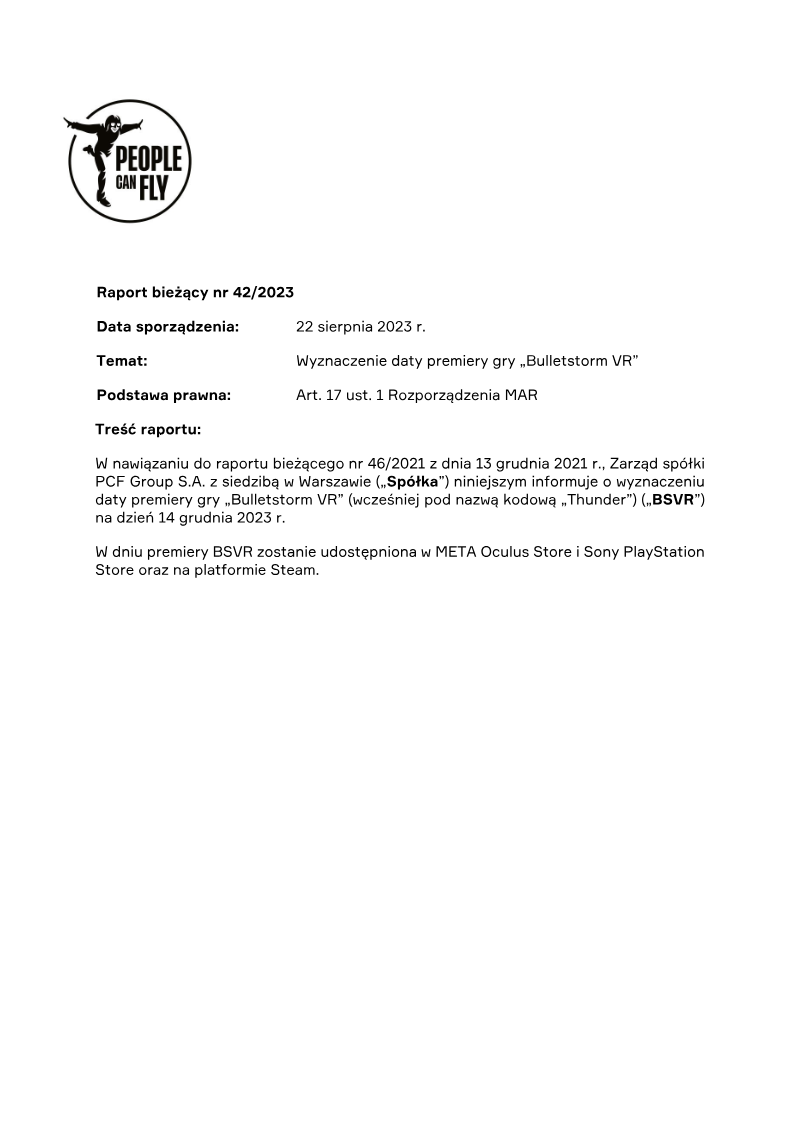
Metropolis, People Can Fly, who was like the offspring of of of of Metropolis. Um you know, CI Games uh uh ourselves um and so on. And I think it's the success of all these companies. Uh you know, probably right now we're probably the biggest success in the in the in the Polish industry. Uh um financially, whatever. But uh this this somehow impregnated the imagination of a lot of people and and and drew a lot of talent into that industry.
Showed what's possible.
Yes. I I think so. I think it showed, you know, in Poland I always hated that when I was when I was younger where we we used to have that saying in media, whenever something could happen, it was usually never at a global scale, maybe a little bit European or something. But but in culture, let's say. It was always but also in business. It was always Polish Steve Jobs, Polish Bill Gates, Polish Tom Cruise, you know, which which
sounded was supposed to sound great, but in reality it was showing certain inferiority. Like it meant we cannot be as big as these guys, but this is the next big we next best thing we have. Like almost chocolate.
cap success.
Almost chocolate, but kind of, you know, not not where it should be. So uh so I think I think what what us and some of these other companies showed, you don't have to be Polish something. You can be yourself and be one of the best, if not the best, you know, in a certain area. And that was something that I think spoke to minds of a lot of young people that said, "Okay, I want to be part of that right." And some of them joined our company or other companies, then left, then started their other companies. Like there's a lot of companies. I'm proud of that, to be honest, that were started by people who left CD Projekt and or or Techland or, you know, one of these companies because that means um uh you know, a lot of them were entrepreneurial and and and just decided to leave the ship and do something of their own and and be successful, you know, in their own area uh by doing something very different,
which we would never do anyway. So, um so, I think that's cool. That the stock exchange thing you mentioned is actually funny. We were actually not the first uh gaming company on the stock exchange. I think CI Games was. But, we were by far the most successful uh uh in that front. And I think at some point that created like a bit of a gold rush, specifically the Warsaw Stock Exchange, where it was a little bit easier to list and uh you know, the investors were just, you know, this was the big story of the day. Um and I think a lot of things happened. Right now, it's a little bit a lot more difficult uh to list in Warsaw as well with the game story. Not impossible, a lot more difficult.
It's a great games, huge games, like success in their own right, but then difficult afterwards.
That That That's true, but I think it's in general, I mean, if you're if you have a gaming story right now, you want to list on the Warsaw I'm sorry, stock exchange, it's for sure more difficult. Uh and I wouldn't blame it on Cyberpunk. That's part of it, but in general, the whole temperature about gaming was a little bit lower after COVID and so on.
So, it's a it's a it's a mixed bag. But again, those things go in cycles. I think, you know, the next big success may change things. Although, I don't think we're ever going to come back in Poland specifically to the gold rush, where if you're just, you know, standing on the corner saying, "I have a game idea." they're going to throw bags of money at you and you list it and tomorrow you're driving new Aston Martin or something, you know. That's That's not going to happen uh again.
Through the streets of Wroclaw or the one. Um but I'm trying to understand like what are structurally different about Polish market because you talked about math skills. So, that was one. That's of course important. Second part is storytelling that is very inherited in the Polish lore. And then the third one is of course public markets, which is essentially funding. What makes Polish companies structurally different compared to other ecosystems?
Kick-ass live ops need kick-ass tools. That's where Heroic Labs comes in. They just released a massive update to their
Satori live ops platform. And having done my research, I can say with confidence that it's second to none. In a single product, you get everything you need, including event capture, player segmentation, feature flags, remote configuration, [music] AB testing, experimentation, live events calendar, messaging, retention, graphing, analytics, and so much more. If you're serious about running live services in a game, get serious about the tools you use. Connect with Heroic Labs and make some serious cheese with your live ops.
I don't know if there is a structure issue. I mean, there used to be a certain cost advantage, which still is the case for a lot of companies. Actually, oddly enough, not for us, because we uh some some years ago, we actually had to gauge our salaries against in Europe against UK. In US, we pay US salaries. So, we don't really have the advantage anyway, because we don't compete for the
talent on a local level.
global company.
But we're a global company. So, and also in the remote times, you can have people working out of the balcony for a company in the Bay Area.
Can you really?
It used to be the case in the in the COVID. Less and less now, but but still in Europe, yes. I mean, you can be living in Wrocław and and working for somebody in UK. So, we we had to uh adjust to that and and and we are. Um I think I'm not sure if I would put it on the structure itself. I I put it on a certain hunger of success. There's still uh a massive massive hunger of of of being successful uh amongst Polish people, amongst Polish companies to win. Like we really really want to win. I was listening to our Turkish colleague who was basically describing the same kind of thing in the in the in the Turkish games industry uh earlier today and uh I think I think that's a that's a very valid point. So, a combination of both creativity and a certain kind of hunger and drive is
really what's what what drives I think a lot of Polish companies. They really want to be successful and they are willing to work very very hard to get there.
Last question. Do you think the Polish gaming ecosystem would be the same without CD Projekt Red?
Ooh, that's a good question. I mean, for sure we contributed to that in the way I mentioned, which is uh you know, we were one of the bright examples of success. Some people left, started their own companies, were successful. So, so in many ways I think I I I would say we were seminal, one of the seminal companies in the in the market. Um I don't know. I mean, it's hard to, you know, like erase it completely from the history and go back in the
You're very I would say no, it wouldn't.
Maybe. It would be different, but I I like to think that still, you know, um there's so many crazy, very intensely passionate about games people in Poland that and that was the case in the since
the '80s that somebody would do something like that at some point if if if it wasn't us. And again, there were anyway great companies like, you know, Techland, Metropolis, and so on. So.
I would say like CD Projekt Red is is truly a unique company. I think the definite the definitive moment for your company is is not only the success of Witcher franchise, but how you push through with Cyberpunk. It really shows uh the tenacity that your company has and the uh the tenacity to please the fans, please the players, but also to show what you're capable of and not giving up even though any financial advice would be to move on to the next part. Uh it's it's truly astounding to see how you've grown from a from an area that did not have these these the funding nor the people to become one of the best in the world, if not the best in the genre that you've chosen. And your ability to not only create games, but create cultural moments and then and
IPs is is phenomenal. So, I know you're very humble the way you talk about the company, but you've built your your team, you and and the whole CD Projekt have built a truly astounding company.
Lots of good words. I'd probably insert a thing or two here and there, but I'll take them. I was told at some point you should take the, you know, compliments when you when you hear them. So, I'll take them on behalf of the team. But again, I I would not underestimate how much you still have to, you know, prove going going further. And and I personally I really really believe, you know, everything we've done uh so far is is just the beginning. Like I I I am therefore the right, and I hope to see the company, you know, a decade 15, 20 years from now in a very different spot to where we are right now. And I hope we're going to surprise people with also some cultural moments, you know, uh in due time.
I hope so, too. And one thing to add to our Polish uh ecosystem is that not only hungry, but also very humble.
No.
That's all right. Actually, the fixing part, that's the funny bit when you were talking about. I'll add that one where because part of that was really we wanted to please the fans, yes. But part of that was because uh as the creators, we felt this is really we felt it's just not just that the game is judged like this, and we felt this is going to be such a pity if if the thing that the team was creating in in in such uh massive effort would always go down in the history as, you know, as something that was terrible and we just wanted to be sure that people uh uh are going to see it in a way when it's going to shine. I'm not sure if that's humble. I think it's actually quite the opposite, but I think the combination of it was in the end good for fans. I hope they would see it this way.
it was good for fans and it was good for the company.
I hope so.
Thank you so much for joining the podcast.
Thank you.
Thank you.
You did it.
[music]
You made it to the end of the episode. As a fan of the show, it would help us out if you'd subscribe and leave [music] us a review on the podcast service of
your choice. Those stars and likes, while a small action on your part, mean a lot to us and help to grow the show. More importantly, are you a member of the Deconstructor of Fun Slack group? If you have 5 years or more of games industry experience, go to deconstructoroffun.com/slack and apply to join.
[music]
Join the games industry's best professional community filled with peers always willing to lend a hand or [music] subscribe to our newsletter to get all the latest insights from the Deconstructor of Fun content creators. Thanks for listening.
Auto-generated captions from YouTube — names and numbers may be misheard.

















Comments