Team Cherry
CompanyAustralia · Founded 2014
Team Cherry is an indie games developer in Adelaide, South Australia. Our mission is to build crazy, exciting worlds for you to explore and conquer. We happily spend hours and hours lovingly cramming these worlds full with intense battles, memorable characters and mysterious secrets.
Connections
Each row is a game or company named alongside Team Cherry, each column a document, oldest first. A mark means that document names it. Select a row to see those documents.
About the company
- Founded
- 2014
- Country
- Australia
Company data from IGDB.com
Key figures from the reports
Team Cherry's seven-year development cycle for Hollow Knight: Silksong was driven by a lack of financial pressure, as the original Hollow Knight achieved 15 million copies sold, providing the developers with generational wealth.
Jason Schreier, 2026 · Why Hollow Knight: Silksong Took Seven Years To Make, p. 1
Team Cherry’s Silksong reached 5 million players within three days of its release.
Alinea Analytics, 2025 · Silksong: 5 Million Players in Three Days
Documents about Team Cherry
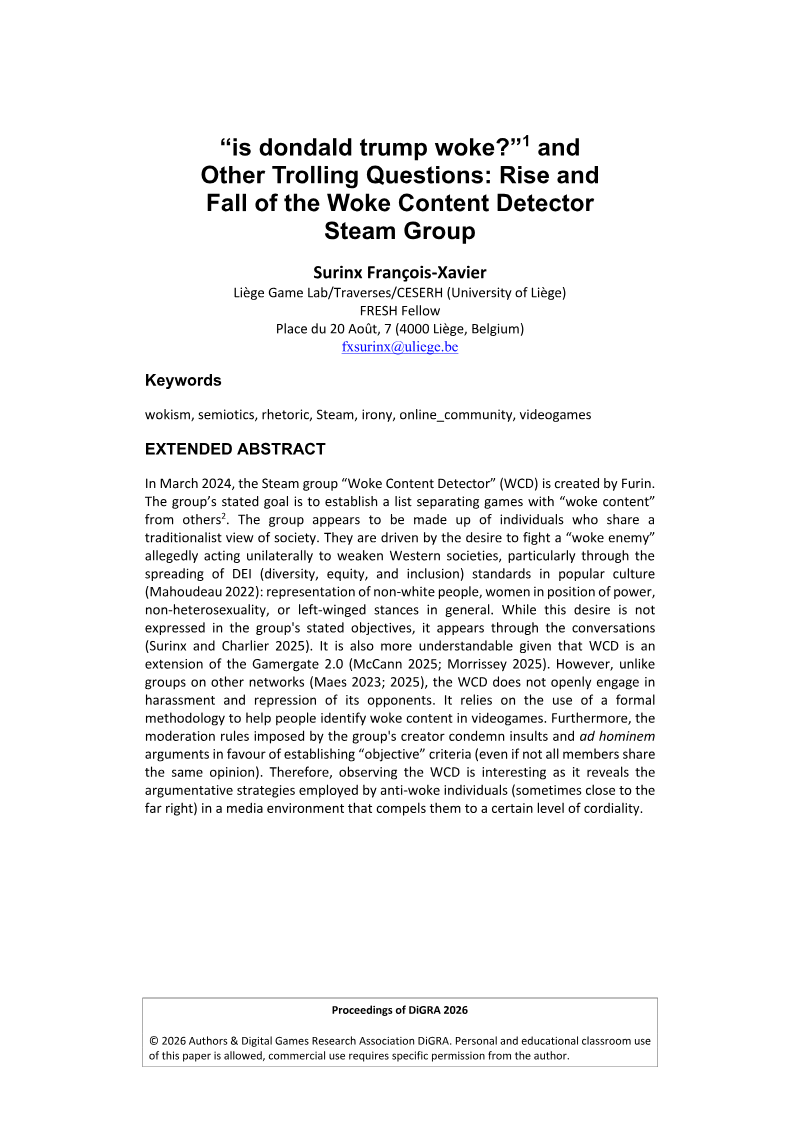
"Is Donald Trump Woke?" and Other Trolling Questions: Rise and Fall of the Woke Content Detector Steam Group
This paper examines the Steam group "Woke Content Detector" (WCD), created in March 2024 with the stated aim of compiling a list of video games containing "woke content," and its transformation after the unexplained disappearance of its founder, Furin, in May 2025, when the group had reached about 3,500 members.
- The Steam group "Woke Content Detector" was created in March 2024 to compile video games it deemed to contain "woke content," and it grew to about 3,500 members before its founder, Furin, unexplainedly disappeared in May 2025.
- After Furin's departure, trolls invaded the group and used irony, mockery, and "flooding" rather than insults to disrupt serious discussion, producing debates that advanced little because each camp's premises remained irreconcilable.
- The group's central difficulty was defining "wokism": original members struggled to distinguish genuine allies from imitators, and some left while others sought to reassert control over the definition.
Why Hollow Knight: Silksong Took Seven Years To Make
The seven-year development cycle of Hollow Knight: Silksong was driven by the creative ambitions of the small, Adelaide-based studio Team Cherry rather than technical failure or external pressure.
- Team Cherry's seven-year development cycle for Hollow Knight: Silksong was driven by a lack of financial pressure, as the original Hollow Knight achieved 15 million copies sold, providing the developers with generational wealth.
- The studio maintained a highly efficient internal development pipeline that allowed for rapid iteration, enabling the team to implement and test new ideas within minutes rather than hours.
- Development was characterized by continuous 'over-scoping' and a commitment to quality over deadlines, with the team intentionally avoiding public release dates to ensure the sequel matched the scale of the original.

I Tried To Remake Silksong In 10 Hours (Hint: It Was Brutal)
Recreating the visual aesthetic of a high-fidelity 2D platformer like Silksong within a ten-hour timeframe presents significant technical and artistic challenges.
- Achieving the Hollow Knight visual style requires a perspective camera rather than a standard orthographic camera to accommodate complex, multi-layered parallaxing.
- To maintain visual consistency across varying depths, a custom sprite shader is necessary to integrate Z-buffer depth for post-processing blur, depth-based darkening, and interaction with Unity's global 3D fog.
- Importing artwork as PSB files into Unity allows for the automatic breakdown of Photoshop layers into individual sprites, which can then be organized into prefabs for efficient reuse and animation.
How To Make A Hollow Knight Style Game (Live Workshop Day 2)
Achieving the atmospheric, 2.5D aesthetic characteristic of titles like Hollow Knight requires a disciplined approach to modular level design and Z-axis manipulation.
- Achieving a Hollow Knight-style aesthetic relies on using Unity shaders and color-shifting layers to create depth and parallax effects, rather than relying on blurring background artwork.
- Establishing a reference sprite at the start of development—sized to the grid (one unit high by one unit wide)—is essential for maintaining consistent scale between the player character and environmental assets.
- Parallax depth can be simulated by manually adjusting the color values of background elements, making distant objects darker to blend them into the scene's atmospheric fog.
GMTK Digest: December 2025
The December 2025 industry digest serves as a year-end retrospective, focusing on the critical reception of major game releases as highlighted by the 2025 Game Awards.
- Nintendo utilized specific design methodologies for the 2025 release of Donkey Kong Bananza, serving as a primary case study for industry production philosophies.
- Team Cherry’s development process for Hollow Knight Silksong is highlighted as a key reference point for understanding the year's most acclaimed game production cycles.
- Doom: The Dark Ages set a new industry benchmark for the implementation and advancement of accessibility features in high-budget titles.
Metroidvania Ecologies: Exploration and the Environmental Imagination in Hollow Knight and Rain World
"Metroidvania Ecologies" argues that the Metroidvania genre, and specifically Hollow Knight (2017) and Rain World (2017), deserves a central place in ecogaming scholarship, which has so far concentrated on titles such as SimCity, Red Dead Redemption 2, and Kentucky Route Zero.
- The report argues that the Metroidvania genre, particularly Hollow Knight (2017) and Rain World (2017), deserves a central place in ecogaming scholarship, which has so far focused on titles like SimCity, Red Dead Redemption 2, and Kentucky Route Zero.
- The authors contend that the genre's interconnected, gated level design, with recursive exploration, backtracking, and gradual unlocking of space, parallels Gibsonian ecological relations between organism and environment.
- Gated progression, punishing traversal, and opaque maps are read as resisting the colonial "direct use-value" ideology of exploration, making the environment refuse the player's command.

Steam Pricing Research: From $0.0 to $69.99
The Steam marketplace is currently defined by a hyper-competitive landscape, characterized by a 27.8 percent increase in annual new releases and a significant expansion of free-to-play titles.
- Steam has seen a 27.8 percent annual increase in new releases, intensifying competition and forcing developers to use data-driven pricing to meet shifting consumer value expectations.
- Market saturation has made price points a primary indicator of quality, requiring developers to align their pricing directly with their production scope to remain competitive.
- The majority of releases are concentrated in the sub-$29.99 range, with $14.99 and $19.99 serving as key psychological anchors to optimize conversion rates.

The World Design of Hollow Knight: Silksongs
Mark Brown's Boss Keys analysis examines how Team Cherry built Pharloom, the twelve-area world of Hollow Knight: Silksong, and argues that its structure is a "concertina" that alternates between tightly guided, linear stretches and looser, exploratory ones.
- Hollow Knight: Silksong utilizes a concertina-style architecture that alternates between linear, goal-oriented sequences and open-ended exploration to manage player pacing.
- The game features a total of 45 boss encounters, split between 20 mandatory battles and 25 optional challenges that reward thorough exploration with power-ups.
- The progression structure evolves from a guided, key-and-lock first act into a highly open second act, concluding with a third act that introduces a corrupted world state.

The Game Awards 2025 Nominees on Live Streaming
The analysis evaluates the relationship between live streaming performance and The Game Awards 2025 nominations, assessing whether viewership metrics can effectively predict award winners.
- Grand Theft Auto VI dominates the 'Most Anticipated Game' category with 496,000 unique Twitch chat mentions over the past year, significantly outpacing Resident Evil Requiem at 76,000 mentions.
- League of Legends remains the most watched title in the 'Best Esports Game' category, generating 246.6 million hours watched and maintaining its status as the most-watched game overall.
- Kingdom Come: Deliverance 2 leads the 'Game of the Year' nominees in streaming performance, recording 48.8 million hours watched during its peak month.
September’s Top PlayStation Games by Copies Sold: Horror and Sports Reign
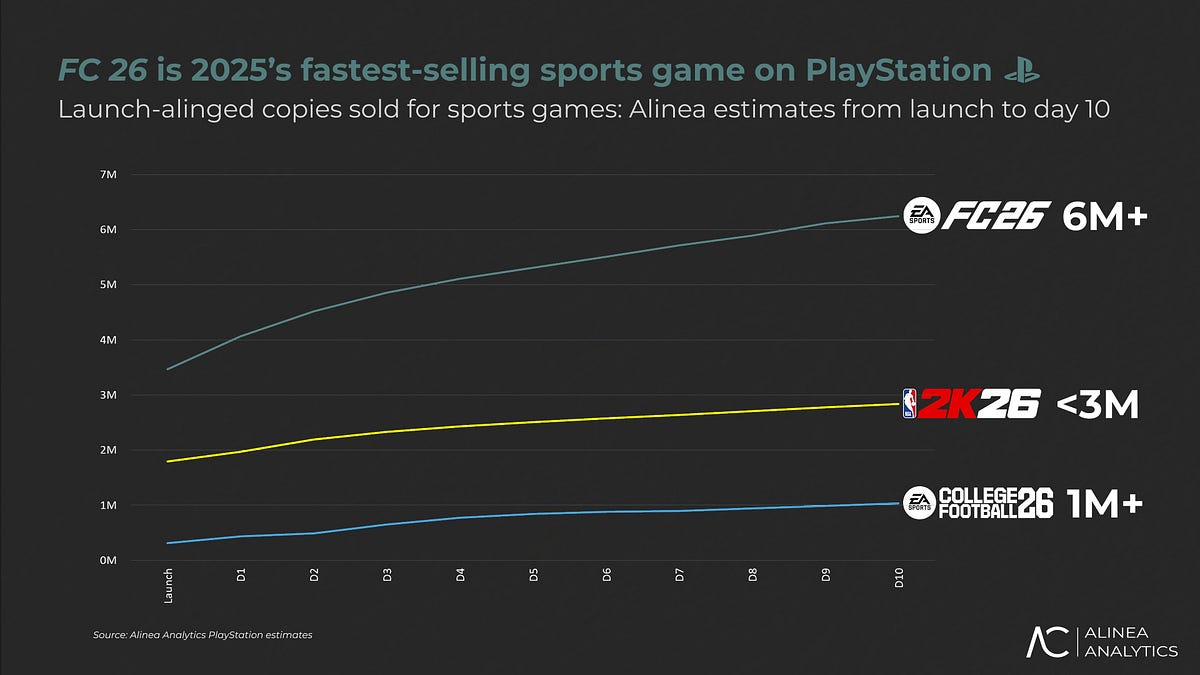
September’s PlayStation sales performance highlights the continued dominance of major sports franchises alongside the enduring popularity of legacy titles and niche horror releases.
- EA and 2K dominated September PlayStation sales, with NBA 2K26 selling just under 2 million copies and FC 26 continuing to outperform other licensed sports titles globally.
- The free-to-play title Skate achieved a strong launch with over 15 million players across consoles, including 7.5 million on PlayStation, and generated approximately $3 million in cosmetic revenue on Steam.
- Borderlands 4 moved nearly 800,000 units on PlayStation, while Team Cherry’s Silksong sold over 600,000 units in its first month of release.

GMTK Digest: September 2025
The September 2025 edition of the Game Maker’s Toolkit digest serves as a curated industry update, focusing on significant software releases and critical analysis within the gaming sector.
- Hollow Knight: Silksong is defined by its expansive world design and precise, experimentation-focused gameplay mechanics.
- LEGO Voyagers failed to deliver a compelling co-op experience due to repetitive puzzle design and cumbersome construction mechanics.
- The September 2025 market landscape shows a distinct divide in quality between highly anticipated Metroidvania titles and underperforming puzzle-based projects.
Watch THIS If You're Making Your First Game
The primary objective of this discussion is to analyze the challenges of independent game development, specifically focusing on the risks of long-term production cycles versus high-frequency release strategies.
- Launch-day performance is critical for long-term visibility, as demonstrated by the 2017 release of Sundered, where technical issues and poor balancing led to negative initial Steam reviews that hindered the game's market trajectory.
- Developers must choose between a 'perfectionist' model of multi-year development or a 'high-frequency' model that treats game releases like a portfolio to mitigate the high failure rate of individual titles.
- Relying on viral success is not a sustainable business strategy; developers must instead align their production models with their specific strengths and current market realities.