AppMagic
Research12 documents
Documents

Article
Top Mobile Games by Revenue and Downloads: August 2026
The mobile gaming market in August 2026 demonstrated significant shifts in both revenue generation and user acquisition. Honor of Kings maintained its market leadership with $152.7 million in net revenue, benefiting from sustained engagement during the Chinese summer holiday period. Notably, Gossip Harbor achieved a record-breaking performance, securing second place with $112.3 million. The broader revenue landscape saw five titles surpass the $100 million threshold, an increase from three in July, with PUBG MOBILE, Royal Match, and Roblox rounding out the top five.
Performance trends varied significantly among established titles. While Century Games solidified its market presence with two entries in the top ten—Whiteout Survival and Kingshot—other major titles faced declines. Last War: Survival continued a five-month downward trend, and Pokémon GO experienced a 50% revenue contraction following the conclusion of its anniversary events. These figures, provided by AppMagic, exclude store commissions, taxes, and Chinese Android store revenue, offering a standardized view of global net earnings.
In terms of user acquisition, Roblox remained the most downloaded title with 21.8 million installs, followed closely by Free Fire MAX and Subway Surfers. The month also saw the successful debut of Tencent’s Codename Crime-Vice Open World, which captured 12.2 million downloads, primarily driven by the Indian market. Conversely, the "arrow" puzzle game subgenre experienced a sharp decline in popularity, with several leading titles from previous months dropping significantly in the rankings or exiting the top 15 entirely. The data reflects a dynamic environment where seasonal events and genre-specific trends continue to dictate short-term market leadership.
- Honor of Kings maintained its lead in August 2026 with $152.7 million in revenue, marking its second consecutive month exceeding $150 million.
- Gossip Harbor achieved its best performance to date, securing second place with $112.3 million in revenue.
- Five mobile games surpassed the $100 million revenue threshold in August, an increase from three games in July.
- Pokémon GO revenue dropped 50% month-over-month to $50.2 million following the conclusion of its anniversary celebrations, while Last War: Survival continued a five-month decline to $56.7 million.
- Roblox remains the only title to appear in both the top 15 revenue and top 15 download charts, leading the latter with 21.8 million installs.
+2
AppMagicSept 2026

Article
Mobile Casual Games in H1 2026
The mobile casual games market remained stable during the first half of 2026, generating approximately $11 billion in net in-app purchase (IAP) revenue. This performance was largely driven by three core genres: Puzzle, Casino, and Simulation. While overall revenue remained flat compared to the same period in 2025, specific sub-genres exhibited significant growth, particularly in the hybrid-casual and merge categories.
Puzzle games maintained their dominance, accounting for 44% of the casual market with $4.9 billion in IAP revenue. Within this segment, the Merge-2 genre nearly doubled its revenue to $1.24 billion, while hybrid-casual puzzle titles—specifically sort, screw, and block games—grew by 46% in revenue. These hybrid titles are increasingly capturing player interest from traditional match-3 and merge games due to their lower development costs and efficient monetization strategies. Conversely, the Casino segment saw a 9% decline in IAP revenue to $3.3 billion, though the Coin Looter sub-genre remains a critical area of focus, with evidence suggesting a substantial shift toward direct-to-consumer (D2C) revenue models.
The Simulation genre also demonstrated growth, earning over $1.1 billion in the first half of 2026. Farming games, in particular, showed resilience, with established titles like Hay Day achieving record-breaking daily revenue through intensive LiveOps strategies. The market analysis relies on net IAP revenue estimations, excluding D2C income and non-iOS revenue from China, which likely results in an underestimation of total market performance. The findings suggest that success in the current landscape is increasingly tied to a studio’s ability to master LiveOps, manage user acquisition competition, and experiment with hybrid-casual mechanics.
- The mobile casual games market generated approximately $11 billion in net IAP revenue during H1 2026, remaining flat compared to the same period in 2025.
- Puzzle games remain the dominant casual genre, accounting for 44% of the segment's revenue with $4.9 billion in H1 2026 earnings.
- The Merge-2 genre saw significant growth, nearly doubling its revenue from $636 million in H1 2025 to $1.24 billion in H1 2026, led by Microfun’s Gossip Harbor.
- Hybrid casual puzzle games are rapidly gaining traction, with over 2,000 new titles launched in H1 2026—an 89% increase—and a major $1 billion acquisition of Pixel Flow! developer Loom Games by Scopely.
- Royal Kingdom is outpacing the performance of its predecessor, Royal Match, having earned over $510 million in IAP revenue since its November 2024 launch.
+4
AppMagicAug 2026
Article
Top Mobile Games by Revenue and Downloads: July 2026
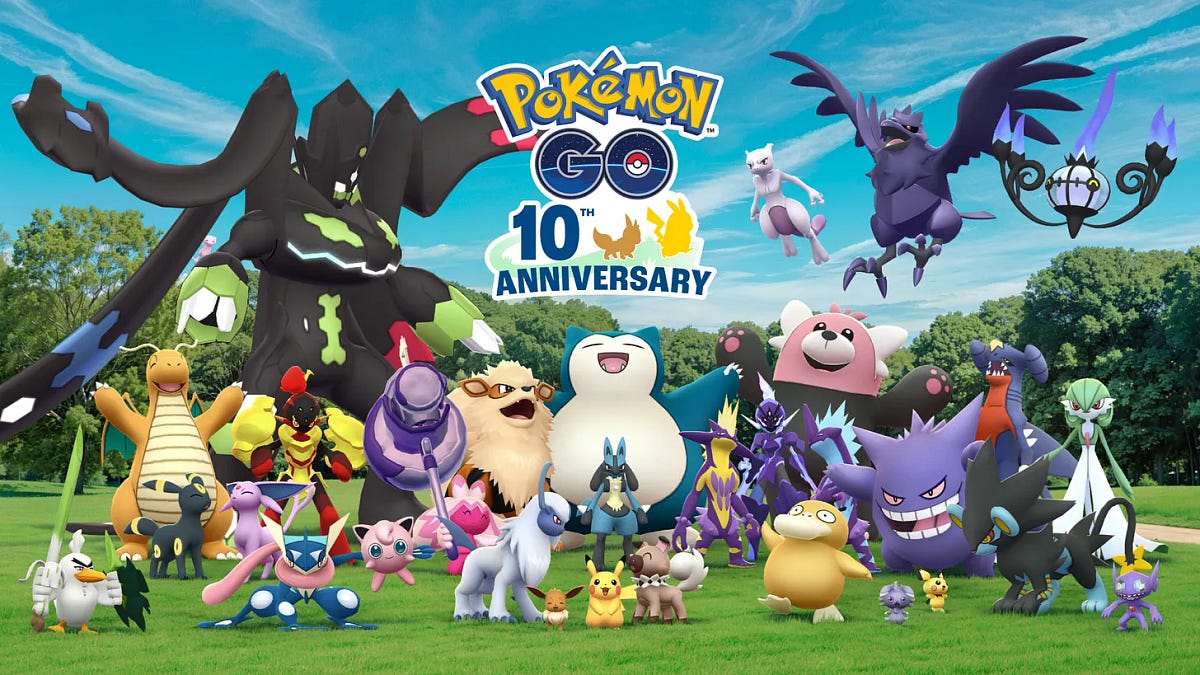
The mobile gaming landscape in July 2026 was characterized by significant revenue surges for established titles and shifting trends in user acquisition. Data provided by AppMagic indicates that Honor of Kings reclaimed strong performance levels, generating $157.6 million, a 42% increase from June, likely driven by seasonal summer events in China. Pokémon GO also experienced a notable resurgence, earning $101.1 million—its highest monthly revenue since July 2021—following its tenth-anniversary celebrations. Meanwhile, eFootball achieved an all-time revenue record of $69.9 million, bolstered by its alignment with the World Cup.
In contrast, Last War: Survival faced a sustained downturn, with revenue falling to $64.5 million as it dropped to 12th place, a decline attributed to a significant reduction in user acquisition efforts. The top of the revenue chart remained highly competitive, with Roblox, Gossip Harbor, PUBG Mobile, Royal Match, and Whiteout Survival all posting figures between $98 million and $102 million.
Regarding download volume, Roblox emerged as the market leader with 22.9 million installs, closely followed by Free Fire with 22.8 million. The market saw a cooling of the previously dominant "arrow-game" trend, as titles like Arrows - Puzzle Escape and Amaze GO! experienced sharp declines in new installs. Conversely, football-themed games maintained a strong presence, accounting for four of the top 15 most downloaded titles. These figures reflect global mobile market trends, excluding revenue from Android stores in China, and provide a snapshot of performance for the month of July 2026.
- Honor of Kings revenue surged 42% in July 2026 to $157.6 million, marking its strongest performance since January 2026 due to seasonal summer events.
- Pokémon GO achieved $101.1 million in revenue, its highest monthly total since July 2021, driven by its 10th-anniversary event and first anniversary under Scopely.
- Roblox led the mobile market in July 2026 by securing the top spot in downloads with 22.9 million installs while simultaneously generating $101.6 million in revenue.
- eFootball reached an all-time revenue record of $69.9 million in July, successfully leveraging the World Cup to drive player spending.
- Last War: Survival experienced its fourth consecutive month of revenue decline, falling to $64.5 million and dropping to 12th place as user acquisition efforts appear to have stalled.
+1
AppMagicAug 2026

Article
Top Mobile Games by Revenue and Downloads: June 2026
The mobile gaming market in June 2026 experienced notable shifts in both revenue generation and user acquisition, driven largely by seasonal sporting events and evolving genre popularity. The primary objective is to track top-performing mobile titles globally, excluding revenue from Android stores in China, to provide a snapshot of industry health and consumer trends.
Revenue performance in June was characterized by a significant decline for the market leader, Honor of Kings, which saw its monthly earnings drop 29% to $110.6 million. Other top-tier titles, such as Whiteout Survival ($109.1 million) and Royal Match ($102.7 million), maintained relatively stable positions. Conversely, Last War: Survival continued a three-month downward trend, with its revenue falling to $71.4 million as developers seemingly curtailed user acquisition efforts. A standout performer was eFootball by KONAMI, which reached its highest-ever monthly revenue of $43 million, climbing to 12th place by effectively leveraging the momentum of the World Cup.
In terms of downloads, the market remains dominated by puzzle-oriented titles, with Arrows - Puzzle Escape and Amaze GO! retaining the top two spots despite slight volume decreases. The arrow-puzzle mechanic has gained significant traction, with three such titles appearing in the top five. Furthermore, the influence of the World Cup was evident in download charts, as football-themed games saw massive surges in popularity; Soccer Superstar, Football League 2026, and EA SPORTS FC Soccer Mobile 26 all climbed significantly in the rankings. These findings, based on AppMagic data, highlight a period where major sporting events served as a primary catalyst for both monetization and user growth across the mobile gaming landscape.
- Honor of Kings maintained its top revenue position in June 2026, though its earnings fell 29% month-over-month to $110.6 million.
- Whiteout Survival ($109.1 million) and Royal Match ($102.7 million) secured the second and third revenue spots, showing stability compared to May figures.
- Konami’s eFootball achieved its best-ever month with $43 million in revenue, climbing 6 spots to 12th place as it capitalized on World Cup momentum.
- Last War: Survival continued a three-month revenue decline to $71.4 million, driven by a significant reduction in user acquisition efforts that pushed downloads to their lowest levels since November 2023.
- Football titles saw a major surge in download volume, with Soccer Superstar, Football League 2026, and EA SPORTS FC Soccer Mobile 26 jumping 20, 21, and 9 spots respectively.
+1
AppMagicJul 2026
Article
Türkiye's Mobile Gaming Market: 2026
The report presents a comprehensive snapshot of Turkey’s mobile gaming ecosystem as of 2026, focusing on revenue dynamics, genre performance, developer activity, investment flows, and emerging trends. In 2025 the market grew 6 % to $347 million, yet downloads fell 4 % year‑over‑year, marking a shift toward higher monetisation per install. Revenue gains concentrated in puzzles (+26 %), racing (+16 %) and kids’ games (+14 %), while location‑based, action and party titles suffered steep declines. Top earners included PUBG Mobile ($17.3 M), eFootball ($10.4 M) and Whiteout Survival ($10 M).
Developer‑generated IAP revenue surged 450 % from $504 million in 2020 to $2.76 billion in 2025, representing a five‑fold increase in market share from 1 % to 5 %. The developer base tripled over the same period, with a recent uptick of 18.6 % in 2025 after a dip in 2023‑24. Puzzle games dominate revenue (96 % of IAP), yet studios are diversifying into arcade, action and simulator genres. Leading studios such as Dream Games, Peak Games, and Rollic drive the market; Dream’s titles Royal Kingdom/Match generated $5.2 billion in IAP, while Rollic’s recent hit Knit Out achieved a 50 % success rate for titles earning over $100 k in six months.
Capital inflows have accelerated, with 24 investment deals announced annually and total funding reaching $3.6 billion since 2009; Turkish companies raised $234 million in 2025, a 32‑fold increase from 2020. Unicorn prospects emerge with Grand Games (IAP $115 M, $105 M raised in 16 months) and Loom Games (acquired by Scopely for $1 B). M&A activity remains robust, exemplified by Peak Games’ $1.9 B acquisition by Zynga and multiple studio acquisitions by Rollic.
Trend analysis highlights Turkish studios’ influence on hyper‑casual and hybrid casual markets, with titles such as Royal Match, Twisted Tangle, and Pixel Flow setting mechanics that spread globally. The market is entering a maturity phase: revenue growth persists while download declines plateau, suggesting a shift toward monetisation efficiency and high‑quality live‑ops strategies.
- Turkish mobile gaming revenue reached $347 million in 2025, a 6% increase despite a 4% decline in downloads, signaling a strategic shift toward higher monetization per install.
- Developer-generated in-app purchase (IAP) revenue grew 450% between 2020 and 2025, reaching $2.76 billion and increasing the sector's market share from 1% to 5%.
- Investment in the sector has surged significantly, with Turkish companies raising $234 million in 2025—a 32-fold increase compared to 2020—and total funding reaching $3.6 billion since 2009.
- Puzzle games dominate the market, accounting for 96% of IAP revenue, with major titles like Dream Games' Royal Kingdom/Match generating $5.2 billion in total IAP.
- The developer base has tripled since 2020, experiencing a recent 18.6% growth in 2025, with major players like Dream Games, Peak Games, and Rollic leading the ecosystem.
+1
AppMagicJun 2026
Report54 pages
Türkiye's Mobile Gaming Landscape 2026
Türkiye has emerged as a preeminent global force in the mobile gaming sector, characterized by a resilient ecosystem that achieved 6% year-over-year revenue growth despite broader international market stagnation. This expansion is underpinned by a maturing domestic industry where local developers have increased their collective revenue by 450% since 2020, now commanding a 5% share of the global market. The sector’s success is heavily concentrated in the puzzle genre, which accounts for nearly 97% of local earnings, while a strategic pivot toward hybrid-casual titles and sophisticated LiveOps strategies continues to influence international development trends.
The rapid professionalization of the Turkish gaming landscape is driven by a self-sustaining flywheel effect, where successful exits and high-profile valuations for studios like Dream Games and Loom Games attract consistent capital and elite technical talent. Since 2020, the number of local developers has tripled, supported by a robust network of venture capital firms and over 700 active gaming startups. This growth is further accelerated by proactive government intervention, including substantial tax incentives and user-acquisition subsidies, which provide a competitive advantage in an increasingly saturated global environment.
Looking toward 2026, the industry is transitioning from rapid iteration models toward AI-native development and deeper engagement mechanics to maintain its competitive edge. With over $3.6 billion in total investment fueling the rise of category-defining companies, the region has solidified its status as a global hub for mobile gaming innovation. By leveraging a data-driven creative playbook and a highly replicable development framework, the Turkish market is well-positioned for sustained dominance, effectively balancing rapid scaling with the long-term technical maturity required to navigate the evolving demands of the global mobile gaming audience.
- Türkiye’s mobile gaming sector has achieved a 6% year-over-year revenue growth, with local developers increasing their collective revenue by 450% since 2020 to capture a 5% global market share.
- The industry is heavily concentrated in the puzzle genre, which generates nearly 97% of local earnings, while studios increasingly pivot toward hybrid-casual titles and sophisticated LiveOps strategies.
- The ecosystem is supported by over 700 active gaming startups and $3.6 billion in total investment, which has helped triple the number of local developers since 2020.
- High-profile exits and valuations for studios like Dream Games and Loom Games have created a self-sustaining flywheel that attracts elite technical talent and venture capital.
- Proactive government intervention, including tax incentives and user-acquisition subsidies, provides a competitive advantage that helps local developers scale in a saturated global market.
+2
AppMagicJun 2026
Article
Mobile Live Ops in 2025
Mobile game downloads expanded by 4.1 % year‑over‑year in 2025, yet revenue growth lagged at only 0.7 %. Midcore titles accounted for roughly two‑thirds of earnings, while hypercasual games contributed minimally. Live‑ops activity intensified across the ecosystem, with an average of 89 events per month by year’s end. Casual games concentrated on collections (80 %) and competitive formats, monetizing through leaderboards, event currency, and special offers. Seasonal themes tied to public holidays dominated the event calendar, with 30 % of casual titles running Black Friday promotions and many re‑using holiday motifs such as summer‑relaunches of Christmas.
Midcore games experienced a modest revenue increase of 2.3 % to $33.9 B, accompanied by a 23 % rise in event density. New mechanics centered on collections, login calendars, and gacha systems. Hybrid casual/hypercasual titles saw a striking 75 % revenue jump, largely driven by puzzle content; these games added fewer events overall but emphasized competitive play and occasional holiday spikes. Across all segments, developers favored proven mechanics—collections, win streaks, and seasonal themes—to sustain player engagement and monetization.
The analysis covers the global mobile gaming market for 2025, focusing on casual, midcore, and hybrid/hypercasual segments. It highlights the growing importance of live‑ops events as a revenue lever, the strategic use of holiday themes, and the continued dominance of midcore titles in driving overall earnings. The findings suggest that while download growth remains robust, revenue expansion hinges on refined event strategies and the effective integration of proven gameplay mechanics.
- Midcore titles remain the primary market driver, accounting for two-thirds of total earnings and achieving a 2.3% revenue increase to $33.9 billion in 2025.
- Hybrid casual/hypercasual titles experienced the most significant growth, with a 75% revenue jump driven primarily by the integration of puzzle content and competitive play.
- While global mobile game downloads grew by 4.1% year-over-year, total revenue growth significantly lagged at only 0.7%, highlighting a monetization gap.
- Live-ops intensity increased across the industry, reaching an average of 89 events per month by the end of 2025.
- Casual games heavily utilized collection mechanics, with 80% of titles implementing them alongside competitive formats and event-based currencies.
+2
AppMagicMay 2026

Article
AppMagic: Friendslop Games in 2025 and Their Retention
The 2025 landscape for "friendslop" games—a genre characterized by cooperative, social-focused gameplay—reveals a market defined by high initial sales volume but notably low long-term player retention. These titles, which typically retail at low price points between $5 and $20, have achieved significant commercial success on Steam. In 2025, four of the top ten best-selling games by units sold fell into this category, including R.E.P.O. with 18.5 million copies and Peak with 15.4 million.
Data indicates that the average 30-day (D30) retention for games in this genre is approximately 3%. This figure is significantly lower than industry benchmarks for other multiplayer titles; for comparison, Dead by Daylight maintains an 11.3% D30 retention rate, while Phasmophobia, a foundational title for the genre, holds a 5.3% rate. While some niche titles like Ball x Pit have managed to outperform the genre average with 4.7% retention, the general trend remains one of rapid player churn.
The analysis concludes that this low retention is an inherent feature of the friendslop model rather than a failure of design. Because these games prioritize accessible, core gameplay loops over complex meta-progression or long-term engagement systems, they are optimized for short-term social experiences. Players engage with these titles intensely for a brief period before moving on to new releases. This development strategy allows teams to focus resources on immediate fun, which, combined with low entry costs, fosters high initial adoption and player forgiveness regarding the lack of long-term content.
- The 'friendslop' genre is characterized by high initial sales volume, with four of the top ten best-selling Steam games in 2025 falling into this category, including R.E.P.O. (18.5 million units) and Peak (15.4 million units).
- Long-term player retention for the genre is notably low, with an average 30-day (D30) retention rate of approximately 3%.
- Friendslop retention rates significantly trail established multiplayer titles, such as Dead by Daylight at 11.3% D30 retention and Phasmophobia at 5.3%.
- Low retention is an inherent feature of the business model rather than a design failure, as these games prioritize short-term social experiences over complex meta-progression.
- The genre's development strategy focuses resources on immediate core gameplay loops, which, combined with low $5–$20 price points, drives high adoption despite rapid player churn.
+1
AppMagicApr 2026
Report94 pages
Mobile Market Landscape 2026
The mobile ecosystem is undergoing a fundamental structural transformation as the industry shifts from a volume-based growth model to one defined by monetization efficiency and technological integration. By 2026, the market has reached a state of saturation where total app releases have surged by 25% year-over-year, yet only 10% of new titles successfully secure meaningful user attention. A pivotal milestone occurred in late 2025 when non-gaming applications surpassed gaming in total revenue for the first time, largely propelled by the explosive 273% revenue growth in generative AI and the strategic expansion of utility-based tools.
Within the gaming sector, traditional genres such as Casino and RPG have faced stagnation, forcing publishers to adopt hybridization strategies that blend deeper monetization mechanics into previously hypercasual titles. This pivot has yielded significant results, with hypercasual revenue increasing by approximately 80% as developers move toward puzzle and simulation subgenres. Meanwhile, midcore gaming revenue has plateaued at $33–34 billion, prompting a reliance on intensified LiveOps and direct-to-consumer strategies. Across the broader app landscape, the integration of generative AI into creative assets has become standard, with over half of top-grossing games utilizing these tools to scale production, despite ongoing concerns regarding creative monotony.
Geographically, growth patterns are diverging as emerging markets like Indonesia continue to drive massive download volumes, while mature Western markets focus on maximizing revenue per user. The utility and social segments are similarly prioritizing premium subscription models to combat plateauing download numbers. While tools such as antivirus and cloud storage are seeing a resurgence in demand, the industry faces a broader challenge in maintaining long-term retention. Ultimately, the market is transitioning away from hypergrowth toward a sustainable, mature phase characterized by subscription-driven monetization and the strategic application of AI to optimize both user experience and operational efficiency.
- Non-gaming applications surpassed gaming in total revenue for the first time in late 2025, driven by a 273% revenue surge in generative AI and utility-based tools.
- The mobile market has reached saturation, with a 25% year-over-year increase in app releases while only 10% of new titles successfully capture meaningful user attention.
- Hypercasual gaming revenue grew by approximately 80% as developers pivoted toward hybridization, blending deeper monetization mechanics into puzzle and simulation subgenres.
- Midcore gaming revenue has plateaued at $33–34 billion, forcing publishers to rely on intensified LiveOps and direct-to-consumer strategies to maintain performance.
- Over 50% of top-grossing games now utilize generative AI to scale production of creative assets, despite industry concerns regarding potential creative monotony.
+3
AppMagicFeb 2026

Report60 pages
Global LiveOps Trends 2025
The global mobile gaming landscape in 2025 is characterized by a notable deceleration in overall market growth, with revenue increases stalling at 0.7% and download growth slowing to 4.1%. In response to this stagnation, developers are intensifying LiveOps strategies to sustain engagement and monetization. The average number of monthly events per game has risen to 89, shifting away from traditional holiday-centric scheduling toward persistent, competitive mechanics such as Win Streaks, Leaderboards, and various collection-based systems. This strategic pivot reflects a broader industry effort to maximize the lifetime value of existing player bases, particularly within the Midcore and Hybridcasual segments.
Genre performance is undergoing a significant realignment, as Puzzle and Strategy titles experience growth while RPG and Shooter categories face substantial declines. Midcore titles remain the primary drivers of revenue, relying on cooperative events and targeted monetization of high-spending players to maintain stability. Simultaneously, the Hybridcasual sector has emerged as a high-growth area, recording a 75% year-over-year revenue increase despite stagnant download figures. This success is largely attributed to the integration of Casual-style mechanics, such as Digging and Expedition events, which effectively boost session length and ad-based monetization.
The industry is currently defined by a move toward greater mechanical complexity and event density. By adopting diverse features like Stamp-based systems and Core Duplicates, developers are successfully diversifying their monetization strategies across different player archetypes. While Midcore games continue to prioritize whale-focused cooperative events, Hybridcasual titles are increasingly leveraging competitive, short-term engagement loops to drive performance. Ultimately, the 2025 market environment demonstrates that sustained success is no longer dependent on rapid user acquisition, but rather on the sophisticated, data-driven application of LiveOps to deepen engagement within established gaming ecosystems.
- The global mobile gaming market has stagnated, with revenue growth slowing to 0.7% and download growth to 4.1%, forcing a shift toward maximizing the lifetime value of existing players.
- Hybridcasual games have emerged as a high-growth sector, recording a 75% year-over-year revenue increase despite flat download numbers.
- LiveOps strategy has shifted toward high-frequency engagement, with the average number of monthly events per game rising to 89.
- Developers are moving away from holiday-centric calendars in favor of persistent, competitive mechanics like Win Streaks, Leaderboards, and collection-based systems.
- Genre performance is realigning, with Puzzle and Strategy titles showing growth while RPG and Shooter categories face substantial declines.
+3
AppMagicJan 2025
Report12 pages
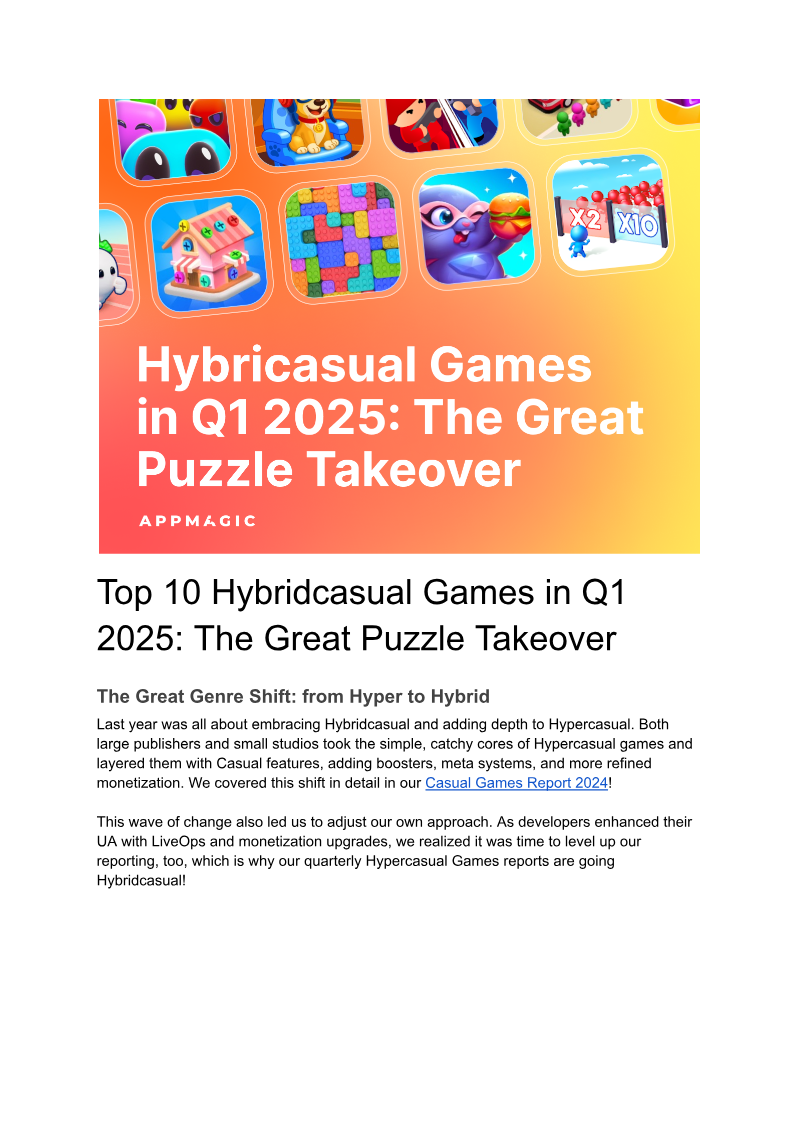
Top 10 Hybridcasual Games in Q1 2025: The Great Puzzle Takeover
The analysis highlights a rapid maturation of the hybrid‑casual segment in the mobile gaming market, showing that the top ten titles generated $87 million in net in‑app‑purchase (IAP) revenue in the first quarter of 2025—a 67 percent year‑over‑year increase from the same period in 2024. Puzzle games dominate the revenue mix, contributing 48 percent, while arcade titles account for 45 percent; together they represent more than 90 percent of total earnings. Within puzzles, block‑puzzle titles lead with 71 percent of puzzle revenue, followed by screw‑puzzle (20 percent) and sort‑puzzle (9 percent), the latter posting a 5.6‑times YoY growth. The report covers a global scope of 60 countries, focusing on the period from Q1 2023 through Q1 2025 and concentrating on the hybrid‑casual niche that blends hyper‑casual mechanics with deeper casual‑style monetisation and live‑ops.
Methodologically, the study isolates hybrid‑casual games by filtering the hyper‑casual tag for top‑grossing apps, then examines revenue, download, and release data for each title. Key case studies include Color Block Jam, which achieved $25 million in Q1 2025 after a modest Q4 2024 start, All in Hole, whose eat‑and‑grow model drove a nine‑fold YoY revenue surge and now accounts for 84 percent of its sub‑genre’s earnings, Mob Control, which posted 27 percent revenue growth and introduced “skip tickets” to balance ad and IAP streams, and Screwdom, whose shift to 3D puzzle design generated $3.6 million and set a new benchmark for screw‑puzzle games.
The findings suggest that successful hybrid‑casual titles combine a highly clickable core loop with layered progression, strategic live‑ops, and nuanced monetisation—often leveraging high‑budget user‑acquisition campaigns and viral social media exposure. This convergence of design and marketing is reshaping sub‑genres, lowering acquisition costs, and establishing hybrid‑casual as a dominant, profit‑rich trend in the mobile gaming ecosystem.
- The top ten hybrid-casual games generated $87 million in net IAP revenue in Q1 2025, marking a 67 percent year-over-year increase.
- Puzzle and arcade titles dominate the hybrid-casual market, collectively accounting for over 90 percent of total earnings with a 48 percent and 45 percent revenue share, respectively.
- Block-puzzle games lead the puzzle category with 71 percent of revenue, while sort-puzzle titles experienced the fastest growth, increasing 5.6 times year-over-year.
- Individual title performance highlights include Color Block Jam reaching $25 million in Q1 2025 and All in Hole achieving a nine-fold year-over-year revenue surge through its eat-and-grow model.
- Successful hybrid-casual titles are increasingly integrating deeper monetization strategies, such as Mob Control’s implementation of 'skip tickets' to balance ad and IAP revenue streams.
+2
AppMagicJan 2025
Report61 pages
Mobile Monetization Report 2025
The global mobile gaming market reached $57.1 billion between 2023 and 2025, representing a 3.4% increase driven primarily by the App Store and emerging regions such as LATAM and MENA. While established markets like China and Japan experienced revenue contractions of up to 15%, the Strategy genre surged by over 25%, bolstered by a massive 213% increase in Card Battlers. A pivotal shift in the industry is the rise of direct-to-consumer revenue, which grew by 46% among the top 100 US titles as developers increasingly adopt webshops and alternative payment systems to bypass traditional platform fees.
Monetization trends indicate a widening performance gap between platforms, with the App Store consistently outperforming Google Play in both revenue growth and average revenue per paying user. In the United States, the share of high-value players spending over $100 rose from 22% to 32%, while the App Store’s 90-day ARPPU climbed by 71%. This growth is largely attributed to rising transaction values, including the introduction of $159.99 price caps in top-tier titles. Conversely, Google Play’s growth remains dependent on a higher frequency of smaller, low-priced purchases, particularly as the RPG sector faces a 15% decline and a significant drop in Android spending.
Genre-specific performance reveals a move toward diversification and sophisticated LiveOps. The Puzzle genre grew by 15%, led by a 911% revenue explosion in Block Puzzles, while the Hybridcasual segment saw in-app purchase revenue surge by 84% through the standardization of Season Passes and failure-triggered offers. Despite a 7.5% decline in the Casino market, the Simulation genre successfully increased average purchase values by 52%. Across all segments, developers are prioritizing customizable bundles and high-value special offers to maintain engagement and offset declining purchase frequencies among long-term players.
- Top US mobile titles are increasingly bypassing platform fees, with direct-to-consumer revenue via webshops and alternative payment systems growing by 46%.
- The App Store is significantly outperforming Google Play, evidenced by a 71% increase in 90-day ARPPU and a rise in high-value US players spending over $100 from 22% to 32%.
- The Strategy genre surged over 25% globally, driven by a 213% explosion in Card Battlers, while the Puzzle genre grew 15% behind a 911% revenue spike in Block Puzzles.
- Hybridcasual games are successfully monetizing through IAPs, which surged 84% due to the standardization of Season Passes and failure-triggered offers.
- While the global mobile market grew 3.4% to $57.1 billion, established markets like China and Japan contracted by up to 15%, shifting growth focus to emerging regions like LATAM and MENA.
+2
AppMagicJan 2025