Digital Games
Company
Documents about Digital Games

Key Aspects of Game Design Research: A Scoping Review
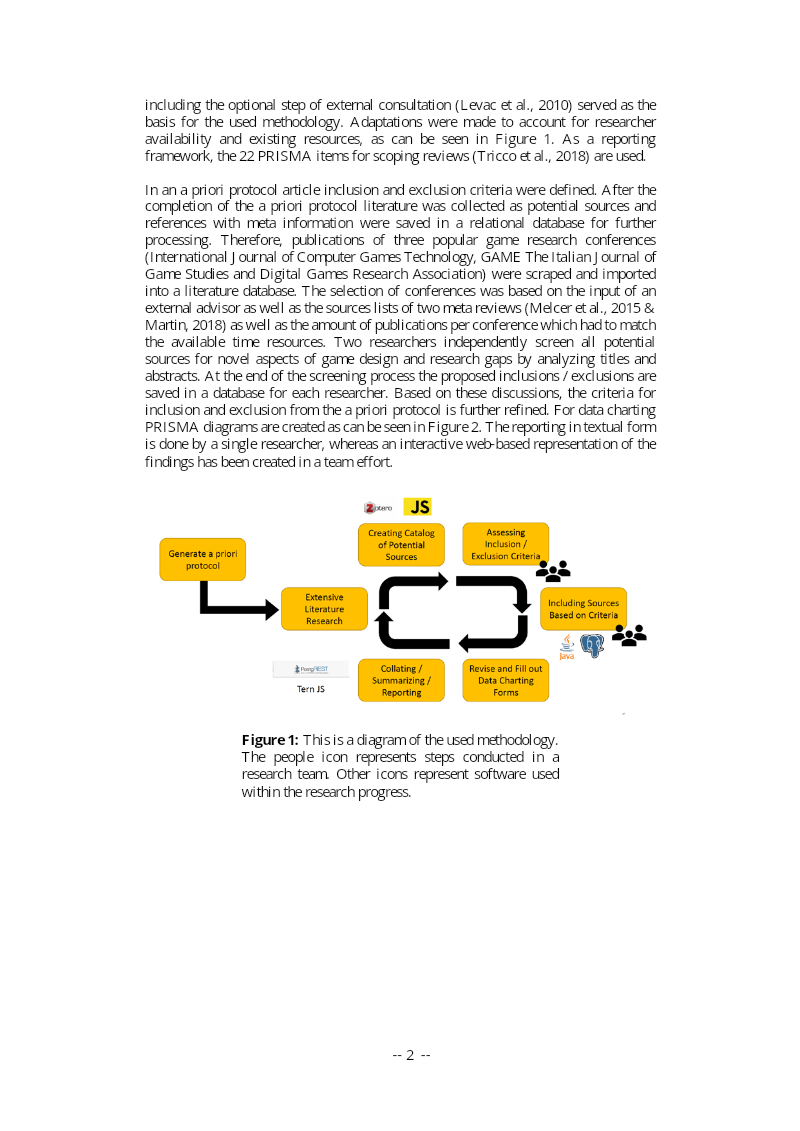
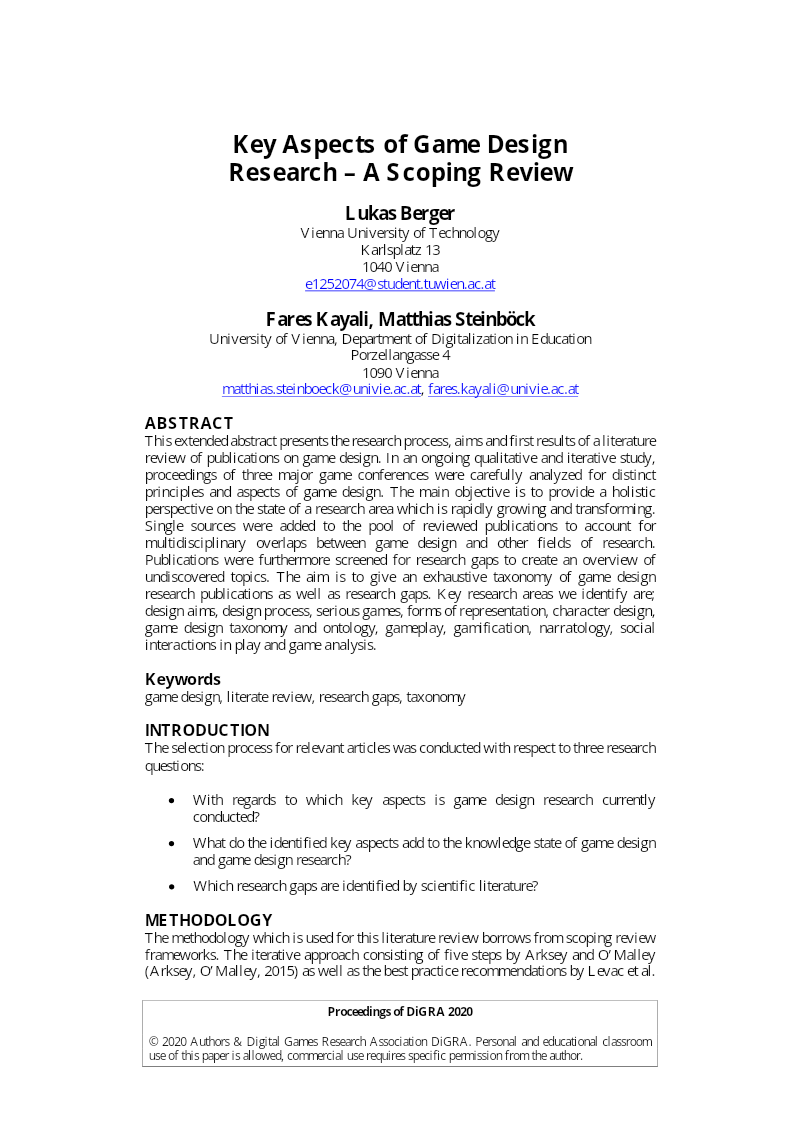
This scoping review aims to provide a holistic perspective on the state of game design research by identifying key aspects and research gaps.
- The scoping review screened 614 articles from three venues (International Journal of Computer Games Technology, GAME: The Italian Journal of Game Studies, and DiGRA proceedings), narrowed them to 249 for full-text assessment, and included 241 articles, about 37 percent of those scraped.
- Included literature was organized into eleven research categories: design aims, design process, serious games, forms of representation, character design, game design taxonomy and ontology, gameplay, gamification, narratology, social interactions in play, and game analysis, each containing at least four subcategories.
- Technical implementations and straightforward applications, such as field studies of game-based learning, were generally excluded in favor of work contributing usable game design knowledge.
Digital Games as Persuasion Spaces for Political Marketing: The Case of Fortnite and Joe Biden's Campaign
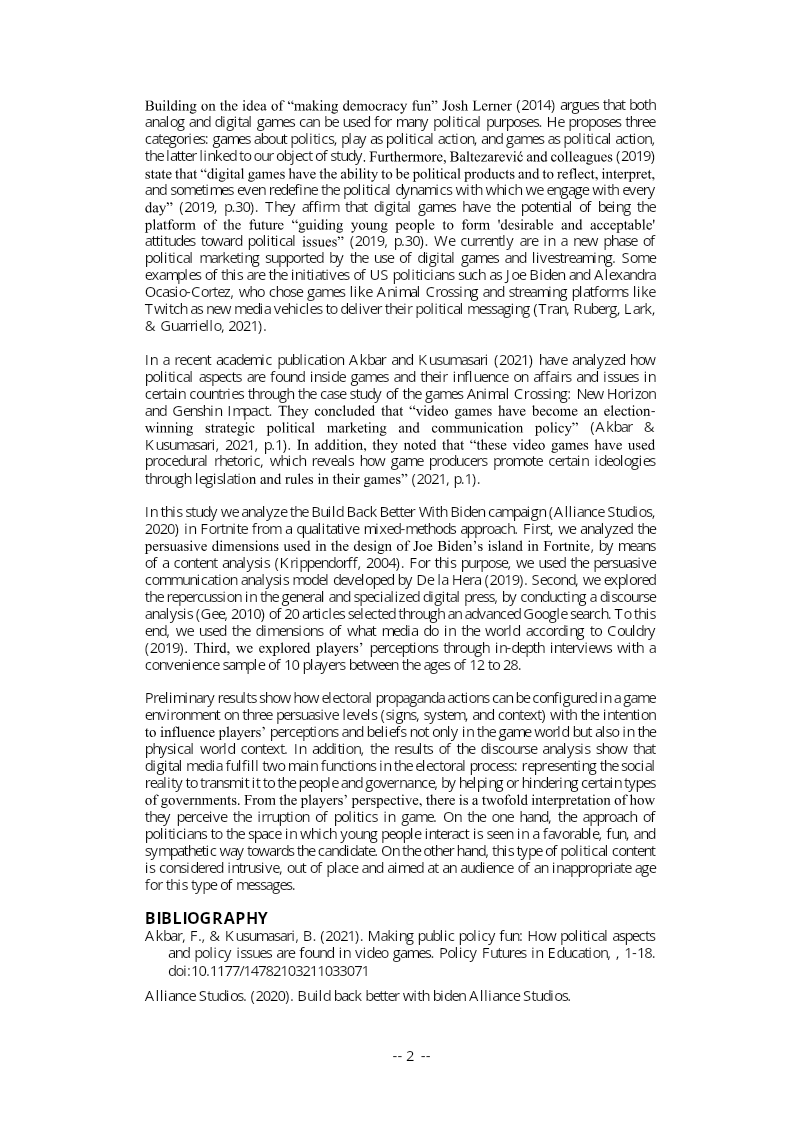
This study investigates the integration of political marketing and electoral propaganda into entertainment digital games, specifically examining Joe Biden's "Build Back Better With Biden" campaign within Fortnite during the 2020 U.S. presidential election.
- The study uses Joe Biden's 2020 presidential campaign island "Build Back Better With Biden" in Fortnite as a case study of how commercial entertainment games can be used for political persuasion, an area it describes as under-examined compared with serious games designed for persuasion.
- Preliminary findings suggest electoral propaganda in game environments works on three persuasive levels: signs, system, and context, with the aim of shaping players' beliefs both inside the game and in the physical world.
- The methodology combines a content analysis of the Fortnite island using a persuasive communication model, a discourse analysis of 20 digital press articles, and in-depth interviews with 10 players aged 12 to 28.
Posthumanist Attitude Towards Animals in Digital Games
The document explores the concept of posthumanist attitudes towards animals in digital games, arguing that certain game designs challenge traditional anthropocentric representations.
- The paper argues that many contemporary games feature animals that resist the standard roles of heroes, enemies, companions, tools, and background (Jański's five-category typology), instead decentering humans and granting animals a measure of standing.
- The central thesis holds that posthuman animal treatment in games rests on at least one of three qualities: agency, subjectivity, and ephemerality.
- Examples such as Shelter, The Last Guardian, Zelda: Breath of the Wild, Shadow of the Colossus, Undertale, and The Witcher 3 are used to show how these qualities alter gameplay obstacles, player control, and the ethical weight of player choices.
Habit and Perception Towards Games and Game-Based Learning in India: A Survey Study of Awareness and Experience with Digital Games
This study investigates the habits and perceptions of the Indian population regarding digital games and game-based learning.
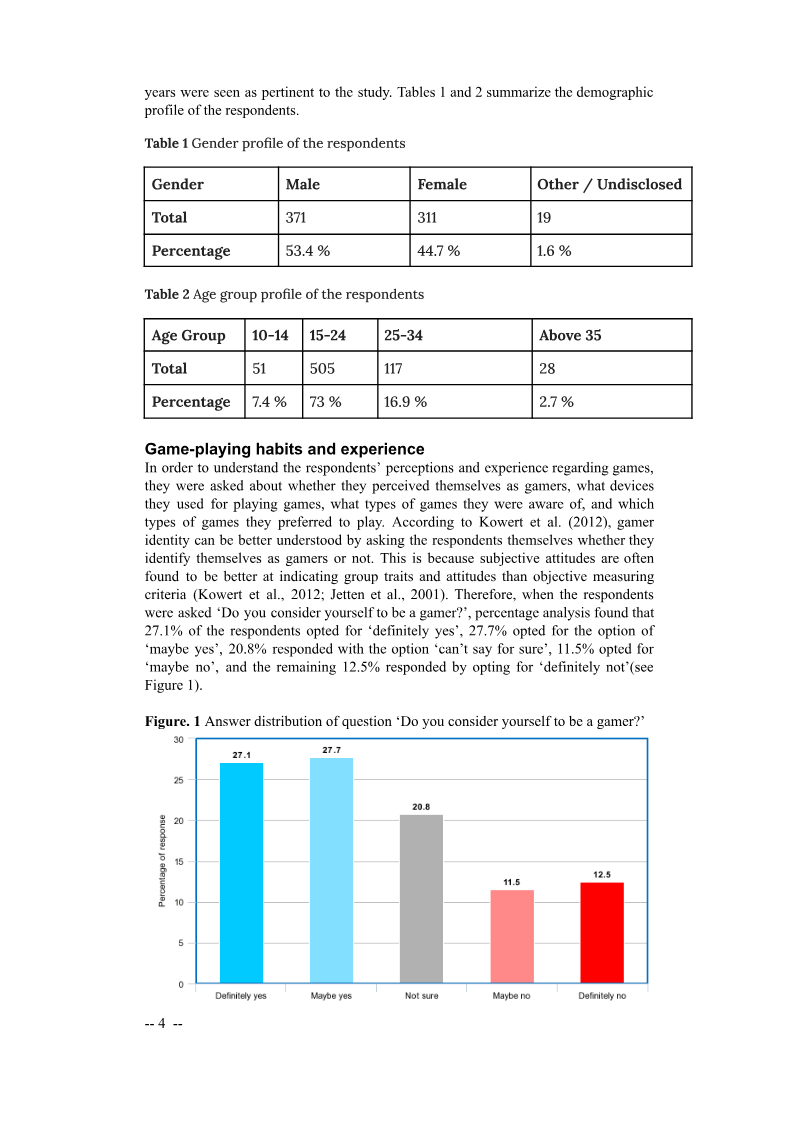
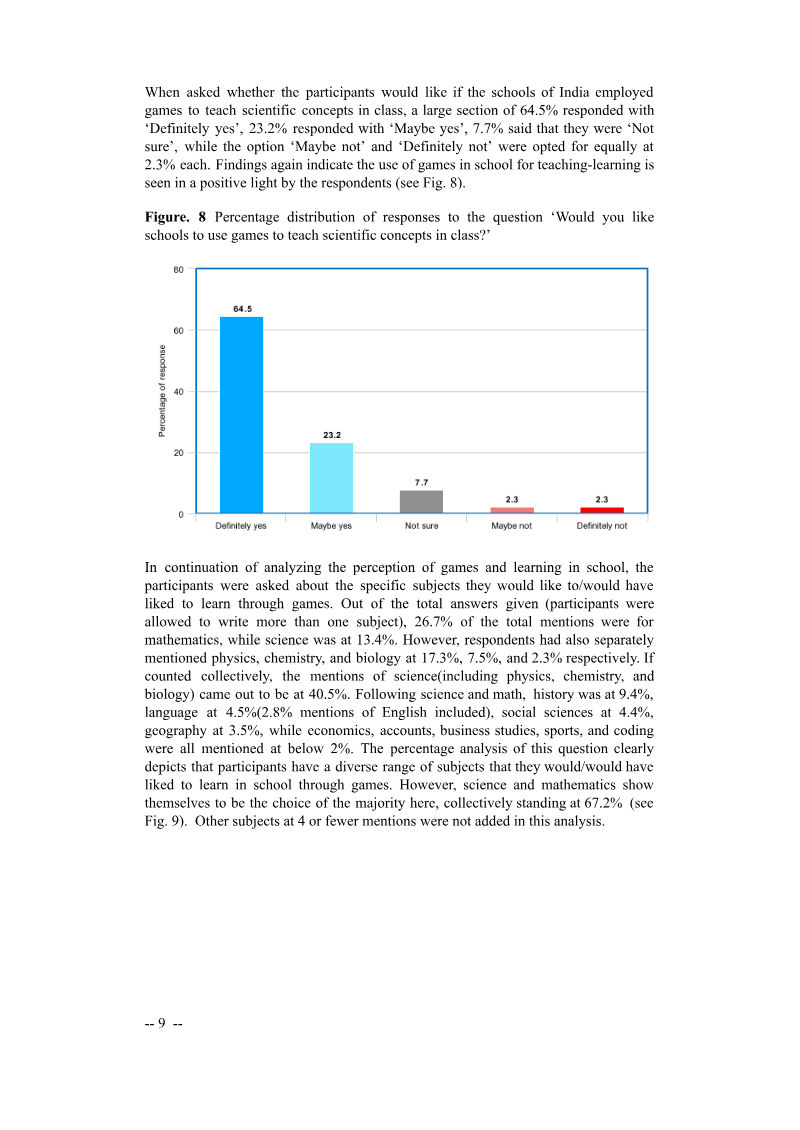
- Survey of 701 Indian respondents, mostly students and teachers at seven schools and 73% aged 15–24, found 79% considered games a learning tool at least maybe, and about 88% supported schools using games to teach scientific concepts.
- Mathematics and science were the most requested subjects for game-based instruction, together accounting for 67.2% of mentions, with history, languages, and geography also cited.
- Mobile phones were the dominant gaming platform at 83.3%, and action-adventure (46.7%) and puzzle games (46.6%) were the most preferred genres, while puzzle games were the most widely recognized at 63.9%.
It All Starts with a Name: Mapping the Terms Used by Researchers to Describe Gambling-Like Elements in Digital Games
This document outlines a research project aimed at mapping the terminology used by scholars to describe gambling-like elements in digital games.
- Naming gambling-like elements in digital games is never neutral: the chosen term signals whether a design practice is seen as socially acceptable and what regulatory treatment it warrants.
- The literature review identified 313 candidate terms, which were narrowed to 32 relevant expressions by grouping similar terms and dropping overly narrow designations.
- The authors argue that the lack of consistent terminology hinders the research field, motivating a mapping of how researchers currently name and define these elements.
The Image of Nikola Tesla and His Inventions in Digital Games
Nikola Tesla's representation in digital games is examined through a qualitative analysis of twelve titles in which he appears as a character, released through the end of 2018.
- The study analyzes twelve digital games released through 2018 that feature Nikola Tesla as a character, using a cognitive definition method and Nikita Tolstoy's three-code framework to organize his attributes into seven categories.
- Across nearly all titles Tesla is depicted as slim, mustached, suited, exceptionally intelligent, and absorbed in his work, forming a consistent core image.
- Rivalry with Thomas Edison is the dominant relationship, appearing in about three-quarters of the games and often framed around the "War of Currents."
VAPBr: Values in Digital Games for Public Service in Brazil
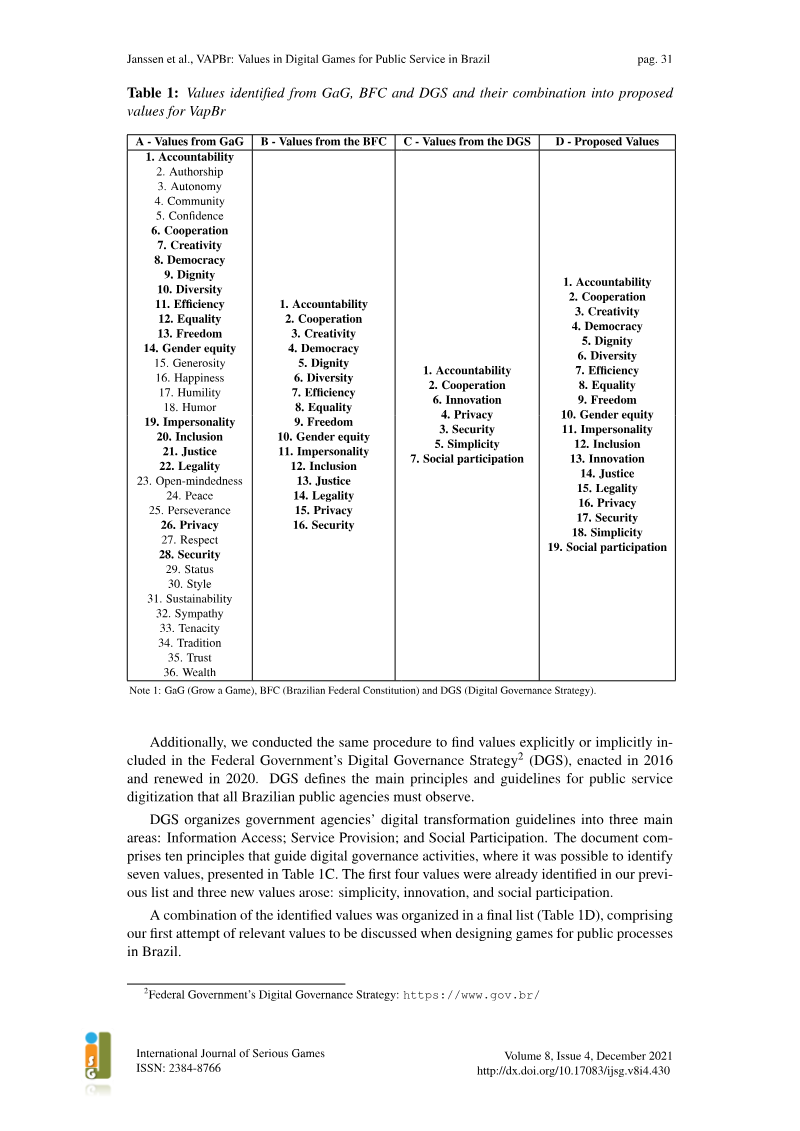
The VAPBr framework serves as a structured methodology for integrating ethical and constitutional principles into the development of serious games within the Brazilian public sector.
- The VAPBr framework provides a structured methodology for embedding 13 core constitutional and ethical values, such as accountability and legality, into Brazilian public sector serious games.
- The project utilizes a 24-card brainstorming deck designed to translate abstract civic requirements into actionable game design elements.
- Empirical testing with game design students simulating police procedures confirmed that the tool effectively structures collaborative decision-making and identifies relevant social values.
Mental Health in 3D: A Dimensional Model of Mental Illness Representation in Digital Games
This paper, by Kelli Dunlap and Rachel Kowert and published in the Journal of the Canadian Game Studies Association (Loading..., Vol 14(24), pp.
- Shapiro and Rotter (2016) found that in top-selling games from 2011 to 2013, 24% depicted one or more mentally ill characters, and that of the 42 individual characters identified as portraying mental illness, 29 (69%) acted violently and in line with the homicidal maniac trope.
- The authors argue that adopting television and film frames for games has yielded a near-universal finding of negative and stereotyped portrayals.
- The proposed model classifies representations on a three-level spectrum: one-dimensional decorative references, two-dimensional defining but shallow portrayals, and three-dimensional fully realized portrayals.
‘Thinking Through’ Games in the Classroom: Using Discursive Game Design to Play and Engage with Historical Datasets
The article by René Glas, Jasper van Vught, and Stefan Werning was published in Transactions of the Digital Games Research Association, November 2021, Vol. 5 No 3.
- The Gamebase64 database lists 177 genre categories, which students found were based on 13 main genres. Some genres such as adventure and arcade were noticeably dominant, while simulation and sports were rare.
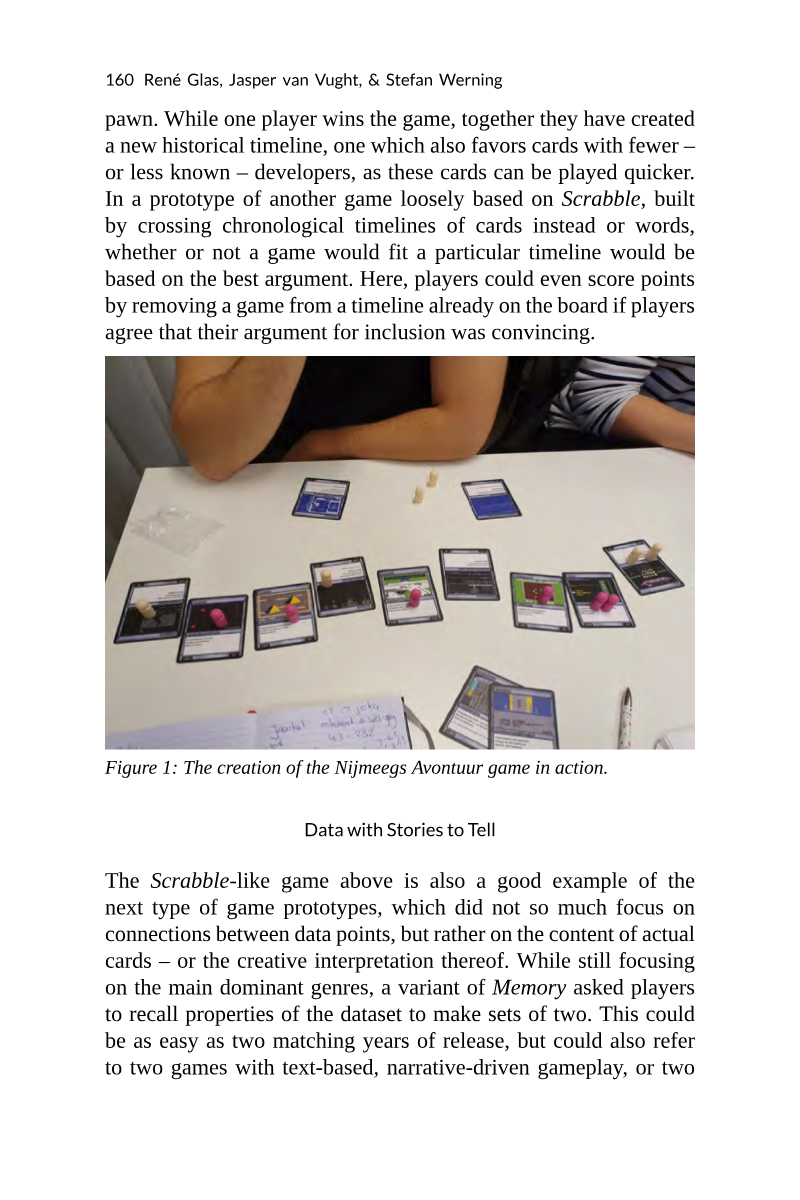
- The authors observed that matching-based card games tended to favour games with shared parameters, so games without obvious connections became worthless for scoring. They argue that the gameplay mechanics themselves favour histories of winners.
- Some student groups used outlier cards as rewards rather than treating them as worthless. One Crazy Eights variant gave bonuses or punishments when such cards were drawn.
Educating Interactive Narrative Designers: Cornerstones of a Program
The paper by Hartmut Koenitz, Christian Roth, and Teun Dubbelman, published in Transactions of the Digital Games Research Association (November 2021), reports on the first iteration of a minor in interactive narrative design at the University of the Arts Utrecht.
- The authors argue that interactive narrative aspects have not been the focus of video game education, which indicates that many narrative designers are self-trained, and that many designers use private vocabulary and conceptualizations that are not directly transferable.
- The minor's first run in fall 2019 was in high demand, and 20 students were accepted after a selection process.
- The authors state that most game design degree programs feature only a single course on narrative, and they know of fewer than ten specific game writing programs worldwide.
A Research-Based Approach to Game Writing Pedagogy
Seth Andrew Hudson, PhD, published this paper in the Transactions of the Digital Games Research Association (November 2021, Vol. 5 No 3, pp. 91-116).
- The study identified five areas of competence required for game writing, rather than finite skills, abilities, and knowledge.
- Three essential roles of the game writer were identified: wordsmith, sensemaker, and advocate, which the author proposes as a structure for the course.
- The research relied on semi-structured interviews with seven individuals who met the study's criteria, collected over two years.
The Paradigm of Game System Building
Hartmut Koenitz and Mirjam Palosaari Eladhari's article, published in the Transactions of the Digital Games Research Association (November 2021, Vol. 5 No 3, pp.
- The authors argue that game system building should replace a purely mechanistic view of game design, in which the result is treated as the sum of its parts.
- The authors propose that game system building comprises three connected layers that all need consideration: architecture, generation, and participation.
- The authors argue that unpredictability is a fundamental element of building non-zero-sum game systems, since designers cannot know how players will use what they build.