Digital Games
Company
Documents about Digital Games
Identity Play as Identity Work: Representation, Identity Integration, and Possible Selves in Digital Games
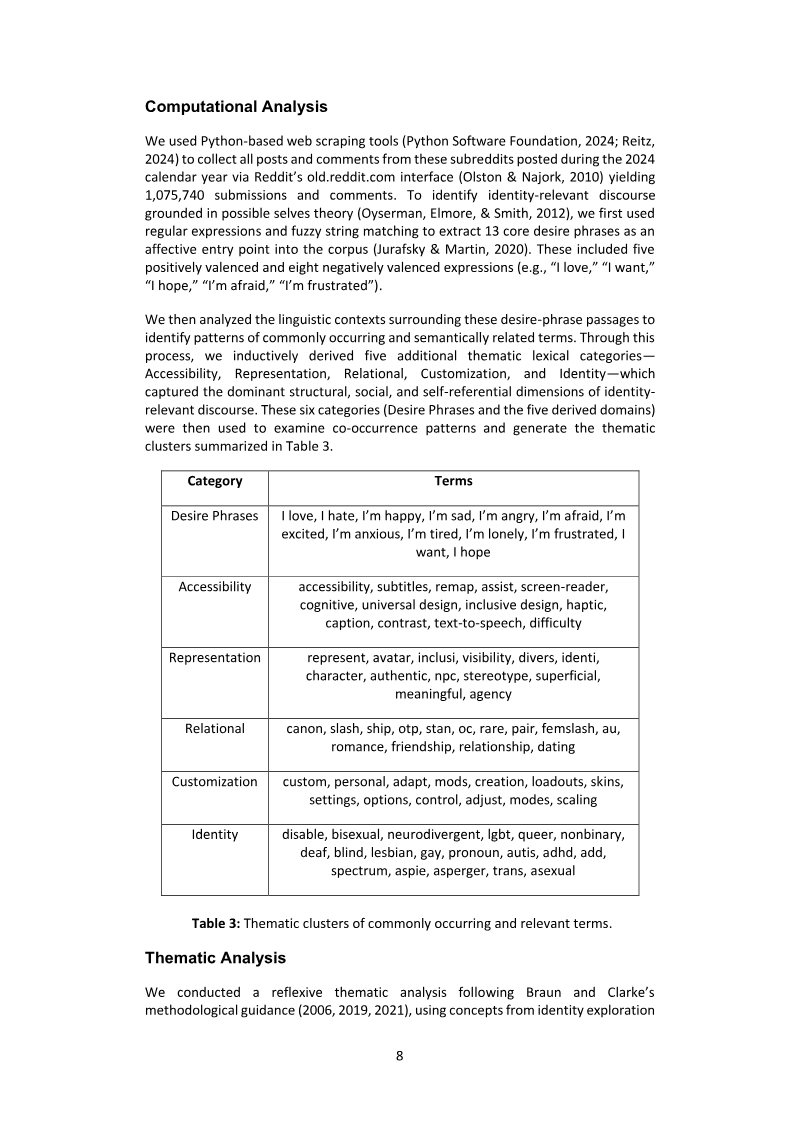
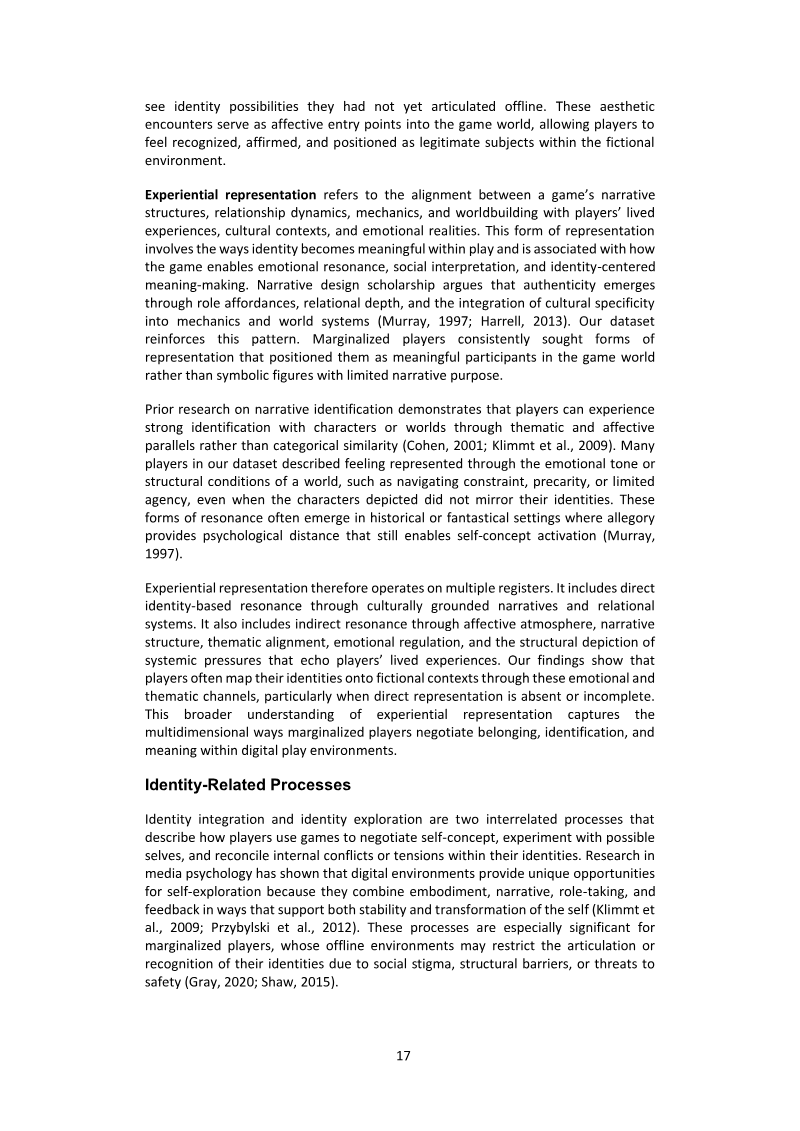
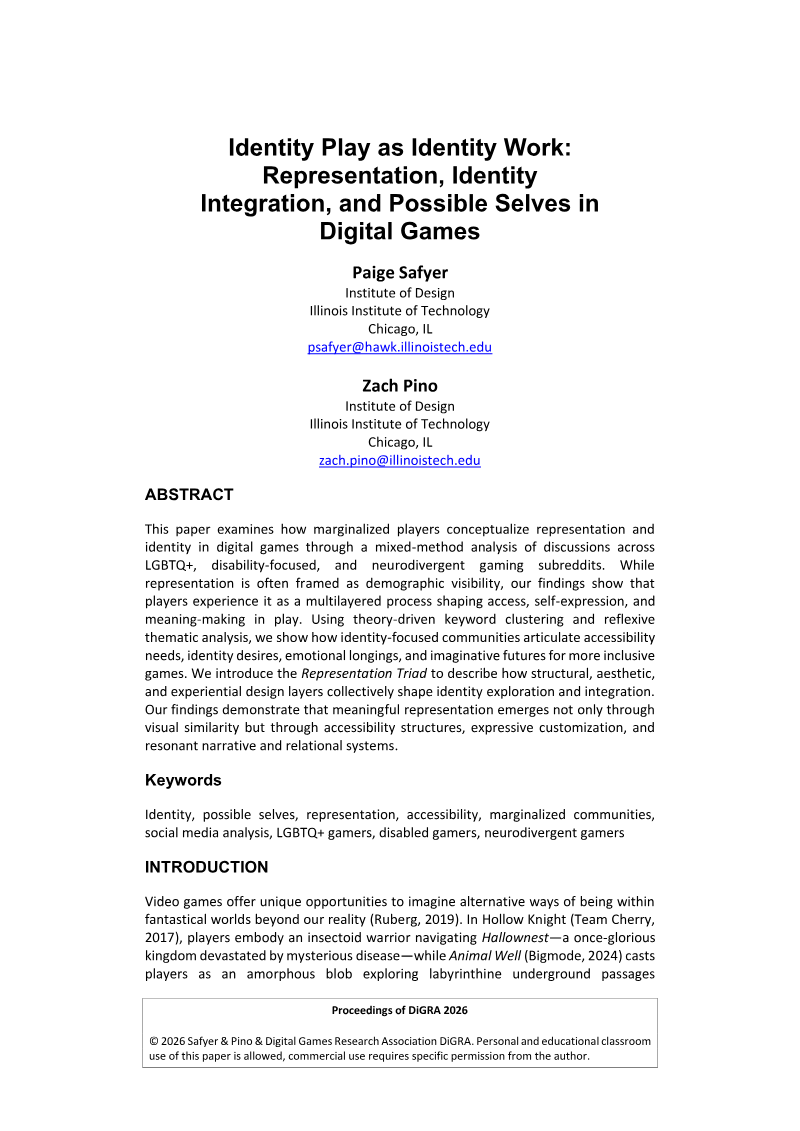
The document, "Identity Play as Identity Work: Representation, Identity Integration, and Possible Selves in Digital Games," examines how marginalized players, specifically LGBTQ+, disabled, and neurodivergent individuals, engage with digital games for identity exploration and integration.
- The authors argue representation in games is not reducible to demographic visibility, but is evaluated across accessibility, expressive customization, and narrative and relational design.
- Players treat accessibility features and customization not as optional extras but as foundational conditions for imagining and inhabiting alternate selves.
- The study proposes the "Representation Triad" of structural (accessibility and pacing), aesthetic (visible identity cues), and experiential (narrative, relational, and affective alignment) representation, with structural accessibility as the precondition for participation.
Time in Digital Games: A Comparative Map of Temporal Constructs
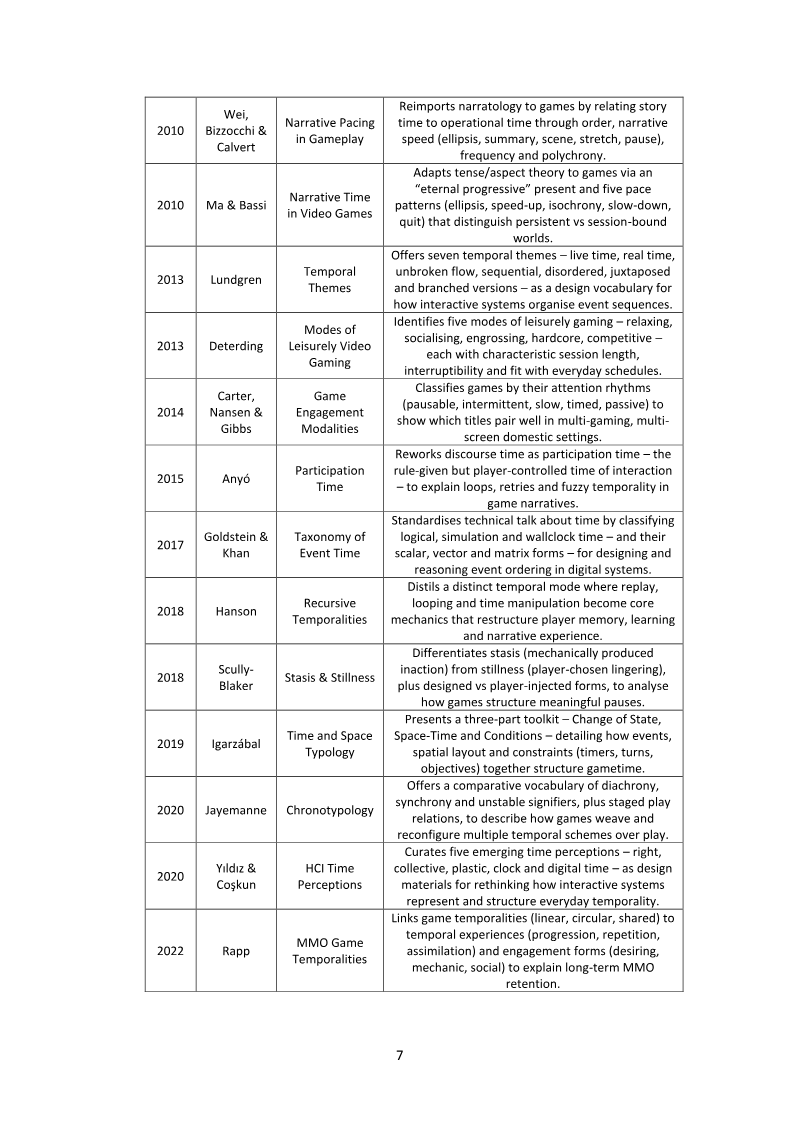
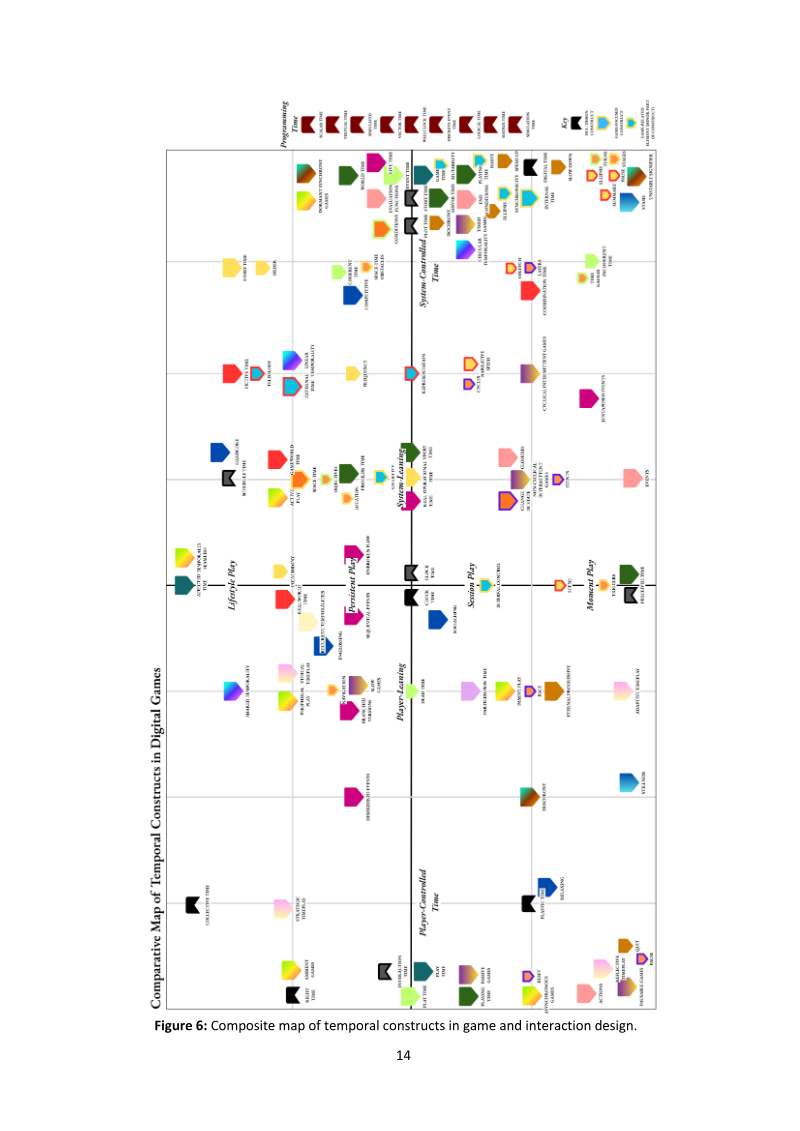
"Time in Digital Games: A Comparative Map of Temporal Constructs" presents a cartographic synthesis of 22 named temporal constructs from digital game studies, spanning 2003 to 2025, rather than a new master theory of game time.
- The report maps 22 named temporal constructs in digital game studies, spanning 2003 to 2025, as a cartographic synthesis rather than a new master theory of game time.
- Constructs are arranged along two axes: temporal control (player-controlled to system-controlled) and temporal scale (moment-level, session, persistent, and lifestyle play), with clock time as a neutral origin point.
- The conceptual landscape is imbalanced: system-controlled constructs, such as the many engineered "X time" labels, are densely represented, while player-organised and affective temporal concepts are sparsely populated.
Epistemic Disobedience in Digital Games: Mega Man X8 16-bit Case
The analysis explores how fan-made digital games and modifications, particularly within the Global South, embody "epistemic disobedience" against the hegemonic structures of the global gaming industry.
- The paper frames fan modifications and fangames, such as a 16-bit demake of Mega Man X8, as "epistemic disobedience": creative resistance to the industry's narrow definition of the "ideal gamer" and its profit-driven standards of value.
- Drawing on Walter Mignolo's decolonial theory and Brazil's history of market reserve policies, console cloning, piracy, and gambiarra (creative improvisation under scarce resources), the author treats fan works as both technical and affective achievements.
- The reception analysis examines roughly 40 player reviews of the Mega Man X8 fangame hosted on Sonic Fan Games HQ, which averaged 4.33 stars, with players praising its fluid gameplay and expressing nostalgia.

Mending the Broken World, Rebuilding the Community: On Positive Biopolitics in Digital Games
Positive biopolitics in digital games functions as a framework for reimagining governance, shifting the focus from traditional state control toward environmental restoration and multispecies stewardship.
- Digital games like Terra Nil and The Wandering Village are shifting simulation mechanics away from traditional conquest toward environmental restoration and multispecies stewardship.
- Game design in this genre is categorized into two paradigms: mandatory governance, which uses fixed parameters for technological restoration, and optional governance, which introduces potential for parasitic relationships.
- These simulation titles function as testbeds for democratic agency and reflexive self-formation, moving beyond neoliberal power models to prioritize care and maintenance.

Digital Arts, Digital Games and Volumetry: State-of-the-Art and Current Scenario
This paper examines the convergence of digital arts, digital games, and volumetric technologies, arguing that volumetric video and volumetry, interactive three-dimensional visualization techniques rooted in mid-twentieth-century computing and photogrammetry, can broaden the creative and social reach of digital games.
- Volumetric video offers six degrees of freedom and deeper immersion than conventional 2D or 360-degree video, but the research on it remains exploratory and inconsistent in its terminology.
- The main barrier to volumetric media is its heavy data demand, with point cloud video reaching roughly 5 Gbps, which keeps the technology outside the mainstream.
- The paper argues that volumetric visualization techniques, rooted in mid-twentieth-century computing and photogrammetry, can broaden the creative and social reach of digital games.
FAIR Game Design Framework: A Player-Centered Model for Developing and Evaluating Digital Games
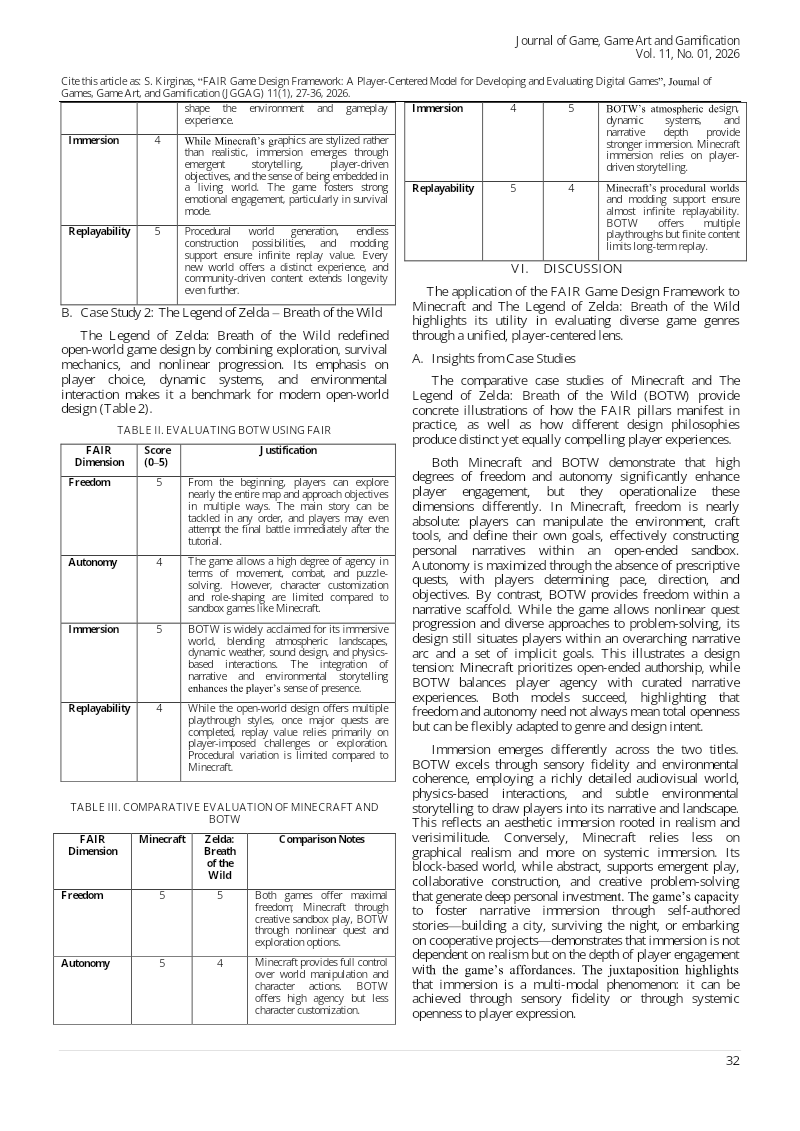
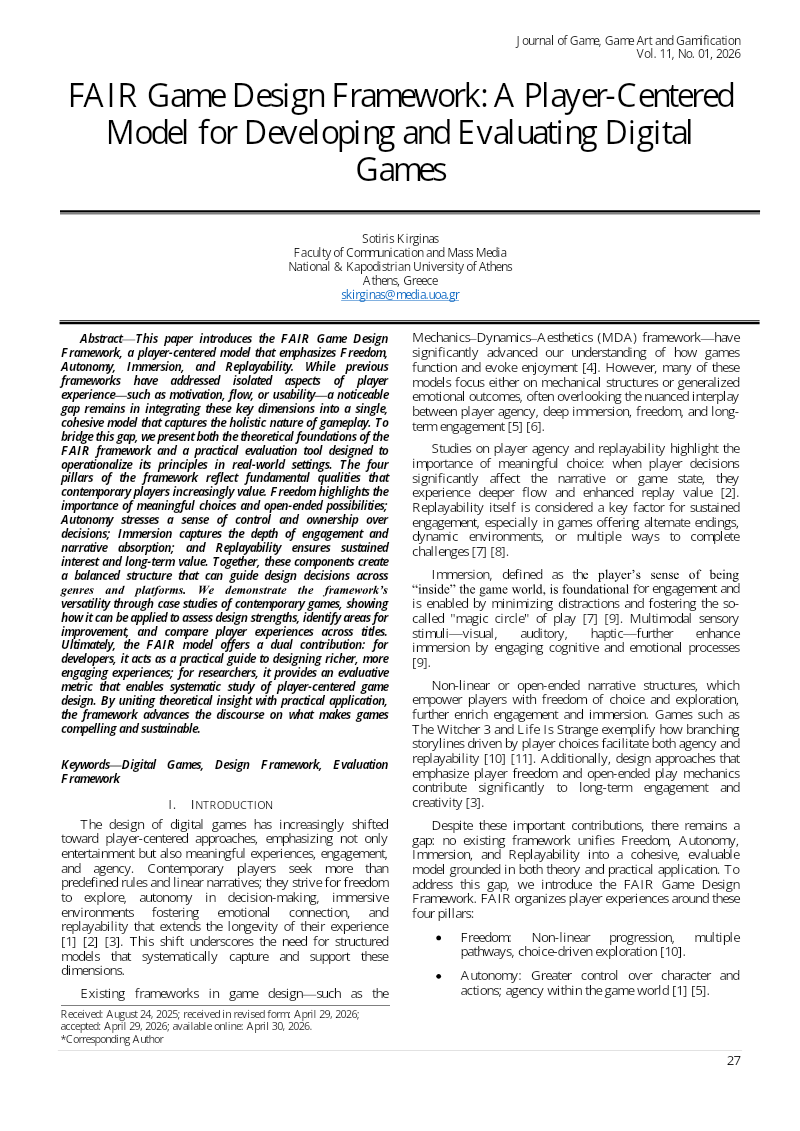
The FAIR Game Design Framework establishes a unified, player-centered methodology for the development and evaluation of digital games.
- The FAIR framework evaluates game design through four core pillars: Freedom, Autonomy, Immersion, and Replayability.
- The model provides a standardized 0-5 ordinal scale, enabling researchers to perform comparative analyses of player engagement across different genres and platforms.
- Empirical testing of the framework, including case studies of Minecraft and The Legend of Zelda: Breath of the Wild, confirms high inter-rater reliability.

Ludic by Design: Integrating Digital Games into an ESL Curriculum to Foster Engagement and Joy
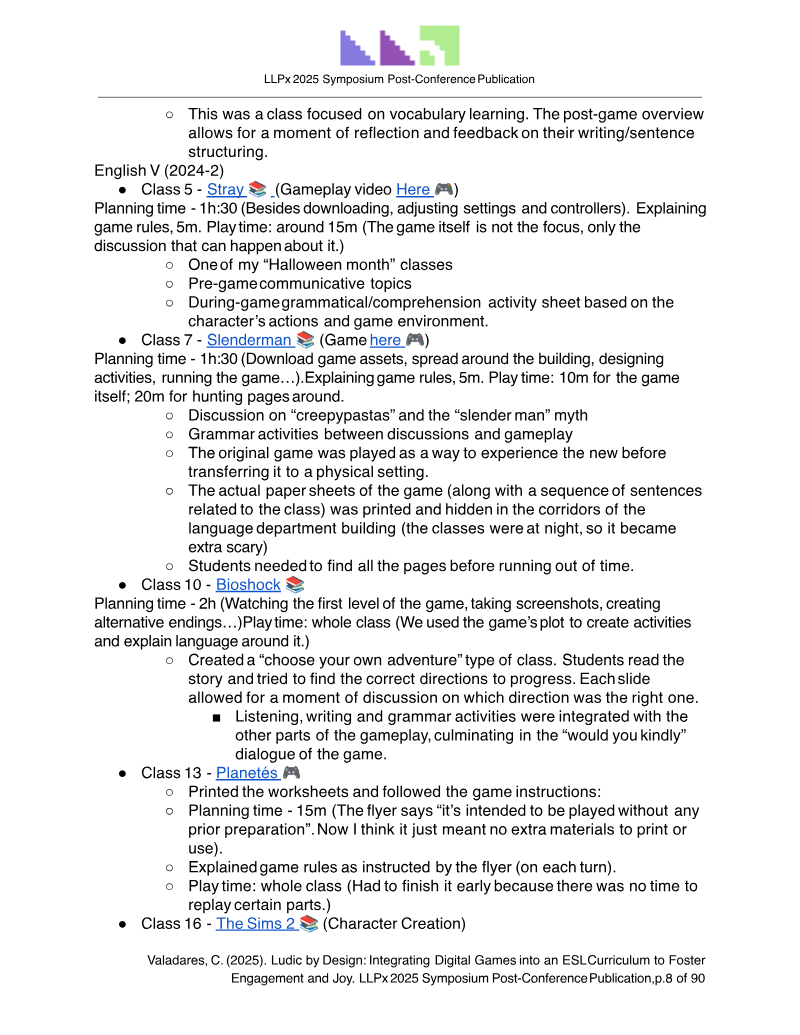
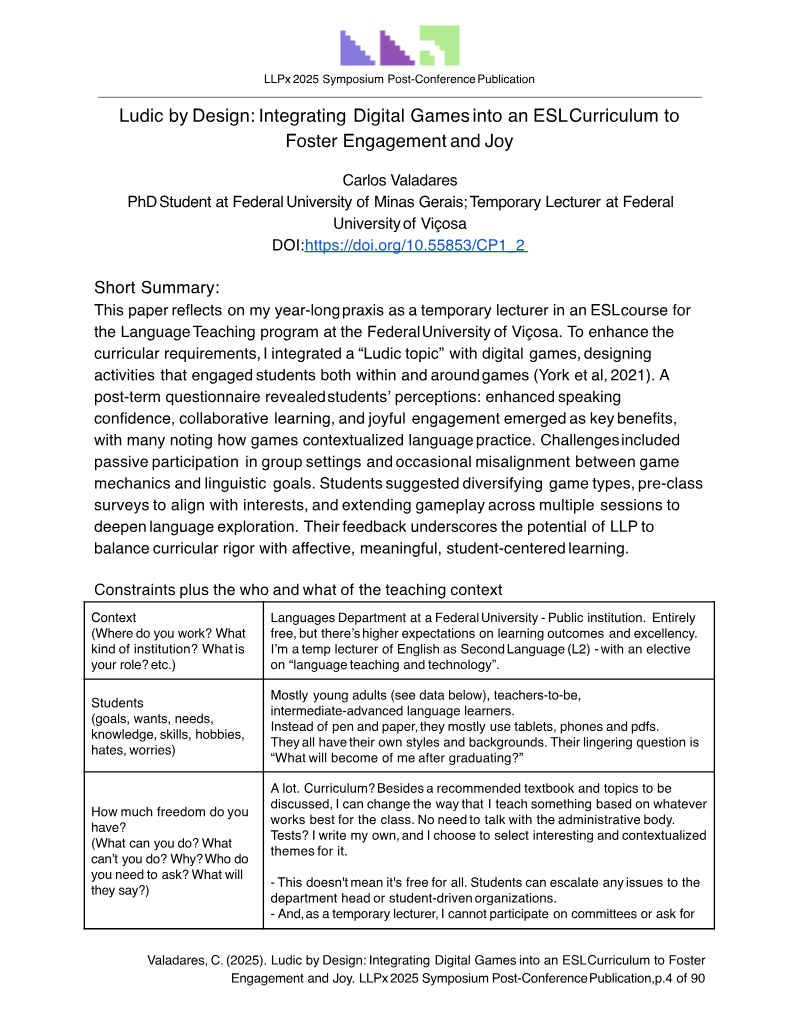
This analysis examines the integration of digital games into an English as a Second Language (ESL) curriculum at a public university in Brazil.
- Integrating digital games like 'Papers, Please' and 'Keep Talking and Nobody Explodes' into an ESL curriculum significantly improved student speaking confidence, peer collaboration, and vocabulary contextualization.
- A year-long action research study at a Brazilian public university found that a ludic-centered approach reduced the pressure of language acquisition, making the learning process feel more natural for undergraduate students.
- Student feedback from 12 of 19 participants highlighted that real-time interaction and immersive storytelling were the most effective game elements for bridging the gap between theoretical study and practical application.
Print-and-Play and Digital Games for a Playful Assessment of Colour Vision Deficiencies
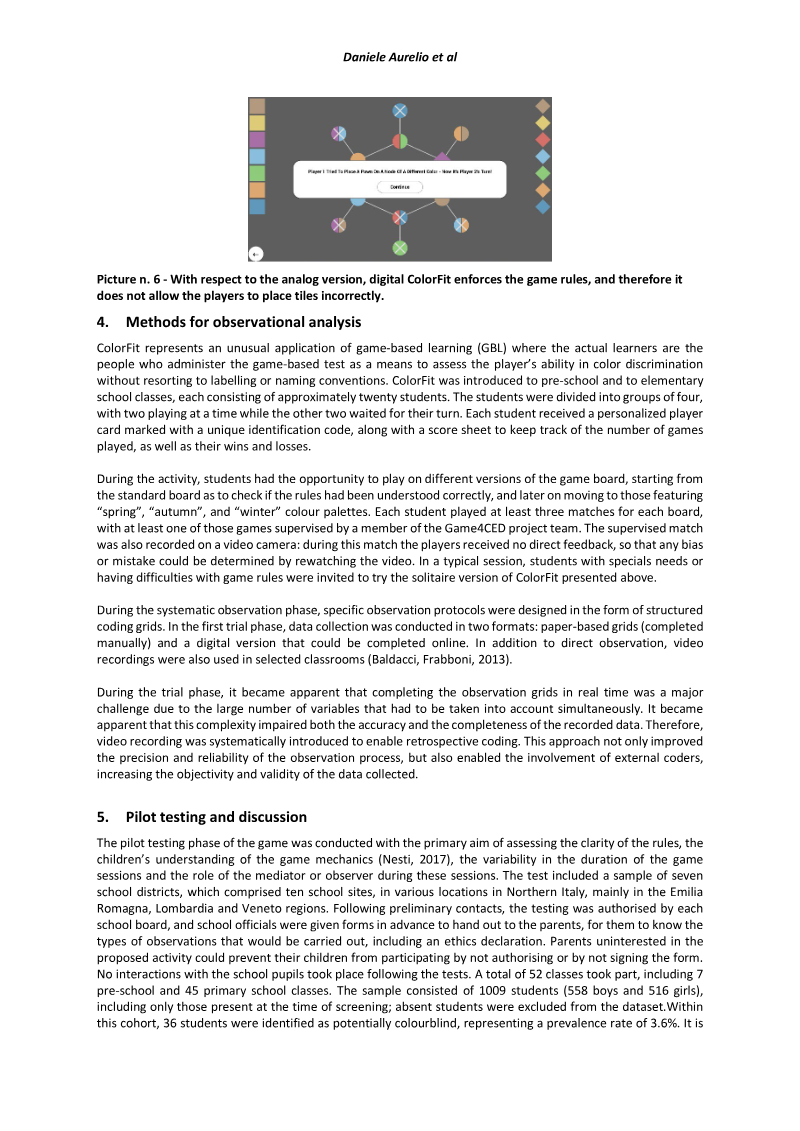
This document outlines the design, implementation, and pilot testing of ColorFit, a print-and-play and digital board game developed by the Game4CED group for the early detection of color vision deficiencies (CVD) in children.
- ColorFit is a two-player tile-placement and colour-matching board game designed as a playful, low-pressure screening aid for colour vision deficiencies (CVD) in children, supporting early detection rather than full diagnosis.
- The paper argues CVD often goes undetected in Italy until primary school, when colour-coded learning causes classroom and self-esteem difficulties, and that clinical tests like the Ishihara plates are intimidating for young children and poorly suited to schools.
- A pilot with 1,009 students (558 boys, 516 girls) across 52 mostly primary classes in northern Italy identified 36 students (3.6%) as potentially colour blind, below the national estimate of about 8.5% for males.
Rewriting History: How Digital Games Are Revolutionising NSW Secondary History Classrooms
The document, "Rewriting History: How Digital Games Are Revolutionising NSW Secondary History Classrooms," investigates the integration of digital games into secondary History education within New South Wales.
- Digital games are already widespread in NSW secondary History classrooms: every one of the 18 surveyed History and Geography teachers had used them at some point, with Kahoot!, Blooket, and Minecraft among the platforms named.
- The main barriers to adoption are structural rather than motivational, with device access, especially inequity under bring-your-own-device (BYOD) arrangements, cited most often, followed by insufficient professional development and low teacher confidence.
- Most respondents did not see student interest as a barrier, suggesting the challenge lies in provision and support rather than learner reception.
The Reach of Digital Games and Their Potential as Global Communication Tools
The "Reach of Digital Games and Their Potential as Global Communication Tools" document presents findings from the Play2Act study, a component of the EU and UKRI-funded GREAT project.
- The Play2Act study, run with UNDP under the EU- and UKRI-funded GREAT project, embedded a climate attitude survey in popular mobile games, reaching about 934,000 players in 188 UN-recognised countries and yielding 181,087 completed surveys (a 15.2% completion rate).
- Games can substantially expand access to citizen opinion data, but participation and response depth varied markedly by demographic and regional group, and some respondents completed the survey suspiciously quickly, raising questions about representativeness and bias.
- Climate attitudes varied across gender, region, education, and income; women were more responsive to environmental narratives, and awareness of the Paris Agreement was over 50% in Europe versus 41% in Asia and 37% in Africa.
Character-Driven Storytelling Design for Digital Games: A Scoping Review
This scoping review examines the design principles and research landscape of character-driven storytelling in digital games.
- Research output on character-driven game narratives grew significantly between 2015 and 2024, with the United States producing 21 studies compared to only 3 in the 2003–2012 period.
- Character believability relies on consistent actions, motivations, and reactions; sudden shifts in morality or uncharacteristic decisions break player immersion and weaken narrative impact.
- Visual design, animation, and emotional expression—including verbal and non-verbal cues like facial movements and posture—must align with a character's narrative role to maintain credibility.

Enhancing the Digital Games Tax Credit (Section 481A)
This pre-budget submission from Imirt, the Irish Game Makers Association, argues that Ireland's Digital Games Tax Credit under Section 481A, introduced in November 2022, has signalled support for the video games sector but has not stimulated substantial domestic growth or foreign direct investment because of structural limits…
- Ireland's Digital Games Tax Credit under Section 481A, introduced in November 2022, has signalled support for the games sector but has not stimulated substantial domestic growth or foreign direct investment due to structural limits in its eligibility criteria.
- Imirt, the Irish Game Makers Association, is positioning Ireland as a candidate for a games hub, citing its storytelling and animation heritage, technical talent, English-speaking EU status, and links to US tech and entertainment markets.
- Imirt faces intense competition from other EU states and the UK in attracting games investment to Ireland.